Schloss Tann: A Renaissance and Baroque Palace Complex in Germany


Site at a Glance
- Rating
- 4.6
- Popularity
- Very Low
- Country
- Germany
- Primary era
- Early Modern
- Eras represented
- Medieval, Early Modern
- Civilizations
- Holy Roman Empire
- Site type
- Domestic
- Remains
- Castle
On this page8 sections
History
Schloss Tann is a Renaissance- and Baroque-style palace complex in Tann, Germany, developed from a medieval castle by the von der Tann family. Its origins lie in a lowland castle built by ministeriales in the twelfth century. These medieval servants of higher-ranking lords often managed estates, administration, or military affairs, and some rose into the lower nobility. From the sixteenth century onward, the family transformed the castle into a palace complex that became its ancestral seat and remains in private family ownership.
From medieval castle to family complex
The palace developed in stages as the three branches of the von der Tann family expanded and remodeled the earlier castle. The resulting complex consisted of the Red, Blue, and Yellow Castles. The branches later adopted their designations from the colors associated with their palace wings, becoming known as the red, blue, and yellow branches. The arrangement preserved the connection between the family’s internal divisions and the buildings in which those branches were established.
Renaissance and Baroque expansion
The Red Castle was completed in 1558 and enlarged around 1591. In 1680 it was largely remodeled in the Baroque style, an architectural period known for projecting forms, movement, and theatrical effects. The Blue Castle acquired its present form between 1680 and 1716, while retaining parts of an earlier Renaissance tower. The Yellow Castle, the youngest section, was built between 1699 and 1714 according to plans by Johann Mützel, an architect and builder active around the turn of the eighteenth century. Its ancestral hall remains open for visits.
Heraldic inscriptions preserve important details of the complex’s history. A stone on the Red Castle names Heinrich von und zu der Tann and bears the date 1689. A late Gothic courtyard portal records the completion of the Red Castle in 1558 and commemorates the alliance of Eberhart von und zu der Than and Anna, born Schenckin zu Schweinsburg. The Blue Castle preserves an extensive genealogical heraldic program connected with Christoph von Tann, his wife Anna von Ebersberg called von Weyhers, and Christoph’s parents, Melchior von der Tann and Margaretha von Mansbach. In its unusually comprehensive form, this family record is unique in Hesse.
Remains
Overall arrangement
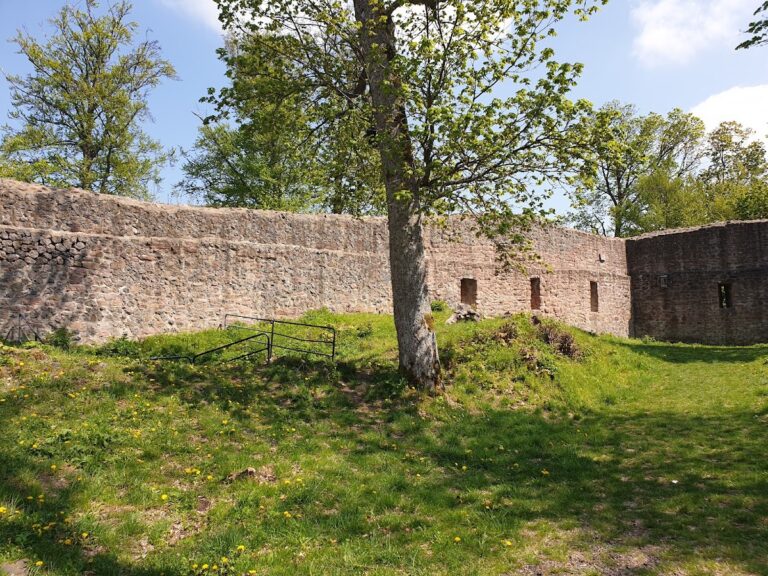
The three palace wings are arranged around an approximately square inner courtyard and almost completely enclose it. An area formerly remained open on the south side between the Red and Yellow Castles, but a low garage building now closes that gap. The complex developed from the earlier medieval castle, while surviving parts of the medieval town wall remain around the park. The park extends westward from the palace into the Ulster floodplain, with sections of the old wall enclosing its western and southern sides.
Red Castle
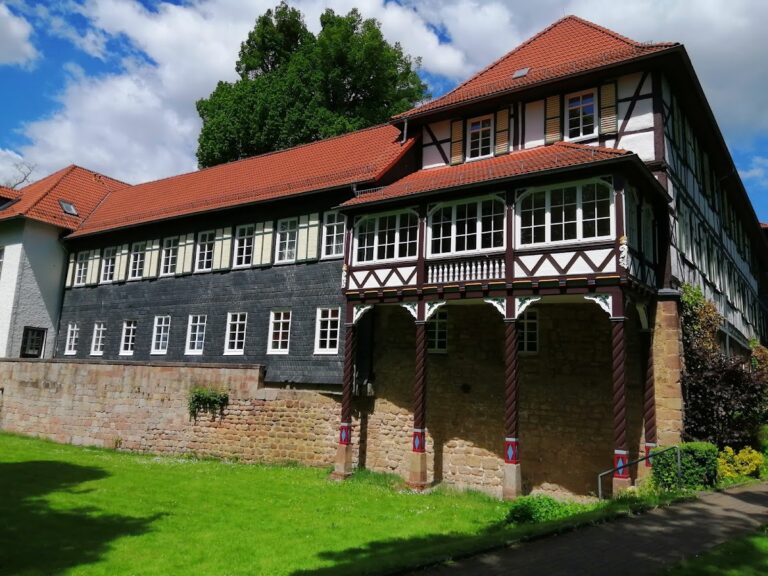
The Red Castle is the three-story wing on the town side. Its red-trimmed windows and red-painted half-timbering give the building its associated color. A polygonal tower marks its southeast corner, and its two upper stories are built in half-timbering, a visible timber frame combined with infill panels. The central gate has a segmental arch and was added during the Baroque remodeling. The entrance to the inner courtyard lies at the northern end, beside the Blue Castle. Its depressed arch is made of red sandstone with flat rustication and a rectangular outer frame. Above it, a heraldic stone carries the name Heinrich von und zu der Tann and the date 1689.
On the courtyard side, a solid round stair tower rises one story above the main building. Its ground floor contains a late Gothic portal with the von Tann arms on the left of the lintel and the arms of the Schenken zu Schweinsberg on the right. Above them is a large alliance coat of arms, combining the arms of two families to record their connection. Fluted columns frame the composition, which is crowned by an ornamented semicircular top. The inscriptions identify Eberhart von und zu der Than and Anna geborene Schenckin zu Schweinsburg, with the date 1558 placed between the coats of arms.
Blue Castle
The four-story Blue Castle adjoins the Red Castle and forms the northeastern corner of the complex. Blue surrounds frame its windows, while the courtyard portal has a strongly projecting segmental-arched gable containing a weathered alliance coat of arms. On the street side, a four-story polygonal tower rises at the northeastern corner. The tower originated in the Renaissance period, and its uppermost story is built in half-timbering. During the later Baroque remodeling, its lower sandstone stories were retained.
The polygonal section facing the passage to the courtyard carries numerous coats of arms and inscriptions on its second and third stories. Eight heraldic stones on each side trace the genealogy of Christoph von Tann, who lived from 1514 to 1575, and his wife Anna von Ebersberg called von Weyhers. The names represented include Than, Mansbach, Stein, Trümbach, Görtz, Brenden, Brunn zu Münnerstadt, and Schenk zu Schweinsberg on one side, and Weyars, Merlaw, Weyers, Liderbach, Ketten, Steinrock, Völckershavs, and Rolczhavs on the other.
The inscription beneath the third-story window identifies Christoph and Anna and names their children Amelia, Sibilla, Eytel Melchior, Kunigundis, Cristiana, and Georgius Fridericus. Another inscription beneath the second-story window names Christoph’s parents, Melchior von der Than, born before 1451 and deceased in 1524, and Margaretha von Mansbach, followed by the names of their seventeen children. Beneath the genealogical text appears the biblical reference “PS 128 ECCE SIC BENEDICETVR HOMO QVI TIMET DOMINVM.” The lintel above the window carries the building inscription “IN NOMINE TVO SALVATOR IESV CHRISTOPHEL VON DER THAN ZVNN KETTEN FIERI FECIT 1574.” A further coat of arms belonging to the von Ketten family stands to the right.
Yellow Castle and palace park
The Yellow Castle is the largest and youngest part of Schloss Tann. It is a solidly built, four-story structure arranged in three wings beneath a low-pitched hipped roof, which slopes downward on all sides. Its principal entrance from the courtyard is set in a strongly projecting central risalit, a section that extends outward from the main wall, on the west wing. A corresponding projection faces the palace park. The park adjoins the Yellow Castle on its western side and reaches into the Ulster floodplain, where remnants of the medieval town wall continue to define parts of its southern and western boundaries.