Krujë Fortress: A Medieval Stronghold of Albanian Resistance



Site at a Glance
- Rating
- 4.6
- Popularity
- Medium
- Country
- Albania
- Primary era
- Early Modern
- Eras represented
- Medieval, Early Modern, Modern
- Civilizations
- Byzantine, Ottoman
- Site type
- Military
- Remains
- Fort
On this page17 sections
History
Krujë Fortress is a medieval fortress in Krujë, Albania, whose fortifications developed from the twelfth century onward around a settlement inhabited by the fourth or fifth century. Its origins are placed variously between the fourth or fifth and sixth centuries. The fortress became the center of Skanderbeg’s rebellion and of the League of Lezhë, a political and military alliance formed by Albanian rulers to coordinate resistance against Ottoman expansion.
Early development and changing rule
The fortress occupied a steep rock outcrop above Krujë and passed through the control of several powers. Among those associated with its history were Stefan Dušan of Serbia, the Thopia family, and the Ottoman Empire. Ottoman forces took control in 1415, establishing a period of rule that later shaped much of the architecture visible at the site.
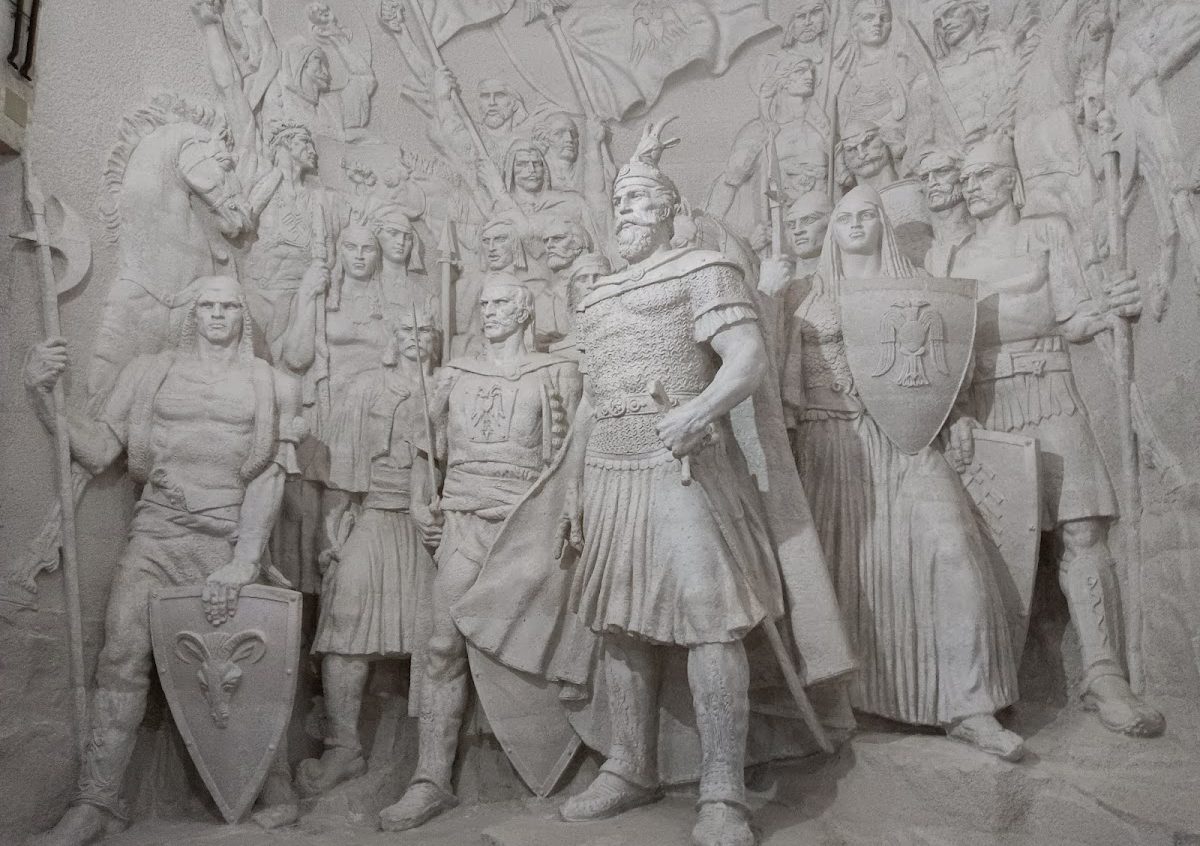
During the Albanian Revolt of 1432–1436, Andrea Thopia, an Albanian nobleman of the medieval Thopia ruling family, unsuccessfully besieged Krujë. Ottoman rule was restored after the failed attack. In 1443, Skanderbeg, also known as Gjergj Kastrioti Skenderbeu, took the fortress without resistance and made it the principal center of his resistance to the Ottoman Empire.
Skanderbeg’s resistance
Ottoman armies besieged Krujë in 1450, 1466, and 1467. The garrisons commanded by Skanderbeg generally numbered no more than 2,000 to 3,000 men. Mehmed II, the Ottoman sultan known as “the Conqueror,” failed to overcome the fortress during the earlier campaigns. Krujë finally fell in 1478, ten years after Skanderbeg’s death.
Ottoman transformation and later damage
After the Ottoman conquest, authorities built houses in the Ottoman style and extensively rebuilt the fortress. As a result, much of the visible architecture belongs to the Ottoman period rather than to the earlier phases of the stronghold.
An earthquake in 1617 caused rock faces in the southeastern part of the site to collapse and destroyed the fortress wall above them. During later unrest against the Tanzimat, the nineteenth-century Ottoman program of administrative, legal, and military reform, Ottoman authorities demolished much of the fortress. The demolition is dated either to 1831 or to 1855.
The Toptani House, an elaborately designed Ottoman mansion built in 1764, later served as Krujë’s subprefecture, court, and prison until the Second World War. The Sultan Mehmed the Conqueror Mosque also changed function over time. It served as a place of worship until 1937 and was used to store ammunition during the Second World War.
Modern preservation and interpretation
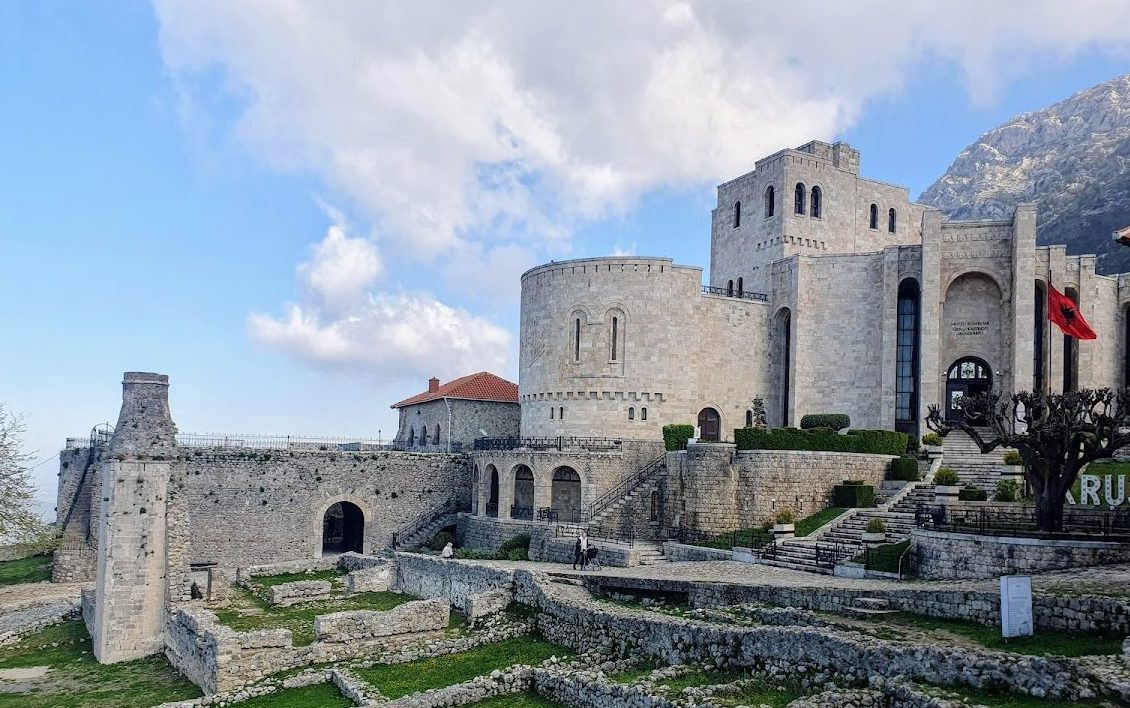
The National Museum “Gjergj Kastrioti Skenderbeu” was built inside the fortress in the early 1980s. The Clock Tower and Dollma Tekke, a lodge associated with a Sufi Islamic order, were severely damaged by the 2019 earthquake and subsequently restored. The fortress is depicted on the reverse of Albania’s 1,000 lek banknote issued from 1992 to 1996 and on the 5,000 lek banknote issued from 1996 onward.
Remains
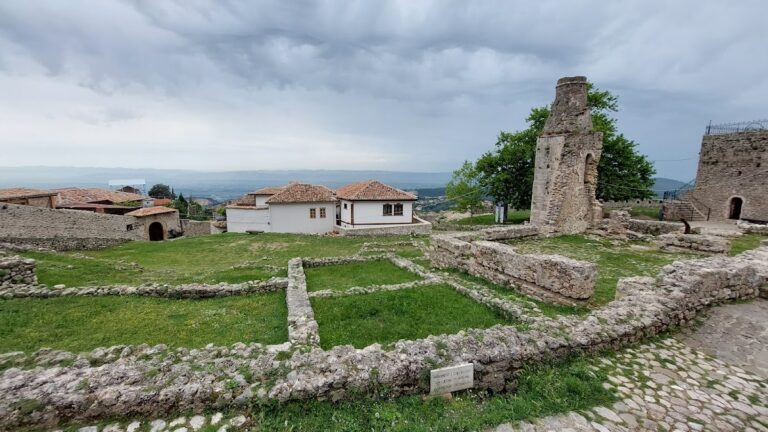
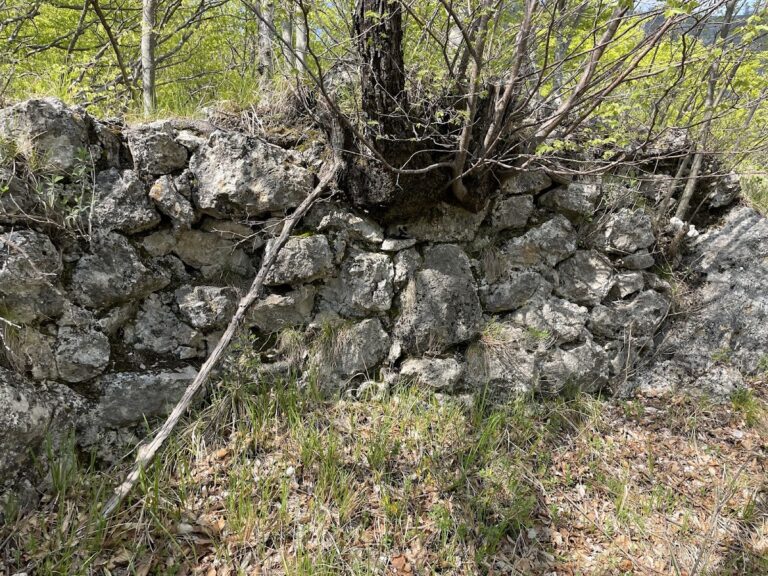
Krujë Fortress occupies a steep-sided rock outcrop south of Krujë’s city center and bazaar. The rock slopes slightly from east to west. Its plateau measures up to approximately 270 by 150 meters, the enclosed area covers about 2.25 hectares, and the circuit wall extends for approximately 800 meters at an elevation of about 555 to 557 meters. The site survives as a ruin containing partial defensive works, Ottoman buildings, religious structures, museums, and houses.
Defences and access
Steep cliffs restricted access to two entrances. On the western side, a small outer defensive enclosure lies below the rock face and is reached through a narrow passage between the Dollma Tekke and the hamam, a traditional Islamic bathhouse with heated bathing and washing areas. The stone enclosure wall is approximately 1.5 meters thick and is reinforced by nine towers. A smaller inner castle occupied the upper part of the fortress for a short period. A spring rises southwest of the main enclosure and is surrounded by an additional wall; the spring is associated with the origin of Krujë’s name.
Religious structures
Churches and chapels
Archaeological remains of churches lie in the southwestern and northeastern parts of the fortress. The southwestern chapel, east of the Dollma Tekke, dates from the ninth century. In the upper fortress behind the large tower known archaeologically as the Acropolis, a church probably dates from the first half of the fifteenth century, while a small chapel beside it probably belongs to the twelfth century.
Sultan Mehmed the Conqueror Mosque
The ruins of the Sultan Mehmed the Conqueror Mosque stand beside the main entrance. The mosque was established between the Ottoman conquest and Mehmed II’s death in 1481, apparently on the site of an earlier church. After its probable destruction in 1831, a completely new mosque was built in 1838 under Sultan Mahmud II, who ruled the Ottoman Empire from 1808 to 1839. The surviving fabric consists of the mosque’s foundations and the lower part of its minaret. A storm had destroyed the minaret in 1917, and the mosque later fell into decay after the Second World War.
Dollma Tekke
The Dollma Tekke stands at the southwestern end of the fortress. Its inscription gives 1788 as the date of construction. The building belongs to the Bektashi tradition, a Sufi Islamic order with a substantial historical presence in Albania.
Ottoman buildings and domestic remains
Toptani House
The Toptani House is a large Ottoman mansion with an elaborate design. Built in 1764, it later accommodated the local subprefecture, court, and prison until the Second World War. Its surviving form represents the Ottoman domestic and administrative architecture that developed within the fortress.
Ethnographic Museum
The Ethnographic Museum occupies a large Ottoman-period mansion on the southern side of the fortress. Designed as a typical nineteenth-century house, it contains displays about household production of tools, food, drinks, and furniture. Old wooden and metal objects represent aspects of life within the fortress.
Several other houses survive within the enclosure, alongside restored Ottoman-period houses. Restaurants occupy parts of the upper area, while some residences remain in the lower area. Together, these buildings preserve the domestic character of the settlement that followed the Ottoman rebuilding of the stronghold.
Museums and later structures
National Museum “Gjergj Kastrioti Skenderbeu”
The National Museum “Gjergj Kastrioti Skenderbeu” is a new building constructed inside the fortress in the early 1980s. Designed by Pranvera Masha and Pirro Vaso, it contains original bibliographic materials, documents, objects, and authentic reproductions connected with fifteenth-century Albanian history.
Clock Tower
The Clock Tower, also called Kulla e Orës or Sahat Kula, stands at the highest point in the northeastern part of the fortress. It was converted from a defensive tower in the seventeenth century and remains strongly defensive in appearance. The tower is 15 meters high, and a priest from Laç donated its bell in 1903. The structure was severely damaged in the 2019 earthquake and later restored.