Åtvids gamla kyrka: A Medieval Parish Church in Sweden
Site at a Glance
- Country
- Sweden
- Primary era
- Medieval
- Eras represented
- Medieval, Early Modern, Modern
- Civilizations
- Swedish
- Site type
- Religious
- Remains
- Church
On this page17 sections
History
Åtvids gamla kyrka is a medieval church in Åtvidaberg, Sweden, built in the late Middle Ages when mining in the area was at its height. The parish appears in records from the fourteenth century, suggesting that an earlier church may have stood on the site.
Church furnishings and changes
Johan Agerwall made a small organ, known as a positive, for the church in 1704. Jonas Wistenius built another organ in 1751, and its facade and decoration were painted and gilded three years later. The instrument was repaired in 1805 by Pehr Schiörlin, in 1825 by Lorentz Lorin, and in 1854 by organist C. Nordqvist.
In the early 1750s, a new bell tower was built east of the cemetery to replace an older tower closer to the church. When the new church was completed, the bells were not transferred to its tower.
Demolition and reconstruction
A decision to build a new church in the late nineteenth century made the medieval building redundant. In 1887, it was demolished and left in ruins after the nave roof was removed. The organ was dismantled that year. Its facade, keyboard, stop knobs, and about 40 percent of its pipes were placed in storage in the choir.
Reconstruction began in 1954, with Professor Erik Lundberg leading the restoration. Work on the organ began in 1955, and in 1957 the gallery organ was reconstructed following a proposal by Einar Erici. Bishop Torsten Ysander, a senior church leader, rededicated the church on 1 September 1957.
Today the church serves as the parish church for Åtvid Parish, a local congregation and administrative unit within Linköping Diocese, a regional church jurisdiction. The Church of Sweden, of which both are part, is Lutheran.
Remains
Plan and medieval fabric
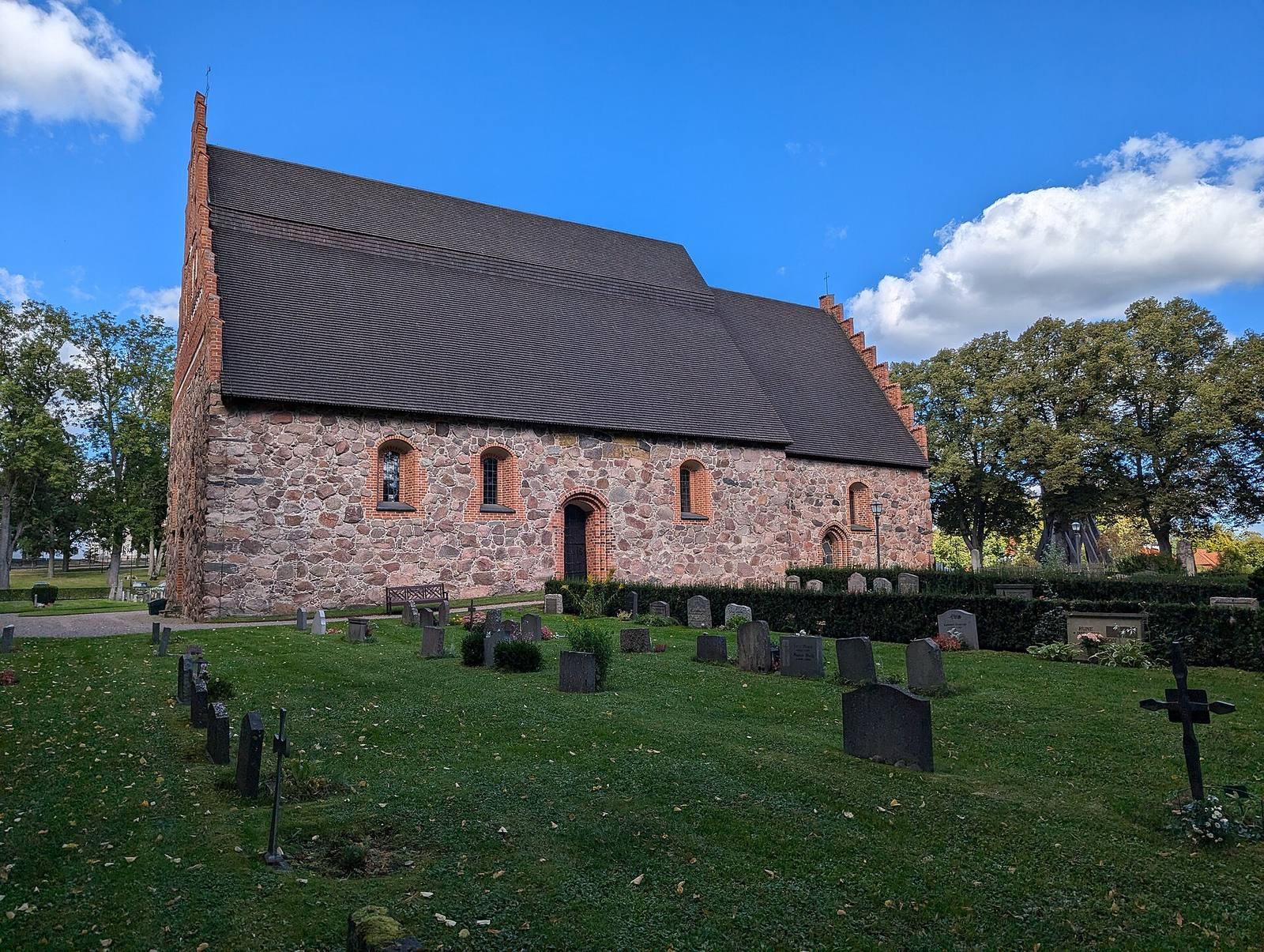
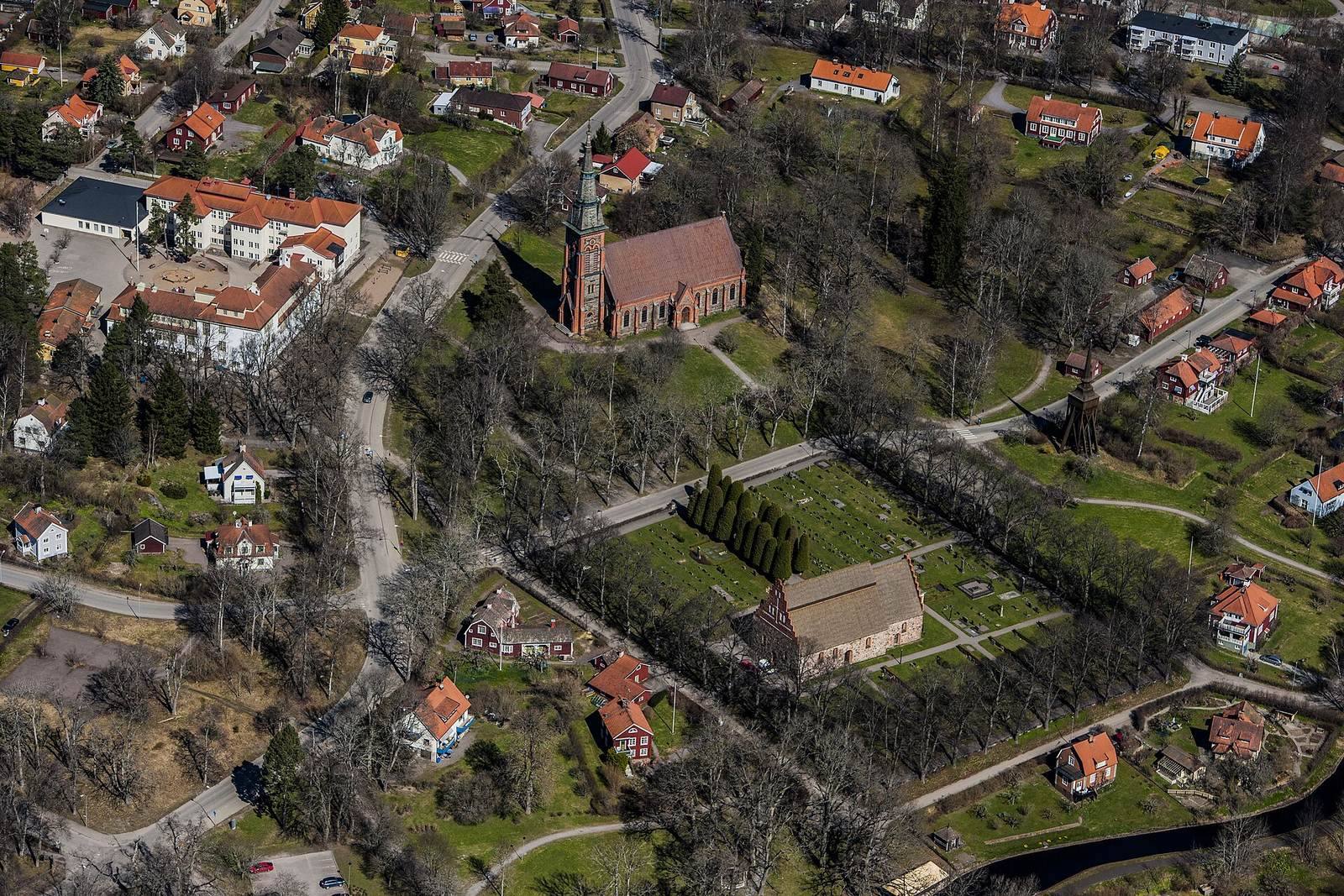
The church stands on Kyrkogatan, south of Åtvids Stora kyrka. Its rectangular nave, the main area for the congregation, joins a narrower chancel, the area around the altar, with a straight eastern end. A porch projects from the middle of the nave’s north wall, and a sacristy, a room used to prepare for services and store furnishings, stands north of the chancel. Late-medieval masonry survives in the chancel, the nave walls, and the northern projection that now forms the porch. The stone walls are unplastered, and the stepped gables contain blind panels, recessed decorations rather than openings. A cloverleaf-shaped wooden barrel vault, a continuous arched ceiling, covers the nave; the chancel retains a medieval star vault, whose ribs form a star-like pattern. The sacristy was built between 1954 and 1957, following the earlier ground plan from 1761. The interior was recreated relatively freely, while the small windows with shallow, curved tops could be reconstructed.
Painted vaults
East vault
Matz Målare painted the church’s wall scenes around 1620. In the east vault, the wall paintings show the creation of Eve and Adam and their expulsion from Eden. Its ceiling depicts the apostles Peter, Bartholomew, and Simon the Zealot, the evangelists Mark and Luke, and Christ as Savior of the World.
South vault
The south vault’s wall scenes show Cain killing Abel and Lot with his wife. Its ceiling includes the apostles Andrew and John, the evangelist John, the prophet Daniel, Joshua, and King David.
West vault
Scenes on the west vault’s walls depict Joseph being sold by his brothers, Joseph son of Jacob, and Potiphar’s wife. The ceiling shows the apostles James, Matthias, Philip, and James son of Alphaeus, together with the prophets Ezekiel and Jonah.
North vault
The north vault’s wall paintings show Joseph interpreting Pharaoh’s dream and Joseph before his brother in Egypt. Its ceiling depicts the apostles Paul, Judas Thaddaeus, Matthew, and Thomas, the evangelist Matthew, and the prophet Jeremiah.
Furnishings and musical instruments
Altarpiece and crucifix
Johan Johansson Werner made the altarpiece and triumphal crucifix, a crucifix traditionally displayed at or near the chancel arch. Nils Assersson Mannersköld paid most of the cost of these works and the wall paintings.
Pulpit and associated altarpiece
Wedulin of Hjo made the pulpit and its associated altarpiece, which Frans Evald Fock donated. The altarpiece is now on the north wall of the nave.
Organ
The reconstructed gallery organ incorporates the original Principal 4′, Mixtur III chor, and Trumpet 8′ stops; the other stops were recreated. The historic instrument had one manual, or keyboard, ten stops that controlled its sounds, and a foot-operated pedal linked to the manual. Its lower manual keys were black, and all the pipes in the facade sounded. The instrument cost 3,000 daler, a historical Swedish monetary unit. An electric organ with two manuals and a pedal is also used. Nils Österbom made the sculptures on the organ facade.
Other furnishings
The church has a baptismal font and two funerary coats of arms, one for Nils Assersson Mannersköld. A seventeenth-century choir bell hangs on the north wall of the chancel. The chancel carpet was designed by Barbro Nilsson and made by Måås Fjetterström in Båstad.
Burial chapel
A burial chapel at the northeast corner of the chancel has Baroque architecture, an elaborate European style, and is associated with Frans Evald Fock.
Bell tower
The separate bell tower stands east of the cemetery. It contains two church bells, cast in 1753 and 1796.