St. Lawrence’s Church: A Medieval Brick Gothic Church in Söderköping
Site at a Glance
- Country
- Sweden
- Primary era
- Medieval
- Eras represented
- Medieval, Early Modern
- Civilizations
- Swedish
- Site type
- Religious
- Remains
- Church
On this page13 sections
History
St. Lawrence’s Church is a medieval church in Söderköping, Sweden, whose construction began in the 13th century. Its surviving medieval structure reflects North German Brick Gothic, a Gothic tradition that uses brick as its principal building material. In the Middle Ages, Söderköping was Sweden’s third-largest city after Stockholm and Kalmar, and a trading centre for Östergötland. The church became a setting for royal coronations and political meetings.
Medieval church and royal ceremonies
A church is first mentioned in writing in 1253. It was dedicated to Lawrence of Rome, a Christian saint traditionally regarded as an early martyr, and his feast day is August 10. Brick may have been chosen in connection with the German merchants active in Söderköping.
In 1281, Helvig of Holstein, wife of King Magnus Ladulås, was crowned Queen of Sweden at the church. Birger Magnusson and Martha of Denmark were crowned king and queen there in 1302. During the 15th century, the Swedish political and military leader Engelbrekt Engelbrektsson and King Charles VIII Knutsson Bonde held meetings with nobles at the church.
Fire, rebuilding, and the Reformation
A city fire damaged the first church in 1494, and rebuilding followed. Bishop Henrik Tidemansson of Linköping consecrated its replacement in 1497, before work on the building was complete. Construction stopped in the 1520s after the Reformation, the 16th-century religious movement that led to Protestant churches in parts of Europe. A planned enlargement was only partly carried out. The church had been Catholic until this period; it retained its dedication to Lawrence as it entered Lutheran use.
Later changes and continuing use
A north aisle and a separate bell tower were added in 1583, and the tower’s bells were recast in 1897. Repeated flooding from the nearby Söderköpingsån led to repairs, as the church also underwent further rebuilding and renovation.
Today the church is an active Lutheran parish church of the Church of Sweden, within the Diocese of Linköping and Söderköping S:t Anna parish. It is protected as an ecclesiastical monument under Sweden’s Cultural Environment Act because it predates 1940. St. Lawrence’s is one of two surviving medieval churches in Söderköping, the other being Drothem Church.
Remains
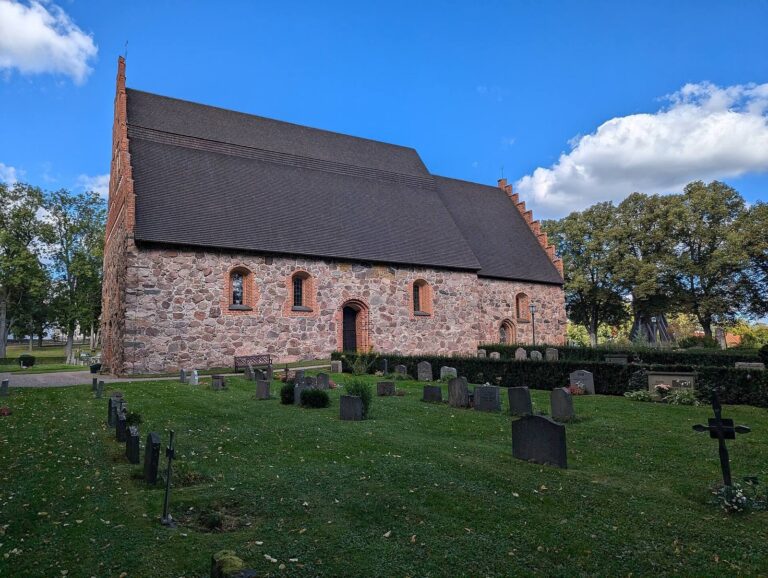
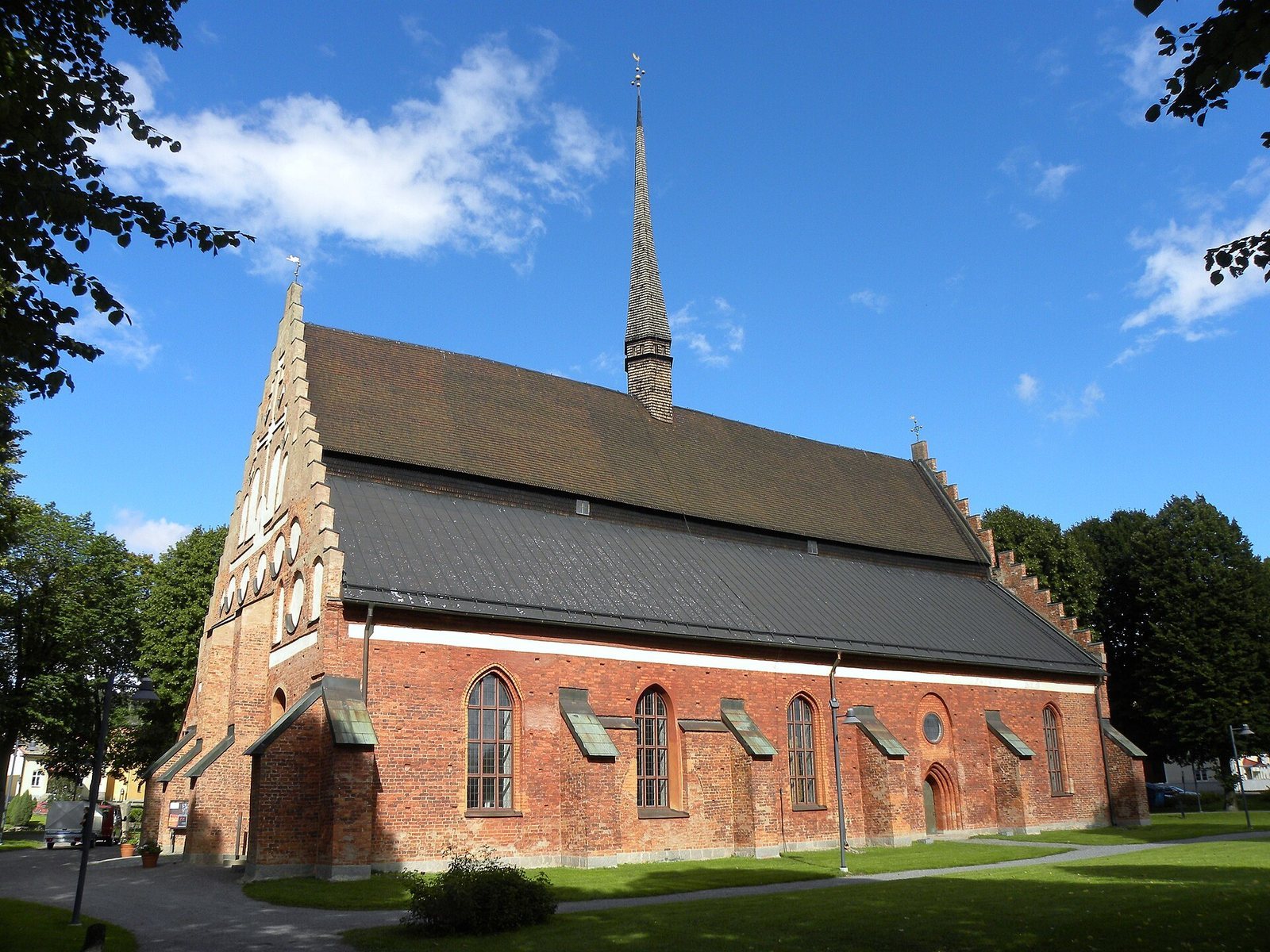
The church is built entirely of brick and retains much of its medieval form. Its present layout is that of a four-aisled hall church, where the nave and side aisles are of nearly equal height. The addition of the north aisle made the plan asymmetrical. The earlier church was a three-aisled basilica, with a central nave higher than its side aisles; some of its outer walls survived the 1494 fire.
Main church
Exterior
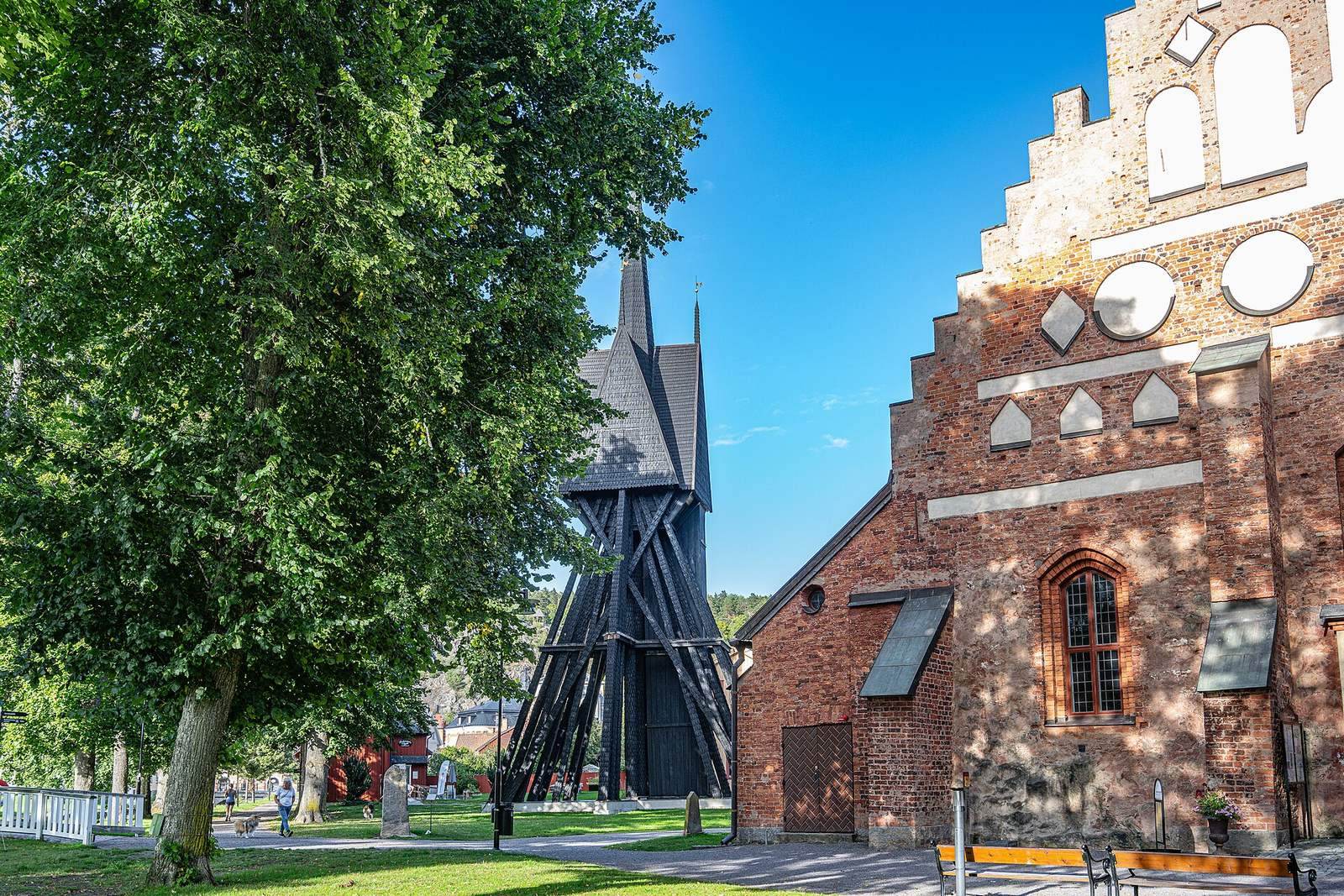
The red-brick exterior has brick buttresses and blind arches, decorative arches closed off within the wall. The east and west ends have straight façades topped by crow-stepped gables, whose outer edges rise in a series of steps. An image of St. Lawrence on the sacristy, a room used by clergy to prepare for services, bears the date 1296, regarded as a possible year of the church’s consecration. Renovation work in 1965 exposed a runestone, a stone bearing a runic inscription, embedded in a church wall.
Vaults and wall paintings
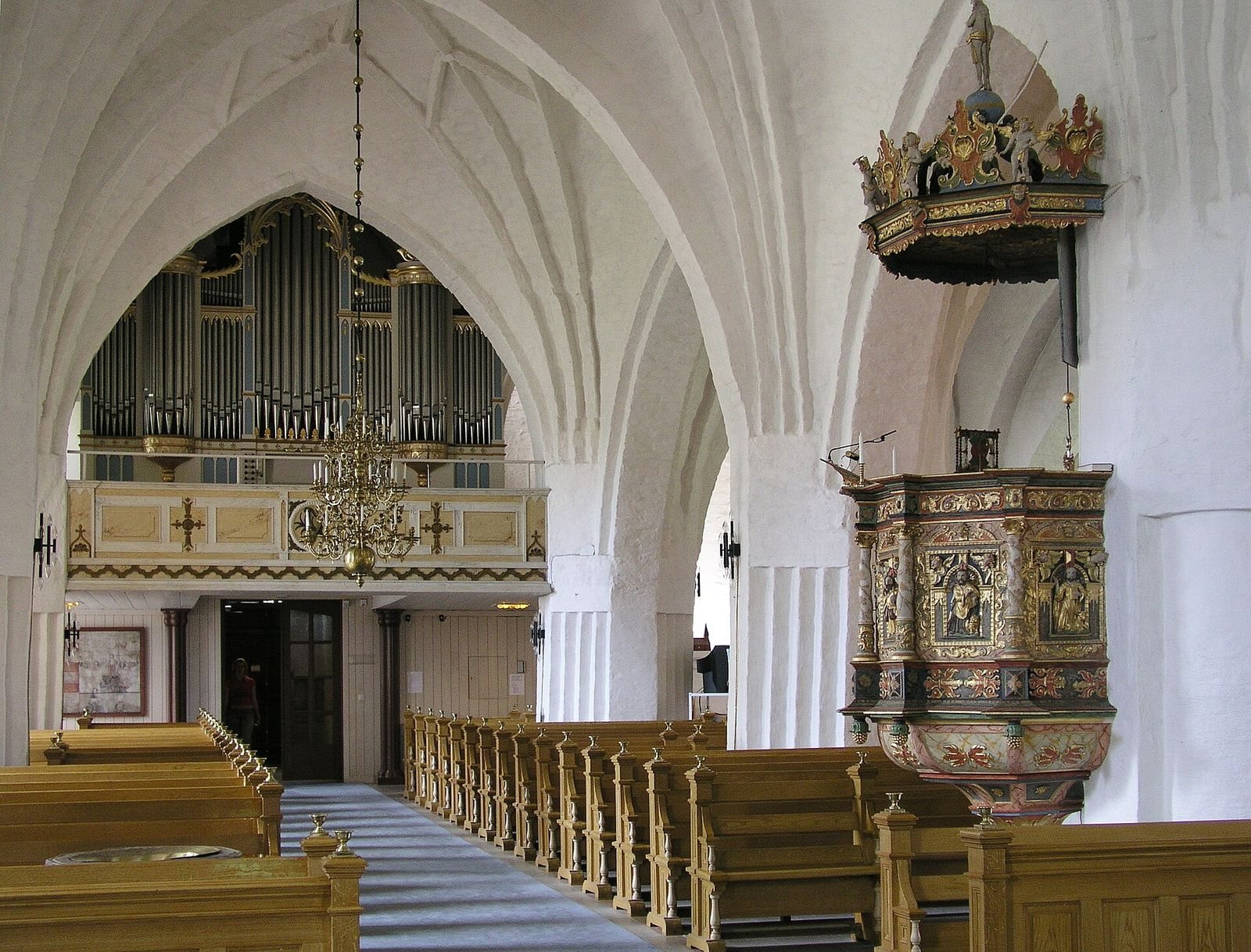
Inside, whitewashed vaults span the hall church. A well-preserved painting in the northwest corner, probably made in the 15th century, depicts the Second Coming of Christ and the resurrection of the dead. Other remains of medieval wall paintings came to light during 20th-century restoration work.
Bell tower
The freestanding brick bell tower stands outside the church and rises 50 metres. Anders “Stapelmakare” built it. Its bells weigh four tons.
Furnishings and sculpture
Altarpieces
The late-medieval altarpiece, possibly made in France, has a gilded central section showing Mary with the dead Christ on her lap. St. Nicodemus, Joseph of Arimathea, and several grieving women accompany them. A separate altarpiece, painted by Pehr Hörberg in 1802, is also among the church’s furnishings.
Crosses and sculptures
A 13th-century crucifix made for use in processions survives alongside a triumphal cross, a large crucifix traditionally displayed between the nave and sanctuary. The latter dates to the early 15th century and was probably made at Vadstena around 1400. The north aisle contains a 15th-century sculpture of St. Catherine of Alexandria by the late-medieval sculptor Bernt Notke. Medieval wooden sculptures of St. Christopher and St. Elizabeth of Hungary are also preserved in the church.
Font, pulpit, and other furnishings
The baptismal font combines a 14th-century bowl, a 17th-century brass water vessel, and a marble base added in 1975. The pulpit was made at Vadstena in 1669 by Johan Belätesskärare and painted in 1723 by Anders Wickström, a painter from Söderköping. Other furnishings include memorial inscriptions to townspeople and chandeliers dating from the 16th and 17th centuries.