Arlesheim Cathedral: A Baroque Church and Seat of the Basel Cathedral Chapter
Site at a Glance
- Popularity
- Medium
- Country
- Switzerland
- Primary era
- Early Modern
- Eras represented
- Early Modern, Modern
- Civilizations
- Holy Roman Empire, Swiss
- Site type
- Religious
- Remains
- Cathedral
On this page10 sections
History
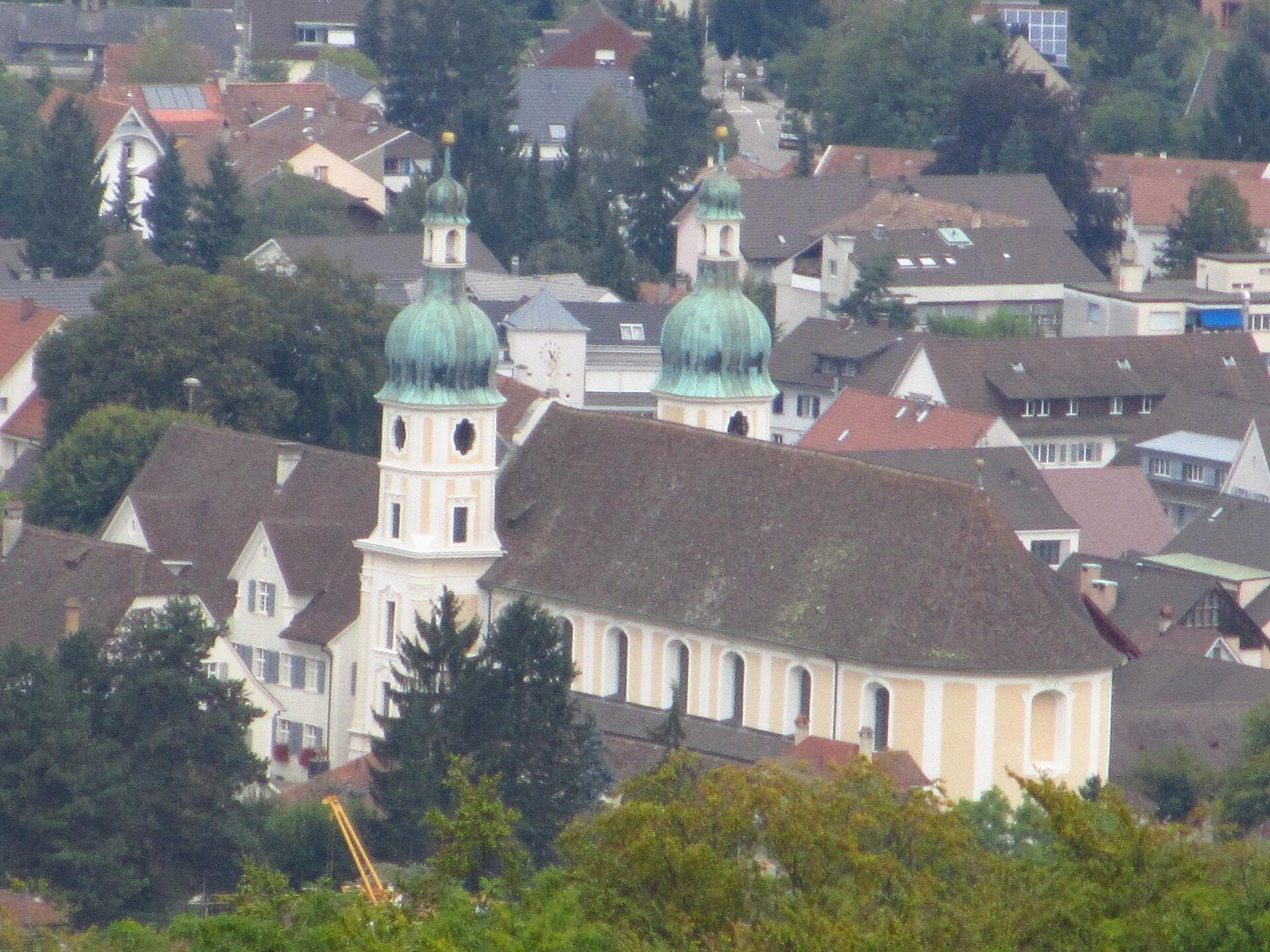
Arlesheim Cathedral is a Roman Catholic church in Switzerland, designed by Franz Demess and built from 1679 to 1681 in the early Baroque style, a European artistic and architectural tradition. From 1679 until 1792, it served as the seat of the Diocese of Basel’s cathedral chapter, a body of clergy responsible for cathedral affairs. The church is dedicated to the Immaculate Conception, the Catholic teaching that Mary was conceived without original sin.
Displacement and relocation
During the Reformation in 1529, the Prince-Bishop of Basel, who held both religious authority as a bishop and temporal rule over a territory, fled first to Altkirch and then to Porrentruy. The chapter initially moved to Neuenburg am Rhein before taking refuge in Freiburg im Breisgau.
The chapter’s residence in Arlesheim
After French forces occupied Freiburg, the bishop and chapter chose Arlesheim in 1679 for a new residence. Porrentruy was unsuitable because it belonged to the Archdiocese of Besançon rather than the Diocese of Basel. Arlesheim lay within the diocese and near Alsace, where the chapter received most of its income. The church and the canons’ houses around Cathedral Square served as the chapter’s seat until 1792, making the complex a local landmark.
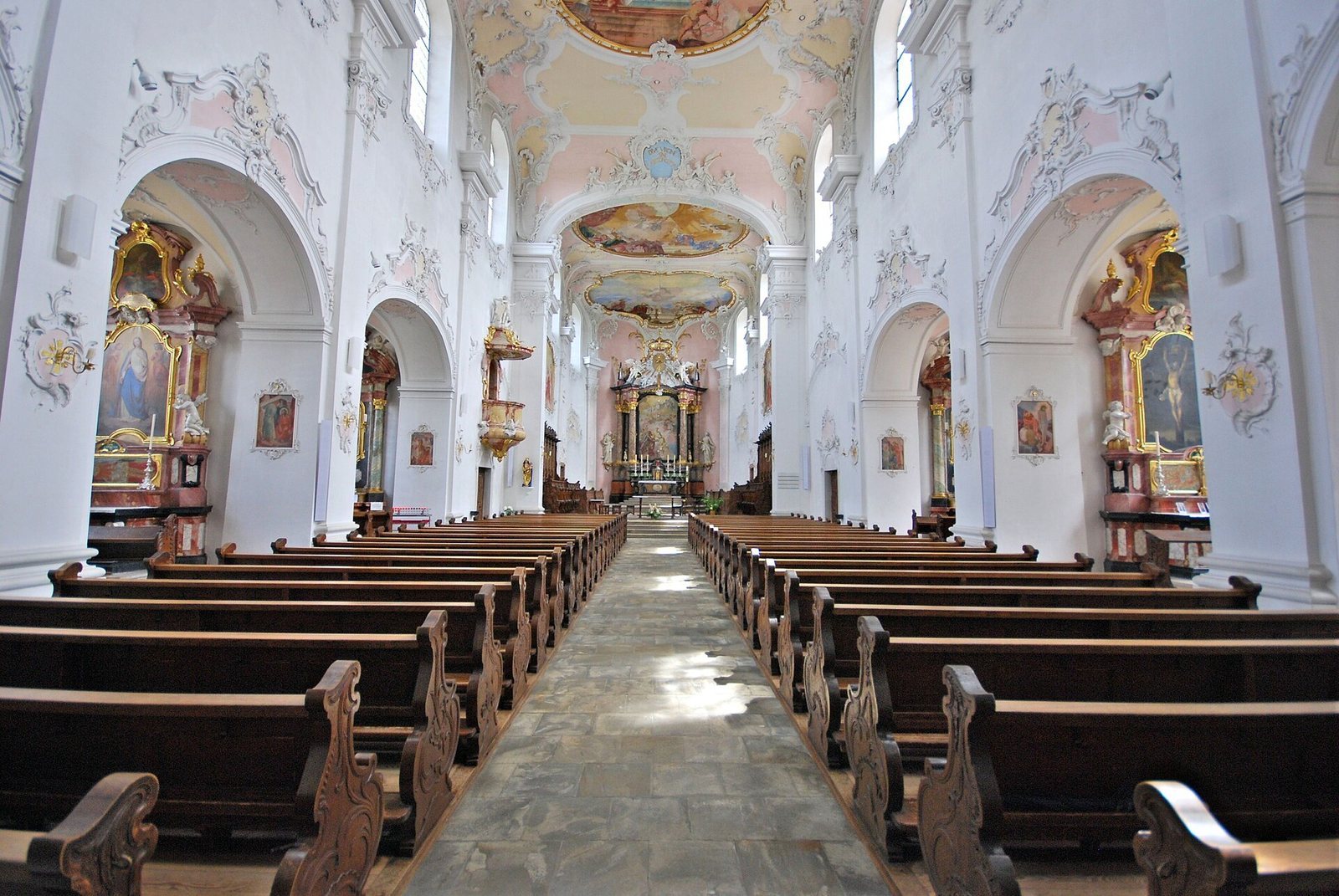
The cathedral was consecrated on 26 October 1681, and its bells were raised in July 1682. Serious damage became apparent after the building’s rapid construction, leading to a comprehensive restoration in 1759. Designed by Franz Anton Bagnato, the work gave the church a Rococo character, a later European style known for lighter, more elaborate ornament.
Revolution, parish use, and preservation
During the French Revolution, Prince-Bishop Sigismund von Roggenbach went into exile at Constance in 1792. The last canons left Arlesheim in 1793, when Freiburg again became the chapter’s official seat. The cathedral, the canons’ houses, and their movable property were then sold at auction. The church was subsequently used as a storehouse, wine cellar, and stable before becoming Arlesheim’s parish church in 1812. Saint Odilia, an early Christian saint associated with Alsace, is the parish’s patron saint.
The church’s interior was renovated in the early 1930s, followed by exterior work in 1954 and 1955. A complete restoration of both interior and exterior took place in 1980. The cathedral is listed in Switzerland as a cultural monument of national importance.
Remains
The cathedral stands within a group of canons’ houses built around the church. Its original early Baroque design was later reshaped in the Rococo style. The surrounding houses were built between 1680 and 1687 under the direction of Jakob Engel, a master builder from Misox, and his brother Karl.
Church architecture
Exterior
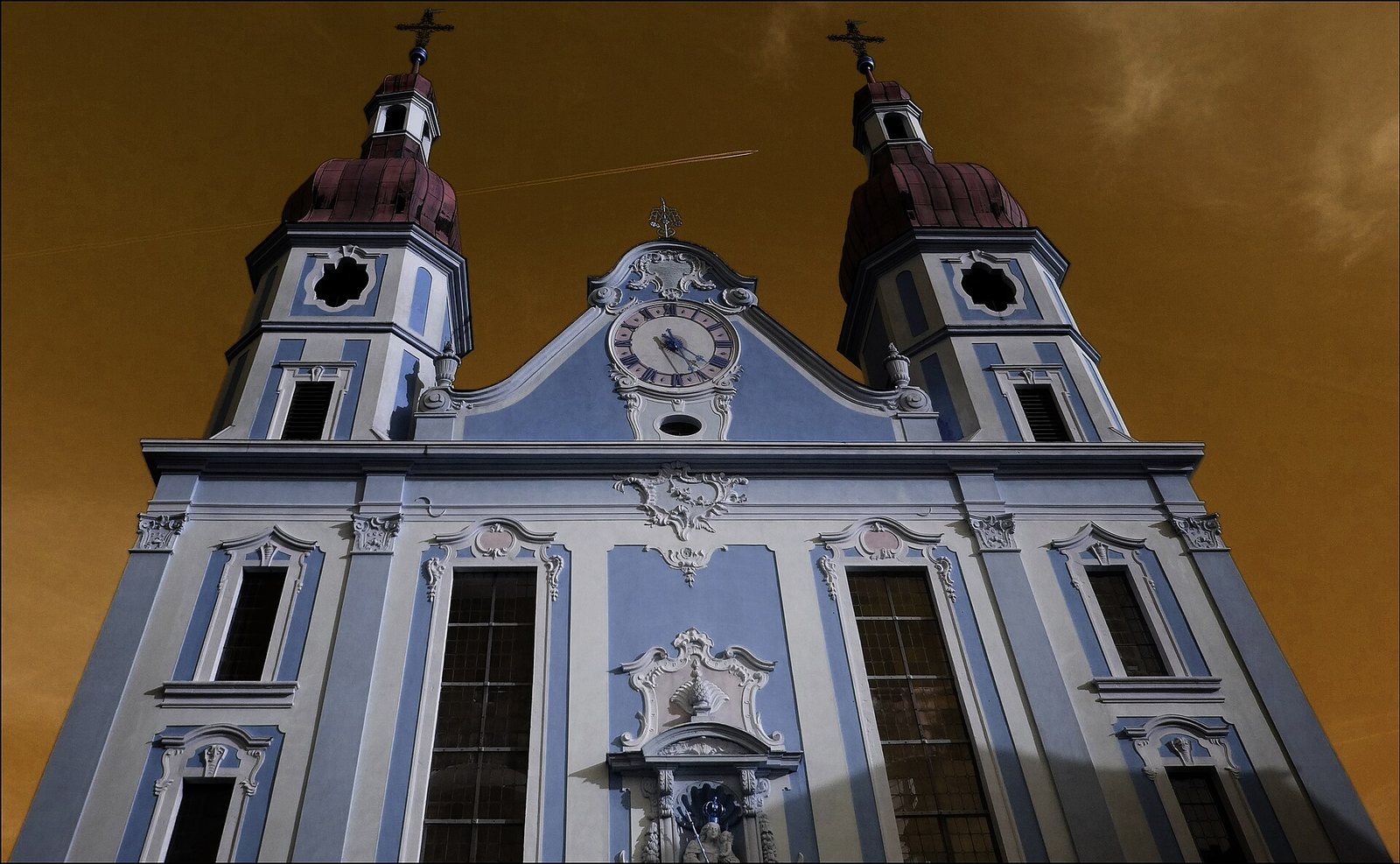
The church has two towers, each crowned by a finial and a cross. Its yellowish masonry contrasts with white surrounds, while the tower roofs are pale green. Above the light-colored wooden entrance door, a niche holds a statue of Mary and the Christ Child with a Basel staff, the cathedral chapter’s heraldic emblem associated with Basel. The 1759 renovation lengthened the building, moved the side entrances closer to the choir, and introduced stronger vertical features and additional ornament around the windows.
Interior and 1759 alterations
The original interior was a unified, austere space flanked by chapels. Low galleries ran along the walls, and the nave ended in a broad, rounded apse. Stucco decoration and heavy garlands across the ceiling softened the room’s plain character. The 1759 redesign altered the interior, removed the small galleries, and added a crypt beneath the choir floor.
Organ
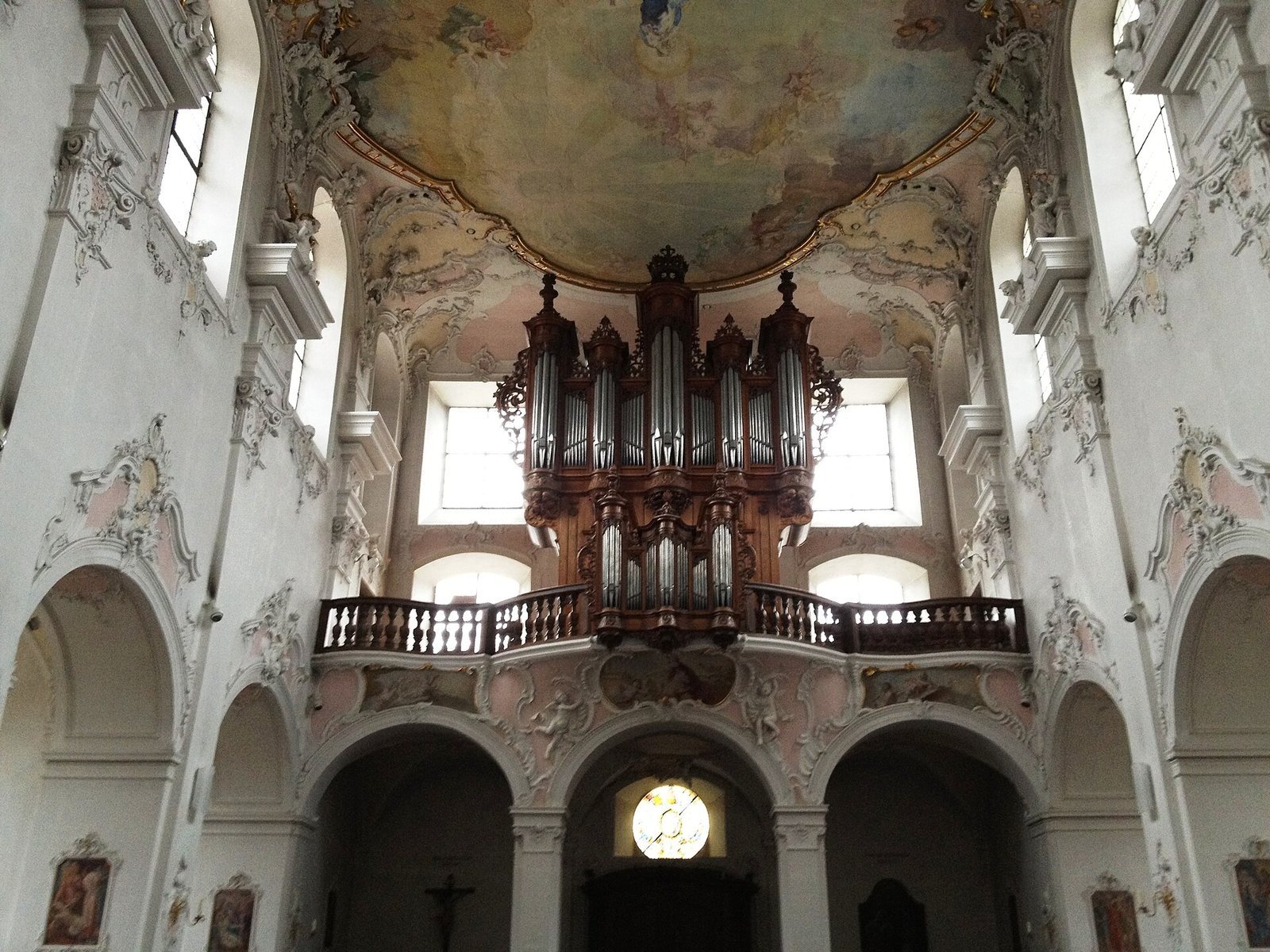
Johann Andreas Silbermann, an eighteenth-century Alsatian organ builder, received the commission for the cathedral organ on 2 November 1759. Installed in the gallery above the entrance, it was completed on 31 August 1761 with 32 stops, controls that select sets of pipes. It is one of the last substantially original Silbermann organs in Switzerland. Its sound is bright, with a cornet, a compound pipe stop, and numerous reed stops.
In 1888, Friedrich Weigle altered the instrument to produce a Romantic-era sound. He melted down 40 percent of its original pipes, moved the positive division, a secondary keyboard division, into a swell box behind the main case, and placed a new console in the positive case so the organist faced the altar. During Metzler Orgelbau’s 1962 restoration, the keyboard and pedal ranges were expanded, and five pedal stops were added to Silbermann’s original three. Stops were reconstructed with reference to Alsatian Silbermann organs and historic pipes, and the positive division was returned to its gallery case.
In 1998, the organ’s magazine bellows, which had harmed the instrument, were replaced with a replica of Silbermann’s wedge-shaped bellows system. Gaston Kern completed a further restoration in June 2005. The organ’s couplings allow the positive division to sound with the main keyboard division, and the main division with the pedal, which is played by the feet.
Bells
The cathedral’s peal consists of five bells cast by H. Rüetschi AG of Aarau in 1926 and 1935. The third bell was cast in 1935.