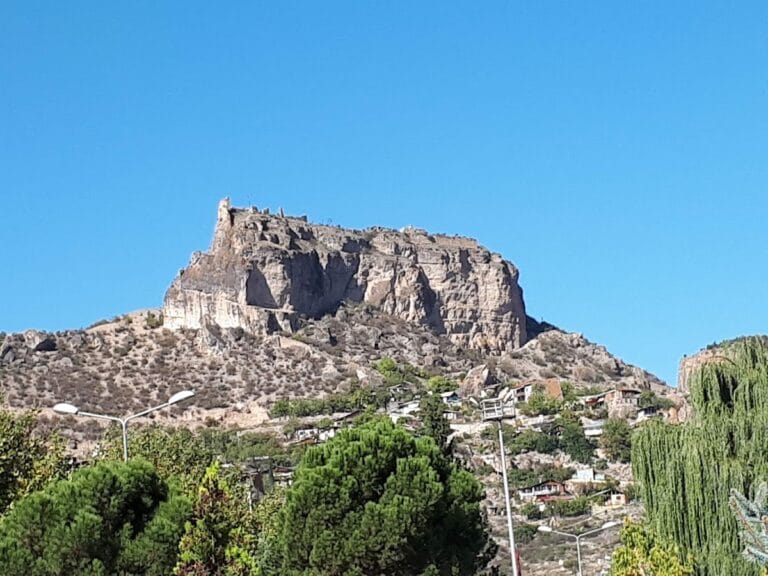
Ardahan Castle: A Medieval Georgian Fortress in Türkiye


Site at a Glance
- Rating
- 4.3
- Popularity
- Medium
- Country
- Turkey
- Primary era
- Medieval
- External website
- Open
- Eras represented
- Medieval, Early Modern
- Civilizations
- Georgian, Ottoman, Seljuk
- Site type
- Military
- Remains
- Castle
On this page7 sections
History
Ardahan Castle is a medieval Georgian fortress in Ardahan, Türkiye, beside the Kura River in the historical region of Artani. Its exact construction date is unknown, although a first castle on the site is dated to the 12th century, during the period of Seljuk rule. The fortress is also known as Parakani Castle, a name derived from the settlement’s former name.
Georgian and Seljuk-era foundations
The castle developed within a region associated with Georgian political and cultural history. The 12th-century date assigned to an earlier castle places the site within the medieval period when Seljuk power extended across parts of Anatolia and the Middle East. The settlement and fortress later retained the name Parakani, reflecting the older identity of the place.
Ottoman administration and repair
In 1551, the Ottomans captured the Artanuci and Artani regions from the Georgians. At that time, the castle and its settlement were known as Parakani. The Ottoman register Defter-i Mufassal-i Vilayet-i Gürcistan, compiled in 1595, referred to the settlement as “Rabat-i Kala-i Parakan.” In this record, Ardahan denoted the wider region rather than the urban settlement that bears the name today.
The Ottomans used Ardahan Castle frequently. An inscription records repairs in 1556, reportedly ordered by Sultan Suleiman I, the Ottoman ruler from 1520 to 1566. During this work, a Georgian church inside the fortress was demolished, and its stones were reused in the defensive walls.
Condition in the early twentieth century
In 1917, the Georgian researcher and journalist Konstantine Martvileli described the fortress as the second-largest castle in Ardahan Sanjak, an Ottoman administrative district within a larger province. He found it neglected and partly ruined, yet its crenellated walls still rose prominently. The fortress had not suffered major damage even during the First World War, and houses leaning against the walls remained intact. The church and other structures were approximately half ruined at that time. Ardahan Castle is described as fully standing today.
Remains
Walls, towers, and inner park
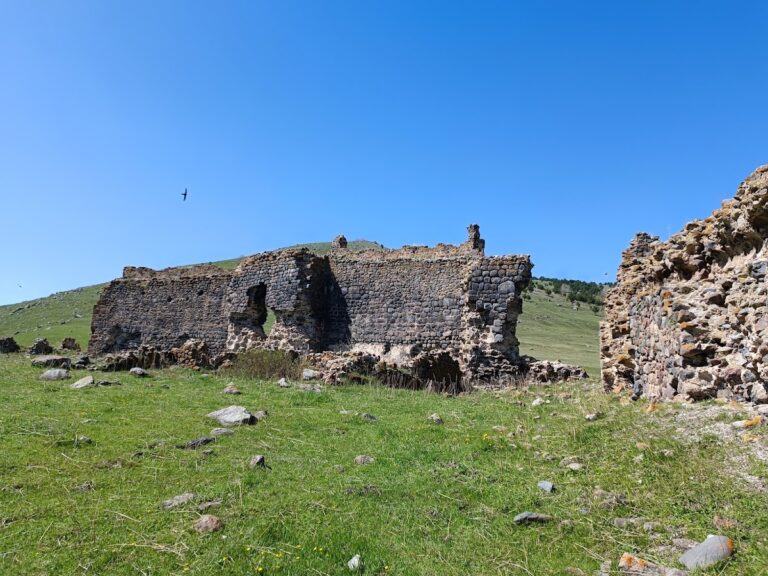
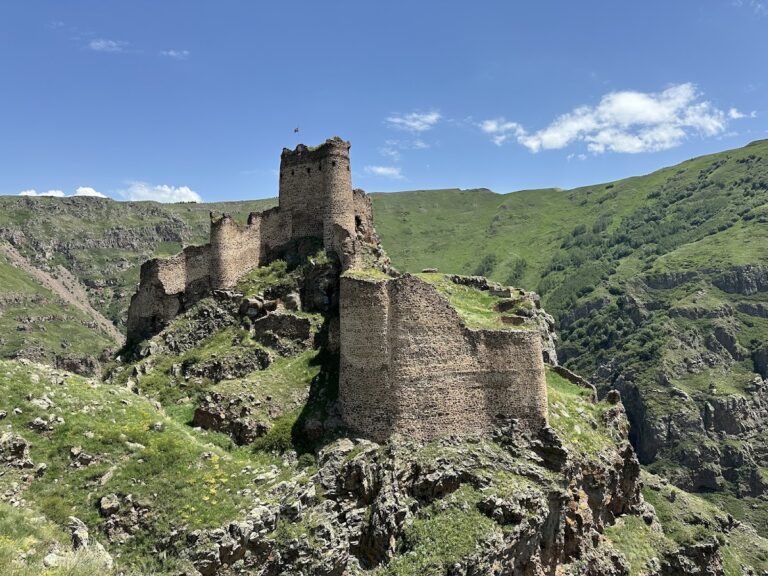
Ardahan Castle stands on the immediate left bank of the Kura River, between Halil Efendi Quarter to the north and the city center. Its fortress walls are built from small and medium-sized roughly dressed stones set in Khorasan mortar, a traditional lime-based mixture that could include brick dust or other materials that strengthen the bond. Larger, neatly cut stones reinforce the corners of the towers. The inner walls extend up to 268 metres from east to west, while their north-south extent varies between 119 and 170 metres. Numerous towers and an interior park occupy the enclosed area.
The ground slopes sharply across the fortress. The southern section, closer to the river, lies below the northern section, and the difference becomes greater from west to east. The lowest southern ground and highest northern ground differ by approximately 35 to 37 metres. This uneven terrain is reflected in the curtain walls, with the southern wall standing almost half as high as the northern wall.
Inscriptions and church remains
Stones incorporated into the fortress preserve Georgian writing on both their inner and outer faces. Two locations on the exterior contain inscriptions in Hutsuri, an older Georgian script traditionally used for religious writing. An Armenian inscription painted in red also survives on a stone inside the castle.
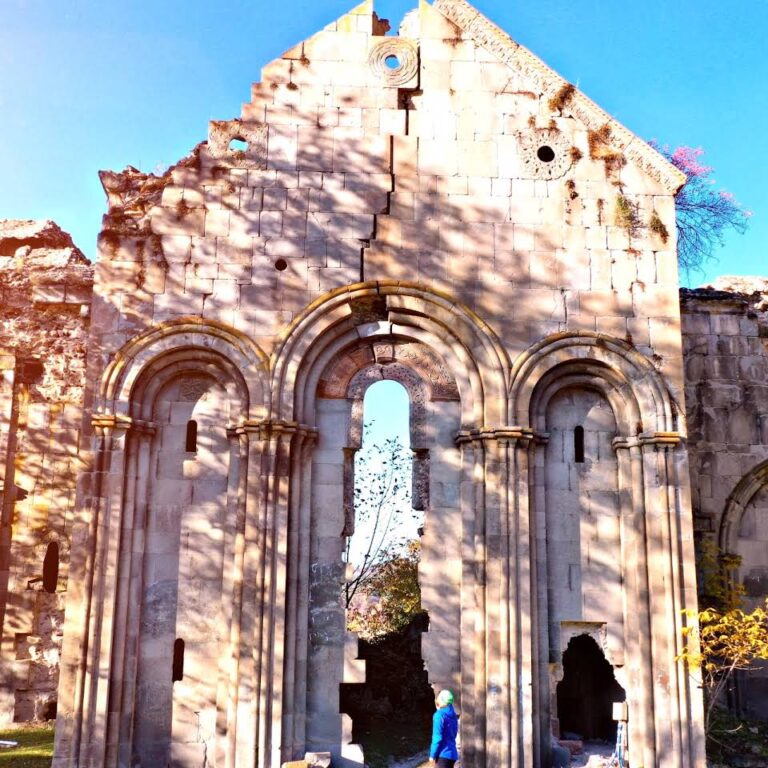
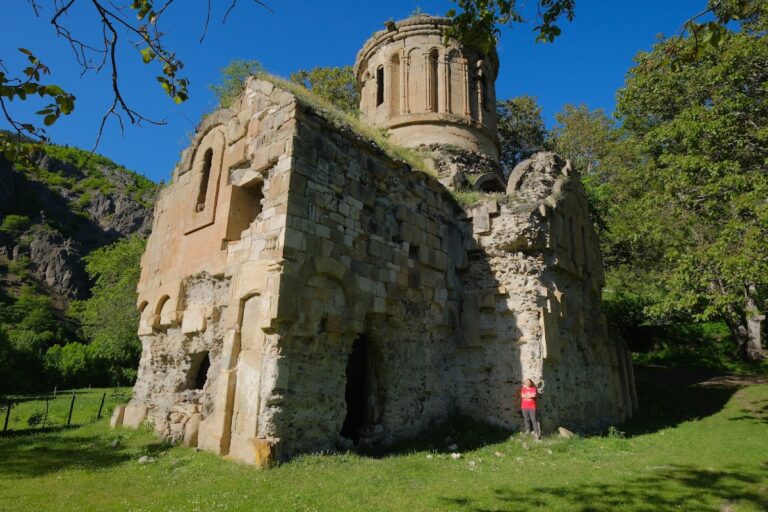
Small sections of the former Georgian church remained visible in 1917. These surviving fragments form part of the evidence for the earlier religious structure within the fortress, whose later history was connected to the Ottoman repairs of the defensive walls.