Ardanuç Castle: A Georgian Castle-City and Political Center in Türkiye


Site at a Glance
- Rating
- 4.6
- Popularity
- Low
- Country
- Turkey
- Primary era
- Medieval
- Eras represented
- Medieval
- Civilizations
- Georgian
- Site type
- Military
- Remains
- Castle
On this page10 sections
History
Ardanuç Castle is a Georgian castle-city in Türkiye, built in the fifth century in the historical region of Klarceti. Set in what is now Ardanuç in Artvin Province, it served as the center of Klarceti and later became the capital of the Georgian principality of Tao-Klarjeti.
Foundation and early development
Georgian historical tradition attributes the castle’s construction to an order from King Vakhtang Gorgasali, a fifth-century Georgian ruler associated with the early formation of Georgian political and religious centers. A related tradition says that his sister’s son, Artavan, carried out the work. These traditions place the origins of the fortress within the early development of Georgian power in the region.
Arab attacks during the first half of the eighth century destroyed Ardanuç Castle during the campaigns of Marwan II, an Arab ruler whose military expeditions reached the South Caucasus. Around 820, Ashot I Kuropalates restored and strengthened the fortress, founded a city below it, and built a church there. Ashot was a ninth-century Georgian ruler of the Bagratid dynasty. His title, kuropalates, was a high Byzantine court rank that indicated a close political relationship with the Byzantine Empire.
Capital of Tao-Klarjeti
Under Ashot’s rule and that of his successors, Ardanuç developed into the political and economic center of Tao-Klarjeti. By the tenth century, the fortified city and its large suburb, or foretown, had become an important trading center. Its position on routes connecting the Black Sea with Persia and the wider Silk Road brought goods from Trebizond, eastern and western Georgia, Armenia, Syria, and other regions. The tenth-century emperor Constantine VII Porphyrogenitus described the city in detail in De Administrando Imperio.
After Georgia was unified in the eleventh century, the royal capital moved first to Kutaisi and later to Tbilisi. Ardanuç then became a peripheral provincial town governed by an eristavi, a Georgian provincial governor or regional military-administrative ruler. In 1551, Ottoman forces under Sultan Suleiman the Magnificent captured Ardanuç from the Jakeli atabegs.
Archaeology and heritage protection
Archaeological excavations began in Adakale in September 2021 under the direction of Osman Aytekin. Work supported by Türkiye’s Ministry of Culture and Tourism and Van University has examined the inner castle and the remains of the Church of Saint Peter and Paul. The area around Ardanuç Castle, including Adakale, is designated a first-degree archaeological site.
In October 2025, an arched tomb was identified beneath the apse of the Church of Saint Peter and Paul. Turkish scholars tentatively identified it as the tomb of Ashot Kuropalates. The tomb measures 2 meters long and 1.8 meters wide.
Remains
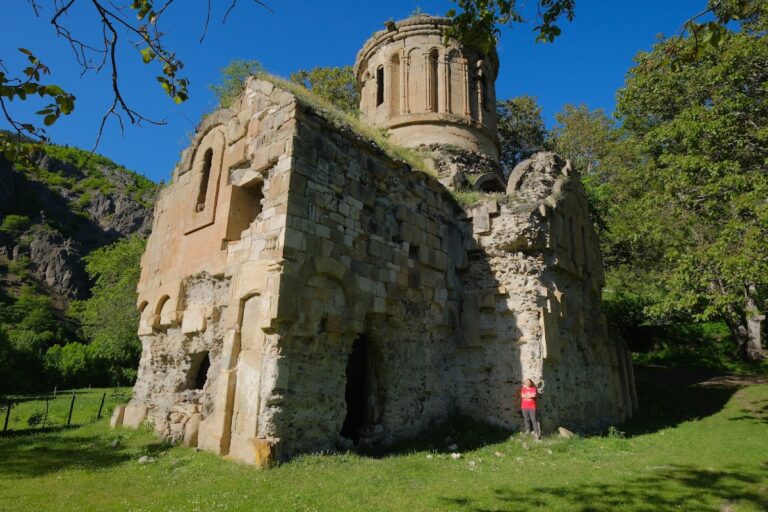
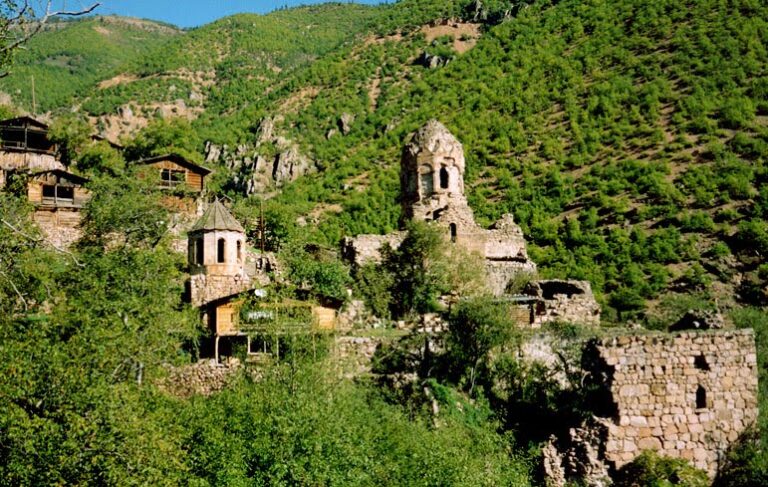
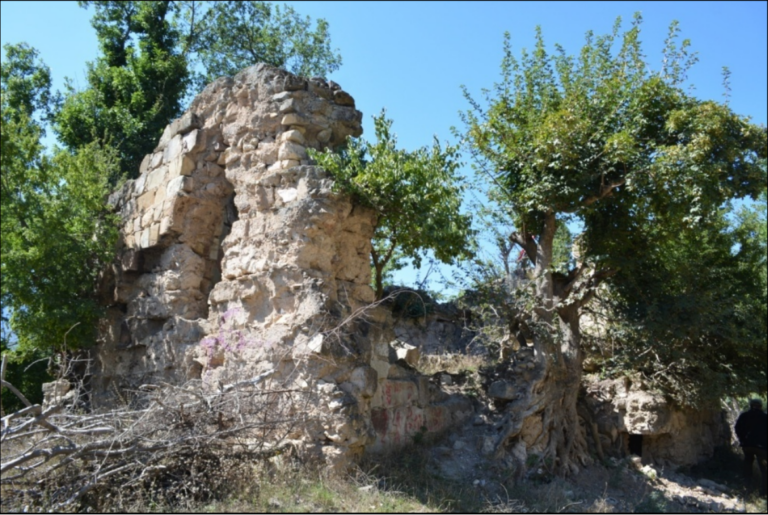
Ardanuç Castle occupies a large rock on the left bank of the Ardanuç River. The castle-city was arranged around a main fortress on the rock and a settlement to its northwest. The fortress itself was divided into an outer castle and an inner castle. The complex extended for approximately 220 meters and reached up to 55 meters in width. Much of it is now ruined, although sections of the fortification walls remain on the rock, together with church and palace remains.
Fortress and castle church
Fortifications and palace
Surviving sections of the defensive walls follow the rocky fortress area and represent the remains of the castle’s outer and inner divisions. A palace also stood within the castle complex, where its ruins remain alongside the fortifications and church. The surviving structures express the arrangement of the elevated fortress above the settlement below.
Church of Saint Peter and Paul
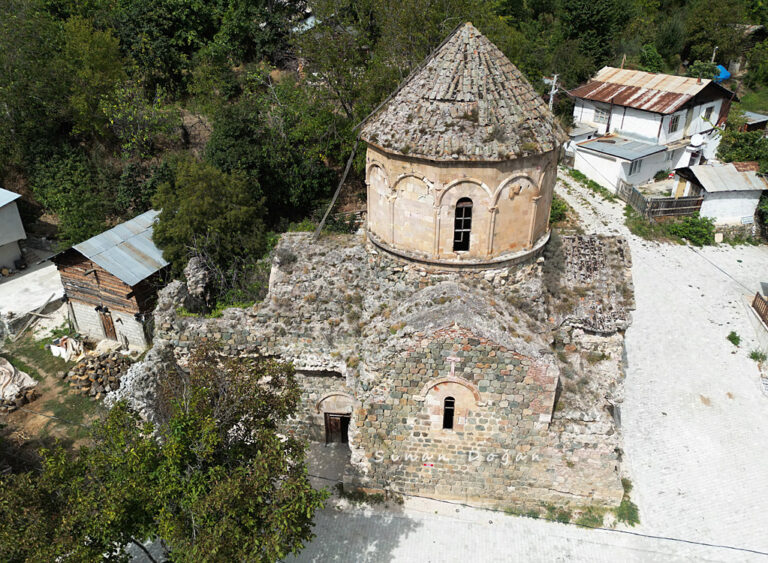
The Church of Saint Peter and Paul is a single-nave building within the castle. An additional structure adjoins its northern side. Its eastern apse, the rounded termination of a church usually placed at the eastern end, survives to a height of approximately 2 to 3 meters, while the roof covering has not survived.
White stone taken from the surrounding rock forms the church walls. The blocks were left unworked, and some measure approximately 1 by 2 meters. Traces of blue paint show that the interior walls were plastered and decorated with wall paintings. The arched tomb found beneath the apse measures 2 meters by 1.8 meters and has been tentatively associated with Ashot Kuropalates.
Adakale and the former city
The archaeological settlement beneath the castle forms part of modern Ardanuç, particularly the area known as Adakale. Its remains include a church, old market shops, sections of fortification walls, and other ruins from the former urban settlement. The Church of Artanuci stands outside the castle within this area, showing that the city extended beyond the elevated fortress.
Domed mausoleum
A domed mausoleum built of rough stone stands somewhere in the town. It is associated with Sefer, Yusuf Pasha, and Ali Pasha, who served as the mutasarrif of the Ardanuç sanjak. A mutasarrif was an Ottoman provincial official responsible for administering a sanjak, an intermediate territorial district.