Aqüeducte de Santa Llúcia: Morella’s Medieval Water Aqueduct
Site at a Glance
- Rating
- 4.5
- Popularity
- Low
- Country
- Spain
- Primary era
- Medieval
- Eras represented
- Medieval, Early Modern, Modern
- Civilizations
- Crown of Aragon, Spanish
- Site type
- Infrastructure
- Remains
- Aqueduct
On this page12 sections
History
The Aqüeducte de Santa Llúcia, also called the Morella Aqueduct or Séquia Reial, is a Valencian Gothic water system in Morella, Spain, built in successive phases during the thirteenth and fourteenth centuries. It brought spring water into the town through underground channels and elevated arcades, linking the surrounding water sources with the urban center.
Foundation and medieval construction
In 1273, Jaime I of Aragon, the thirteenth-century king who ruled the Crown of Aragon during its expansion in the eastern Iberian Peninsula, granted Morella the Vinatxos spring for its water supply. Its water supplemented supplies from the Avellanar and El Romeu springs, as well as the Bassa del Poll and Bassa del Prat reservoirs within the town.
In 1315, Jaime II of Aragon authorized the Council of Morella to build a watercourse from the Vinatxos spring to the Pla de Sant Llàcer, also known as the Pla de Santa Llúcia. The existing sequence of arches was constructed in 1338. By 1359, water had reached the Pla del Sol, now called Font Vella, in the town center. The completed aqueduct extended for approximately 260 metres.
Repairs and continued use
The aqueduct required repeated repairs as individual sections deteriorated. Several arches near the chapel of Santa Llúcia collapsed in 1391 and were repaired by Guillem Palma. Funds were assigned for work on the La Pedrera arches in 1421, while the walls were reinforced in 1739. In 1845, the government of Morella was still seeking to rebuild collapsed parts of the structure.
During the mid-twentieth century, a polyethylene pipe was placed inside the tunnel sections to reduce water loss. The canalization continued to serve agricultural irrigation until the 1960s. Earthworks for a new road in 1992 destroyed a large section of the buried channel and removed the trace of the aqueduct’s beginning. Spain declared the aqueduct an Asset of Cultural Interest, in the monument category, in 2006.
Remains
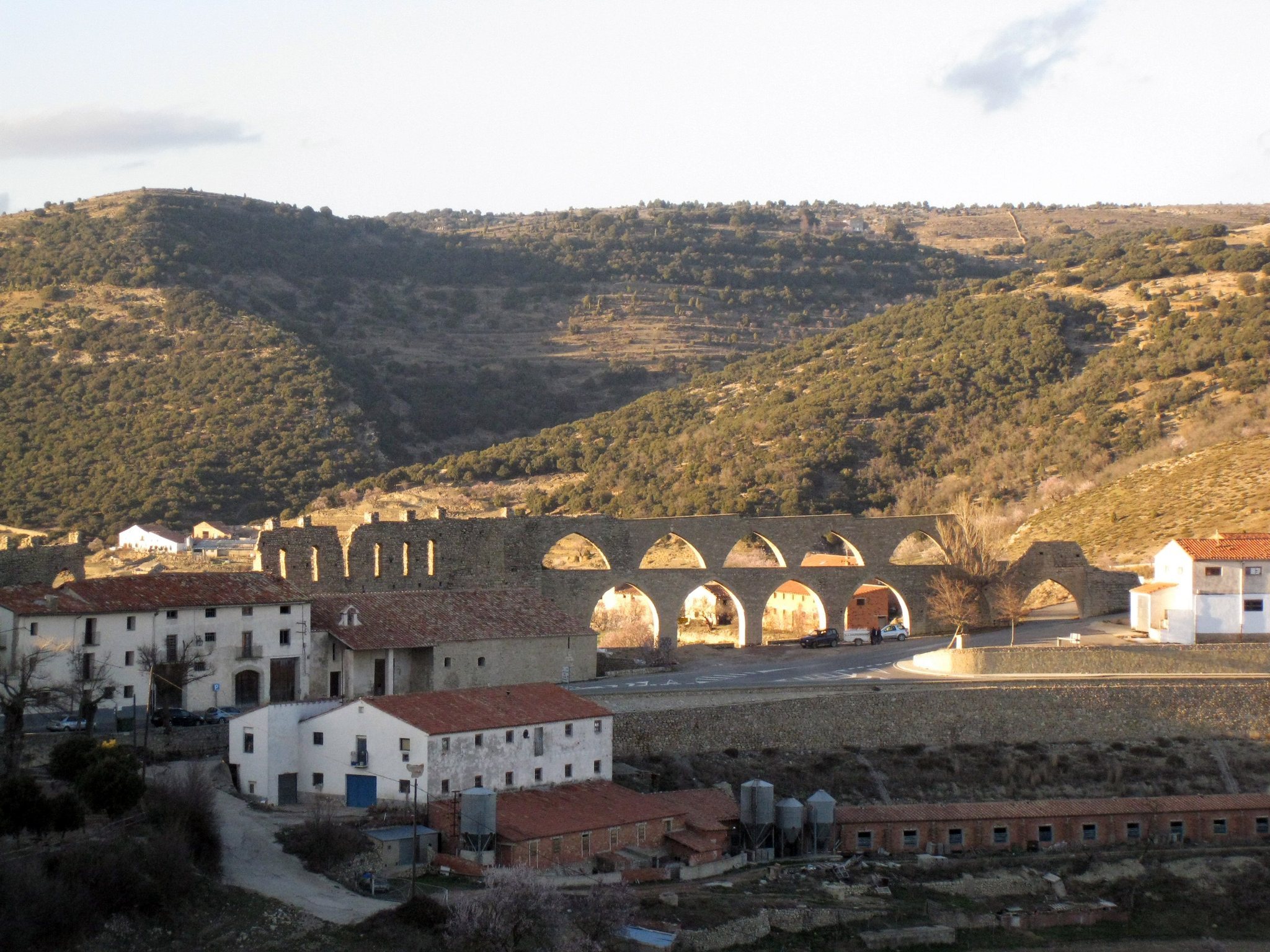
The aqueduct follows the terrain between the aquifer of the Vinatxos spring and the Plaza de la Font in Morella’s urban center. Where the ground permits, the channel runs at ground level through masonry tunnels. It crosses valleys on elevated arcades, creating a linear system of pointed and semicircular arches built from masonry and ashlar, or carefully dressed stone. Its two principal arcade groups are the Arcs de Santa Llúcia and the Arcs de la Pedrera.
Water capture and underground channels
Vinatxos spring
The Vinatxos spring formed the aqueduct’s water-capture point. It is currently used as a place where livestock can drink, retaining a practical connection with the water system’s original function.
Buried canalization
The underground sections are formed by two parallel masonry walls covered with a semicircular barrel vault, a continuous half-circle vault spanning the channel. Water formerly flowed through these passages over a line of channels made from cut stone. Surviving tunnel sections show how the aqueduct carried water through areas where the terrain did not require raised arcades.
Elevated arcades
Arcs de Santa Llúcia
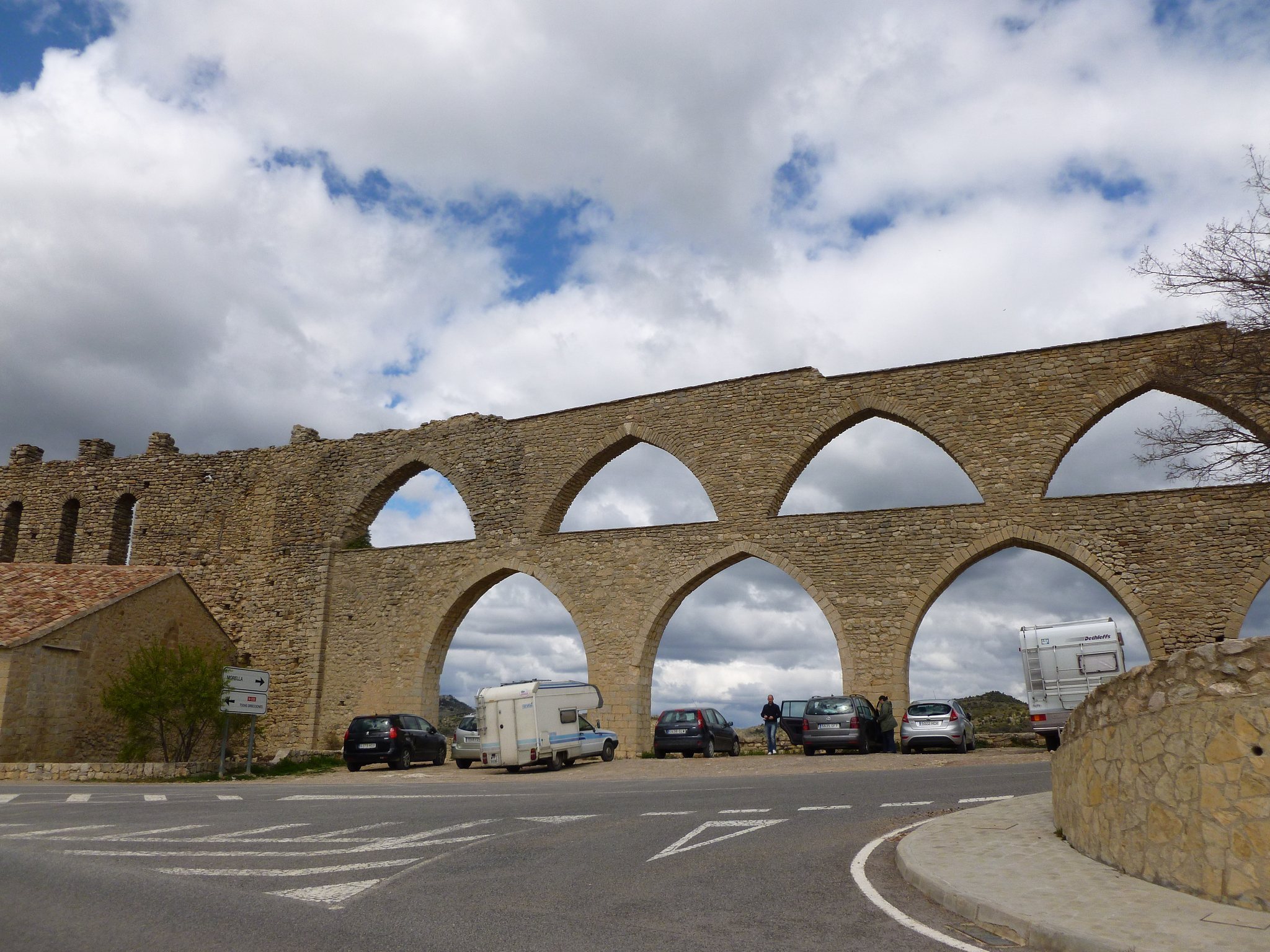
The Arcs de Santa Llúcia consist of two superimposed rows of pointed arches. This arcade section is 120 metres long, 1 metre thick, and 14.50 metres high. Its ashlar and masonry construction carries the water channel above the ground where the route crosses a valley.
Arcs de la Pedrera
The Arcs de la Pedrera form a second elevated section, 140 metres long, 1 metre thick, and 13 metres high. Its two tiers use different arch shapes: the lower row is pointed, while the upper row is semicircular. Ashlar and masonry make up the structure.
Urban cistern
Plaza de la Font reservoir
At the town center, the channel reaches a large cistern in the Plaza de la Font. A monumental façade forms the front of this built reservoir, with the Plaza Vella above it. The plaza preserves medieval stone paving. A spout projecting from the façade formerly directed water into watering troughs, which survive in a very deteriorated condition.