Apsley House: Wellington’s London Townhouse and Museum
Site at a Glance
- Popularity
- Very High
- Country
- United Kingdom
- Primary era
- Early Modern
- Eras represented
- Early Modern, Modern
- Civilizations
- British
- Site type
- Domestic
- Remains
- Elite Residence
On this page15 sections
History
Apsley House is an aristocratic townhouse at Hyde Park Corner in London, United Kingdom, built by Scottish architect Robert Adam for Henry Bathurst, Lord Apsley, between 1771 and 1778 in the neoclassical style. It later became the London home of Arthur Wellesley, 1st Duke of Wellington, and is known as “Number One, London.”
Before Apsley House
The site had been occupied by a royal lodge. During the Interregnum, the period between the execution of Charles I in 1649 and the restoration of the monarchy in 1660, new buildings went up between the area now called Old Park Lane and Hyde Park Corner. After the Restoration, James Hamilton leased them. His widow, Elizabeth, renewed the lease for 99 years in 1692.
A tavern called the Hercules Pillars stood on the site immediately before the house was built. Henry Fielding included it in The History of Tom Jones, a Foundling, as a place where Squire Western stayed on his first journey to London. Adam built the house for Bathurst, a lawyer and politician who served as Lord Chancellor, a senior legal and government office. Bathurst’s title gave the house its name.
Wellington’s London home
Richard Wellesley acquired the house in 1807 and sold it in 1817 to his younger brother Arthur, then Duke of Wellington. Wellington wanted a London base for his political career. The house earned the nickname “Number One, London” because it was the first house visitors from the countryside passed after the Knightsbridge toll gates.
Wellington commissioned architect Benjamin Dean Wyatt to remodel the house in two phases, starting in 1819 and 1828. The later work began after Wellington became Prime Minister. Structural defects discovered during the alterations led to further repairs.
The Waterloo Gallery commemorated Wellington’s victory over Napoleon at the Battle of Waterloo on 18 June 1815. An annual banquet marked the victory. It began in the Dining Room, then moved to the gallery after that room was completed in 1828. The larger space could seat 74 people, compared with 36 in the Dining Room.
Wellington’s collection also grew through wartime acquisitions. After the 1813 Battle of Vitoria in Spain, paintings from the baggage train of Joseph Bonaparte, Napoleon’s brother and former king of Spain, came into Wellington’s possession. Most of the paintings in the train were lost after the battle. Wellington’s brother, Lord Maryborough, sorted and listed 165 that reached the house. Wellington chose to return paintings from the Spanish royal collection, but Ferdinand VII of Spain instead presented them to him.
From family home to museum
In 1947 Gerald Wellesley, 7th Duke of Wellington, gave the house and its most important contents to the nation. The Wellington Museum Act 1947 provided for a museum and other public uses while allowing the Wellington family to occupy part of the building for as long as the dukedom continued. The 9th Duke retains private accommodation in the northern part of the house.
Following refurbishment by the Ministry of Works, including the replacement of gas lighting with electric lighting, the house opened as a museum in 1952 as part of the Victoria and Albert Museum. Responsibility passed to English Heritage in 2004. Much of the house serves as a museum and art gallery, while its public rooms have been maintained, as far as possible, in the style and decoration of the 1st Duke. Apsley House is Grade I listed, as are its gates and railings, which have a separate listing.
Remains
Setting and exterior
The house and its surroundings
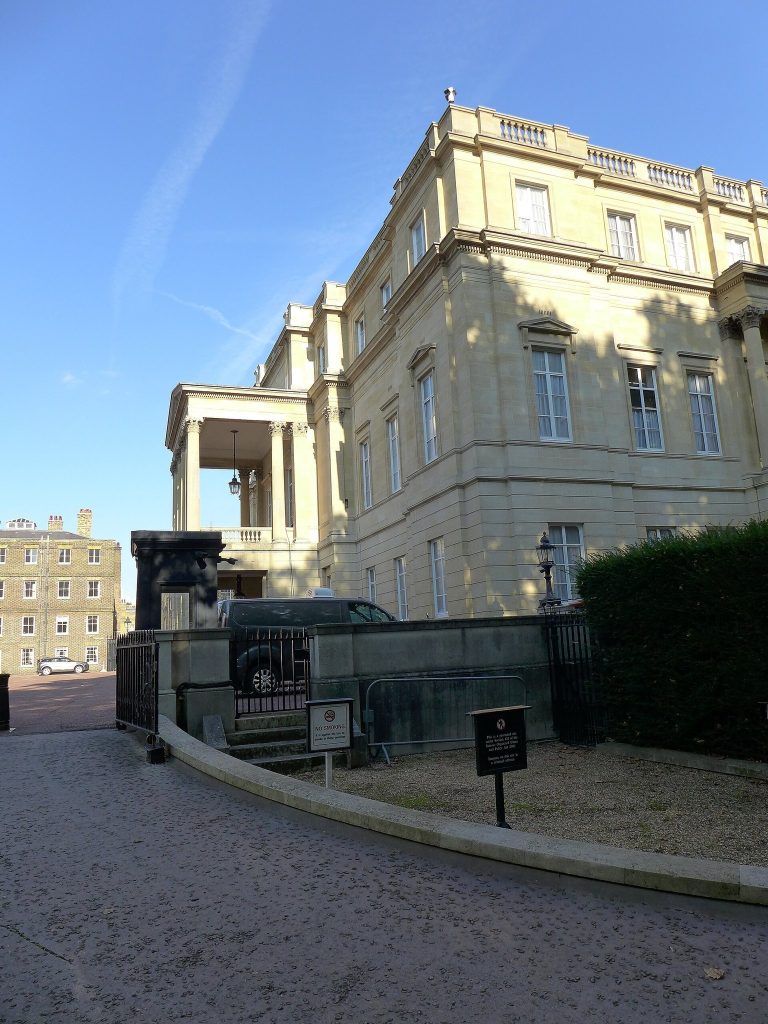
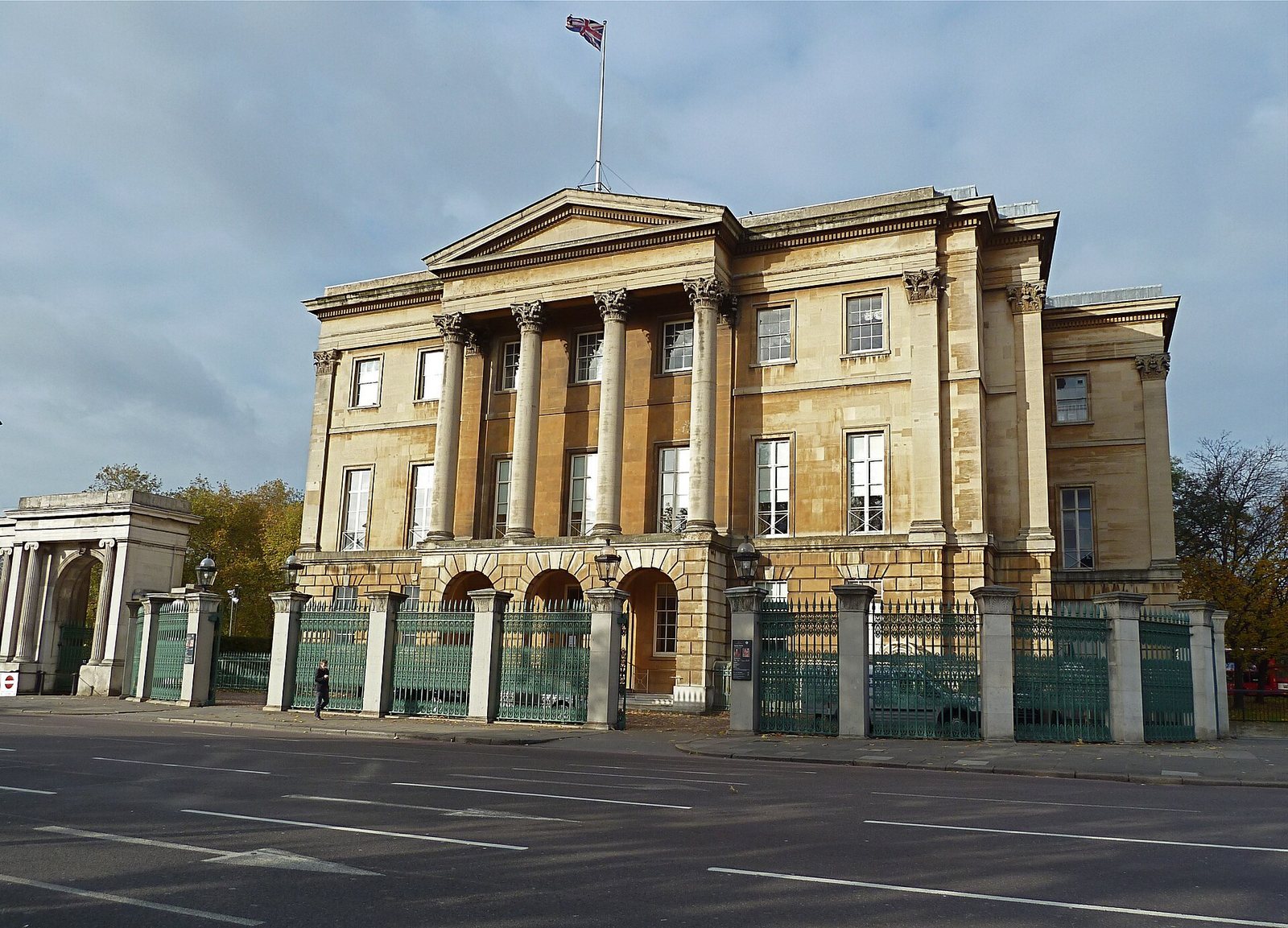
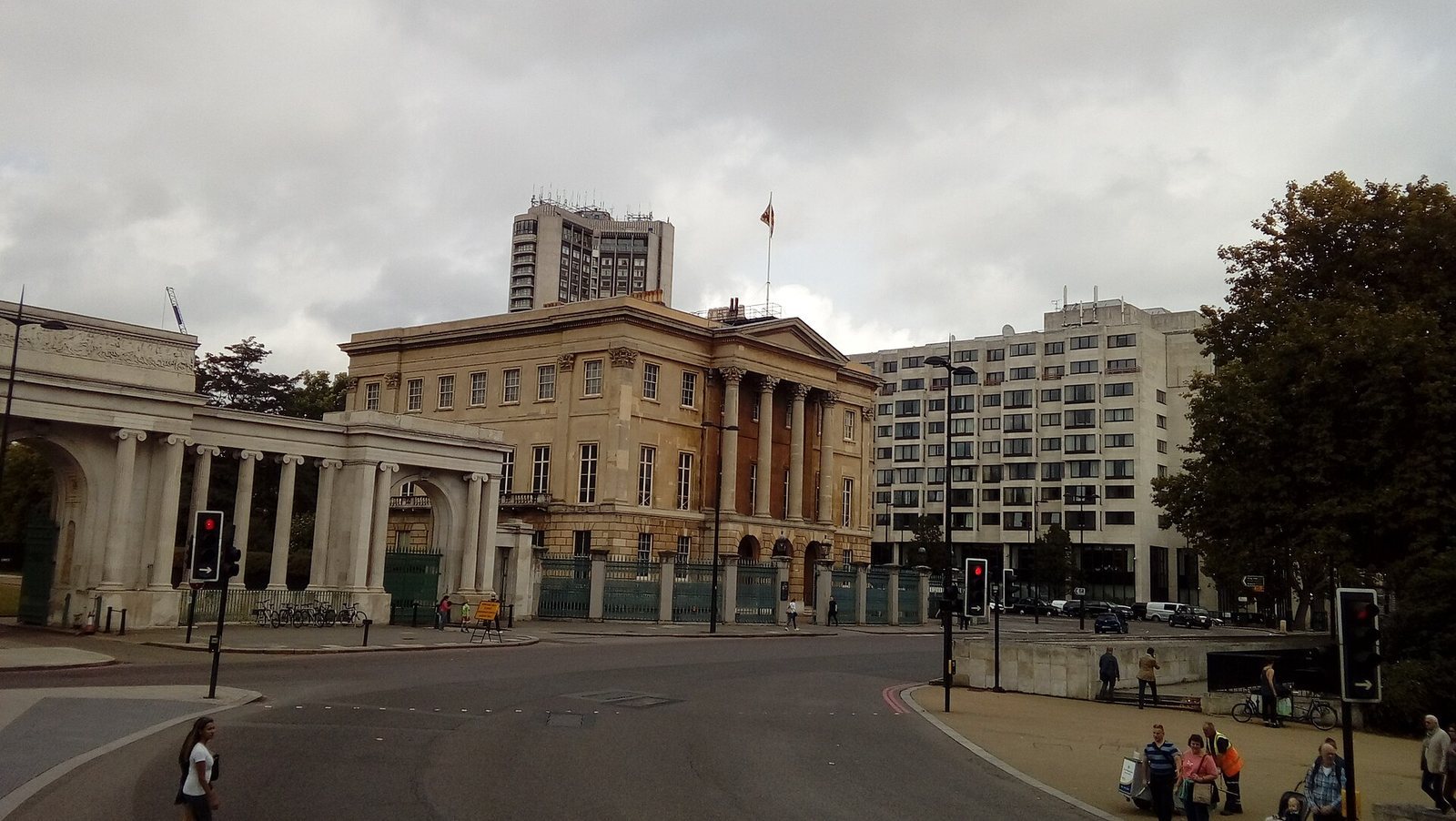
Apsley House stands at the south-east corner of Hyde Park, facing a large roundabout with Wellington Arch at its centre. Its formal address is 149 Piccadilly. Built in red brick, the house was originally neoclassical. It once formed part of a continuous row of large Piccadilly houses; that row was demolished when Park Lane was widened. Apsley House is thought to be the only preserved example of an English aristocratic townhouse from its period.
During Wellington’s ownership, the exterior was clad in Bath stone, a limestone used as building stone, and a portico topped by a triangular pediment was added. Iron shutters and railings followed damage to the windows during riots.
Wellington’s statue
Across the road stands an equestrian statue of Wellington. Its plinth has an infantryman at each corner, and the statue was cast from guns captured at Waterloo.
Interior architecture
Adam’s rooms and staircase
Adam’s surviving interiors include the Piccadilly Drawing Room, which has a rounded end and an Adam fireplace. The Portico Room lies behind the large entrance portico, whose Corinthian columns have ornate capitals. The house also retains a semicircular spiral staircase.
Wyatt’s additions
Wyatt’s first phase added a three-storey extension to the north-east, containing a State Dining Room, bedrooms and dressing rooms. Its scagliola decoration, which imitates marble, was made in Coade stone, an artificial ceramic stone produced by the Coade Ornamental Stone Manufactory in Lambeth.
The later work added a new staircase and the Waterloo Gallery on the west side of the house. Its interior includes French-inspired decoration and an ornate wrought-iron stair rail. Architectural historian Nikolaus Pevsner described the design as a transition from Empire, an early 19th-century French style, to neo-Rococo, a revival of ornate Rococo decoration.
Art and objects
Paintings
The collection includes about 200 notable paintings, among them 83 from the Spanish royal collection. Works include Correggio’s The Prayer in the Garden of Gethsemane (about 1524), Diego Velázquez’s The Water Seller of Seville (about 1620), Thomas Lawrence’s portrait of Arthur Wellesley (about 1815), and Giuseppe Cesari’s The Expulsion from Paradise (about 1610). Other works include David Wilkie’s Chelsea Pensioners Reading the Waterloo Dispatch (about 1820), Bernardino Luini’s The Virgin with the Standing Child, and Pieter de Hooch’s The Intruder: A Lady at Her Toilet Surprised by Her Lover (about 1665). Three paintings by Titian, held in the family’s private rooms, were shown publicly for the first time in the 21st century.
Canova’s sculpture
Antonio Canova’s Napoleon as Mars the Peacemaker stands in Adam’s Stairwell. Commissioned directly by Napoleon, the 3.45-metre-tall sculpture was made between 1802 and 1806. Napoleon holds a gold figure of Nike, the ancient Greek goddess of victory, in his right hand and raises his left, which holds a long staff. After the sculpture was displayed at the Louvre, the British government bought it for Wellington.
Gifts and tableware
Objects associated with Wellington include a silver centerpiece made for him in Portugal around 1815 and gifts from European rulers and governments. These include Siberian-porphyry and malachite candlesticks with two side tables from Nicholas I of Russia, a Swedish-porphyry vase from Charles XIV John, and Egyptian-revival Sèvres porcelain tableware from Louis XVIII of France. The Portuguese Regency Council gave him more than 1,000 pieces of silver and silver-plated tableware, while Frederick Augustus I of Saxony presented Meissen porcelain.
Frederick William III of Prussia presented Wellington with a 400-piece gilt-porcelain table service in 1817 in recognition of the Waterloo victory. The service went on public display at the house in 2017. The collection also includes Wellington’s baton, presented in recognition of his achievements by military forces from Portugal, Prussia, England, the Netherlands, Spain, Hanover, Austria and the Russian Empire. Those forces awarded him the rank of field marshal or its equivalent.