Apano Kastro of Naxos: A Medieval Defensive Fortress in Greece


Site at a Glance
- Rating
- 4.5
- Popularity
- Very Low
- Country
- Greece
- Primary era
- Medieval
- Eras represented
- Medieval, Early Modern
- Civilizations
- Byzantine, Crusader, Venetian
- Site type
- Military
- Remains
- Castle
On this page7 sections
History
Apano Kastro of Naxos is a medieval defensive fortress in Greece, occupying a position in central Naxos that had strategic value since classical antiquity. Its development began in the Byzantine period, when the Eastern Roman Empire defended the fertile Tragaia valley against raids by Muslim seaborne raiders.
Byzantine and Latin Rule
During the Byzantine period, the fortress was rebuilt and equipped with cisterns and food stores so that its garrison could endure prolonged sieges. Its later history belongs to the era of Latin rule in the Aegean that followed the Fourth Crusade, the campaign that brought Latin-ruled states to parts of the region. Apano Kastro became associated with the Duchy of Naxos, a principality established in the Cyclades after the conquest.
Tradition gives Marco Sanudo, the Venetian nobleman who founded the Duchy of Naxos and became its first duke, responsibility for the castle’s definitive form. He was believed to have rebuilt it shortly after 1207, following the Venetian conquest of the Cyclades. Archaeological interpretation places this attribution more cautiously: Sanudo probably strengthened the fortress, while its final configuration appears to belong to a later phase around the beginning of the fourteenth century.
Ottoman Threats and Venetian Reforms
The early-fourteenth-century rebuilding took place as Ottoman naval raids became a new danger to Naxos. In 1390, Bayezid I, the Ottoman sultan who ruled during a period of expansion into the Balkans and Aegean, organized a fleet of 60 ships to plunder the islands. This threat prompted major reconstruction at Apano Kastro, including new walls and defenses adapted for artillery.
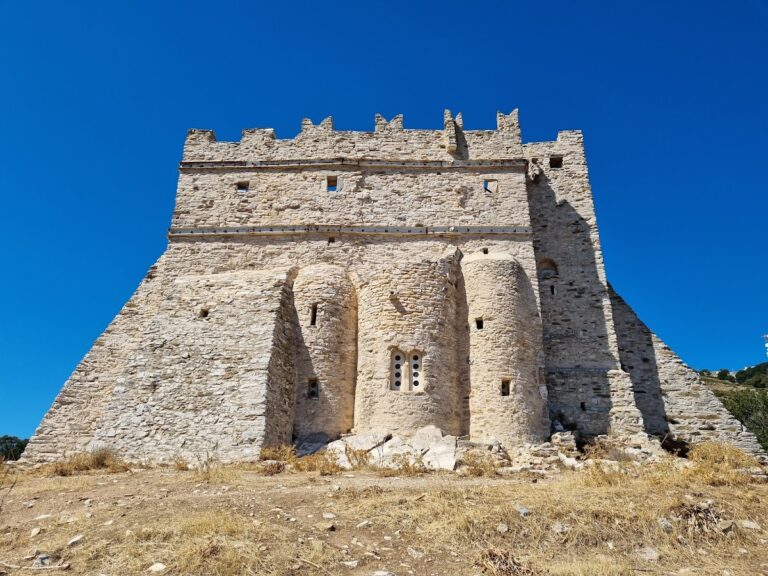
Further reforms took place around 1500 during a brief period of direct Venetian administration under Duke Francesco III Crispo. The southern side was strengthened with additional walls and two circular bastions. Apano Kastro was besieged several times but rarely captured. Hayreddin Barbarossa, an Ottoman naval commander and corsair, failed to conquer it in 1537. In 1678, the French corsair Hugues de Crevelliers captured the fortress, but held it only briefly. The castle is now identified as a protected building in Greece.
Remains
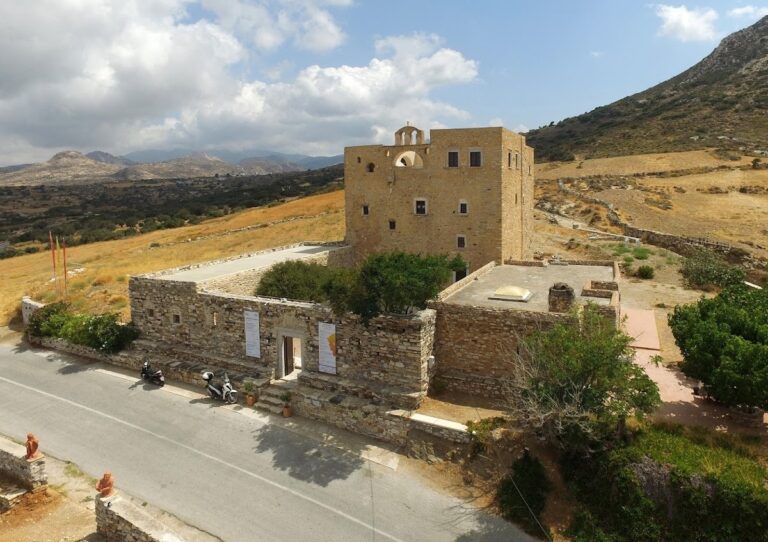
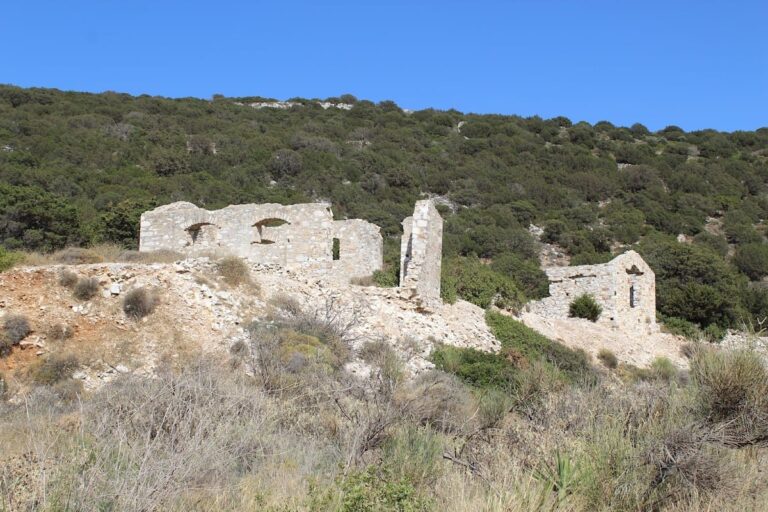
Apano Kastro is arranged in two walled enclosures. The lower enclosure surrounds the base of the hill, while the upper enclosure protects the elevated acropolis, the fortified upper part of the stronghold. Together they express the site’s defensive organization, with the summit reserved for the principal fortified and religious buildings.
Enclosures and Water Supply
The upper enclosure covers less than 3,000 square metres. Its walls incorporate material from earlier buildings, including Byzantine structures and very large, roughly fitted cyclopean stone blocks. Cisterns within the fortress, supported by nearby springs, supplied water to the stronghold and helped it withstand lengthy sieges. These installations formed part of the fortress’s practical defenses alongside its walls and stored provisions.
Upper Enclosure Buildings
The summit enclosure contained the principal bastion, a projecting fortified position designed to strengthen a wall and provide defensive fire, together with a basilica, a large hall-like Christian church. It also held a palace or keep, the principal fortified stronghold within a castle, traditionally associated with a duke or with a figure described as a queen.
Southern Defenses
Later military adaptations included circular towers fitted with gun loops, openings through which firearms or cannon could be used. The southern flank was reinforced around 1500 with two circular bastions, and both remain preserved as part of the castle’s surviving defenses.
Nearby sites