Saint George Diasoritis, Naxos: A Byzantine Orthodox Church


Site at a Glance
- Rating
- 4.7
- Popularity
- Low
- Country
- Greece
- Primary era
- Medieval
- External website
- Open
- Eras represented
- Medieval
- Civilizations
- Byzantine
- Site type
- Religious
- Remains
- Church
On this page9 sections
History
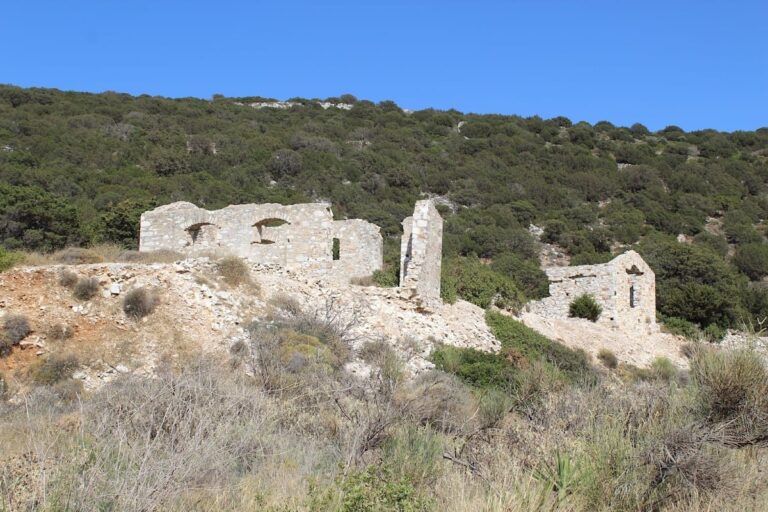
Saint George Diasoritis, Naxos, is an eleventh-century Byzantine Eastern Orthodox church in Greece, located about 600 metres from Halki, also known as Tragaia, in central Naxos. Built and decorated during the eleventh century, it was probably one of the region’s most important churches. Its architecture, sculpture, wall paintings, funerary features, and dedicatory inscription reflect that standing.
An important Byzantine church
The church belongs to the architectural traditions of the Byzantine Empire, the Eastern Roman state and its Orthodox Christian successors. Its position near Halki places it within a region that, during the Byzantine period, appears to have served as an administrative centre overseeing Naxos’s hinterland.
A dedicatory inscription in the narthex refers to John the Protospatharios. A protospatharios was a high-ranking Byzantine court and administrative official. The inscription links the church to an individual of elevated status and provides evidence for the administrative importance of the surrounding area.
Later painted decoration
A second layer of wall paintings, probably dating from the thirteenth century, covers parts of the apse and the lower painted zone of the main church. The narthex contains two or three layers of painting, indicating that its decoration was renewed more than once after the church’s original decoration.
Remains
Church structure
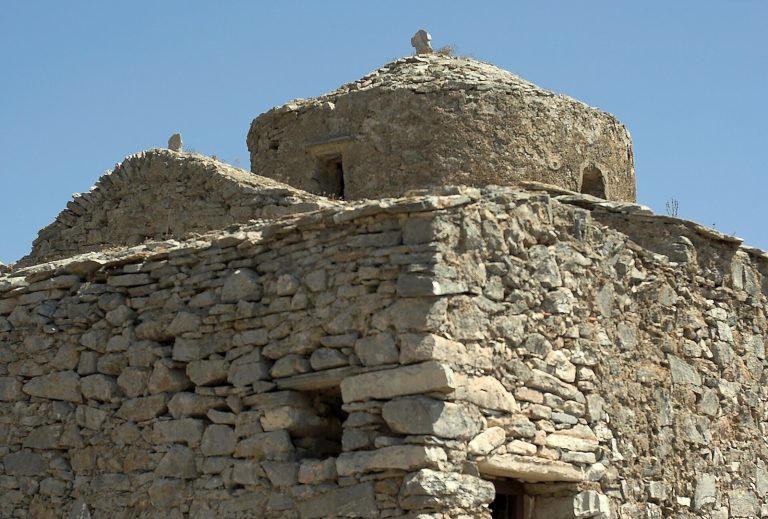
Saint George Diasoritis is a rare example on Naxos of a domed cross-in-square church of the simple four-pier type. In this plan, four arms are arranged around a central domed space. The dome is carried by four built piers, while a lower narthex, an entrance or vestibule area, is attached to the west. The west facade ends in a bell gable. Inside, the four arms of the cross have barrel-vaulted ceilings, and the narthex has a barrel vault divided into three bays.
Stone mouldings run around the interior walls. They articulate the surfaces and divide the painted decoration into three horizontal registers. Two opposing arcosolia, arched wall recesses containing tombs, were built into the north and south walls of the narthex. Their tombs are now empty.
Wall paintings
Dome and apse
The dome contains Christ Pantocrator, the image of Christ as the all-ruling figure in Orthodox church decoration. Four full-length archangels appear around him in the drum, the upright section supporting the dome. In the apse, the Virgin and Child, frontal standing hierarchs, and Saint George occupy the painted registers. Saint George is framed like a portable icon, with his parents shown in medallions on either side.
Feast scenes and saints
The arms of the cross carry scenes from the Twelve Great Feasts, the principal feasts of the Eastern Orthodox liturgical year. These include the Nativity, the Presentation of Christ in the Temple, the Baptism, the Entry into Jerusalem, the Ascension, Pentecost, and the Annunciation. Figures of soldier-saints and martyrs occupy the walls.
Saint George, the Christian martyr traditionally associated with military service, has several especially prominent positions in the decorative programme. He appears again in the Deesis, an intercessory scene in which he takes the place usually held by Saint John the Baptist, and is also shown on the vault of the northwest corner bay and on the south wall of the southwest corner bay. The Archangel Michael and Saint John the Baptist also hold particularly prominent places.
Narthex paintings and inscription
The funerary narthex contains two or three painting layers dominated by representations of the Second Coming, the Christian belief in Christ’s return and final judgment. The dedicatory inscription naming John the Protospatharios is placed in the southeast corner of the narthex, where it forms an important historical and architectural element of the church.