Antoniterkapelle: A Gothic Chapel and Former Monastic Complex in Mainz
Site at a Glance
- Rating
- 4.7
- Popularity
- Low
- Country
- Germany
- Primary era
- Medieval
- External website
- Open
- Eras represented
- Medieval, Early Modern
- Civilizations
- Holy Roman Empire
- Site type
- Religious
- Remains
- Monastery
On this page8 sections
History
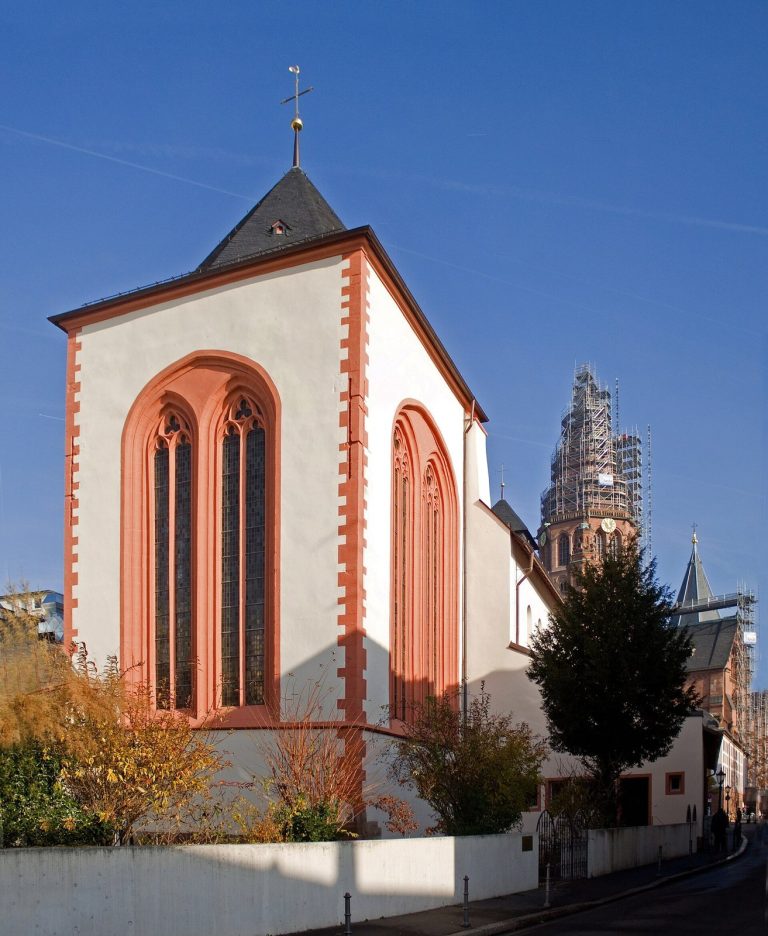
Antoniterkapelle is a Gothic chapel in Mainz, Germany, whose later medieval form was developed by the Antonites during the fourteenth century. An earlier chapel stood here around 1134, while construction of a chapel dedicated to Saint Anthony the Abbot began in 1330. Together with the Antonite House, it formed the complex known as the Antonihof, which became part of Mainz’s expansion of monasteries during the period when the city was a Free City.
Antonite foundation
The Antonites had been present in Mainz since 1324. In 1332, Mechtildis gave the chapel to Friar Nikolaus von Andernach, establishing the foundation that developed into the later monastery. Nikolaus died in 1333 and was buried in the church. The community cared for people suffering from what was then called Saint Anthony’s fire, an illness now identified as ergot poisoning. Its charitable work included a bathhouse at the Thönes or Thöngeshof.
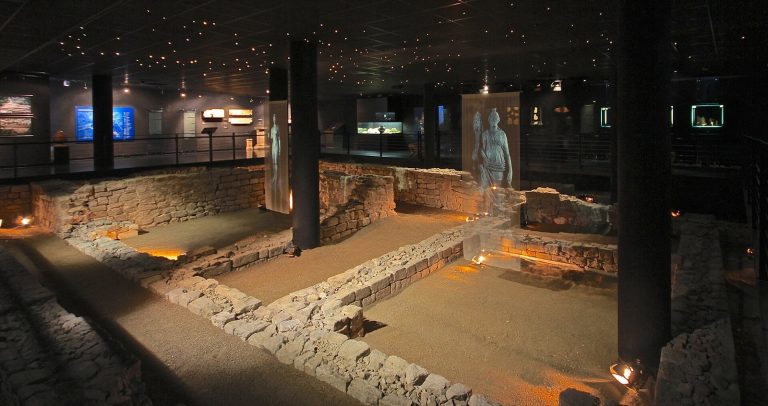
The complex occupied land at the edge of early medieval Mainz that had remained unused for a long period after the nearby sanctuary of Isis and Mater Magna ceased to serve its cult toward the end of the third century AD. The Antonihof therefore formed part of a later religious development in an area with a much older sacred history.
Suppression and changing uses
In 1528, the preceptor of the Antoniter House at Höchst transferred the monastery to Elector Albrecht of Brandenburg. The Antonihof was later closed because too few new members joined. Seven religious brothers expelled from the Cistercian monastery of Haina by the Landgrave of Hesse attempted to preserve the institution, but after Abbot Ditmar died, the remaining monks were assigned elsewhere.
From 1574, the former monastery became the official seat of the Walpoden, officials connected with justice and civic authority in Mainz. Elector Daniel Brendel von Homburg transferred the monastery buildings and church to them, and the church was used as a stable. From 1619, the complex housed Poor Clares, a contemplative women’s order founded by Saint Clare of Assisi within the Franciscan tradition. The Franciscan general Nikolaus Vigerius of Cologne sent four nuns from the Marientempel convent in Cologne. Elector Johann Schweikhard von Cronberg transferred the former Antonite monastery to them on the condition that they provide the Walpoden with other accommodation.
Charitable and religious continuity
The Poor Clares’ monastery was suppressed during the Napoleonic period. Between 1806 and 1903, a midwifery school and attached maternity institution continued the community’s charitable work. The complex later accommodated a post office, a savings bank, Mainz’s municipal building authority, and a medical station. It also contained a “Triller,” an early form of baby hatch for abandoned children.
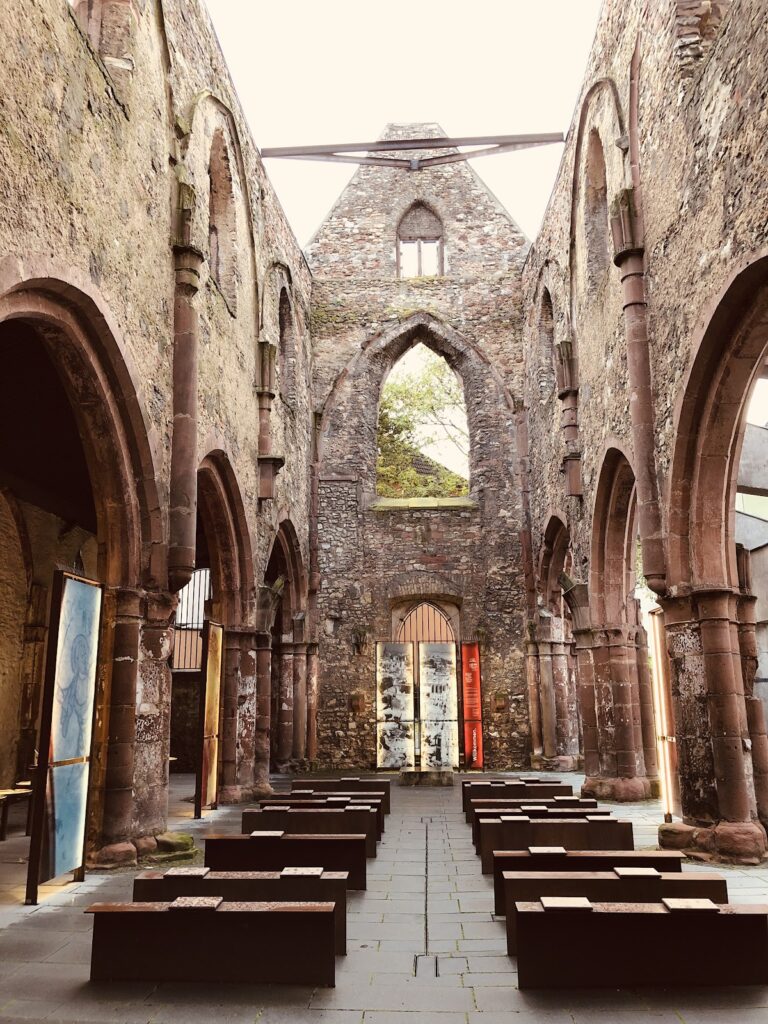
The chapel served Anglican worship for a period and became a place of Old Catholic worship from 1876. During the Second World War, the church burned out in 1942. It was restored in 1948 and then designated as the chapel of the Kolping House opposite. In 1952, the General Directorate for Cultural Affairs organized consolidation work on the Poor Clares’ church.
Today, the Diocese of Mainz uses the buildings as the seat of its Institute of Sacred Music. Portuguese-language Catholic worship takes place in the chapel almost every Sunday, and the building is also used for weddings.
Remains
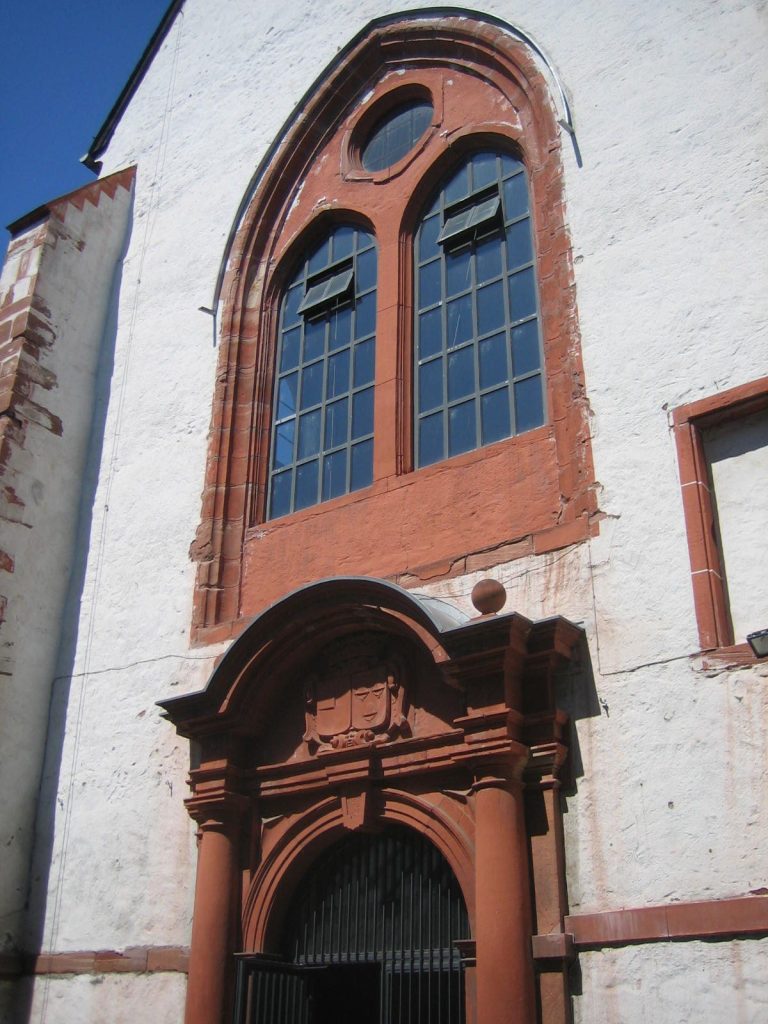
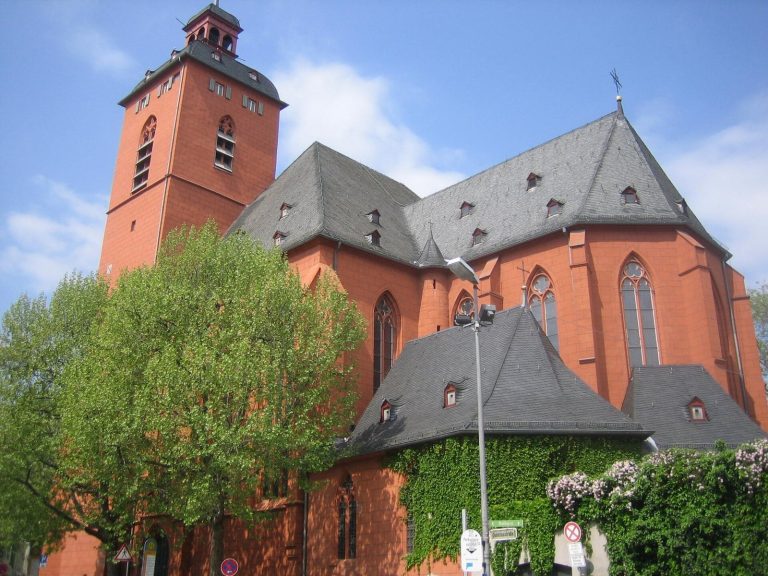
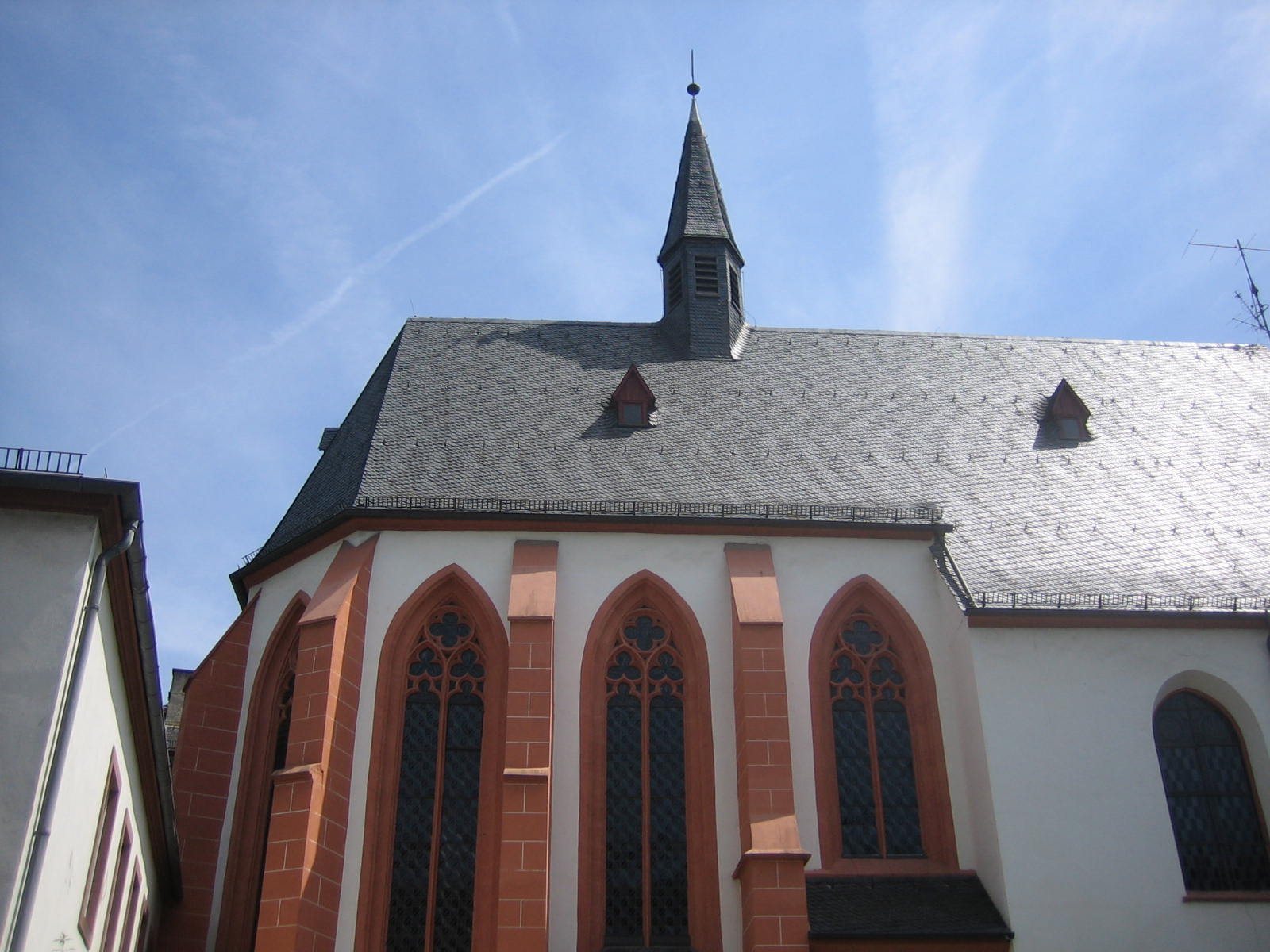
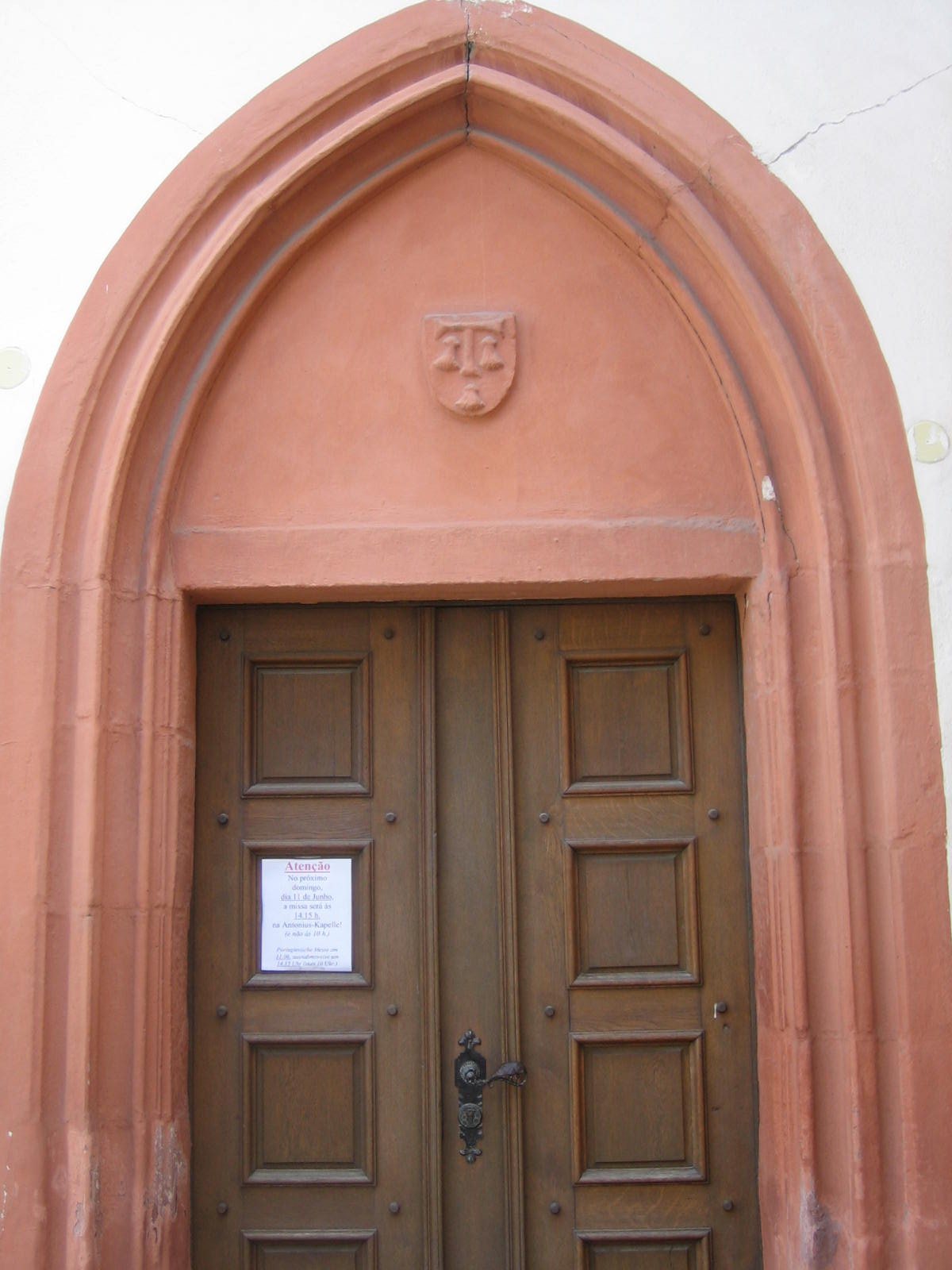
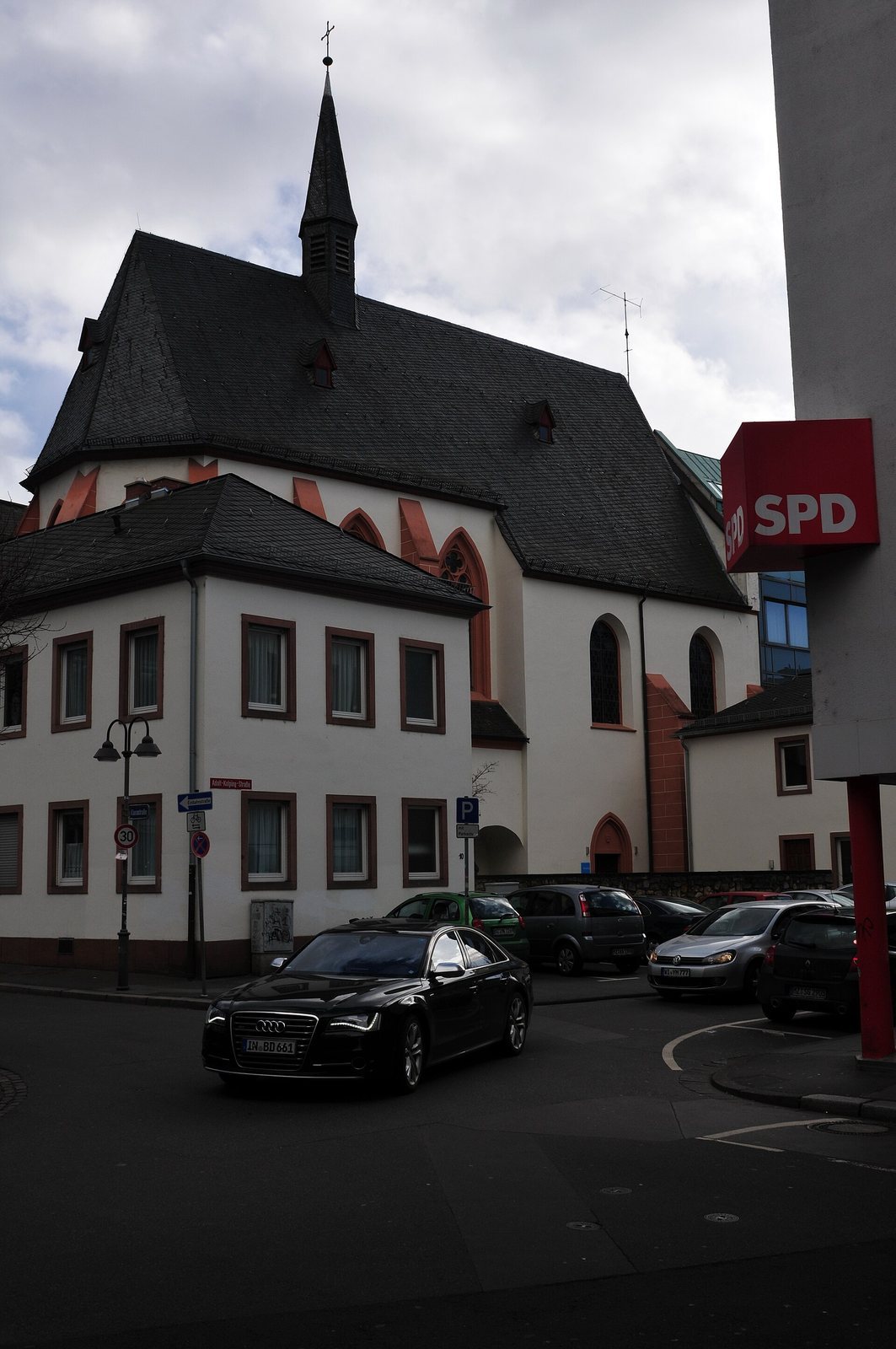
Antoniterkapelle is a Gothic church whose design reflects influences that reached Mainz from Cologne, Freiburg, and the Lahn region. The chapel consists of a nave joined to a two-bay choir, a structural division marked by the vaulting, which ends in a five-eighths apse, a polygonal termination formed from five sides of an approximately octagonal plan. The portal carries the T-shaped cross of the Antonite Order.
Chapel paintings and interior
Restored vault paintings show saints within drawn tracery frames. During the postwar restoration, figures from the chapel’s construction period were uncovered on the vaults and restored. The paintings form the only original surviving painted cycle in a medieval church in Mainz, giving the interior a distinctive place within the city’s medieval ecclesiastical remains.
Monastery buildings and setting
The former complex stood at the corner of Rosengasse and Klarastraße, with its long side along the former Armklaragasse. Rosengasse was once called Auf der Rose, a name derived from the Haus zur Jungfrauen in den Rosen at the corner of Pfandhausstraße; the street is now Adolph-Kolping-Straße. The area was previously known as Am Saukopf because pigsties stood there until the middle of the seventeenth century. Three pig heads carved above the main entrance of the neighboring Younger Dalberg Court recall that earlier local feature.
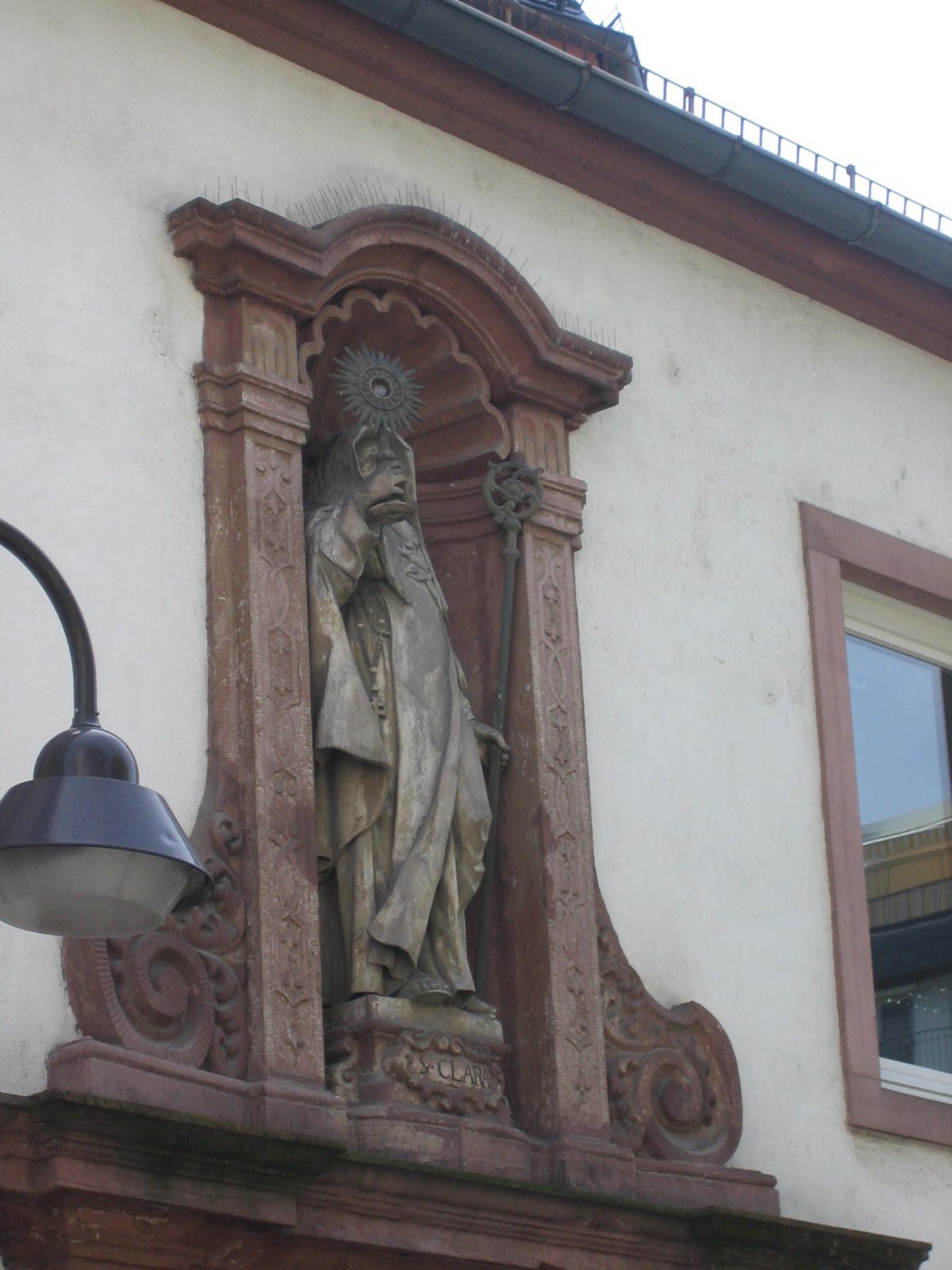
In 1700, the Poor Clares built a four-wing complex adjoining the church to the southwest. In 1726, they constructed the three-part monastery building on Klarastraße that still survives. They were also allowed to incorporate part of Töngesplatz, the space in front of the monastery, into the new construction. A statue of Saint Clare of Assisi stands at the entrance from Klarastraße.
Organ
The chapel contains a large organ built in 1972 by Paul Ott of Göttingen. Its 34 stops are arranged on slider chests, systems in which sliding boards control the flow of wind to individual stops. The instrument has three manuals and a pedal, mechanical key action, electrically operated stop action, and couplers numbered I/II, III/II, I/P, II/P, and III/P. A 256-combination setter system is also installed. The Oberlinger and Rainer Müller organ-building firms have carried out maintenance.