Deutschhaus Mainz: Baroque Palace and Seat of the Rhineland-Palatinate Landtag

Site at a Glance
- Rating
- 4.5
- Popularity
- Very Low
- Country
- Germany
- Primary era
- Early Modern
- External website
- Open
- Eras represented
- Early Modern, Modern
- Civilizations
- German, Holy Roman Empire
- Site type
- Civic
- Remains
- Palace
On this page10 sections
History
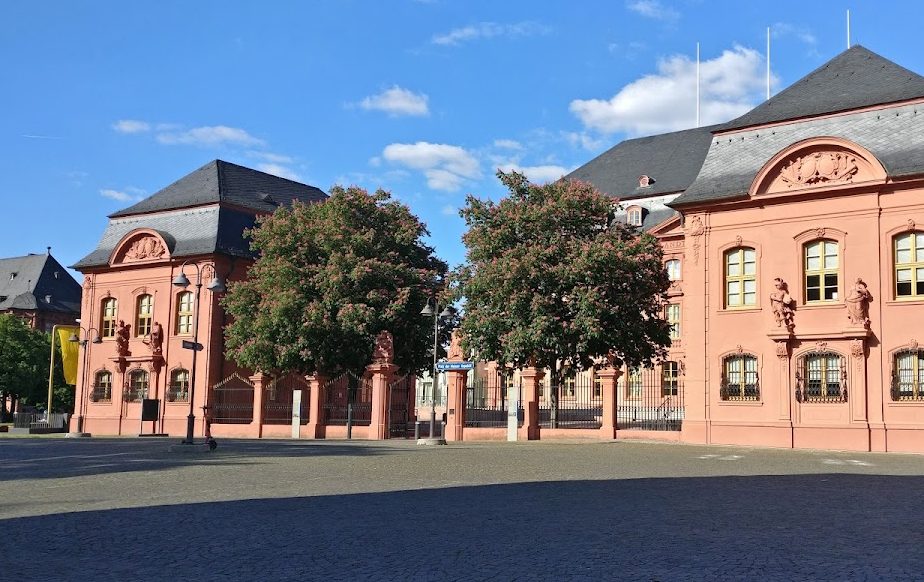
Deutschhaus Mainz is a Baroque palace in Mainz, Germany, built by the Electorate of Mainz between 1730 and 1737 under Anselm Franz von Ritter zu Groenesteyn. Designed in a French-influenced Baroque style, it was constructed as a commandery of the Teutonic Order and as a planned second residence for Franz Ludwig of Palatinate-Neuburg, Elector and Archbishop of Mainz and Grand Master of the Teutonic Order.
Construction for Franz Ludwig
The foundation stone was laid in 1730, and the building was completed in 1737. Its position near the Electoral Palace, Franz Ludwig’s principal residence, allowed it to support the public representation of his responsibilities as Grand Master. The Teutonic Order was a medieval religious and military order, and its Grand Master was its highest-ranking leader. Franz Ludwig died in 1732, before construction ended, so he never used the Deutschhaus as a residence, and no later Grand Master occupied it for that purpose.
The palace was designed and built by Anselm Franz von Ritter zu Groenesteyn, an architect and senior building official of the Electorate of Mainz. Christoph Thomas Scheffler painted frescoes, the Castelli family of Würzburg produced stucco work, and the Mainz court sculptor Burkard Zamels contributed sculpture. Their work made the Deutschhaus one of the most lavish secular buildings in the Electorate of Mainz.
Revolutionary and French rule
French military authorities occupied the building after Mainz was captured in July 1792. During the French occupation and the short-lived Mainz Republic, the Deutschhaus housed the Rhenish-German National Convention. This body served as the parliament of the French-occupied territories on the left bank of the Rhine. It first met in the palace on 17 March 1793, and the territory between Landau and Bingen, including Mainz, was declared an independent state based on liberty and equality. The Rhenish-German Free State was proclaimed from the building’s balcony.
After the French capitulation at the end of the siege of Mainz on 23 July 1793, Archduke Charles, Duke of Teschen, used the palace until the territory was returned to France under the Treaty of Campo Formio. The Deutschhaus then became the administrative seat of the French department of Mont-Tonnerre. Napoleon Bonaparte used it as a palace and secondary residence during his stays in Mainz between 1798 and 1814. He planned to double its size and turn it into an imperial residence, reflecting his intention that Mainz should become one of the major cities of the French Empire, but the enlargement was never completed.
From the nineteenth century to parliamentary use
After the Napoleonic Wars, the reorganization established by the Congress of Vienna placed Mainz in the Grand Duchy of Hesse-Darmstadt. The Deutschhaus became a secondary residence of the Hessian grand duke. Members of the Hessian-Darmstadt dynasty received Queen Victoria there in 1845, and Kaiser Wilhelm II visited between 1900 and 1914. In 1870, during the early stages of the Franco-Prussian War, the building served as the headquarters of the Prussian army.
From October 1919 until the French withdrawal from the Rhineland on 30 June 1930, the palace was the residence of Jean-Marie Degoutte, commander-in-chief of the French Army of the Rhine, and his successor Adolphe Guillaumat. Bombing during the Second World War severely damaged the building, especially in the air raid of 27 February 1945, which left only the exterior walls standing.
When the Rhineland-Palatinate Landtag decided in 1950 to move from Koblenz to Mainz, the exterior walls were reconstructed and the interior was adapted for parliamentary work. The rebuilt building was completed in 1951, and the newly elected Landtag held its constitutive session there on 18 May of that year. The Landtag is the elected parliament of a German federal state, and Rhineland-Palatinate is one of Germany’s sixteen states. Since 1951, the Deutschhaus has served as the parliament’s plenary building.
The palace’s limited office space led to the construction of a separate parliamentary office building in 1999. A renovation begun in late 2015 required the administration to move temporarily to the former Mainz prison, while sessions took place at venues including Mainz Town Hall, the neighboring Rheingoldhalle, and the stone hall of the Mainz State Museum. The Landtag’s return to the renovated Deutschhaus was celebrated on 8 September 2021. In 2013, the square in front of the building was renamed Platz der Mainzer Republik on the 220th anniversary of the Mainz Republic.
Remains
Palace complex and surviving fabric
The Deutschhaus stands on the Rhine side of Mainz’s historic center, between the Electoral Palace and the arsenal. Its Baroque complex consists of a main building and two pavilions arranged around a central courtyard. The exterior walls were reconstructed after the destruction of 1945, while the interior was rebuilt for parliamentary use rather than restored as the original princely residence. The present building therefore combines the surviving and reconstructed outer form of the 18th-century palace with a modern institutional interior.
Interior and artistic elements
Chapel
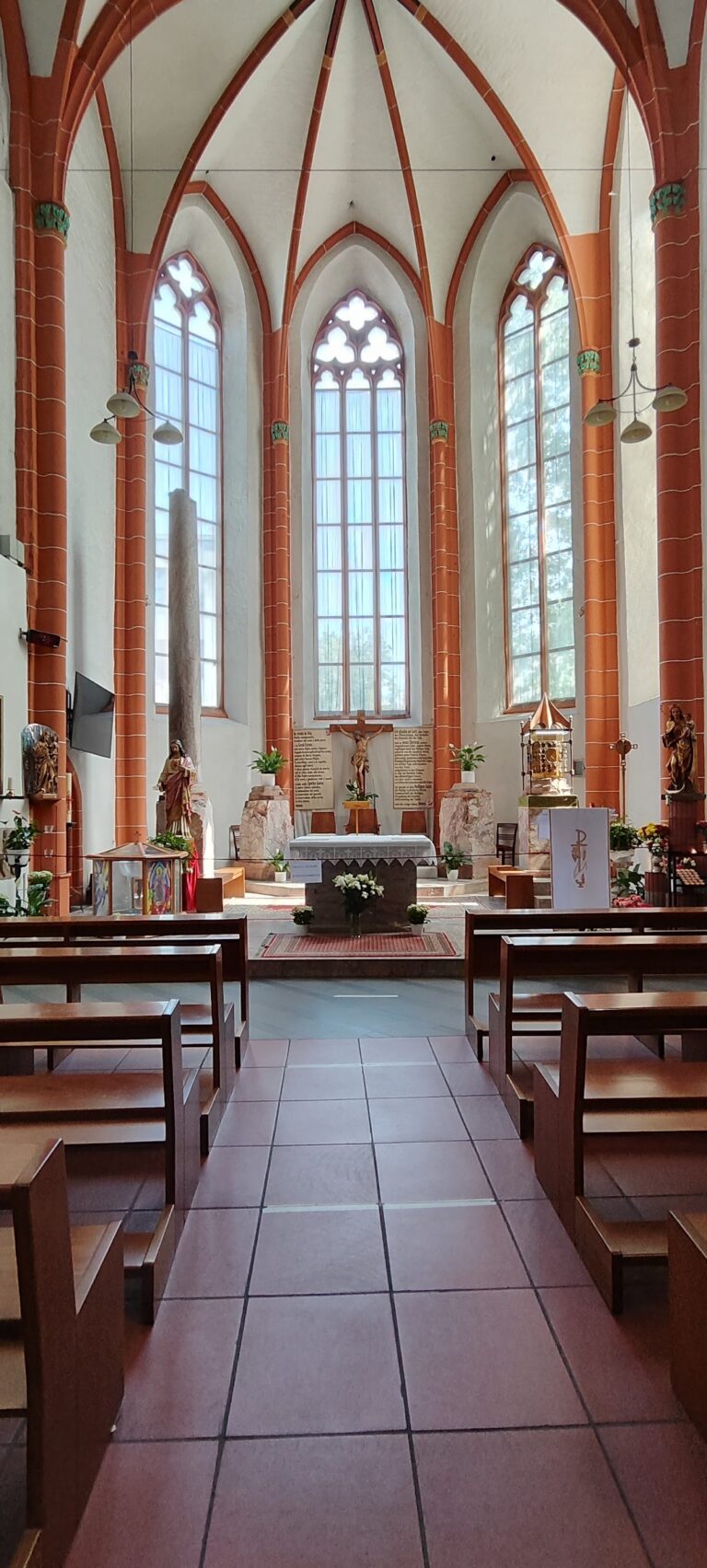
One of the pavilions contained a chapel decorated with frescoes by Christoph Thomas Scheffler. The chapel formed part of the palace’s original religious and representational design, alongside the stucco work of the Castelli family and sculpture by Burkard Zamels.
Plenary hall
The rebuilt interior contains the plenary hall of the Rhineland-Palatinate Landtag. An original black-red-gold flag carried publicly at the Hambach Festival of 1832 is preserved in the hall, linking the parliamentary interior with the political history of nineteenth-century Germany.
Adjacent structures and the palace square
The New Arsenal adjoins the Deutschhaus directly to the southeast and houses the State Chancellery of Rhineland-Palatinate. In the square before the palace stands a replica of the Mainz Great Jupiter Column. The original column, discovered in 1904, is preserved in the Mainz State Museum.
Nearby sites