Amelia Cathedral: A Historic Roman Catholic Co-Cathedral in Italy


Site at a Glance
- Rating
- 4.6
- Popularity
- Low
- Country
- Italy
- Primary era
- Early Modern
- Eras represented
- Medieval, Early Modern, Modern
- Civilizations
- Papal States
- Site type
- Religious
- Remains
- Cathedral
On this page8 sections
History
Amelia Cathedral is a Roman Catholic cathedral in Amelia, Italy, dedicated to Saint Firmina. Its original building was constructed in 872, while the bishopric of Amelia is documented from no later than the fifth century. Destroyed and rebuilt several times, the cathedral reflects medieval, Baroque, and Neoclassical phases in the history of the town.
Medieval origins and Gothic rebuilding
The cathedral served as the seat of the Bishop of Amelia, a church office associated with the city since late antiquity. Emperor Frederick II’s troops destroyed the original cathedral in the thirteenth century. The building was then reconstructed in the Gothic style, establishing the basis for a later series of major alterations.
Fire, earthquake, and later reconstruction
A fire in 1629 almost completely destroyed the cathedral. Its rebuilding gave the interior a Baroque form, a style known for dramatic shapes and rich ornament. Another destructive event followed in 1822, when an earthquake damaged the building. The present facade was completed during the nineteenth century in the Neoclassical style, which draws on the symmetry and architectural vocabulary of ancient Greece and Rome.
Diocesan change and continued religious use
Amelia Cathedral became a co-cathedral of the Diocese of Terni-Narni-Amelia in 1983. A co-cathedral shares the seat of a diocese with another cathedral following an institutional reorganization. The last Bishop of Amelia was Monsignor Vincenzo Lojali, who died on 14 March 1966.
The cathedral preserves the relics of Saints Firmina and Olimpiade, the patron saints of Amelia and objects of local Christian devotion. Its side chapel also holds two Turkish banners believed to have been captured during the Battle of Lepanto in 1571, a major naval conflict between the Ottoman fleet and the Christian Holy League.
Later conservation has included the return of Federico Zuccari’s altarpiece in 1990. The Farrattini family had removed the painting in 1881, and the Cassa di Risparmio di Terni e Narni subsequently repurchased it before its return to the cathedral.
Remains
The cathedral stands at the summit of the hill occupied by Amelia’s historic center. Its Latin-cross plan has a long nave crossed by a shorter transept, while the deep apsidal presbytery forms the sanctuary at the eastern end. A single nave is covered by a frescoed barrel vault and opens onto five chapels on each side.
Facade and bell tower
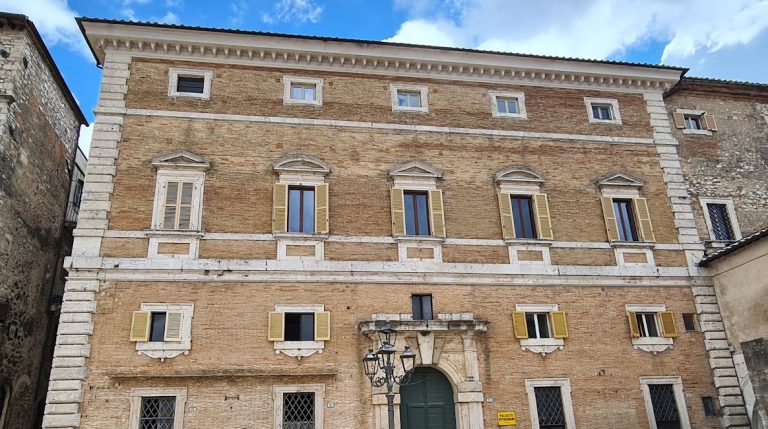
The present facade is built of pink terracotta and follows Neoclassical principles. A central portal with a marble triangular pediment is topped by a large lunette window and a cornice. Above these elements, a triangular pediment is visually supported by two pairs of Corinthian pilasters.
An eleventh-century bell tower stands to the left of the facade. Built in 1050, it has a dodecagonal plan and incorporates fragments from Roman buildings. The tower is notable for its roofless form.
Farrattini chapel and artworks
The second chapel on the right is the Farrattini family chapel. Its ante-chapel contains two war trophies, identified as banners believed to have been taken from the Turks at Lepanto in 1571. Behind the altar is Madonna and Child with Saints, an altarpiece commissioned by Baldo Farrattini. He first assigned the work to Taddeo Zuccari before it passed to his brother Federico Zuccari. The painting dates from the 1560s and returned to the cathedral in 1990.
The chapel contains the funerary monuments of Bartolomeo II and Baldo Farrattini, made respectively by Giovanni Antonio Dosio and Ippolito Scalza. Baldo Farrattini served as Bishop of Amelia from 1558 to 1562. Other works in the cathedral include Giovanni Francesco Perini’s Last Supper of 1538, Agostino di Duccio’s Geraldini Tomb of 1476, a Madonna and Child attributed to Antoniazzo Romano, works by Niccolò Circignani and Federico or Taddeo Zuccari, and a modern copy of Lavinia Fontana’s stolen Martyrdom of Saint Firmina.
Historic organs
The main pipe organ is mounted above the choir loft on the right wall of the presbytery. Built in 1904 by the Austrian firm Rieger Orgelbau to a design by Filippo Capocci, it reuses the case of an earlier eighteenth-century organ. Originally operated pneumatically, it was electrified in 1973 by Leandro Buccolini, who moved the console from the choir loft to the presbytery.
Angelo Carbonetti restored the main organ in 1998, and Pietro Corna of Bergamo restored it again in 2014. The later work added new mutations, a mixture stop to the swell organ, and reed stops to both manuals and the pedal. The registers were reconstructed according to the measurements and alloys used by Rieger in 1904. The instrument has electric transmission, two 56-note manuals, and a straight 30-note pedalboard.
The cathedral also contains a historic winged positive organ built in 1927 by Giulio Geraldini and restored several times. It has direct mechanical transmission, one 45-note manual with a short first octave, and no pedalboard. A further organ dates from 1600.