Brugnato Cathedral: A Co-cathedral and Former Episcopal Seat in Italy


Site at a Glance
- Rating
- 4.1
- Popularity
- Very Low
- Country
- Italy
- Primary era
- Medieval
- Eras represented
- Medieval, Modern
- Civilizations
- Holy Roman Empire, Italian, Lombard
- Site type
- Religious
- Remains
- Cathedral
On this page12 sections
History
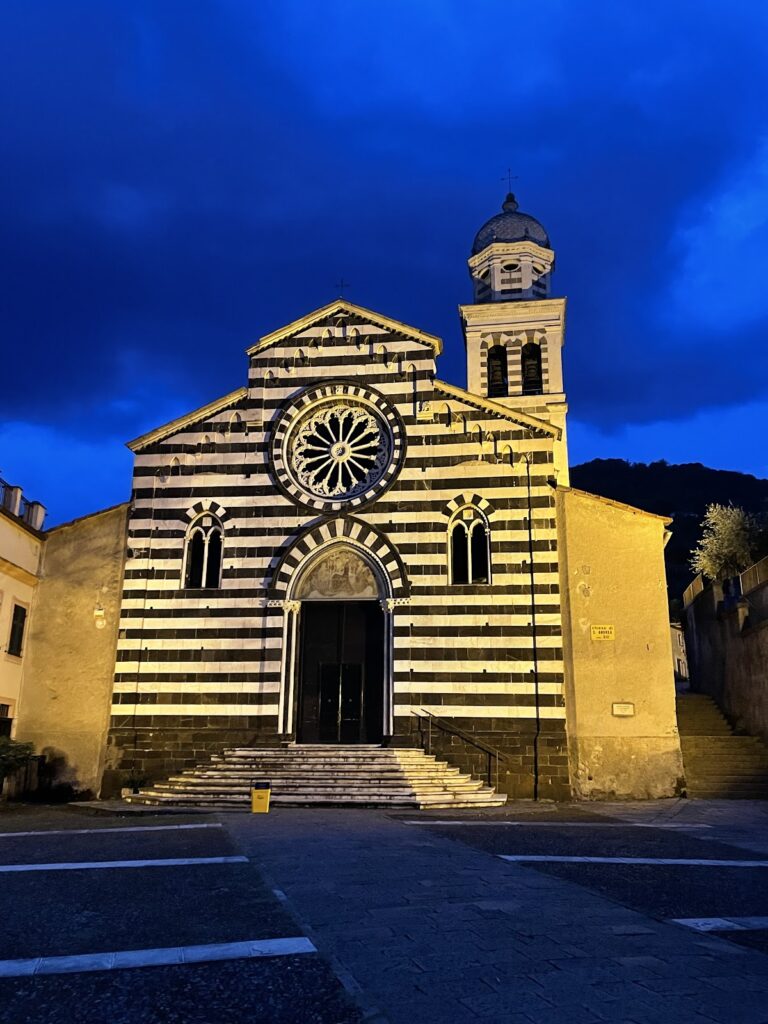
Brugnato Cathedral, formally the Co-cathedral of Saints Peter, Laurence, and Columbanus, is a Roman Catholic church in Brugnato, Italy. Rebuilt during the eleventh and twelfth centuries in the Romanesque period, it developed from a monastic church associated with Bobbio Abbey and later became the episcopal centre of the Diocese of Brugnato.
Early monastic foundation
Evidence in the foundations supports the possibility that a first church stood here in the seventh century over an early Christian burial ground. It belonged to a monastery dependent on Bobbio Abbey, a northern Italian foundation established by Saint Columbanus, the Irish missionary and monastic founder whose communities spread through parts of Europe. The monastery was dedicated to him.
During the eleventh and twelfth centuries, the church was rebuilt and passed to a resident Benedictine community. Benedictines followed the monastic tradition associated with the Rule of Saint Benedict. In 1133, Brugnato became the seat of a diocese under the Archdiocese of Genoa, with spiritual authority over the middle and upper Val di Vara.
Medieval decline and ecclesiastical change
In the fourteenth century, the rise of the Ghibellines, supporters of the imperial position in Italy’s medieval conflicts between imperial and papal factions, led the bishop to flee to Pontremoli. The cathedral consequently lost importance as an episcopal centre, although it continued to serve as the abbey church of the Benedictine community.
In 1820, the Diocese of Brugnato was merged with the dioceses of La Spezia and Sarzana-Luni into a single diocese based at La Spezia. The former abbey church retained cathedral status as a co-cathedral, a church that shares this status within a diocese with another cathedral.
Rediscovery and continuing religious role
Restoration work during the 1950s brought remains of the original Romanesque church back to light. Archaeological excavations carried out in 1994 by Ligurian archaeological authorities examined the earlier structures beneath the present building. In 2009, the cathedral hosted an international meeting of communities associated with Saint Columbanus.
Remains
The cathedral has an asymmetrical plan formed by two parallel naves divided by massive stone columns. This arrangement is common in the religious architecture of Lunigiana but less usual in Liguria. The columns carry thick, round-headed arcades, while the restrained interior preserves sculptural traces and fragments from the earlier church alongside later furnishings and paintings.
Structure and archaeological remains
Two-nave plan
The larger nave is covered by a barrel vault, a continuous semicircular vault, and ends in a semicircular apse. Three single-light windows pierce the apse, each with deeply splayed reveals. The smaller right-hand, southern nave is divided into groin-vaulted bays, formed where two vaults intersect. Its interior ends at a straight wall that conceals the curved apse visible on the exterior.
Earlier church beneath the nave
Excavation beneath the central nave revealed the ancient perimeter walls, terracotta flooring, and a baptismal font. These remains belong to the earlier phases of the church and help define the archaeological fabric preserved below the present building.
Paintings and liturgical furnishings
Frescoes
A medieval fresco on the second column on the right-hand, southern side shows Saint Columbanus giving a blessing. Another fresco, uncovered during the 1994 restoration works, occupies the wall of the smaller nave. It represents the Presentation in the Temple and includes Jesus, Joseph, Mary, the high priest, Saint Francis of Assisi, and Saint Laurence.
Apse artworks and altar
A polyptych, a multi-panel painted or carved artwork, depicting scenes from the Passion is preserved on the apse wall of the right-hand nave near the high altar. The high altar is a Baroque work in coloured marble. Nearby, a painting by Vincenzo Comaschi dated 1821 shows the Virgin Mary holding the Infant Jesus, surrounded by angels and Saints Francis and Laurence.
Later architectural addition
The rose window was created in 2007 by the artist Barbara Ferabecoli, adding a modern element to the cathedral’s medieval and early-modern fabric.