Amarna Tomb 1: The Tomb of Huya at Akhetaten
Site at a Glance
- Popularity
- Medium
- Country
- Egypt
- Primary era
- Bronze Age
- Eras represented
- Bronze Age
- Civilizations
- Egyptian
- Site type
- Burial
- Remains
- Tomb
On this page13 sections
History
Amarna Tomb 1, also known as TA1 and EA1, is an ancient Egyptian tomb dating to the 14th century BCE, located in the Northern Tombs near Amarna, Egypt. It belonged to Huya, a noble who served at Akhetaten, the capital founded by Akhenaten, an 18th-Dynasty pharaoh. The tomb’s position and decoration suggest that work on it began relatively late among the Northern Tombs.
Huya held several offices in the household of Queen Tiye, Akhenaten’s mother. These included chief of the royal harem, treasurer, administrator of the royal household, and attendant to the Great Royal Wife, the pharaoh’s principal wife. He was also praised as a favorite of the ruler and served as standard-bearer, carrying a troop’s identifying emblem, for a group of young fighters called Aten Appears for Him. His tomb at Akhetaten suggests that he lived in the city during his career.
The tomb’s scenes provide evidence for royal life at Amarna. They show Tiye at the city and depict a public reception of foreign tribute in Akhenaten’s 12th regnal year. A scene in the nearby tomb of Meryre II bears a date of year 12, month 6, day 8. The appearance of Tiye and the tribute reception may be connected, but the suggestion that the event honored her or reflected her moderating political influence remains conjectural. Another image shows Amenhotep III, Tiye’s husband and a pharaoh who ruled before Akhenaten, with Tiye and their daughter Baketaten. It does not establish that Amenhotep III was still alive when the scene was made, and it cannot by itself prove a co-regency, a period of joint rule by two monarchs.
Akhetaten was abandoned about 30 years after its foundation, and the tombs were abandoned as well. Coptic monks, members of Egypt’s Christian tradition, later reused some of them as hermitages. Abandonment and subsequent human use damaged the tomb structures, painted scenes, and reliefs.
Remains
Plan and entrance
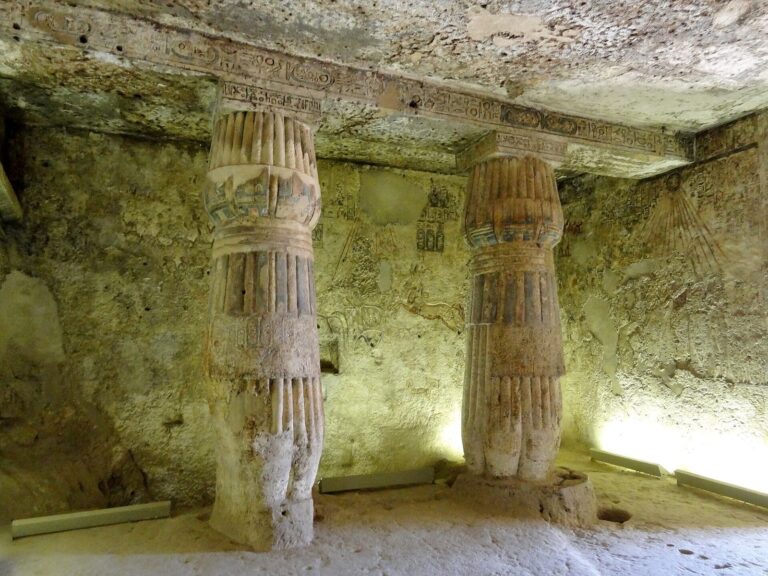
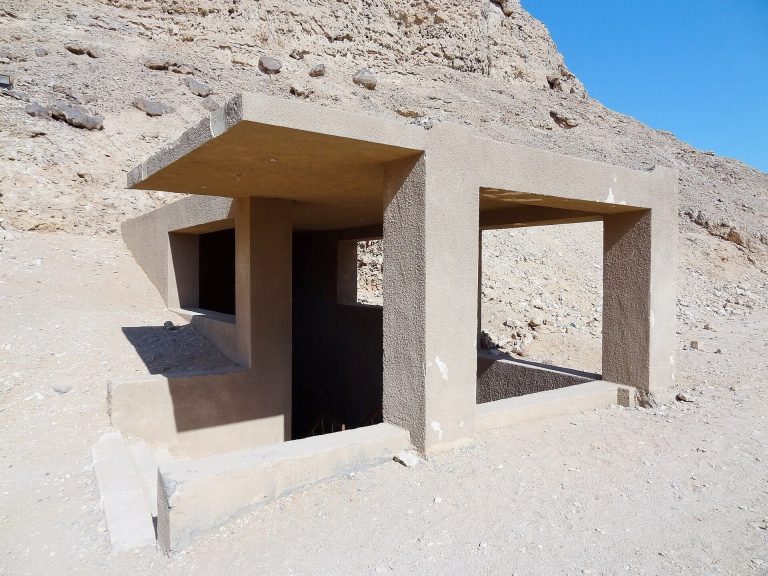
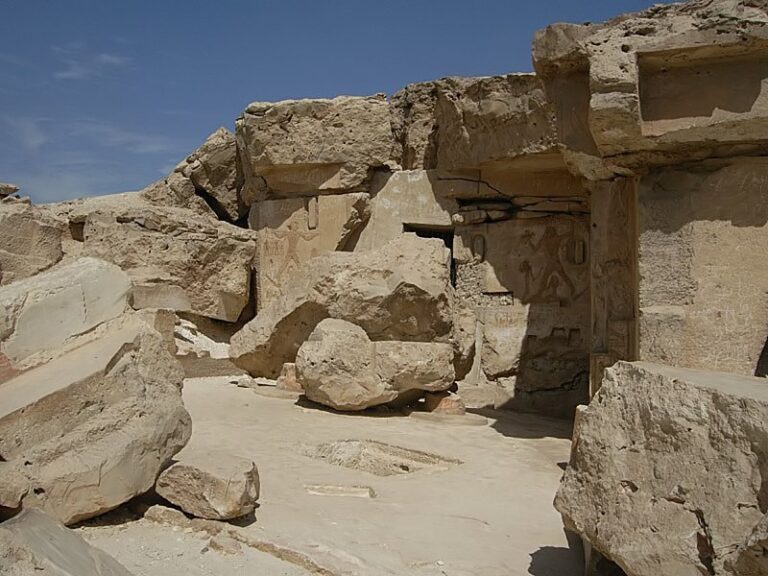
The tomb runs west to east. A short entrance corridor opens into a rectangular outer hall, which leads through another passage to an unfinished inner hall and the sanctuary. An entrance at the eastern end gives access to the burial chamber. The tomb is the northernmost of six tombs situated north of the wadi containing the royal tomb. Its façade is severely damaged. At the outer hall entrance, figures of Huya in pleated clothing are shown praying, accompanied by hymns to Aten, the sun-disk deity. Inside the outer hall, a surviving column is shaped as a bundle of eight papyrus stems. Fragments of painted ceiling remain, and much of the wall decoration consists of painted scenes on plaster.
Painted scenes in the outer hall
Banquets and harvest scenes
Two banquet scenes on the south wall show members of the royal family and their attendants. In one, Akhenaten and Nefertiti sit opposite Tiye, who wears a headdress with two plumes and a horned sun disk. Meritaten and another princess, possibly Neferneferuaten Tasherit, sit beside Nefertiti; Baketaten is beside Tiye. Akhenaten eats meat from a bone, while Nefertiti eats a whole bird. A narrower scene below includes servants, possibly tasting food, and musicians: five girls and foreign men playing a large standing lyre. A damaged strip along the wall’s base shows harvest activity.
In the second banquet, Tiye sits with Baketaten beside her, while Akhenaten and Nefertiti drink from cups. Ankhesenpaaten stands on a footstool before Nefertiti, and another princess, possibly Meketaten, appears nearby. Huya oversees the service. Fan-bearers and musicians occupy the lower part of the scene.
Tiye’s temple procession
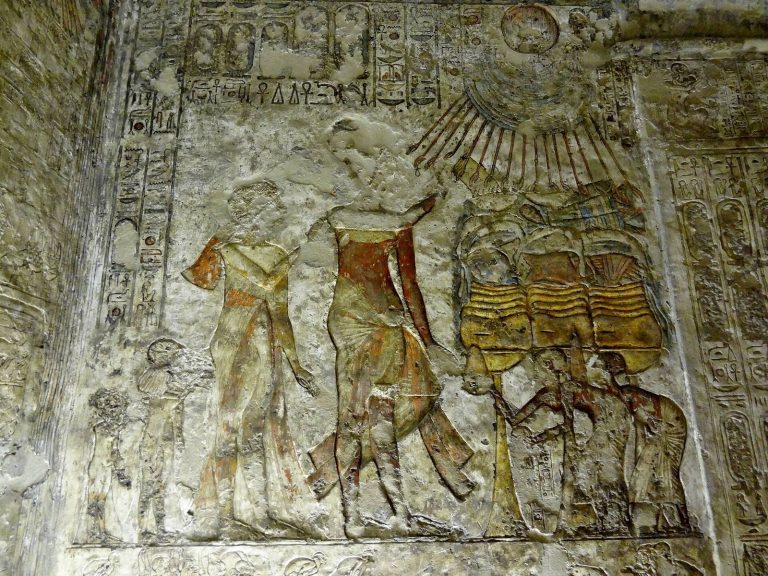
On the east wall, Akhenaten leads Tiye toward a small temple or altar associated with her, with Baketaten accompanying them. Akhenaten and Tiye hold hands beneath the sun’s rays, while Huya bows before the king. The scene includes attendants, offerings, columns around the altar, and statues of Akhenaten and Nefertiti. At the bottom, river scenes show birds being hunted on one side and fishing on the other. Faint drawings around the altar were made by ancient Greek visitors.
Royal rewards and palace work
A scene shows Akhenaten and Nefertiti rewarding Huya from the Window of Appearances, a palace window from which the king appeared publicly, including to grant rewards. Meritaten and Meketaten stand to the right. A damaged image below shows Huya overseeing palace artisans making jewelry, metal vessels, and chests. In a smaller scene, the sculptor Iuti-Iuti works on a statue of Baketaten.
Text in another scene describes the king appointing Huya to his principal offices, apparently confirming positions he already held. A related image shows Huya supervising the weighing and recording of valuables, including a gold necklace. The work takes place in a courtyard surrounded by storehouses and shaded by a continuous covered colonnade.
Procession and foreign tribute
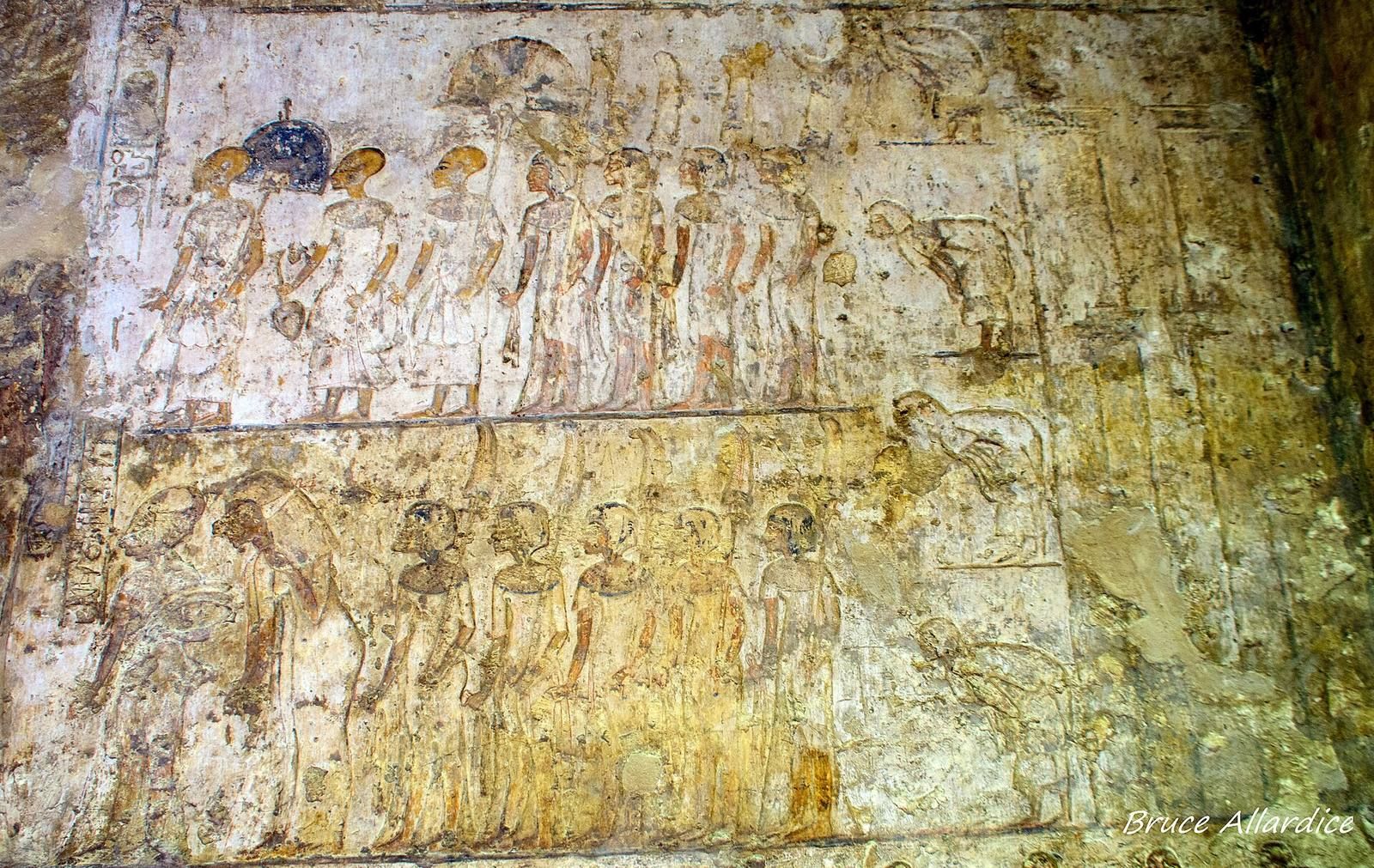
A large west-wall scene depicts the royal procession to the tribute reception. Akhenaten and Nefertiti ride in palanquins, seats carried by bearers, with lion figures at their sides and sphinx-shaped arms on their thrones. Fan- and parasol-bearers accompany them. Their daughters Meritaten, Meketaten, and Ankhesenpaaten follow on foot with attendants; a hieroglyphic label identifies Huya among the people in the procession. Desert warriors appear, and one burns incense before the royal seats. Three dancers, three empty chariots, and gifts from foreign lands complete the scene.
The tribute is arranged in horizontal bands distinguishing offerings from Syria-Palestine and Kush, an ancient kingdom in Nubia south of Egypt. The Syria-Palestine offerings include two chariots carried by men, pillow-shaped metal ingots, ornate gold vessels, and rows of metal vessels displayed on stands. Eight short rows show prisoners or hostages who appear to be Syrian. Comparable scenes at Thebes have been interpreted as depicting sons of city-state rulers.
The Kushite offerings include enslaved people wearing wooden restraints on their wrists, men carrying paired yokes with hides, hanging gold rings, and two gold cups. Other bearers bring a panther, monkeys, and elephant tusks. Additional bands show ivory and chairs that may be made of ebony. A damaged scene below depicts Huya being congratulated at home, with part of a group of female musicians also preserved.
The reception takes place in an open pavilion reached by steps on both sides. The king and queen sit there to inspect the gifts. Three altars stand nearby; the largest is enclosed by a wall and contains an offering table. Small images of offering-filled storehouses appear above and below the main scene. A damaged agricultural strip includes a hoopoe in a tree, a hoe, and a ship’s sail.
Inner chamber and sanctuary
Royal figures at the doorway
The lintel above the inner-chamber entrance presents two royal households. On one side, Akhenaten and Nefertiti sit with Meritaten, Meketaten, Ankhesenpaaten, and Neferneferuaten Tasherit, each holding a wand shaped like a plume. On the other, Amenhotep III sits opposite Tiye with Baketaten; three female attendants stand behind the queen. The doorway frame bears the names of Amenhotep III, Tiye, Akhenaten, and Nefertiti.
Sanctuary entrance
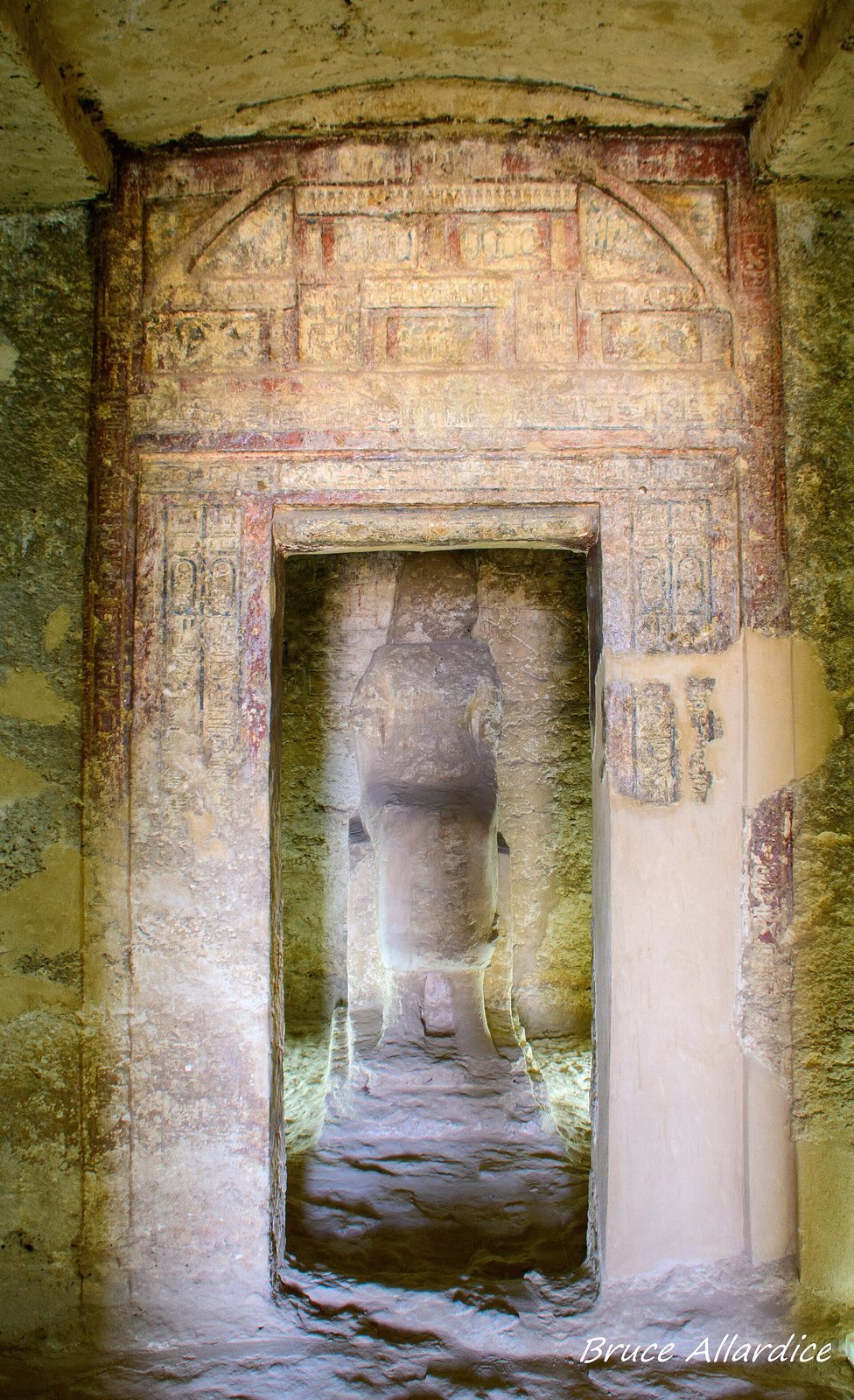
Huya’s sanctuary is one of two decorated sanctuaries in the Northern Tombs. Its doorframe carries blue-painted vertical bands of hieroglyphs on a wine-colored background, perhaps intended to imitate granite. The prayers name Akhenaten, Nefertiti, Tiye, and Aten. The carved and painted design above follows a traditional pattern for important doorways, while rows of cobras bearing sun disks introduce a different motif. Large images of Huya flank the entrance and face inward, accompanied by prayers for offerings. Just inside, two kneeling women, identified as Huya’s sister and wife, worship.
Funeral scenes
The sanctuary’s east wall shows Huya’s funeral. His mummified body stands upright, with four mourning women behind it. Offerings, a priest, lines of male mourners, and sacrificial oxen complete the scene. Mourners and the funeral procession also occupy the west wall.
Furnishings and statue
Images of funerary furnishings are carved into spaces around Huya’s statue. One side shows a chariot, chests, and a canopic jar, a vessel for an organ removed during mummification. The other depicts a bed, two chairs with pairs of sandals hanging on poles, two chests, and two folding stools. Huya’s seated statue is cut from the rock and is badly mutilated.