Mastaba of Mereruka: A Sixth-Dynasty Family Tomb at Saqqara
Site at a Glance
- Popularity
- Medium
- Country
- Egypt
- Primary era
- Bronze Age
- Eras represented
- Bronze Age
- Civilizations
- Egyptian
- Site type
- Burial
- Remains
- Tomb
On this page9 sections
History
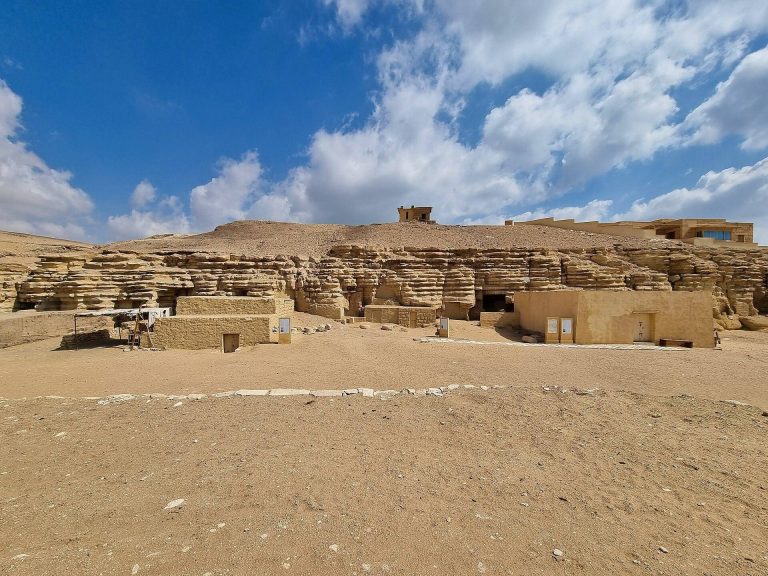
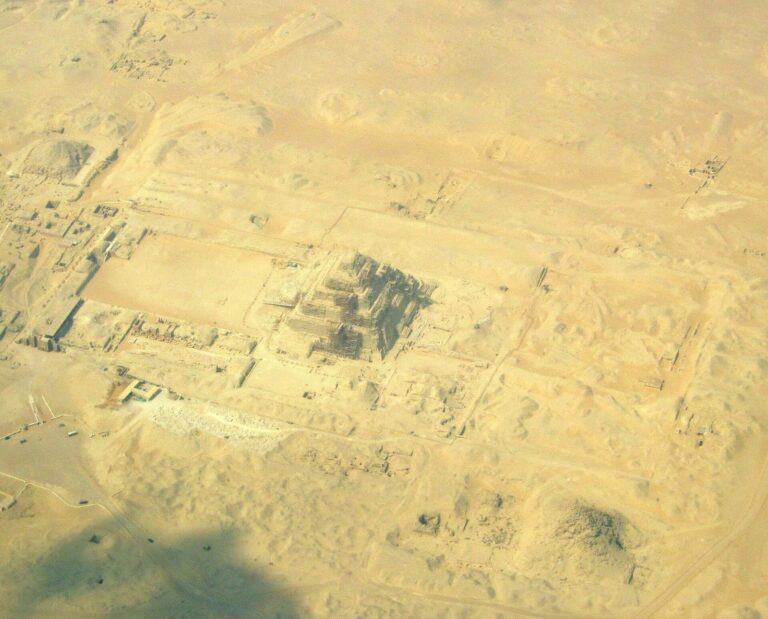
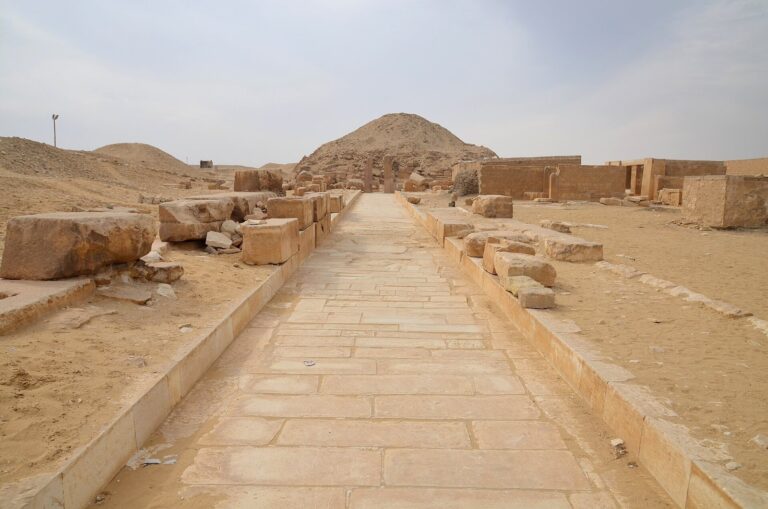
The Mastaba of Mereruka is a family tomb at Saqqara, Egypt, dating to the Sixth Dynasty of the Old Kingdom, an early period of Egyptian history. A mastaba is a rectangular tomb with a flat roof and sloping sides. The tomb belonged to Mereruka, a vizier, or senior official serving the king, under Pharaoh Teti.
Teti sought alliances with powerful nobles and granted privileges to officials loyal to him. He married his eldest daughter, Sesheshet Waatetkhethor, to Mereruka, who already held the vizier’s office. Mereruka also served as chief priest of Teti’s pyramid, governor of the palace, and overseer of the royal records’ scribes. His standing and wealth enabled him to provide a large tomb for his family, including burial spaces for his wife and their son, Meriteti.
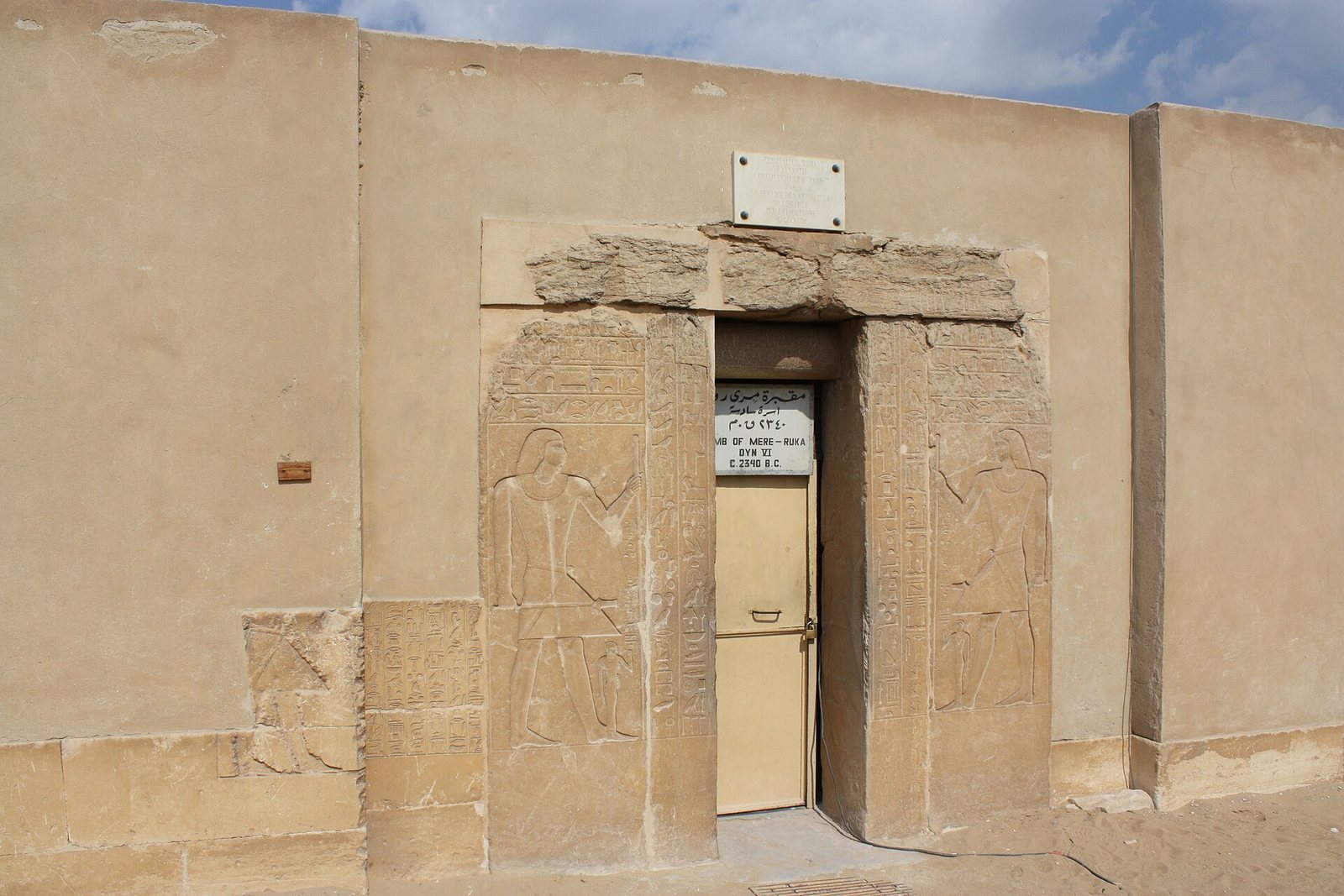
French archaeologist Jacques de Morgan discovered the tomb in 1893. Its complex arrangement has prompted the suggestion that it was designed to evoke Mereruka’s residence, with areas for the head of the household, his wife, and their children. The tomb is regarded as one of Saqqara’s best-preserved examples, alongside the mastaba of Ti, and as a highly developed form of tomb built for an Old Kingdom courtier.
Remains
The tomb measures about 23 by 41 metres and rises 4.5 metres high. Its 32 rooms form three groups arranged west and north of a sequence of rooms leading to a large hall; 16 rooms have decoration. The layout combines an entrance and corridors with family chambers, a courtyard, and a pillared offering hall.
Entrance and family chambers
Vestibule and corridors
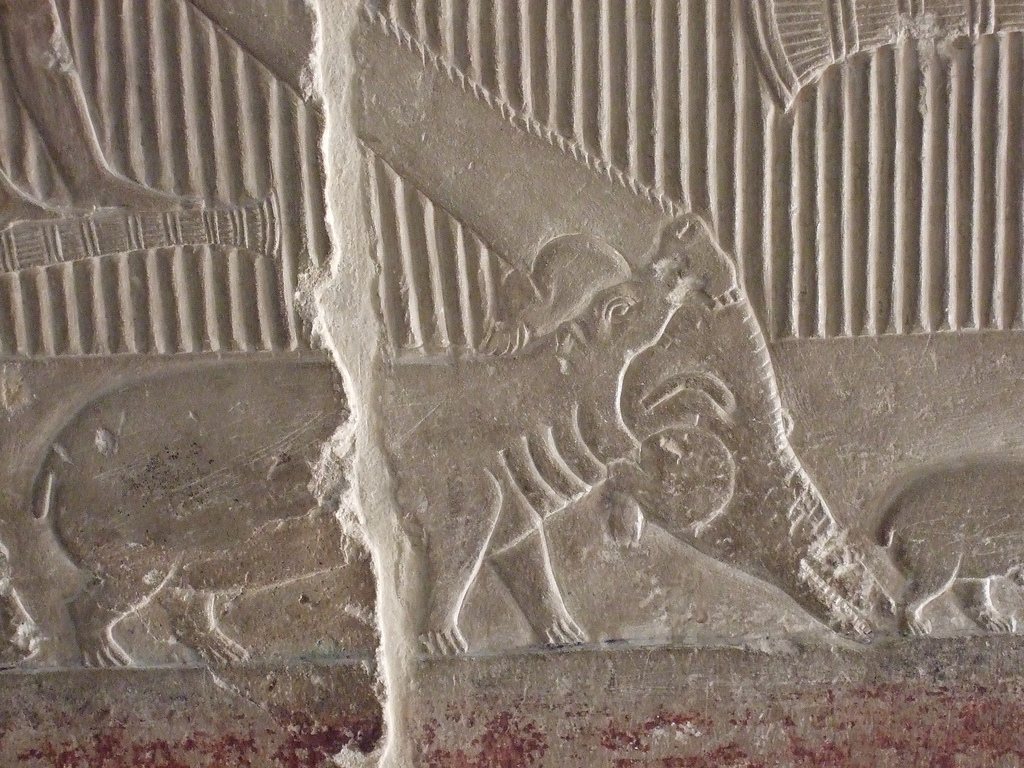
The entrance opens into a vestibule and then into decorated corridors. Scenes in the vestibule show Mereruka and his wife fishing and hunting birds with a javelin, while other men hunt hippopotamuses with harpoons. Corridor scenes include further hunting as well as goldsmiths, stoneworkers, and carpenters at work. One room, perhaps used as the vizier’s office, depicts farmers being punished for failing to pay taxes.
Family burial areas
Meriteti’s tomb opens near the false door at the far end of the offering hall. Its decoration is extensive, though described as less inventive and naturalistic than the work elsewhere in the mastaba. Sesheshet Waatetkhethor’s tomb is reached from one side of the vestibule. Its first room shows farm life, including grazing cattle and milking; an adjoining room contains a serdab, a chamber associated with a statue. Offering and dancing scenes continue through a further room to the chapel.
Courtyard and offering hall
Courtyard and false doors
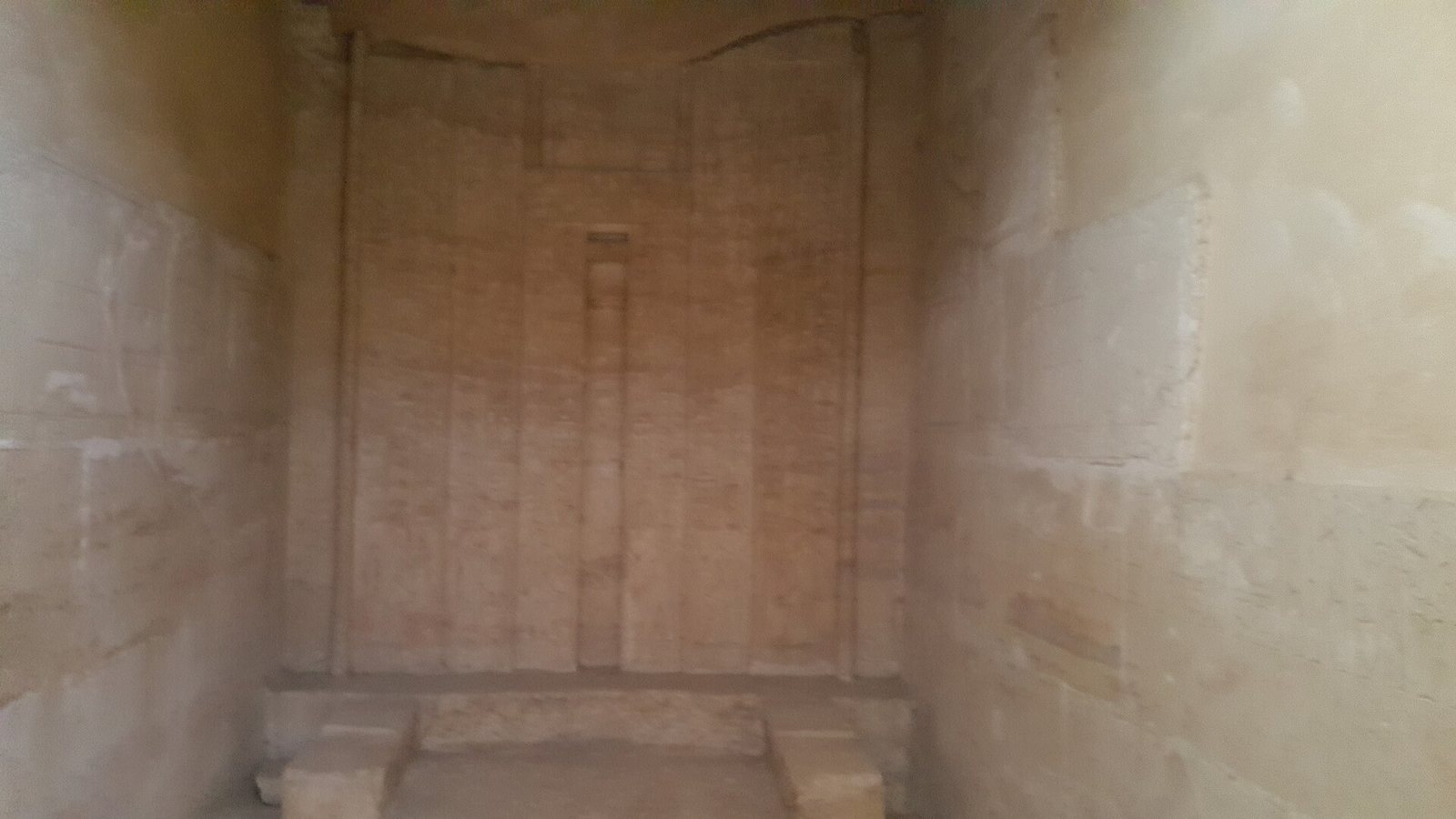
A courtyard forms part of the central area and contains a false door, a symbolic tomb feature rather than a passageway. A red-granite false-door stela, an upright inscribed stone slab, stands at the back of a room before the pillared hall.
Pillared hall and statue niche
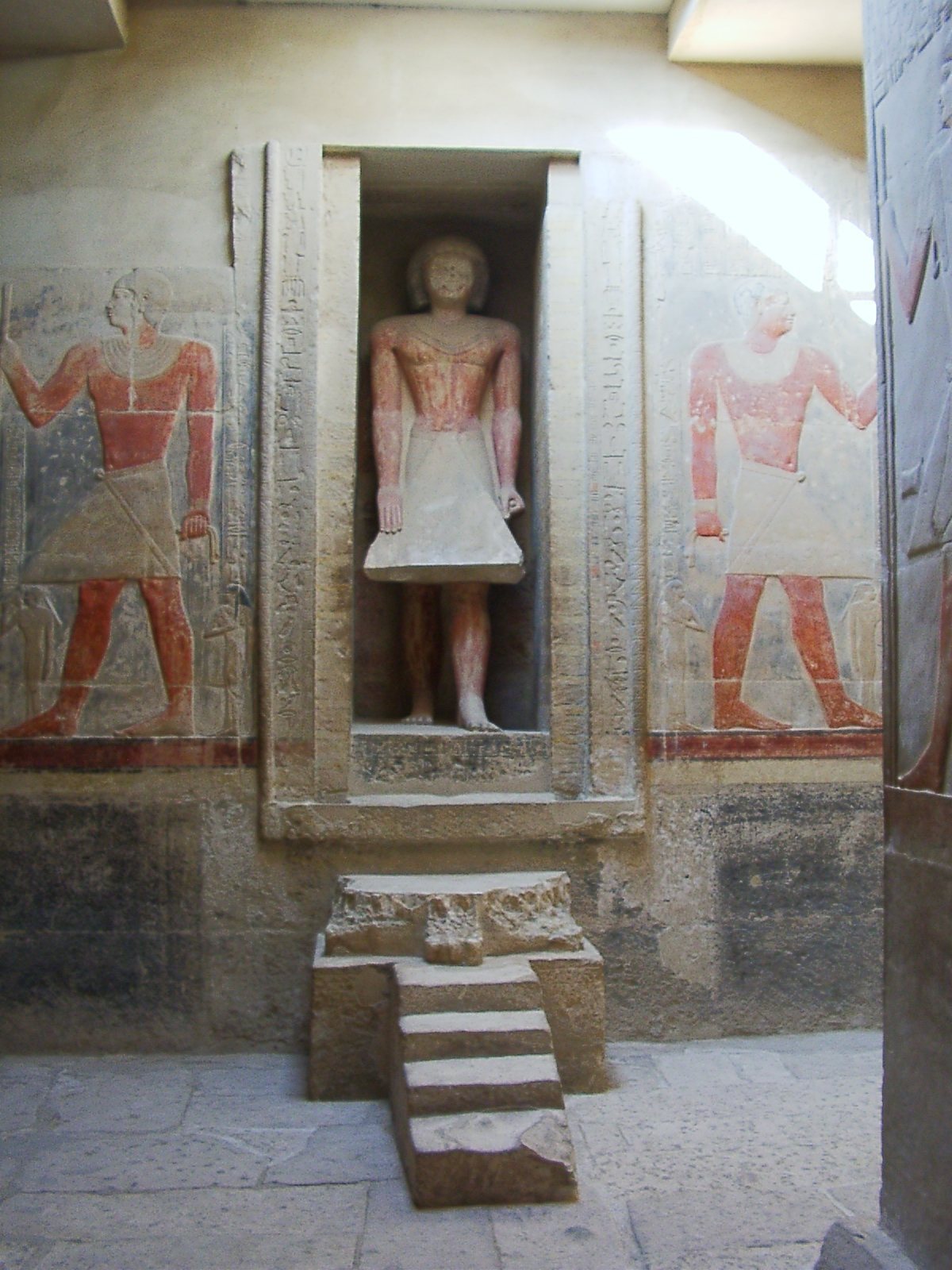
The large offering hall has a ceiling supported by six pillars painted to resemble granite. Storerooms adjoin the hall. A niche in its north wall held a statue of Mereruka, whose original is now in the Cairo Museum. The standing figure wears a curled wig, broad collar, and bracelets; one leg is advanced, and his hands hold a roll and rest against his kilt. In front of the niche, an alabaster offering table carved in the form of the hotep sign, associated with offerings, sits on a pedestal reached by four short steps. Hieroglyphs around the niche give offering formulas and lists of goods for the deceased.
Funeral and estate scenes
A stone ring between the pillars was used to tether animals intended as offerings to Mereruka’s ka, the spiritual aspect believed to receive offerings after death. Painted scenes on the hall walls follow his funeral procession: carriers take the coffin to a boat, transport it across the water, and bear it toward the tomb while singing verses inscribed above them. Other scenes show Mereruka and his wife watching a feast with dancers, musicians, and guests, a cattle procession, and the fattening of hyenas. Hunting and fishing scenes show wild animals captured alive, while images of farming follow work from sowing to harvest. These scenes connect the estate with the country as a whole, present hunting as control over untamed nature, and evoke the three seasons that shaped life along the Nile.