Alte Schanzen: 1866 Earthwork Fortifications near Vienna
Site at a Glance
- Popularity
- Medium
- Country
- Austria
- Primary era
- Modern
- Eras represented
- Modern
- Civilizations
- Austria-Hungary, Austrian Empire, Habsburg
- Site type
- Military
- Remains
- Fort
On this page13 sections
History
The Alte Schanzen are four earthwork fortifications in Floridsdorf, Vienna, Austria, built in 1866 to defend the Austrian capital during the Austro-Prussian War, a conflict between Prussia and the Austrian Empire.
Construction in 1866
The four works, numbered X to XIII, formed part of a belt of 31 fortifications. It ran from Langenzersdorf across Bisamberg and the Alte Schanzen, then through Leopoldau, Kagran, Hirschstetten and Aspern to Lobau, which was then an island. Workers were requisitioned to build the defenses, including women, children and older people.
The belt was equipped with 260 guns and manned by 5,000 soldiers, but the fortifications did not see combat in the war. An armistice was concluded, and Prussian troops halted at the Russbach.
Reuse during the world wars
At the start of the First World War, the aging defenses were reactivated as part of Vienna’s bridgehead, a defended position intended to protect the city and its approaches, against a possible Russian attack. They were not used after Russian troops were stopped in the Carpathians. A munitions building was constructed on Earthwork X.
During the Second World War, anti-aircraft gun positions were established on some of the earthworks. An aircraft-engine repair facility stood nearby in Herrenholz. In the war’s final weeks, the front reached the area, where German troops fought the advancing Red Army, the armed force of the Soviet Union.
Protection and land management
The four earthworks were protected as nature monuments on 5 June 1981. The group is also part of the Bisamberg Natura 2000 area, the European Union network of protected areas. Since December 2004, Earthworks X to XII have additionally been within the roughly 340-hectare Bisamberg European protected area. Its protected habitats include three types listed in Annex I of the Habitats Directive, which identifies habitat types for protection.
Grazing kept the earthworks largely free of woody growth until the late 1970s. After it stopped, scrub spread to varying degrees, while agricultural activity around the site continued to reduce habitat area. Since 2007, the City of Vienna has used goats to graze selected areas and limit scrub growth.
Remains
Setting and earthwork design
The four works cover about 9.5 hectares on a gently rolling ridge at approximately 220 metres above sea level, between Brünner and Hagenbrunner streets. They were made by removing topsoil from their central areas, digging ditches around them and piling the excavated earth into ramparts. The resulting terrain, together with the difficulty of cultivating the surrounding agricultural land, helped vegetation persist on the earthworks.
The area lies on the Laaerberg Terrace, the highest and oldest glacial river terrace in the Vienna region, formed from river deposits associated with glacial conditions. Gravel from the terrace sometimes reaches the surface in nearby shallow-soiled fields, and the local soils are fertile chernozems, a dark, humus-rich soil. Herrenholz lies to the south, beyond which the land descends through vineyards toward Stammersdorf. Bisamberg is to the west; intensively farmed Marchfeld lies to the east and north, beyond a distinct slope. A Vienna waterworks reservoir stands between Earthworks XI and XIII.
Grassland and vegetation
The uneven earthworks support dry and semi-dry grassland. Their warmth, dryness and exposure to wind foster Pannonian vegetation, characteristic of the Pannonian region and adjacent parts of central and southeastern Europe. Continental dry grassland occurs in the central areas of Earthworks XI and XII. Subcontinental semi-dry grassland grows on dry, permeable chernozem and grades toward fringe vegetation at the edges. Drought-adapted bloody-cranesbill communities and downy-oak scrub, a precursor to woodland, also occur. The surrounding fields support arable plants, including field nigella.
Individual earthworks
Earthwork X
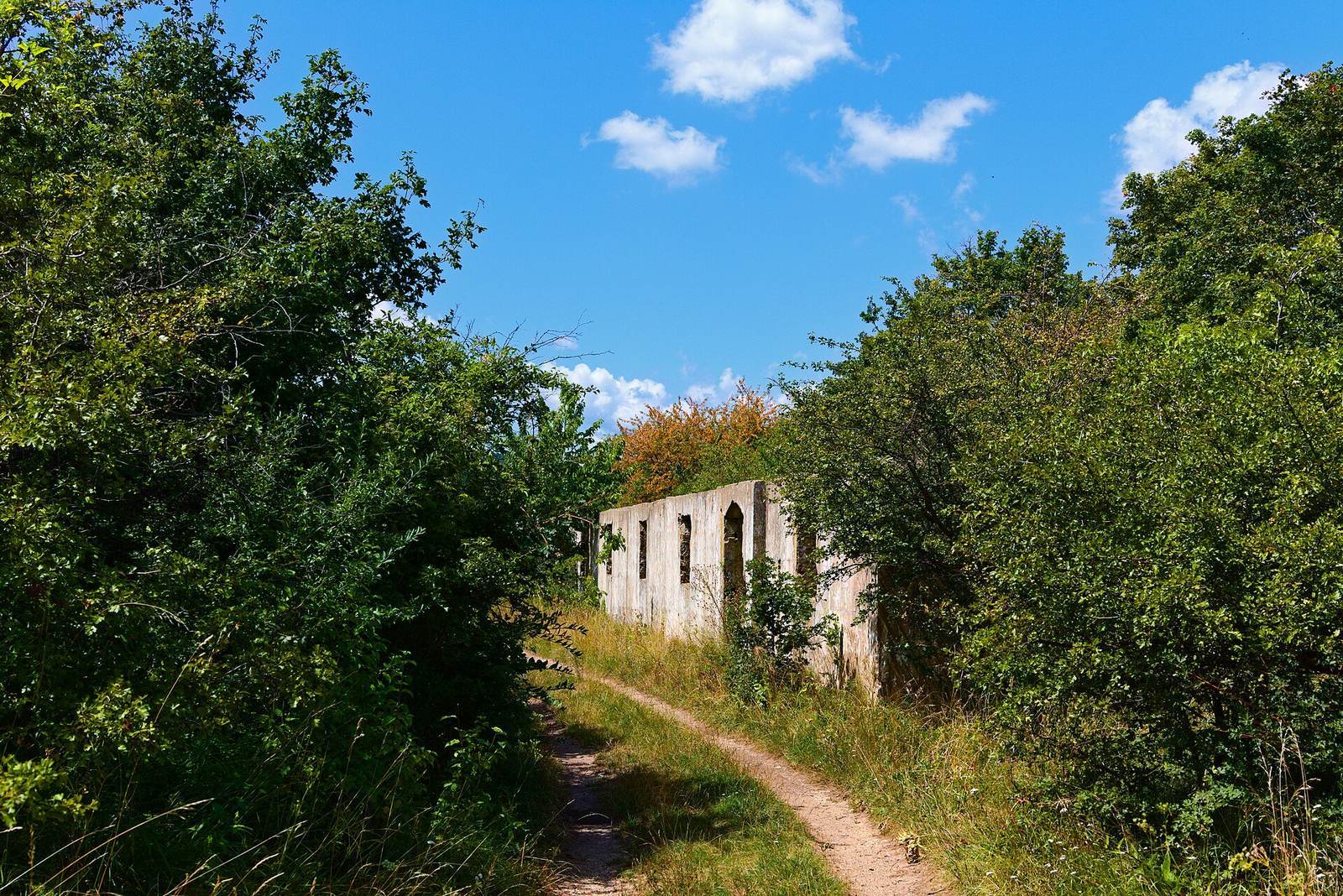
The northwesternmost work covers about 3 hectares and consists mainly of subcontinental semi-dry grassland. A ruined munitions building survives on the earthwork, with dry-grassland plants growing on its masonry. The rare Adriatic lizard orchid also grows here.
Earthwork XI
The largest work, covering 4 hectares, lies to the northeast. Its central area is continental dry grassland, formed where soil was removed. Plants include bloody cranesbill, dittany, upright clematis, spring pheasant’s-eye, sand cinquefoil, narrow-leaved grape hyacinth, large pasque flower, yellow garlic and variegated seseli. Purple mullein also grows on the earthwork, while dittany occurs in its ditch.
Earthwork XII
Earthwork XII covers 1.3 hectares. Its strongly uneven surface supports small patches of different vegetation, including continental dry grassland. Recorded plants include tasteless stonecrop, dwarf yellow star-of-Bethlehem and variegated iris.
Earthwork XIII
The southeastern work, near Brünner Street, covers 1.1 hectares and is heavily wooded or overgrown with scrub.
Recorded species
About 360 plant species grow at the Alte Schanzen. Of these, 62 are classified as threatened, ten as highly threatened and two as threatened with extinction. Across the Alte Schanzen and Bisamberg, recorded wildlife includes 731 butterfly species, 393 bee species and 347 true-bug species. The European ground squirrel is a notable species in the protected area.