Alcázar of the Caliphs (Córdoba): Seat of Government in Al-Andalus


Site at a Glance
- Rating
- 4.3
- Popularity
- Low
- Country
- Spain
- Primary era
- Medieval
- External website
- Open
- Eras represented
- Medieval
- Civilizations
- Almohad, Umayyad
- Site type
- Civic
- Remains
- Palace
On this page15 sections
History
The Alcázar of the Caliphs was a fortified palace in Córdoba, Spain, built and expanded by Muslim rulers from the eighth century and used as the seat of government and royal residence in Al-Andalus, the Muslim-ruled part of the Iberian Peninsula. Emirs and caliphs lived there from the eighth to the eleventh century, while Muslim governors continued to occupy the complex until the Christian conquest of Córdoba in 1236.
From Visigothic palace to Muslim seat of power
After the Muslim conquest of Hispania in 711, governors appointed by the Umayyad Caliphate of Damascus first established themselves in Seville. In 717, the governor al-Hurr transferred the capital to Córdoba and took possession of a former Visigothic royal palace called Balat al-Ludriq in Arabic sources. The palace stood beside the Roman bridge and near the city’s first mosque, a Christian basilica then shared by Christians and Muslims.
The Visigoths had built the palace over a Roman castellum, or fortified military site. Its earlier history may therefore have included Roman and Visigothic phases. The Berber chieftain Razin al-Burnusi, who had accompanied Tariq ibn Ziyad during the conquest, may also have adapted the site before the governors made it their base.
When the Umayyad dynasty was overthrown by the Abbasids in 750, Abd ar-Rahman I escaped to Córdoba. In 756 he established the independent Umayyad Emirate of Córdoba, a Muslim state ruled separately from the Abbasid caliphate. He initially lived in suburban palace-villas, particularly al-Rusafa, but a conspiracy against him in 784 prompted his permanent move to the former palace within the city. He transformed it into a new alcázar, a fortified palace or royal citadel, and began constructing the adjacent Great Mosque the following year.
Expansion under the Umayyads
Abd ar-Rahman I and his successors continually enlarged the complex. It became the official royal residence and the principal center of political authority in Al-Andalus, as Córdoba developed into a major political and cultural center during the emirate and the later caliphate.
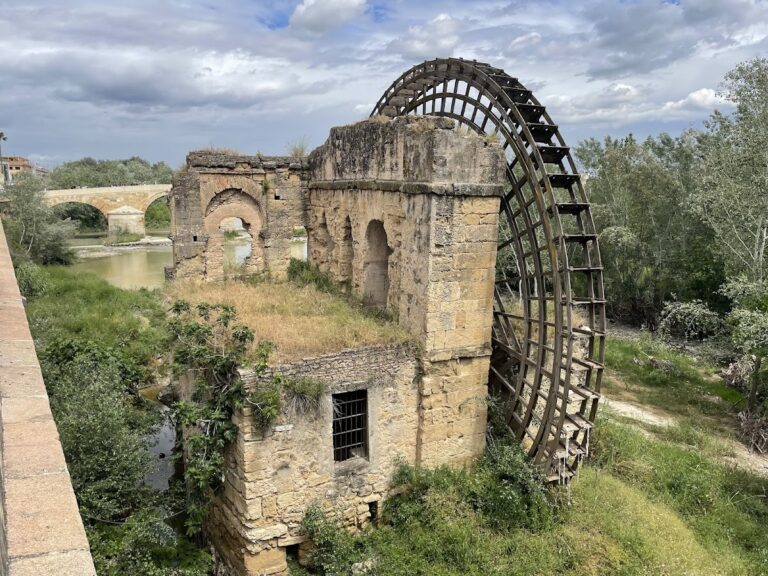
Abd ar-Rahman II improved Córdoba’s water supply and the palace gardens with waterwheels installed along the Guadalquivir. The Albolafia and other norias, waterwheels used to raise water for irrigation or supply, are associated with this system. The Albolafia has also been attributed to the tenth century or to the Almoravid period in the twelfth century, when the Almoravids, a North African Muslim dynasty, ruled territories in Al-Andalus.
In the tenth century, the official seat of government moved outside Córdoba to Madinat al-Zahra, a new palace city built by Caliph Abd ar-Rahman III. The original Alcázar remained important during his reign. He carried out hydraulic works there and may have built the Garden Palace, Dar al-Rawda. Abd ar-Rahman III became the first Umayyad caliph of Córdoba in 929, when the emirate was transformed into a caliphate.
The caliphate collapsed in the early eleventh century, and Madinat al-Zahra was destroyed. Political authority then returned to the Alcázar, where governors of later Muslim regimes resided. Around 1070, the Taifa ruler al-Mutamid stayed there when he annexed Córdoba to the Taifa of Seville. The palace included royal apartments, government offices, administrative departments, baths, gardens, and a major library created by al-Hakam II. Its internal arrangement is more clearly understood for the emirate period than for the caliphate.
Christian conquest and later use
Ferdinand III’s conquest of Córdoba in 1236 ended the Alcázar’s role as the Muslim political center of the city. One part was granted to the bishop of Córdoba and converted into the Episcopal Palace and other religious buildings. Much of the remaining royal complex became the Alcázar of the Christian Kings, a residence of the Castilian monarchy.
The conquest thus redirected the palace complex toward Christian religious and royal uses. A latrine belonging to the Andalusi Alcázar was found within the Episcopal Palace in September 2019, adding physical evidence for the earlier Islamic occupation beneath the later buildings.
Remains
The Islamic palace occupied a broad area southwest of the Great Mosque. Its walls enclosed approximately 39,000 square meters, covering an area that now corresponds broadly to the Alcázar of the Christian Kings, the Episcopal Palace, the Seminary of San Pelagio, the Campo Santo de los Mártires, and nearby buildings. The complex brought together royal residences, administrative spaces, service quarters, baths, gardens, pavilions, and access points within a varied group of buildings.
Walls, passages, and entrances
The surviving wall fabric
Sections of the Alcázar’s walls are incorporated into the façade of the Episcopal Palace and into part of the adjoining Palacio de los Congresos. A tower from the northern wall survives in a small courtyard reached through the Episcopal Palace’s main courtyard. These fragments preserve parts of the enclosure within later structures.
The sabbat and mosque connection
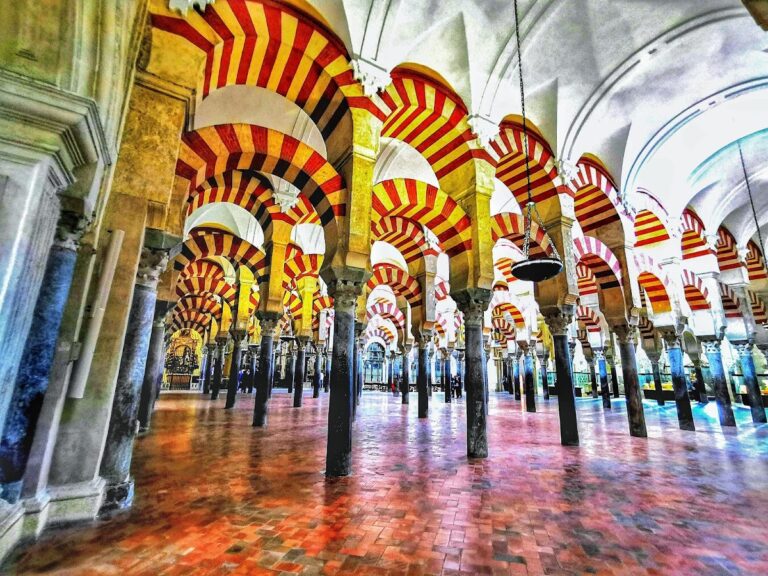
A raised, covered passage called the sabbat once linked the palace to the Great Mosque across the intervening street. This protected route allowed the emir or caliph to reach the mosque’s maqsurah, the enclosed prayer area associated with the ruler, and the space behind the qibla wall, which marked the direction of prayer, without crossing the street openly. Emir Abdallah built the first passage between 888 and 912. Al-Hakam II replaced it when the mosque was enlarged. The passage itself has disappeared, while a small doorway on the mosque’s western façade preserves its former access.
Southern and northern gates
The principal southern entrance was Bab al-Sudda, or the Gate of the Embankment, beside the Guadalquivir. A public square before the gate hosted executions and military parades. Caliph Abd ar-Rahman III watched these events from a balcony or platform above the gate, where the heads of executed enemies were displayed. A prison stood nearby.
Bab al-Hadid, or the Iron Gate, stood on the northern side of the complex. Its name was traditionally linked to door knockers taken from a gate at Narbonne, a city briefly occupied by Muslim forces in the early eighth century. Other recorded entrances included Bab al-Jinan, or the Gate of the Garden; Bab al-Quriya, also called Bab al-Qariya or the Village Gate; and Bab al-Jami, or the Gate of the Mosque.
Additional palace entrances
Further gates were known as Bab al-Adil, or the Gate of Justice; Bab al-Wadi, or the Gate of the River; Bab al-Ishbiliya, or the Gate of Seville; Bab al-Siba, or the Gate of the Lion; Bab al-Asad; and Bab al-Hammam, or the Gate of the Bathhouse. Their precise positions are not all certain. Bab al-Adil stood at the southeastern end of the palaces near the mosque, where citizens presented petitions to the emir. Bab al-Hammam was near the baths, while Bab al-Ishbiliya was associated with the direction of Seville.
Government buildings and royal gardens
Administrative and audience halls
The Dar al-Wuzara, meaning the House of the Viziers or House of the Ministries, was an official building near Bab al-Sudda. Close by stood the Majlis al-Kamil, or Perfect Hall, the principal audience or throne hall. Together, these buildings formed part of the governmental core of the palace.
The Rawda and Garden Palace
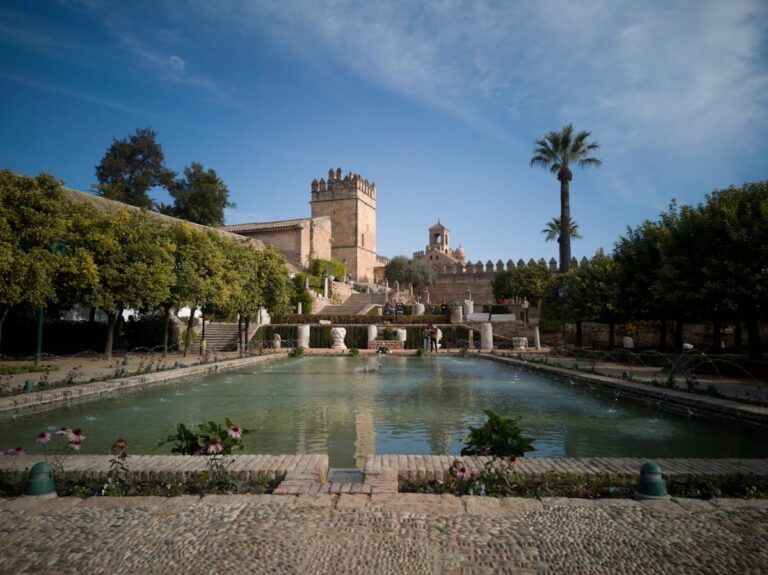
The palace gardens included the Rawda, a royal cemetery or necropolis near Bab al-Jinan. Dar al-Rawda, or the Garden Palace, encompassed this garden and is attributed either to Abd ar-Rahman I or possibly to Abd ar-Rahman III. A hall or pavilion called the Majlis al-Zahir, or Luminous Hall, stood to its north. The Rawda contained the burials of Abd ar-Rahman I, Hisham I, al-Hakam I, Abd ar-Rahman II, Muhammad I, Abdallah, Abd ar-Rahman III, and the Hammudid caliph Ali. Their recorded deaths range from 788 to 1018.
Caliphal Baths
The hammam complex
The Caliphal Baths were a hammam, or bath complex, in the northwestern part of the palace near the private apartments of the emirs and caliphs. They date from the reign of al-Hakam II, between 961 and 976. The Almohads, a North African Muslim dynasty that ruled parts of Al-Andalus during the twelfth and early thirteenth centuries, enlarged the baths during their period of rule.
The baths are among the surviving structures explicitly identified with the former Islamic palace and have been converted into a museum in the Campo Santo de los Mártires. Along with the wall fragments and northern tower incorporated into later buildings, they provide a physical link with the palace that served Córdoba’s Muslim rulers.
Nearby sites