Alcañiz Town Hall: A Renaissance Civic Building in Spain
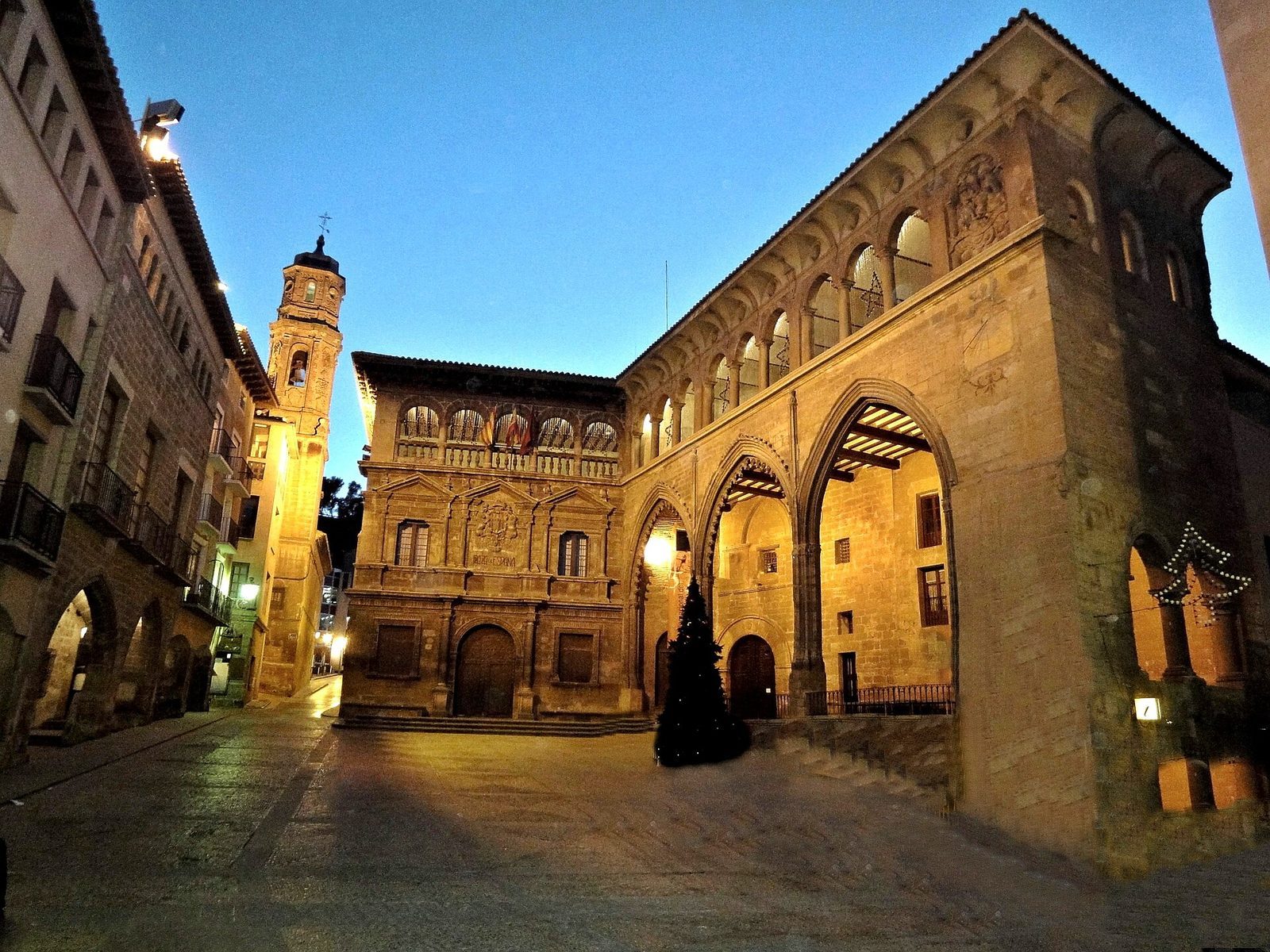
Site at a Glance
- Popularity
- Very Low
- Country
- Spain
- Primary era
- Early Modern
- Eras represented
- Early Modern
- Civilizations
- Crown of Aragon, Spanish
- Site type
- Civic
- Remains
- Town Hall
On this page10 sections
History
Renaissance foundation
Alcañiz Town Hall is a Renaissance civic building in Alcañiz, Spain. The town began arranging for its construction in 1547, and the building was completed around 1570. The new Plaza Mayor replaced Calle Mayor as Alcañiz’s principal urban axis, reflecting Renaissance ideas, a European movement that revived classical art and architecture. Similar approaches had been adopted in Italian states and in some territories of the Crown of Aragon, a composite monarchy that included Aragon and, at different times, other lands around the Mediterranean. The town hall also followed a pattern used across Aragon, adapting features of manor houses for public buildings.
Alterations and civic use
The building underwent successive reforms and expansions, especially to its interior. A Baroque enlargement, in the elaborate European style, took place in 1797.
The town hall and adjoining loggia, an open-sided gallery, were declared Historic-Artistic Monuments on 3 June 1931. From 1985 the town hall was classed as an Asset of Cultural Interest, and a regional order in 2004 completed the original declaration for the town hall and loggia. A restoration plan was prepared in 1977, with work carried out in phases from 1982 to 1984.
In 1996, after Spanish researcher Juan José Barragán published a study of a mural he had discovered and examined, the town council acquired it and the Government of Aragon restored it. The council installed the mural in the town hall to revive its civic role. It had once been displayed in a Gothic-style palace, now destroyed, above the town’s medieval communal civic halls. Comparable scenes in civic premises in Valencia appeared in principal halls where council judgments were held, supporting an interpretation of the mural as more than decoration.
Remains
Exterior
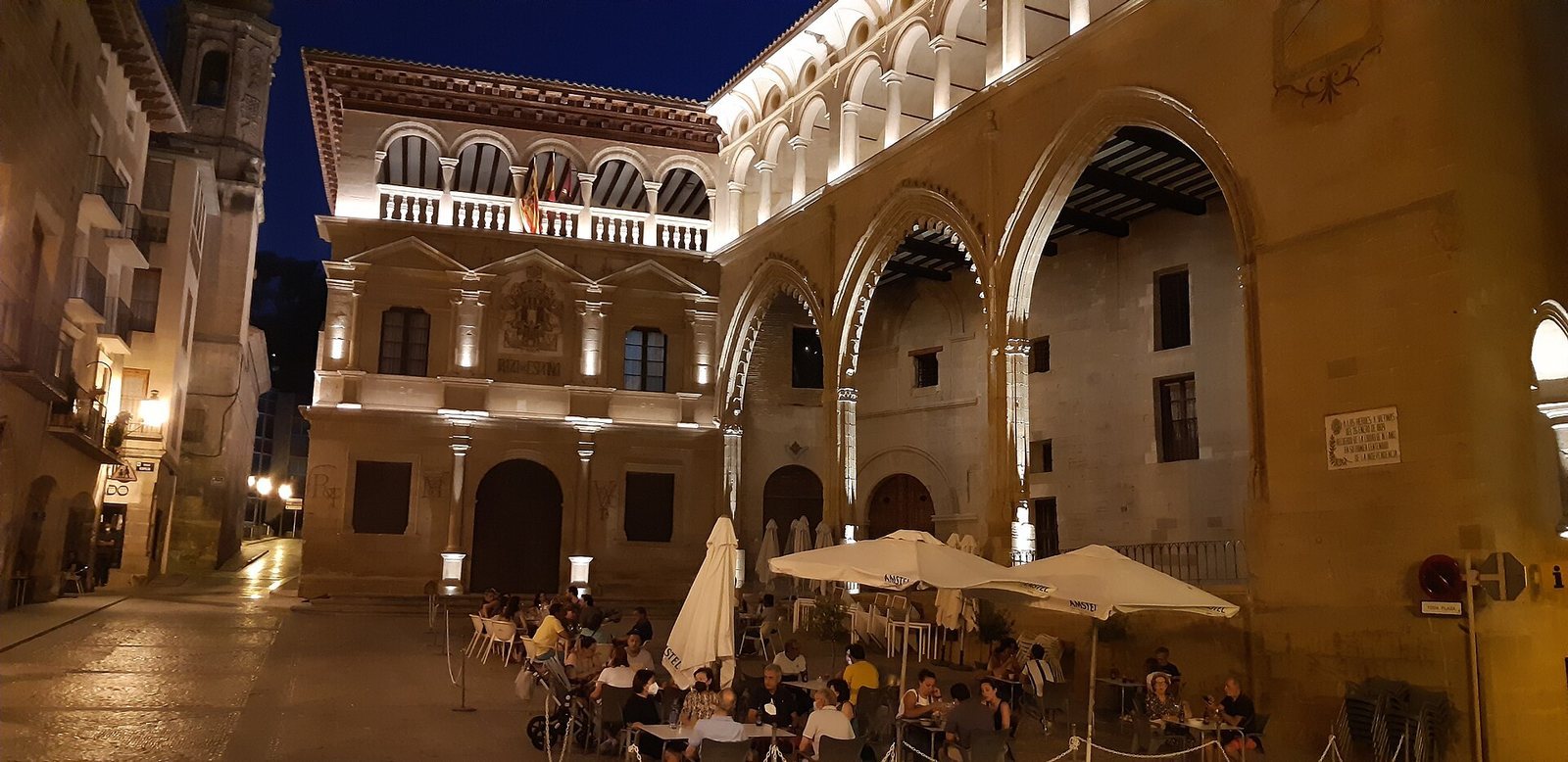
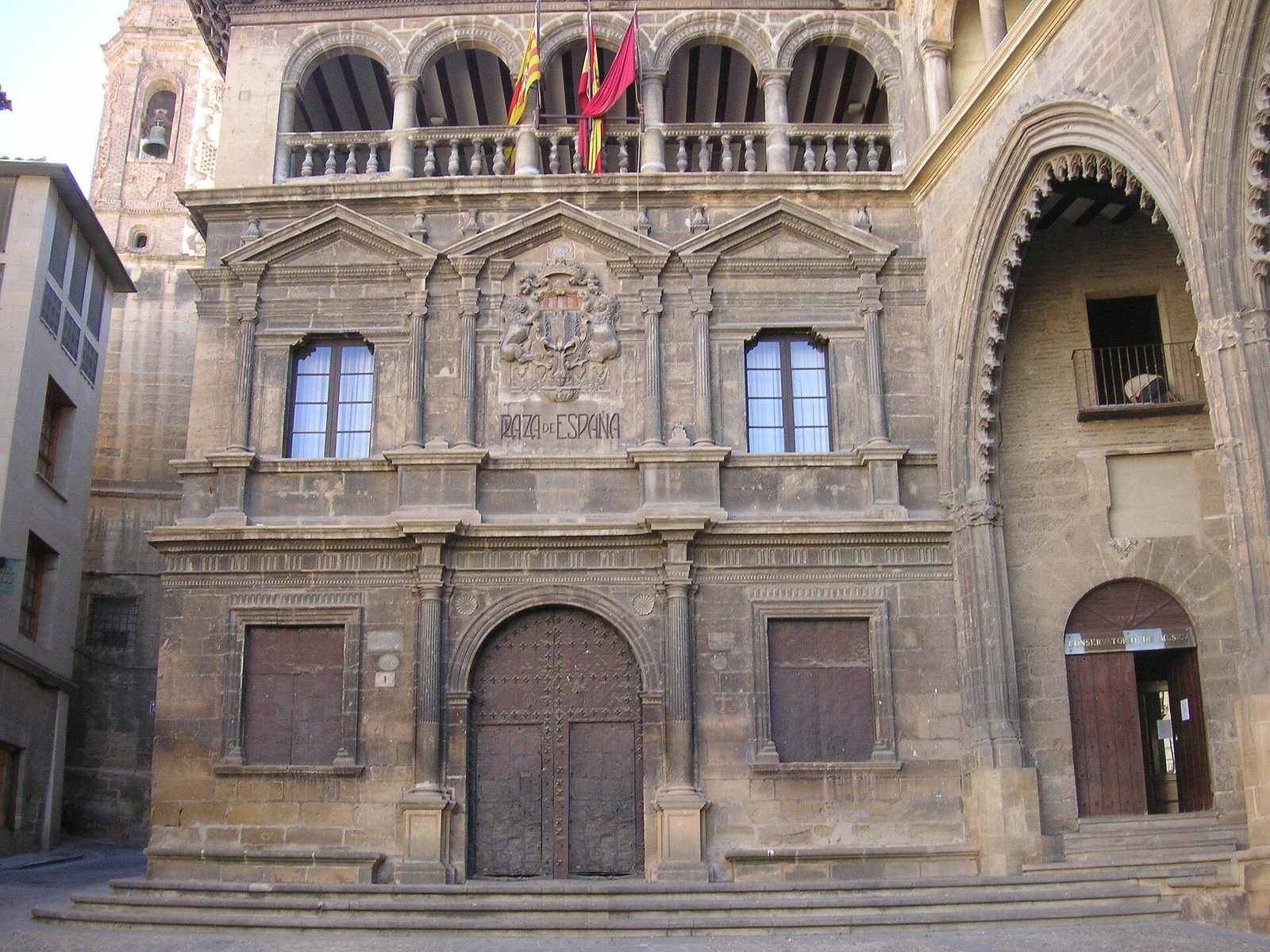
The three-storey town hall has a principal façade of large cut stone blocks and a side façade of brick above a stone base. It meets the adjoining loggia at a right angle. Prominent cornices divide the principal façade into three levels.
Principal façade
A decorated semicircular archway occupies the centre of the ground floor, framed by worked pilasters and flanked by two moulded windows with lintels. A decorated frieze and projecting cornice mark the division above. On the second level, two lintelled windows rest on corbels and recessed pilasters. Fluted columns with scroll-shaped Ionic capitals frame the windows and support a frieze and triangular pediment. The town’s coat of arms occupies the space between the windows, with an associated inscription dated 1742.
Side façade
The ground level has a smooth wall, a semicircular-arched doorway, and windows on either side. Above it, the brick second level contains five lintelled balconies and a horizontal band of sawtooth brickwork. A gallery of five semicircular arches sits above, with grooved, wedge-shaped stones supported by columns with smooth shafts. A deeply projecting wooden eave crowns the façade.
Interior
Plan and rooms
Successive changes, particularly during the eighteenth century, left the interior irregular, though its rectangular plan is arranged around three parallel bays. A courtyard supported by seven columns occupies the front and central bays on the ground floor; stairs from it lead to the principal floor. The council chamber, with a timber-beam ceiling, is in the front bay, while a room for council officials occupies the central bay and the archive and notary’s office are at the rear. The upper floor follows the same arrangement, with a reception hall at the front.
Gothic-style mural
The large mural is installed in a lower room of the town hall. It depicts three scenes from the Passion and Resurrection of Christ, two of which survive: the Crucifixion and the weighing of souls by the archangel Michael.