Alanya Castle: Seljuk Fortress and Regional Stronghold in Türkiye


Site at a Glance
- Rating
- 4.7
- Popularity
- Very High
- Country
- Turkey
- Primary era
- Medieval
- External website
- Open
- Eras represented
- Classical, Medieval, Early Modern, Modern
- Civilizations
- Ancient Greek, Byzantine, Ottoman, Roman, Seljuk
- Site type
- Military
- Remains
- Citadel
On this page14 sections
History
Alanya Castle is a fortress in Alanya, Türkiye, whose present form was shaped in the thirteenth century under the Seljuk Sultanate of Rum. Built upon earlier Greek, Roman, and Byzantine defenses, it became the military and administrative center of the surrounding region and incorporated the port, shipyard, and arsenal.
Early Fortifications and Byzantine Kalonoros
The peninsula was first occupied by a Greek settlement and later developed as a Roman city. Its earliest fortifications belong to the Hellenistic period, and Roman and Byzantine authorities expanded them over time. The Byzantine Empire, the medieval Roman state centered on Constantinople, strengthened the castle and city walls during the seventh century in response to Arab raids. At that time, the city was known as Kalonoros.
Seljuk Conquest and Expansion
After the Fourth Crusade in 1204, a campaign that resulted in the capture and division of Constantinople, the city and castle came under the control of Lesser Armenia, the medieval Armenian kingdom in Cilicia and neighboring parts of southeastern Anatolia. Seljuk forces captured them in 1221.
Sultan Alaeddin Keykubad I, the thirteenth-century ruler of the Seljuk Sultanate of Rum, established and greatly enlarged a new city on the existing urban site. He named it Alaiye after himself. Under his rule, the castle and its associated walls were extensively rebuilt and expanded into the form largely recognizable today. The city’s modern name, Alanya, was adopted in the twentieth century after the introduction of a new alphabet.
A Fortress for the Region
The expanded fortifications created successive defensive zones. The innermost walls enclosed the citadel, while outer walls protected the urban settlement and allowed defenders to shift resistance into additional areas during an assault. The fortress also controlled the harbor through its port defenses, shipyard, and arsenal. Alanya changed hands several times in later centuries, but these transfers had little effect on the general form of the castle and its wider defenses.
In 1525, the Ottoman naval commander and cartographer Piri Reis included Alanya in his Book of the Seas. His depiction showed the walled peninsula, the Red Tower at the harbor entrance, and the castle overlooking the area. The castle and its remains are now presented as an open-air museum and archaeological monument, forming part of the city’s Seljuk architectural heritage.
Remains
Peninsula and Defensive Walls
Alanya Castle occupies a rocky peninsula approximately 250 meters above sea level. The Mediterranean surrounds it on three sides, while a steep landward slope protects the fourth. On the western side, a cliff more than 200 meters high provides additional defense. The fortress combines a citadel with a defensive-wall system about 6.5 kilometers long. Fourteen towers form part of the walls, whose eastern section descends almost to the sea and continues toward the Red Tower near the harbor.
Citadel
The citadel, also called the Inner Castle, occupies the southwestern and highest part of the peninsula. Its innermost fortifications enclose buildings arranged mainly along the walls. The western wall follows the cliff and has comparatively little construction beside it. Most of the citadel buildings are thought to have served military purposes, including barracks and storage spaces. The fortress accommodated about 400 residents. Several main and auxiliary gates once served the complex, and the main gates carried inscriptions. Most of the gates are now destroyed.
Rainwater Cisterns
Well-preserved brick rainwater cisterns remain within the castle. Built under Alaeddin Keykubad I, they could supply water during a prolonged siege and formed part of the citadel’s defensive infrastructure.
Palace Ruins
Excavations in the citadel revealed ruins interpreted as the remains of Alaeddin Keykubad I’s palace. The surviving structures are fragmentary, while the principal buildings on the summit are now largely represented by ruins.
Byzantine Church
A Byzantine Christian church stands within the citadel away from the perimeter walls. Dating from the fourth or fifth century, it is also identified as the Church of Saint George, named for the widely venerated Christian martyr.
Harbor Defenses
Red Tower
The Red Tower stands at the harbor entrance as part of the port defenses. Built for Alaeddin Keykubad I in 1226, it protected the harbor and shipyard from attacks by sea. Its plans are attributed to Ebu Ali Reha el Kettani of Aleppo. The tower is 33 meters high and has a regular octagonal plan 29 meters in diameter. Five levels rise above a cistern at the top, which collected rainwater and also helped distribute the structure’s weight.
Red bricks used in the construction, especially after difficulties arose during work on the upper sections, gave the tower its characteristic color. Some wall sections contain marble reused from the ancient city on whose site Alanya developed.
Shipyard
The shipyard lies south of the Red Tower beside the castle walls. Begun in 1227, it extends 57 meters along the shoreline and contains five covered docks, each 40 meters long. The docks have masonry walls and arched vaults. A small watchtower connected to the dock building housed soldiers who guarded the shipyard, where smaller vessels were built and repaired. The shipyard was the first Seljuk shipyard on the Mediterranean.
Wider Fortress Area
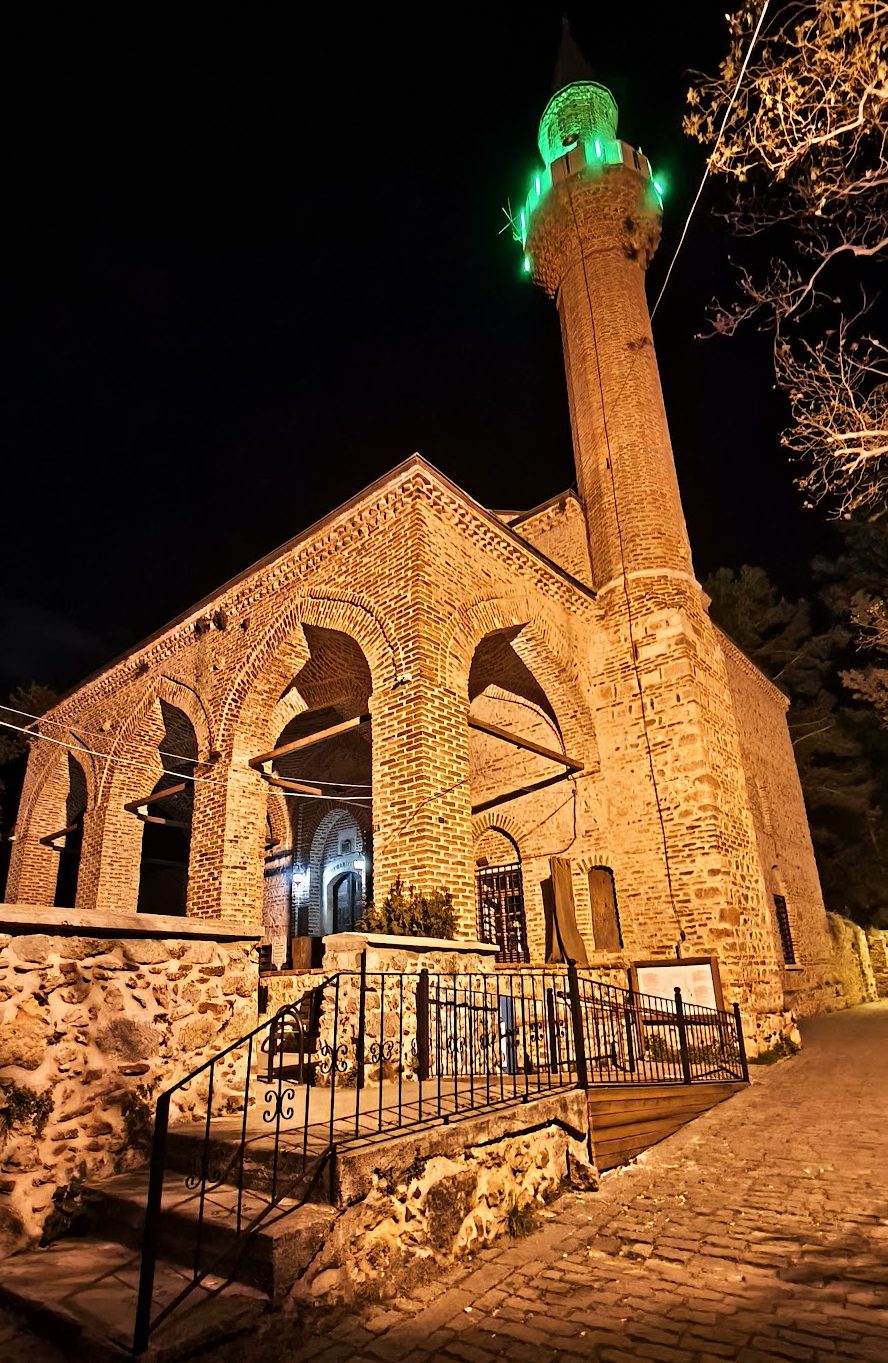
The Red Tower and shipyard connect with the wider fortification system rather than standing as isolated buildings. The eastern walls join the harbor defenses to the citadel and the outer defenses of the urban settlement. Outside the walls enclosing the citadel but within the broader fortress area stand a mosque and a caravanserai, a roadside establishment offering shelter and services to travelers and caravans, both built under Suleiman the Magnificent. Baths and an arsenal are also among the surviving or documented installations. Nineteenth-century residential villas were later constructed within the fortress area.