al-Hamra Mosque: A Historic Twelver Shia Mosque and Shrine in Kufa


Site at a Glance
- Rating
- 4.6
- Popularity
- Very Low
- Country
- Iraq
- Primary era
- Modern
- Eras represented
- Medieval, Modern
- Civilizations
- Unclassified
- Site type
- Religious
- Remains
- Mosque
On this page10 sections
History
Al-Hamra Mosque, also known as the Yunus ibn Matta Mosque, is a seventh-century Twelver Shia mosque and mausoleum in Kufa, Iraq, associated with the period of Ali ibn Abi Talib. Twelver Shia Islam recognizes a succession of twelve Imams beginning with Ali, who ruled from Kufa. The mosque is regarded as one of the city’s oldest places of worship.
Origins and Religious Traditions
The mosque takes its name from the Hamra tribe, whose origins lay in the Daylam region. After settling in Kufa and allying with the Banu Abd al-Qays following the Battle of al-Qadisiyyah, the tribe converted to Islam and developed an attachment to the Imams of the Ahl al-Bayt. The Ahl al-Bayt are the family of the Prophet Muhammad, especially the household regarded in Twelver Shia belief as the source of rightful religious leadership.
Tradition holds that Ali prayed at the mosque and considered it one of Kufa’s sacred places. The site also became associated with a shrine attributed to Yunus, the Quranic name for the biblical prophet Jonah. Shia traditions state that Yunus’s body lay there after his death before being taken to Mosul, where a major shrine was later built. Another tradition, attributed to Ali, says that Yunus was buried at the shrine. These associations made the site a place of prayer for scholars and a pilgrimage destination for Muslims.
Schools, Renewal, and Destruction
A Sunni madrasa for the Hanafi school was established at the site in 1086. The Hanafi school is one of the four major Sunni traditions of Islamic jurisprudence. The mosque’s mihrab, the recessed feature indicating the direction of prayer, was renewed in 1895.
In 1924, a cylindrical minaret was added through donations from Hajj Abd al-Karim, a wealthy Kufa businessman. The local architect Jawad al-Baghdadi was involved in the renovation. During the Ba’athist period, around 1990 and 1991, the earlier mosque building and its minaret were demolished. Before that destruction, the site still retained recognizable boundaries and its original mihrab.
Reconstruction
Plans to rebuild the mosque were developed in 2003 after the overthrow of Saddam Hussein’s government. Ayatollah Ali al-Sistani was involved in the effort, and the Shia Endowment later funded reconstruction of the mosque and its adjoining shrine. The rebuilt complex was completed and reopened in 2018 at a ceremony attended by religious figures from Najaf.
Remains
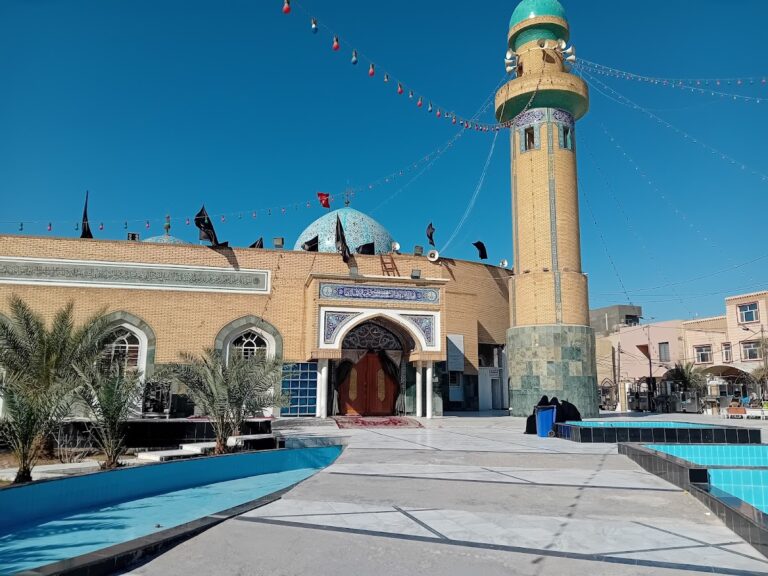
Al-Hamra Mosque stands on the right bank of the Kufa River. The present complex follows a modern Iraqi architectural style and combines the mosque with an adjoining shrine attributed to Yunus. It includes a large dome and two minarets, each reaching approximately 30 meters, while the reconstructed building provides space for about 1,000 worshippers.
The Rebuilt Complex
Prayer Hall and Shrine
The current mosque forms part of a rebuilt complex that incorporates the adjoining shrine of Yunus. Reconstruction followed the demolition of the earlier building and minaret, producing the present arrangement of prayer space and shrine. The complex’s design combines the mosque, the dome, and the two minarets within a modern Iraqi architectural setting.
Earlier Architectural Features
Renewed Mihrab
The mosque’s mihrab was renewed in 1895 during a late nineteenth-century phase of restoration. It remained in place until the destruction of the earlier mosque around 1990 and 1991, when the former building was demolished.
1924 Minaret
The minaret added in 1924 was cylindrical and contained two spiral stairways. One stairway rose from the base to the gallery, while the other continued from the gallery to the summit. The gallery was enclosed by ornamental muqarnas, tiered niche-like forms used in Islamic architecture. Colored glazed-tile designs decorated the base and shaft. This minaret was demolished with the earlier mosque during the Ba’athist period.