Akoris: An Ancient Egyptian Administrative and Religious Center
Site at a Glance
- Popularity
- Medium
- Country
- Egypt
- Primary era
- Bronze Age
- Eras represented
- Bronze Age, Classical, Medieval
- Civilizations
- Egyptian, Ptolemaic, Roman
- Site type
- Settlement
- Remains
- Town
On this page16 sections
History
Akoris is an ancient Egyptian administrative town in Egypt, occupied from the Old Kingdom and important to the 17th nome of Upper Egypt. A nome was an administrative district. The settlement remained in use through ancient Egyptian times and may also have had a harbor on the Nile.
Early Egyptian history
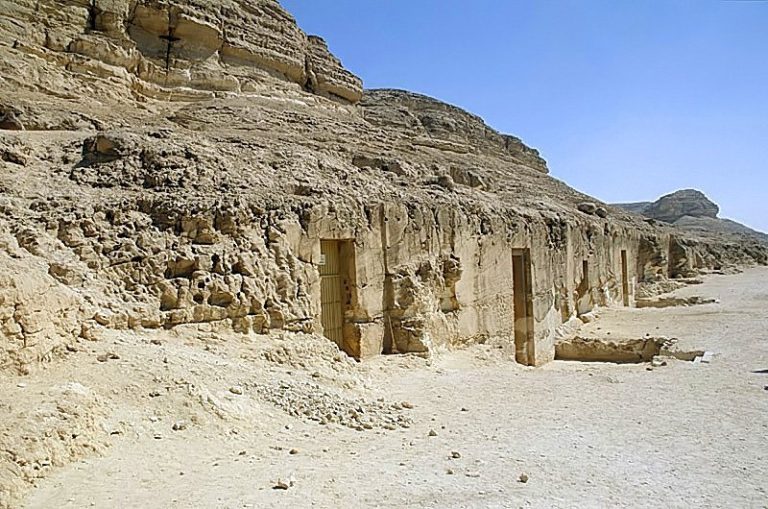
In the Old and Middle Kingdoms, successive phases of ancient Egyptian history, the town was called Mer-nefer(et), meaning beautiful channel. Its name later changed with its political and religious history. Rock-cut tombs for officials were made from the middle of the 4th Dynasty, one of ancient Egypt’s ruling houses.
Tomb evidence associates Hathor, a goddess linked with protection and fertility, with Akoris during the reign of Menkaura, an Old Kingdom pharaoh. She was known there as mistress of the valley entrance. The earliest deity worshipped at the site is uncertain, though it may have been a lion goddess.
New Kingdom and later Egyptian periods
In the New Kingdom, another phase of ancient Egyptian history, Akoris was known as Per-Imen-mat-khent(j), meaning House of Amun, the foremost lion. Amun, a major Egyptian god, was worshipped there from the 18th Dynasty. A temple to him was established in a former tomb chamber during Ramesses II’s reign and completed under Ramesses III. Some older tombs were converted into chapels for Amun and, later, Sobek. Priests were also buried in tombs at Akoris during the 21st and 22nd Dynasties, and the tombs were plundered.
From the 26th Dynasty, Akoris was called T3-dehenet, meaning cliff top. Sobek, a god associated with crocodiles and the Nile, joined the local cult and eventually became its principal deity. The temple complex was greatly enlarged during the reign of Nero, the Roman emperor.
Persian, Greek, and Roman periods
A fortress may have been established during Persian rule because of Akoris’s strategic position, but this possibility remains unconfirmed. The town became important in the Greek and Roman periods. Both Akoris and Tēnis were used as names in the Greek period. The name Akoris appears on a rock stela of Ptolemy V, in the geographer Ptolemy’s work, and on the Tabula Peutingeriana.
Worship at Akoris broadened over time. Alongside Sobek, other Egyptian deities, including Thoth, Isis or Mut, Osiris, Horus, and Khonsu, were worshipped in the Greek and Roman periods. Settlement activity continued into the Roman and Coptic periods, the latter being Egypt’s Christian late-antique era. The site’s limestone was also quarried in antiquity.
Investigation and excavation
Akoris was recorded during Napoleon’s expedition to Egypt. Karl Richard Lepsius led a more extensive investigation in the 1850s, and Heinrich Brugsch found the Fraser Tombs in 1853. George Willoughby Fraser described them about half a century later. Ahmed Kamal and Gustave Lefebvre carried out further investigations in the early 20th century. Japanese-led excavations under H. Kawanishi began in 1981. From 2002, the team investigated the southern part of the site and uncovered a town dating to the Third Intermediate Period, a later phase of ancient Egyptian history.
Remains
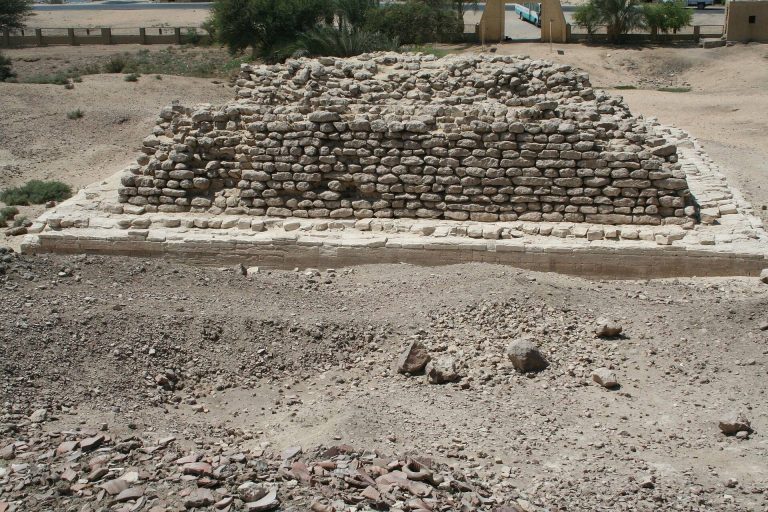
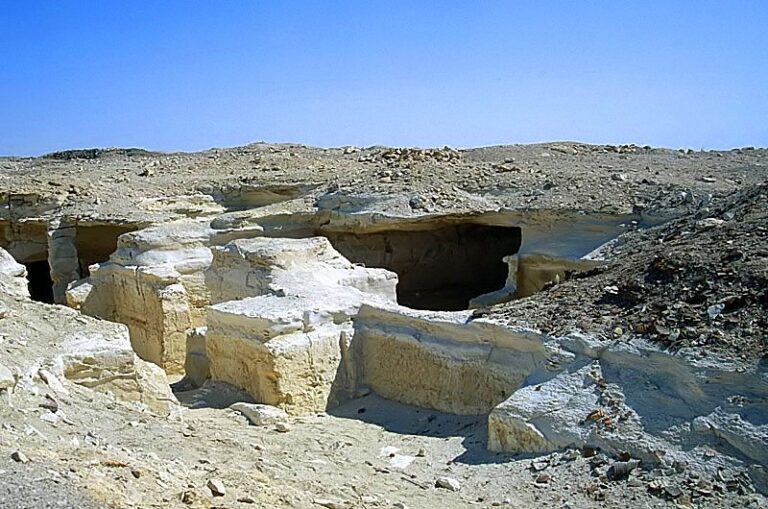
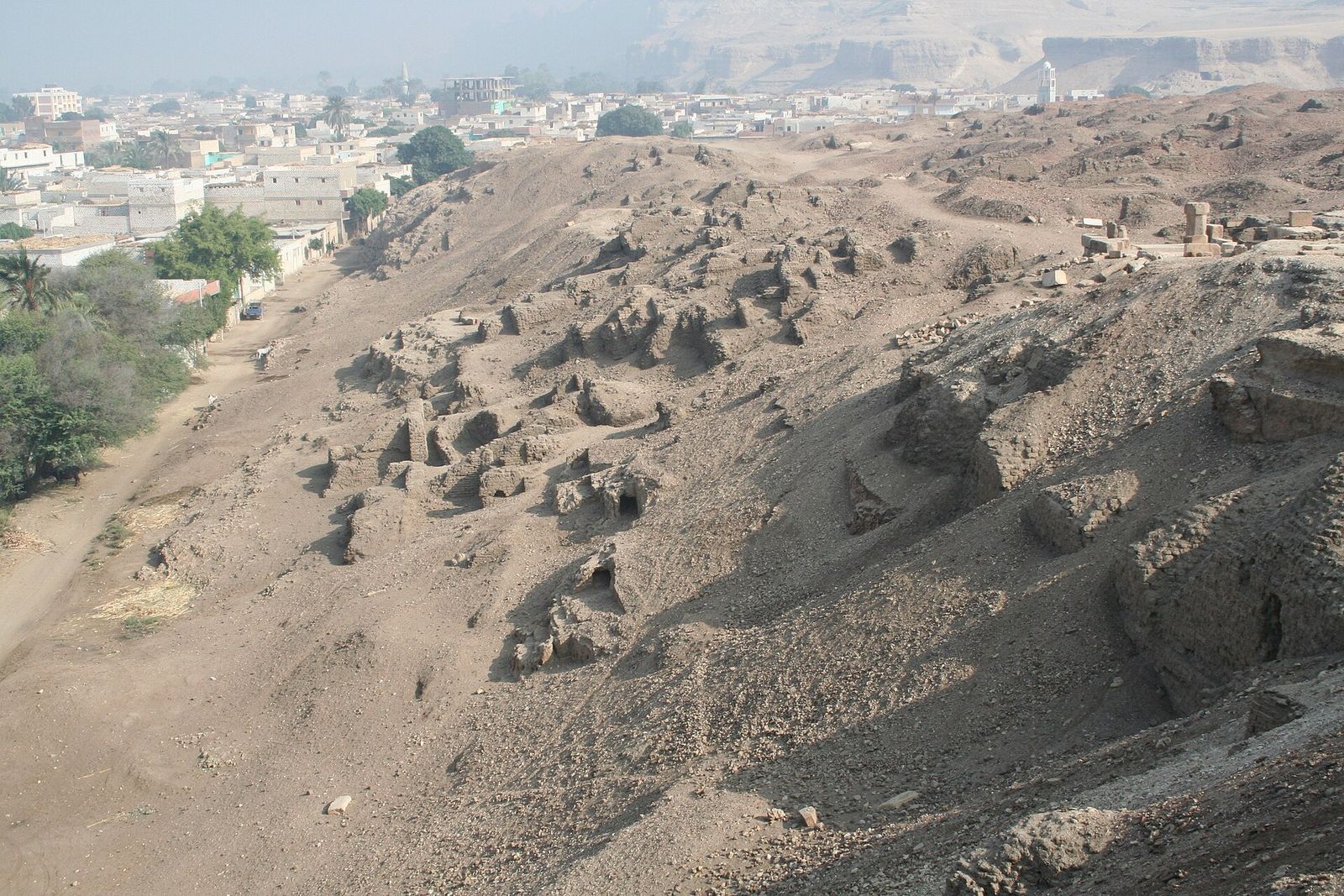
Akoris’s monuments and archaeological remains extend for about 3 km across desert ground and limestone rock. The site includes rock-cut tombs and temples, settlement remains, funerary features, and inscribed monuments. Much of its architecture was cut into the local limestone.
Landscape and layout
The site lies southeast of Ṭihnā al-Ǧabal, about 12 km north of Minya, on the Nile’s east bank. Limestone cliffs rise at and above the archaeological area. The valley of al-Wādī aṭ-Ṭihnāwī divides the eastern cliffs, while the southern rock formation resembles a reclining lion. Local stone is white, calcified limestone containing abundant fossilized marine organisms.
Rock-cut tombs and temples
Fraser Tombs
The Fraser Tombs lie about 2 km south of Akoris. They are cut into the rock, and some are large chamber tombs with rooms excavated into the limestone.
Temple of Amun
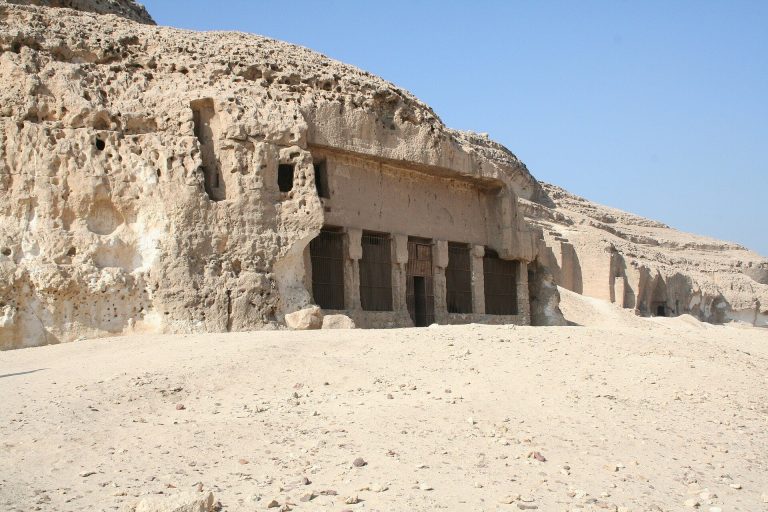
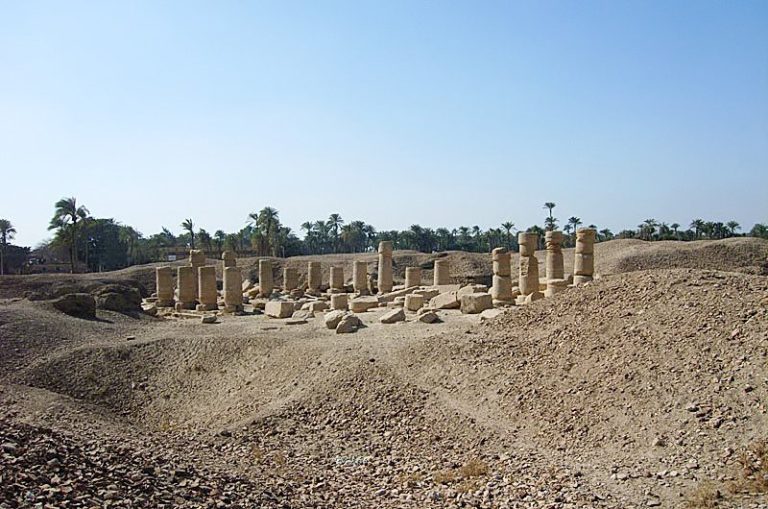
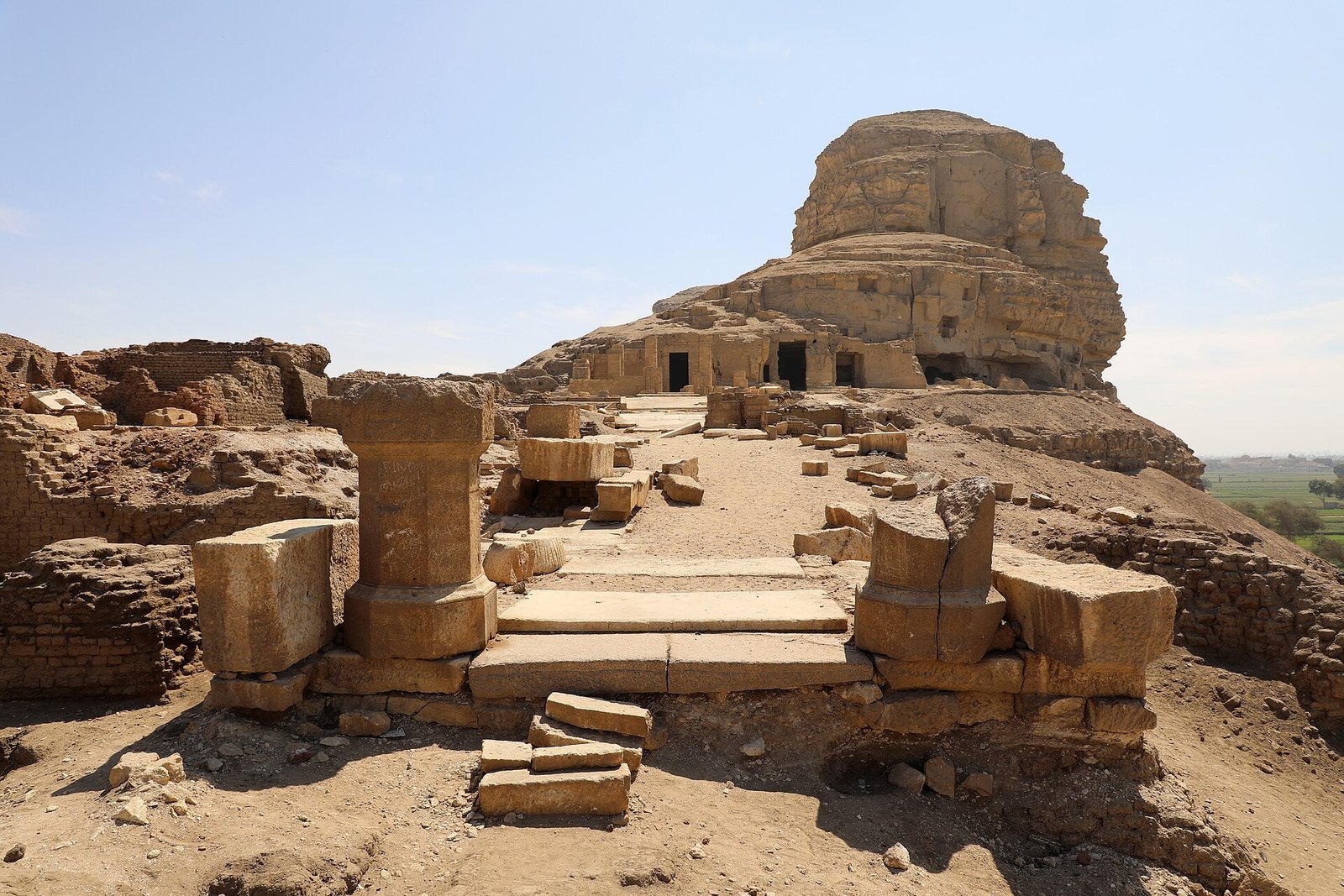
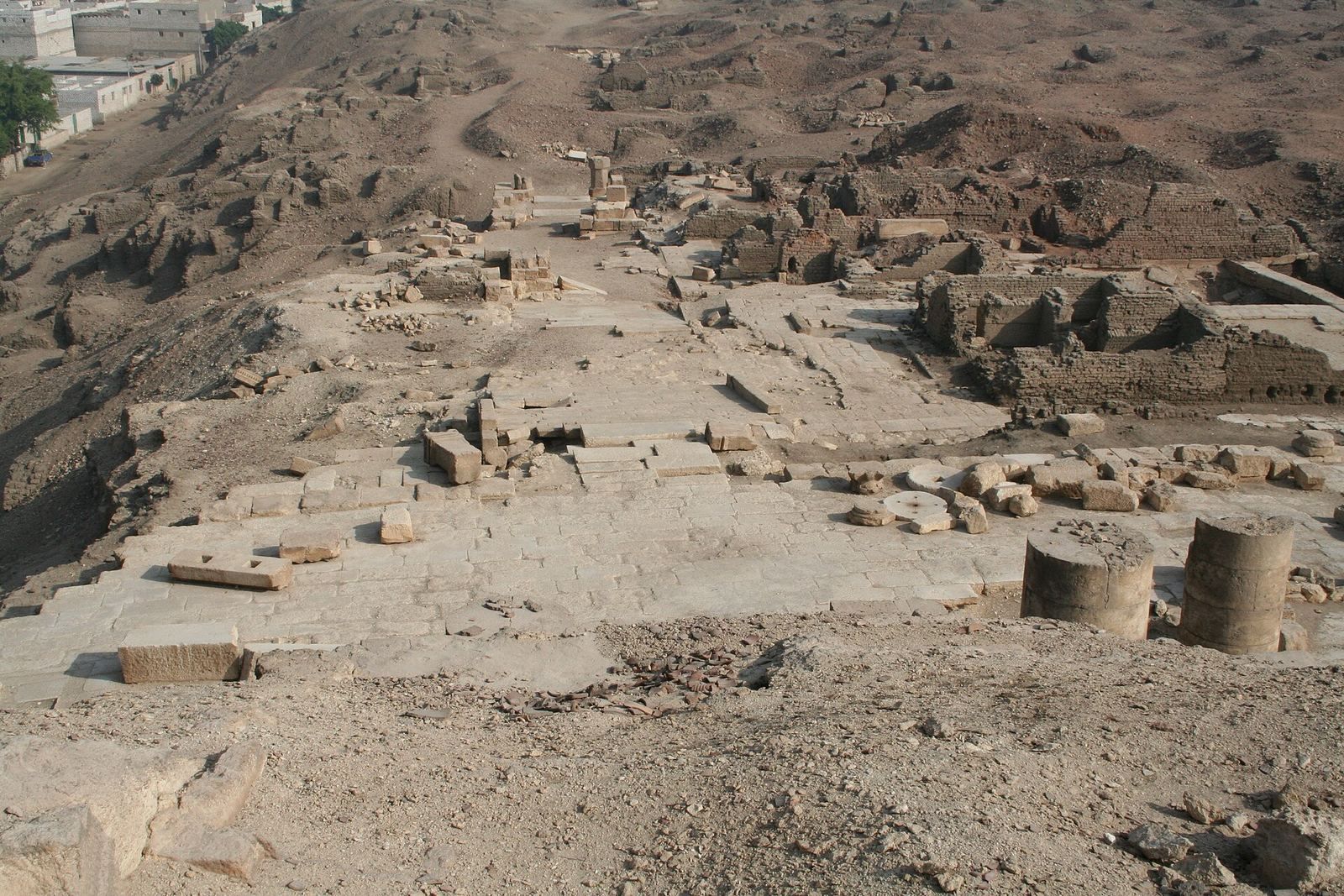
The Temple of Amun, also called Temple B, occupies a chamber tomb cut into the rock. Four chambers follow one another, with an altar in the last; the first retains the original tomb shaft. In front of the rock-cut chambers, a later addition includes an approach ramp and a hall supported by eight pillars. The hall entrance bears scenes of Nero making offerings. Fragments of horizontal stone beams above the pillars show Sobek, Thoth, and either Isis or Mut in offering scenes associated with Nero or, possibly, Germanicus.
Temple of Sobek
Immediately south of the Amun temple stands the pre-Ptolemaic Temple of Sobek, also known as Temple C or Rock Chapel C. It was cut into a large chamber tomb. The surviving remains include four pillars arranged around the tomb shaft, with an image of Hathor among them. An inscription on a door jamb identifies the god worshipped in the temple, and a statue niche sits at the rear.
Settlement and funerary remains
Settlement and burial areas
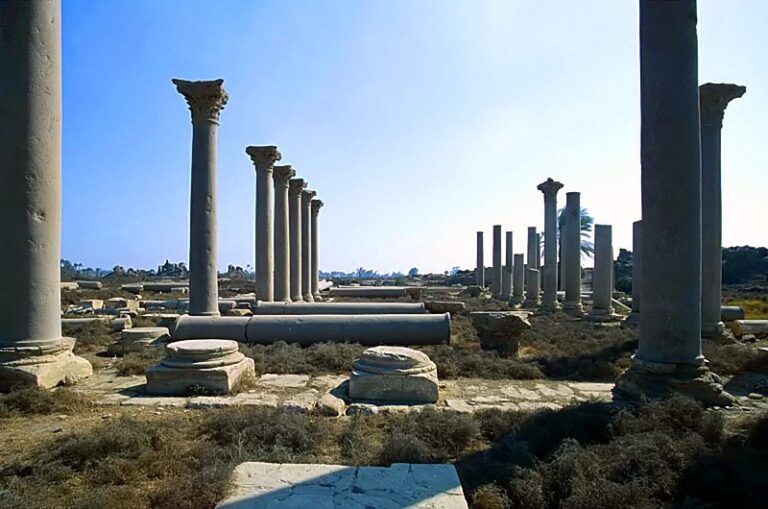
Remains of a Roman settlement are visible in front of the temples. Other funerary features include a Greek chapel once called the Roman Temple and a Greek-Roman necropolis.
Stelae and finds
Rock stelae
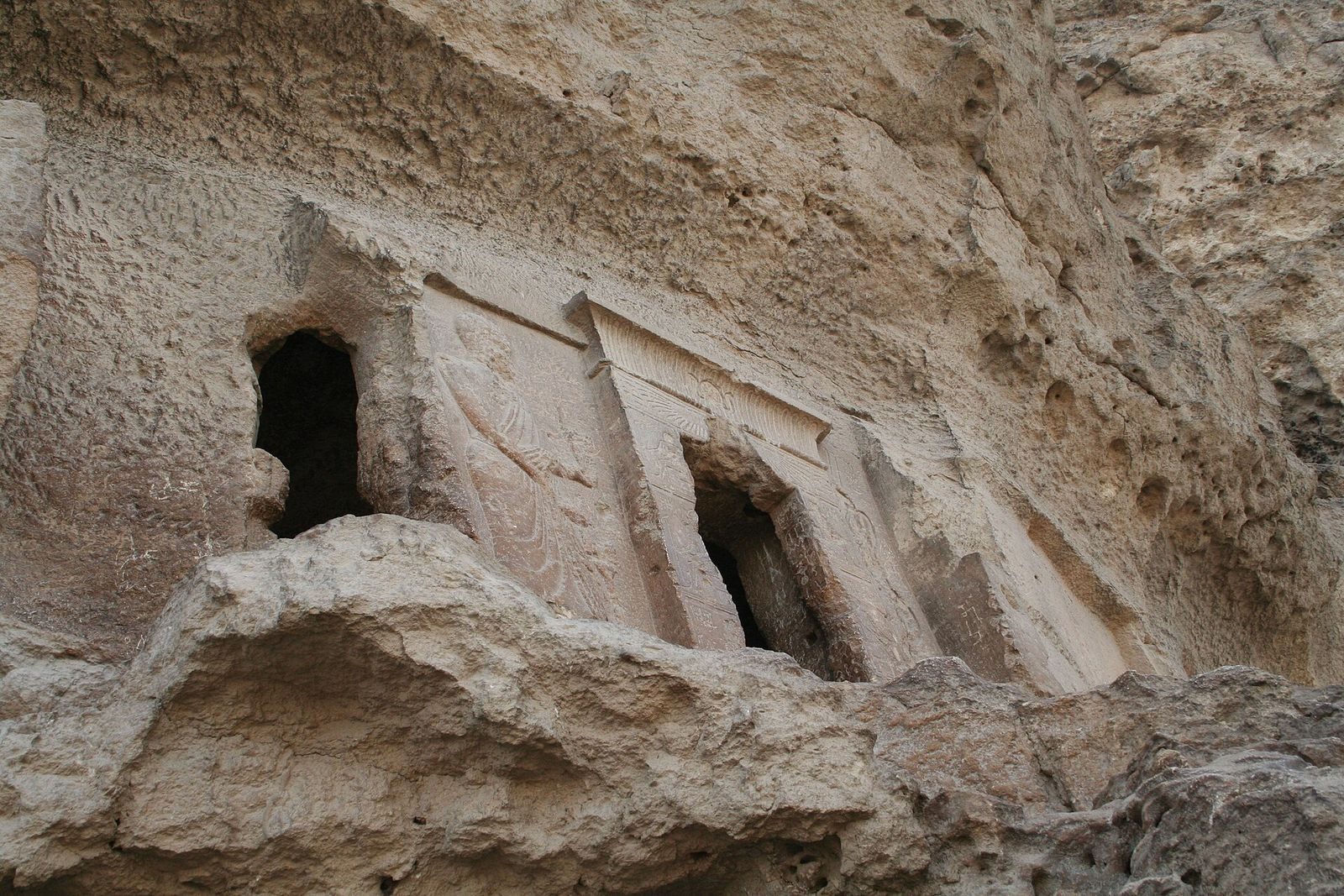
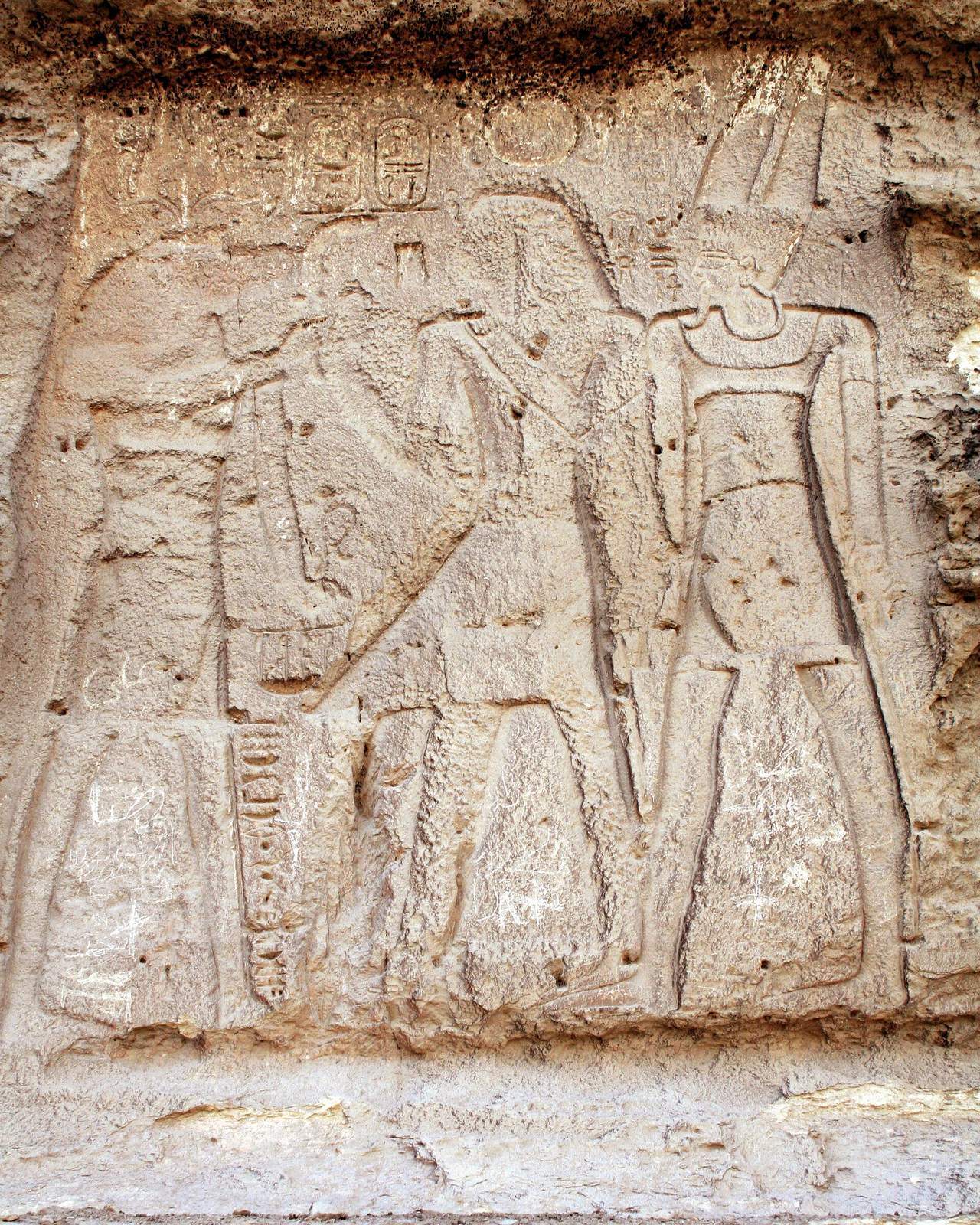
Two rock stelae of Ramesses III are among the monuments. One stands farther south than the temples and depicts the pharaoh before Sobek-Re, accompanied by Amun, Lord of Shana. Other monuments include a stela of Ptolemy V and one showing Diana, a Roman goddess, with Castor and Pollux, twin figures in Greek and Roman mythology.
Boat model
A finely made wooden boat model dating to the Middle Kingdom survives in fragments.