Acinipo: An Ancient Roman City near Ronda, Spain



Site at a Glance
- Rating
- 4.3
- Popularity
- Medium
- Country
- Spain
- Primary era
- Classical
- External website
- Open
- Eras represented
- Stone Age, Bronze Age, Classical
- Civilizations
- Celtic, Roman
- Site type
- City
On this page12 sections
History
Acinipo is an ancient city in Spain, near Ronda in Málaga Province, whose greatest development took place under Roman rule, especially during the late first century AD. Occupying a high limestone elevation in what was Hispania Baetica, the Roman province in southern Iberia, it grew beside trade routes and fertile agricultural land. Its theater, surviving urban remains, and evidence of coin production reflect the importance it acquired in antiquity.
Prehistoric occupation
Human occupation at Acinipo began in the Neolithic period. Later Copper Age and Bronze Age communities left circular huts, whose remains were found during archaeological excavations. These early settlements established a long-lived pattern of occupation on the elevated site before the city became associated with Roman political and urban development.
Roman foundation and growth
The foundation of Acinipo is not firmly established. Some historians connect its creation with the period after the Battle of Munda in 45 BC, fought during the final phase of Julius Caesar’s civil war against the supporters of Pompey the Great. The location of Munda remains disputed. Some Spanish historians place the battle near Ronda, while Pliny the Elder, a first-century AD Roman author, located it at Osuna.
Acinipo is generally regarded as a settlement established for retired veterans of Julius Caesar’s legions. Arunda, the separate settlement that later became Ronda, was a different Roman outpost and may have been founded earlier for veterans of Pompey’s legions. The two communities coexisted for centuries, although Acinipo was later known as Ronda la Vieja, meaning “Old Ronda.”
Acinipo reached its greatest prosperity during the Roman period. Major construction occurred particularly from the late first century AD, when its strategic position, access to trade routes, and productive surroundings supported urban expansion. The city also possessed the privilege of minting coins. Its name appears in ancient written references, on coins, in an inscription, and in the record of the Council of Iliberis, an early Christian council held in Roman Hispania.
Name and ancient references
Ptolemy, a second-century AD Greco-Roman geographer and astronomer, described Acinipo as a town of the Celtici in Hispania Baetica, situated on a high mountain. Pliny the Elder also mentioned the city. The name Acinippo has been interpreted as a combination of Acini, probably referring to inhabitants of a peak or hilltop, and ippo, a Tartessian word for “city.” Tartessian was an ancient language associated with the southwestern Iberian Peninsula. The grape clusters shown on Acinipo’s coins may have encouraged Roman readers to associate acini with grains of grapes.
Decline and later recognition
Acinipo began to decline during the third century. By the fourth century it had lost regional importance, and Arunda assumed authority in the surrounding territory. Ceramic finds and archaeological research indicate that occupation may have continued until no earlier than the seventh century.
Sixteenth-century scholars, including the Spanish historian Lorenzo de Padilla, studied the ancient settlement. In 1650, Fariña del Corral identified the surviving theater as Roman. Archaeological excavations have since exposed prehistoric occupation and parts of the Roman city. Spain designated Acinipo an Asset of Cultural Interest in 1981, recognizing its archaeological value. The theater also continues to serve as a performance venue, extending one of the site’s ancient functions into the present.
Remains
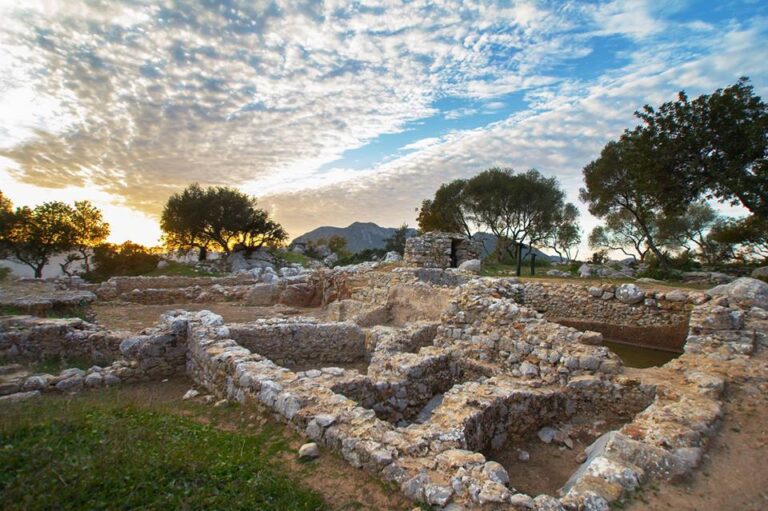
Acinipo occupies a steep limestone elevation of Tertiary geological origin at approximately 1,000 meters above sea level. The settlement was arranged across terraces that accommodated the slope. Its remains extend over the former high plateau and along the southern descent of Las Mesas, where four archaeological complexes lie between approximately 920 and 980 meters in elevation. The surviving features include a theater, partially excavated baths, domestic and economic buildings, a perimeter wall, and a cistern foundation.
Public buildings
Theater
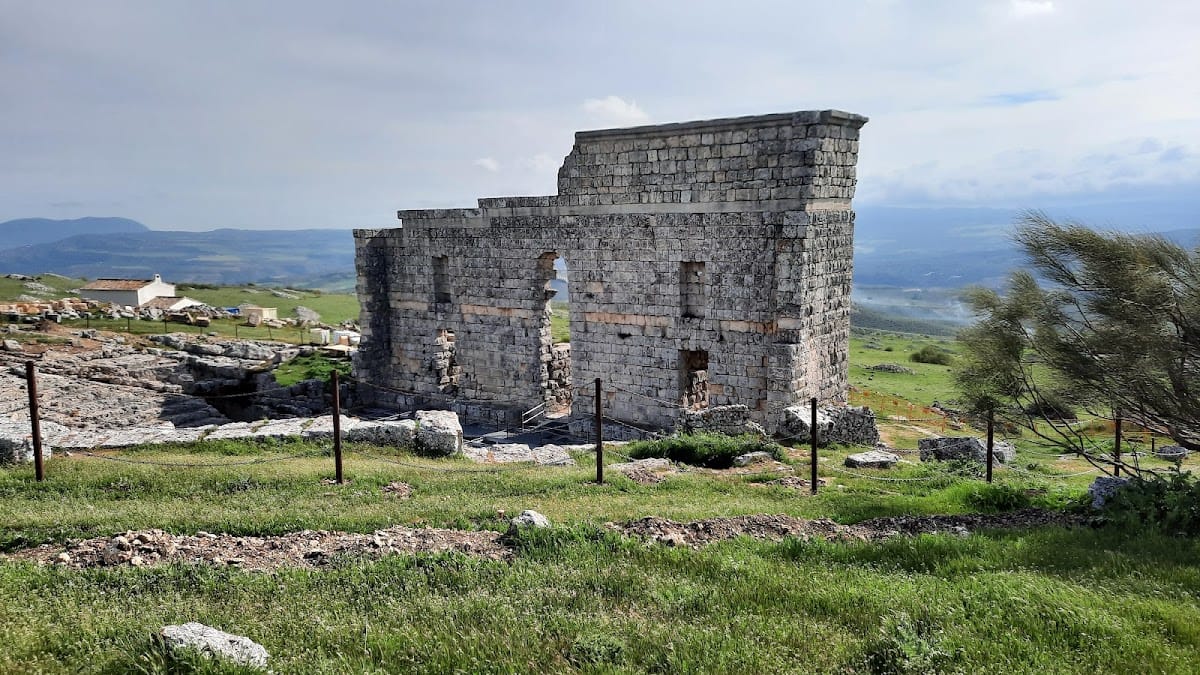
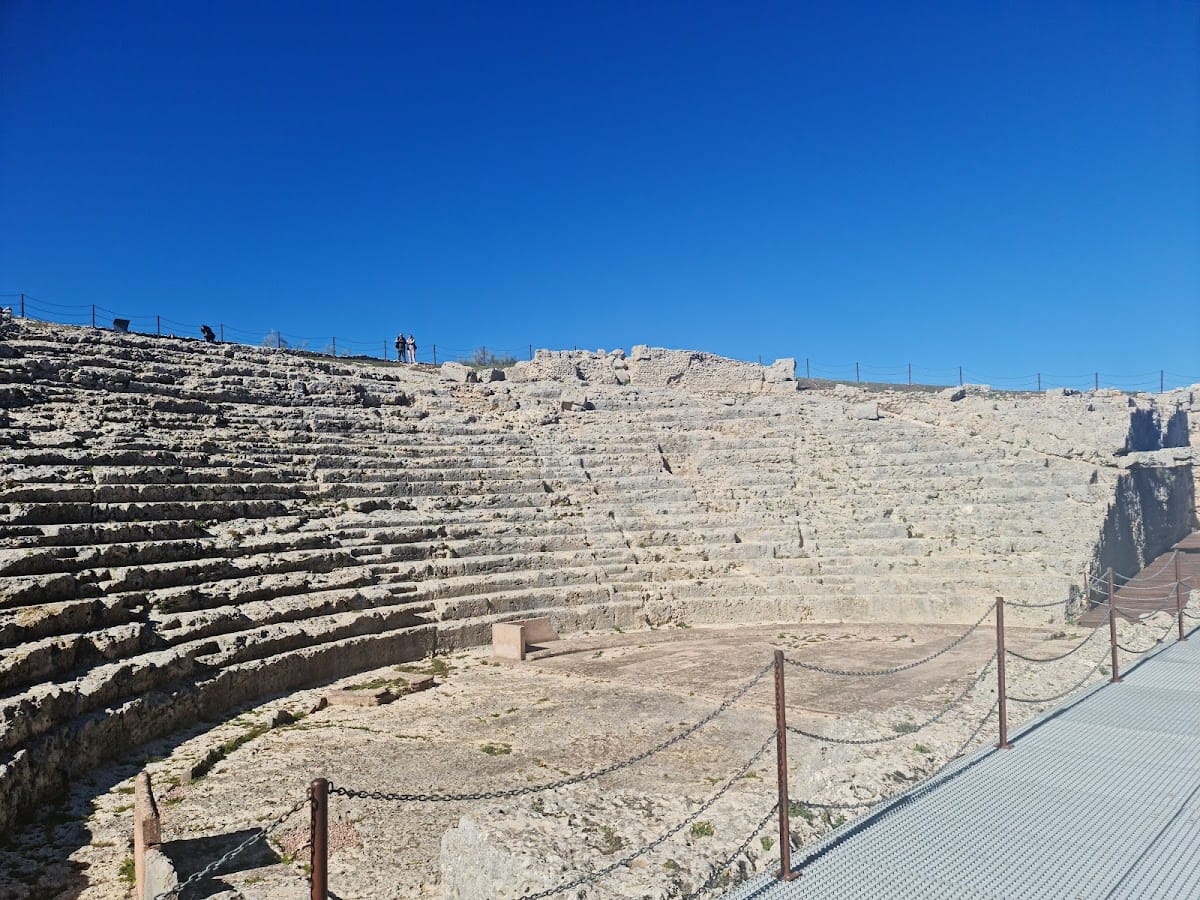
The theater is the best-preserved part of Acinipo. Its seating area uses the natural slope and was cut directly into the bedrock, creating the stepped space for the audience. Stone removed while cutting the seating area was used to build the stage wall, which still stands through almost its entire height. Many of the wall’s most representative architectural elements have disappeared, while the perimeter wall has also been lost. Two lateral entrance passages, known as vomitoria, originally provided access to the seating area.
Baths
The baths stand in the lower part of the city and have been only partly excavated. Their construction date remains uncertain. The exposed rooms include a caldarium, a hot room in a Roman bath complex, and a tepidarium, a warm room, together with other chambers, water conduits, and architectural elements such as columns. These remains show the presence of a public bathing complex within the terraced urban settlement.
Urban enclosure and settlement remains
Perimeter wall
A wall enclosed the entire perimeter of Acinipo. Sections survive at ground level, but the original height is unknown. Most of the city’s presumed circular towers have disappeared, although part of one tower remains visible above ground.
Domestic, economic, and water structures
Numerous ruins and foundations belong to domestic and economic buildings spread across the settlement. Their surviving bases form part of the archaeological complexes on the plateau and slopes. A cistern is represented by a surviving foundation, adding evidence of the systems that supported urban occupation on the elevated site.