Fraumünster: A Former Benedictine Abbey and Church in Zürich
Site at a Glance
- Popularity
- Very High
- Country
- Switzerland
- Primary era
- Medieval
- Eras represented
- Medieval, Early Modern, Modern
- Civilizations
- Carolingian, Holy Roman Empire, Swiss
- Site type
- Religious
- Remains
- Church
On this page17 sections
History
Fraumünster is a historic church and former Benedictine women’s abbey in Zürich, Switzerland. Its name combines Frau, meaning “women’s,” with Münster, a term for a major church. Founded by the East Frankish king Louis the German in 853, the abbey became a centre of religious and political authority. Work on its church began during the ninth century, and the building was remodelled in Gothic style from the mid-thirteenth century.
Foundation and royal endowment
A foundation legend tells of Louis’s daughters Hildegard and Bertha living in seclusion at Baldern on the Albis. While travelling through a dark forest to a chapel in Zürich, they followed a stag whose antlers shone with light. The animal led them to a place beside the Limmat where they wished to build a church. In the historical account of the foundation, Louis established the abbey on 21 July 853 by placing an existing small monastery under the authority of Hildegard, his eldest daughter. Bertha succeeded her after her death.
The royal endowment included the estate at Zürich, lands in Uri, the estate at Cham, forests on the Albis and Sihl, and property at Horgen, Langnau and in the Reppischtal. Issued by the royal chancery at Regensburg, the foundation charter is the earliest written document in the State Archive of the Canton of Zürich. The women admitted to the community were mainly of high noble birth and paid a dowry. They followed the Benedictine Rule, a guide to communal religious life, but could leave the house and marry. A restriction to women descended from counts appears to have been customary for centuries; Pope Innocent VII confirmed it in a bull of 6 February 1406.
The institution was known in its early centuries by titles meaning “Monastery of Zürich” and “Abbey of Felix and Regula.” The German word Münster appears in records from 1267, while Fraumünster came into use in the first half of the fourteenth century. Zürich’s oldest written city law called it “God’s House in Zürich”; “God’s House at Fraumünster” was also used from the fourteenth century until 1524.
Abbey power and the city
After the Carolingian dynasty ended, an imperial bailiff, an official acting for the emperor, was appointed to protect the abbey and its rights. The office passed to the dukes of Zähringen after 1097, to the counts of Lenzburg around 1153, and back to the Zähringen after the Lenzburg line ended in 1173. Emperor Henry III granted the abbess the rights to levy tolls, hold markets and mint coins, making her Zürich’s effective ruler. Henry V confirmed these privileges in 1114. At Christmas 1055, King Henry IV celebrated his engagement to Bertha of Savoy in the abbey church.
The abbey reached the height of its authority in the thirteenth century. In 1218 Frederick II placed it under direct imperial authority, so it answered to the emperor rather than an intermediary lord. Zürich citizens then held the imperial bailiwick in two-year terms, giving the abbey more freedom of action. Before 1234, Frederick’s son Henry (VII), acting as his governor, raised Abbess Judenta von Hagenbuch to princely rank. The prince-abbesses combined leadership of a religious house with the political standing of a prince. Elisabeth von Wetzikon, abbess from 1270 to 1298, was a prominent holder of that office.
The abbey’s lands and income extended well beyond the church. Its holdings included the Zürich court estate, lands between the Limmat and Sihl, the Stadelhof estate from the lakeshore to the Glatt valley, and properties at Cham and on the Albis. It also held estates across the Zürich area, in the Haslital and Uri, and in Alsace. In Uri, its rights included church patronage, the right to present candidates for church posts, and associated tithes, payments traditionally used to support churches. By the extent of its holdings, it was the most important monastery in what is now Switzerland, surpassing St Gallen and Reichenau.
Within Zürich, the abbey owned houses, courtyards and gardens on both sides of the Limmat, as well as all the mills on the Sihl and Limmat. It also owned the ground beneath towers held by service nobles such as the Mülner, Manesse and Biber families. Market, toll and minting rights brought further income. Its earliest surviving coins date to around 1100 and circulated in the Thurgau, the medieval region around Zürich known as the Zürichgau, and the Aargau as far as Hauenstein, except around Lake Constance. The minting right was later leased and eventually passed to the city, though it legally remained with the abbey until its dissolution.
Loss of authority and religious change
Zürich gained some self-government from the abbey in 1262. In political changes led by Rudolf Brun in 1336, the abbey lost the right to appoint the city’s chief magistrate and its lower judicial authority. It retained the power of clemency, however, which allowed it to overturn city court sentences. Zürich took control of the imperial bailiwick definitively in 1400.
By the late medieval period, the community had declined and was at times reduced to three women. Its members lived in separate residences with servants, could wear permitted secular clothes, and could leave to marry; choir prayer remained their principal monastic obligation. In 1406 Innocent VII described Fraumünster as a secular church rather than a monastery, while confirming the women’s status. Zürich’s council repeatedly sought changes to the community’s way of life.
Dissolution and later use
On 30 November 1524, during the Reformation associated with the Swiss theologian Huldrych Zwingli, the last abbess, Katharina von Zimmern, dissolved the community and handed its rights and property to Zürich’s council. The city managed the former abbey lands through the Fraumünster office and directed the income to its treasury. Until the Reformation, Fraumünster, the Wasserkirche and the Grossmünster formed a processional route linked to Zürich’s patron saints, Felix and Regula. The church now belongs to the Evangelical Reformed Church of the Canton of Zürich and is one of the city’s four principal old-town churches.
The former monastic buildings continued to serve civic and educational purposes. The west wing housed the humanities college Collegium humanitatis from 1601 to 1832. In 1715 the abbey’s grain store became a music hall, and a school was later established in vacant monastic buildings. In 1898 the complex was demolished to make way for Zürich’s new Stadthaus; the nearby Münsterhof takes its name from the abbey.
Nineteenth-century work brought medieval wall paintings to light, and the artist Franz Hegi made watercolor copies. During a thorough renovation in 2006–07, workers removed a film-forming paint applied in 1979, allowing surviving medieval wall and ceiling paintings to be examined and conserved. The church is designated Swiss cultural property of national significance, Class A.
Remains
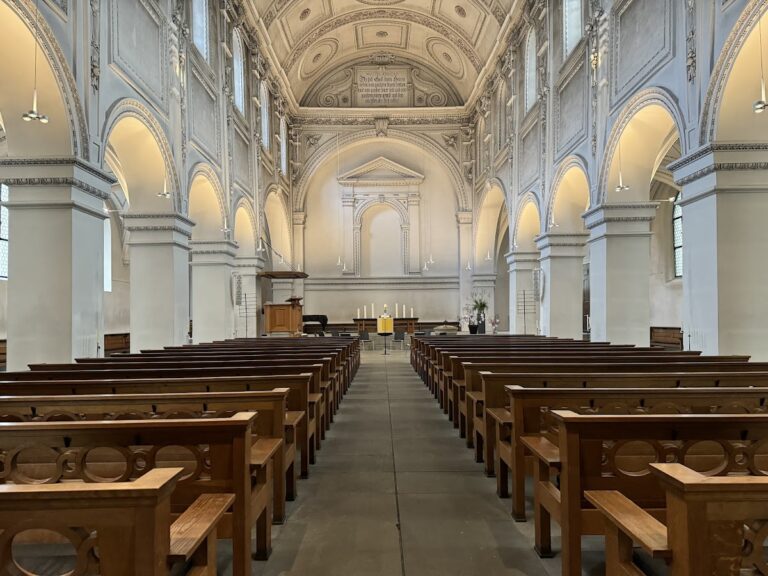
The surviving church brings together early foundations and later Gothic work. Its principal spaces include a nave, the main body of the church, and a choir near the altar; the crypt lies below the choir. The former monastic precinct has been largely transformed, but parts of its cloister survive in the Stadthaus courtyard. Within the church, stained glass, paintings, an organ and a set of bells reflect different periods of its history.
Church fabric and crypt
Choir, nave and towers
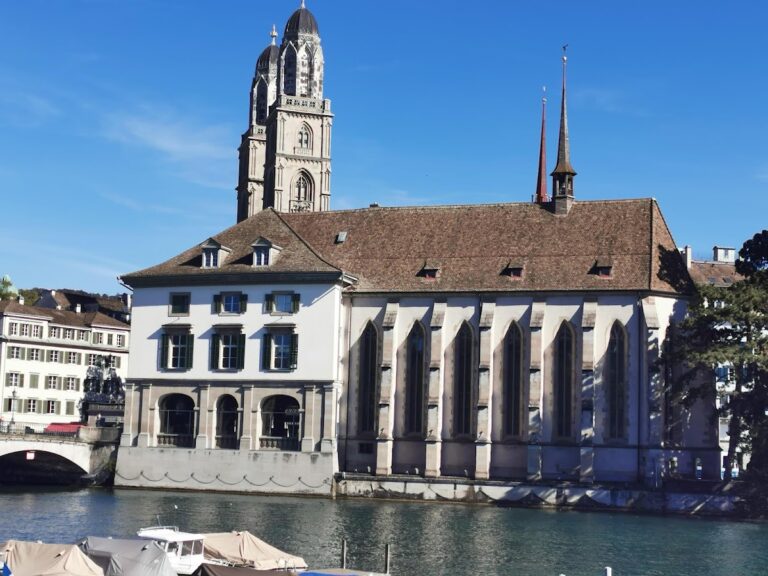
The church was consecrated on 11 September 874 by Gebhard, Bishop of Constance, under the patronage of Felix and Regula. The church’s form changed in a Gothic remodelling that began in the mid-thirteenth century. Its choir dates to 1250–1270, while the nave received its last remodelling in 1911. A preaching pulpit was installed in 1544.
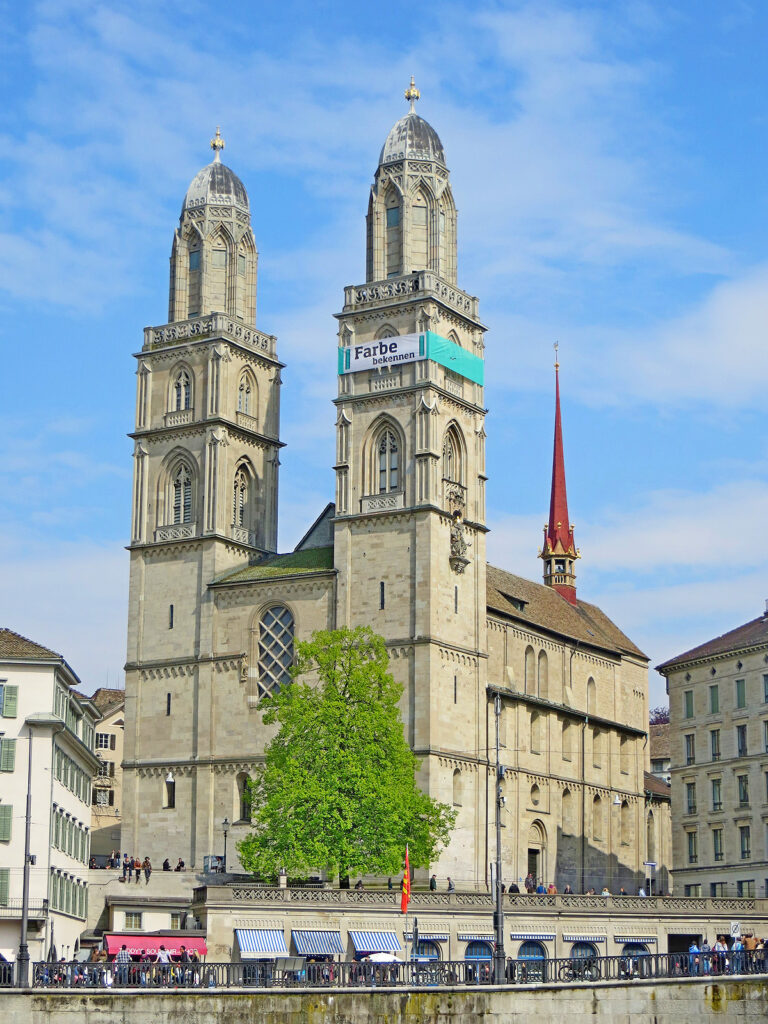
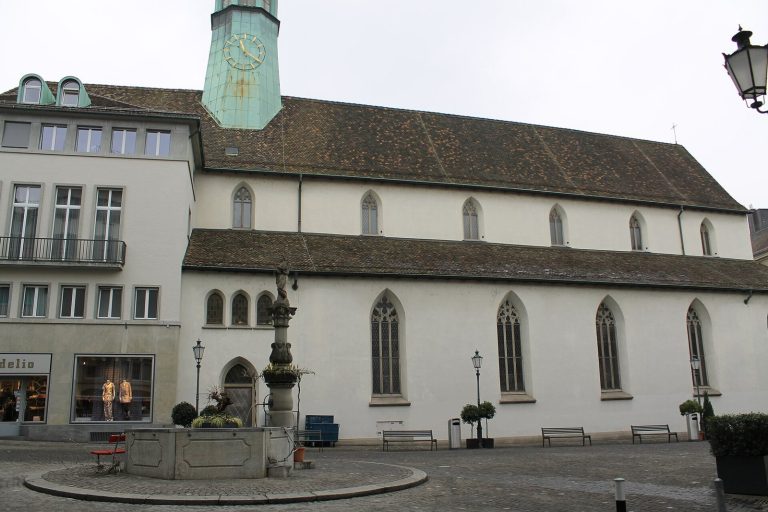
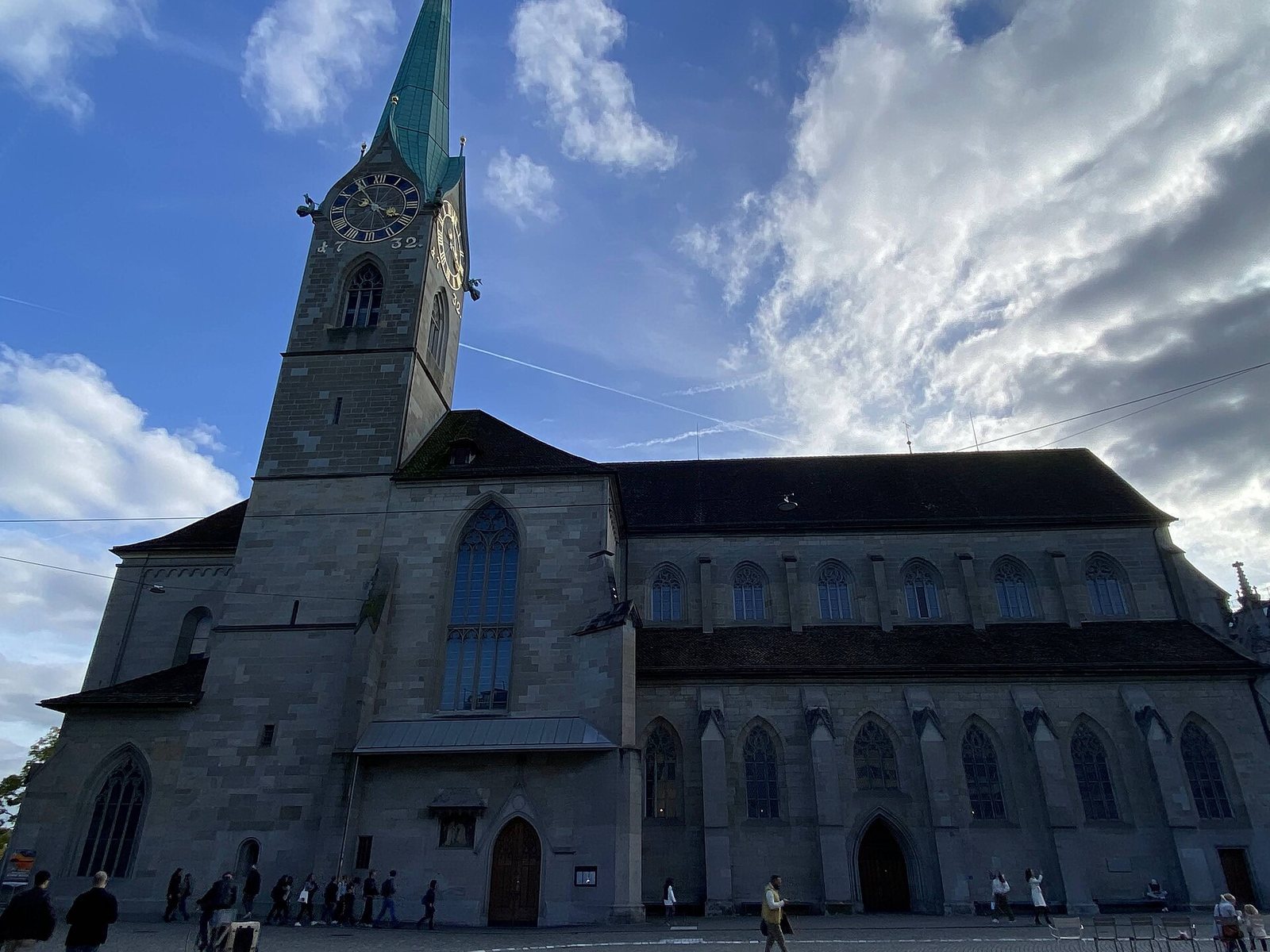
Two towers were constructed, one in 1150 and another in 1250. The southern tower was demolished in 1728, and the northern one was heightened in 1732. In 1898 city architect Gustav Gull added entrances on the west and east sides and closed the earlier entrances facing Münsterhof. A later redesign of the square partly reversed the change; the principal entrance now faces the pedestrian square.
Crypt
The crypt beneath the choir retains foundation fragments dating to the ninth century. Its exhibition presents the church’s development from its early Romanesque phase, a style associated with rounded arches and heavy masonry, to its present Gothic appearance. Sealed after a renovation in 1900, the crypt opened to the public in 2016 with an exhibition about the church, local history and the Reformation.
Windows, paintings and church furnishings
Stained-glass windows
Five choir windows by Marc Chagall have been in place since 1967. Their dominant colors identify the subjects: red for the Prophets, blue for the Law, green for Christ, yellow for Zion and blue for Jacob. Their imagery includes Elijah’s ascent to heaven, Moses looking upon his suffering people, scenes from Christ’s life, an angel sounding a trumpet at the end of the world, and Jacob’s struggle and dreams of heaven. Chagall also designed a window for the south transept’s large circular rose window in 1978.
The north transept contains Augusto Giacometti’s nine-metre-tall stained-glass window Heavenly Paradise, dated 1945.
Foundation paintings
A medieval painting of the foundation legend, probably made around 1300, was located in the south transept and is now largely destroyed. A foundation-legend fresco associated with Abbess Elisabeth von Wetzikon’s period, 1270–1298, was whitewashed during the Reformation. Rediscovered in the mid-nineteenth century, it was copied by Franz Hegi and then whitewashed again, destroying it. During renovation work in the 2000s, a colored image panel was placed in the abbesses’ tomb niche, where the original fresco had been found.
Organ
The church organ contains 5,793 pipes and is the largest in the Canton of Zürich. Genf AG built its main organ in 1953 with 82 stops, which select sets of pipes, across four hand-operated keyboards and a foot-operated pedal. The instrument has visible pipes at its front and electric mechanisms for its keys and stops. The choir organ, built in 1971 by Manufacture d’Orgues Muhleisen of Strasbourg, has 13 stops, two keyboards and a pedal. Its mechanical controls allow it to be played remotely from the main organ.
Bells
Five bells hang in a wooden frame in the tower. Jakob Keller cast the four larger bells at Unterstrass in 1874. They were tuned a semitone lower because their sound did not fit Zürich’s city peal. The smaller fifth bell, cast by the Rüetschi foundry in Aarau, filled the open compartment in 2007. Its crown handles show Huldrych Zwingli and Katharina von Zimmern. The bell carries the inscription “Come to me, all you who are weary and burdened, and I will refresh you,” with a German version as well. Since 2007, the bells have sounded B-flat 0, E-flat 1, G 1, B-flat 1 and C 2.
Former monastic precinct
Cloister and burial ground
The former cloister included a burial ground, and its oldest surviving arches date to the twelfth century. Parts of the Romanesque cloister were reused in the Stadthaus courtyard. Between 1924 and 1934, Paul Bodmer painted a fresco cycle in the cloister based on the foundation legend and the stories of Felix and Regula.
Abbess’s courtyard and grain store
A fountain dated 1742 stood in the abbess’s courtyard. The abbey’s grain store, known as the Haberhaus, stood on the courtyard’s right and was converted into a music hall in 1715. The Stadthaus now occupies the site, where a monument to Katharina von Zimmern also stands.