Luzhetsky Monastery: A Fortified Russian Orthodox Monastery in Mozhaysk


Site at a Glance
- Rating
- 4.8
- Popularity
- Low
- Country
- Russia
- Primary era
- Early Modern
- External website
- Open
- Eras represented
- Medieval, Early Modern, Modern
- Civilizations
- Russian
- Site type
- Religious
- Remains
- Fortified Monastery
On this page16 sections
History
Luzhetsky Monastery, also known as the Nativity of the Theotokos and St. Therapont Luzhetsky Monastery, is a Russian Orthodox monastery in Mozhaysk, Russia, founded in 1408 by St. Therapont of Belozersk. It became a fortified monastic complex on the western frontier of the Muscovite state, and its surviving buildings preserve architectural phases from the sixteenth through the nineteenth centuries.
Foundation and medieval development
Prince Andrey of Mozhaysk invited Therapont to establish the monastery eleven years after the monk had founded Ferapontov Monastery at White Lake. Therapont, a disciple of Sergius of Radonezh, became the new community’s first archimandrite, a senior rank of Orthodox monastic clergy traditionally responsible for supervising a monastery.
The dedication to the Nativity of the Theotokos was selected by Therapont and held particular importance for Prince Andrey. The Theotokos is a title for Mary, the mother of Jesus, while the Nativity of the Theotokos commemorates her birth. The dedication was connected by tradition with the 1380 Battle of Kulikovo, where Andrey’s father, Grand Prince Dmitry Ivanovich, fought on Kulikovo Field. Tradition also says that Andrey’s mother, Grand Princess Eudoxia, later founded a church dedicated to the Nativity of the Theotokos in the Moscow Kremlin in memory of the battle.
Therapont died at the monastery in 1426, aged ninety-five, and was buried beside the north wall of the cathedral. The Russian Orthodox Church canonized him in 1547. The monastery’s medieval history remains partly unclear, although its later religious and military roles are more fully defined.
Fortress and wartime damage
During the sixteenth century, Makary, who later became Metropolitan of Moscow, served as the monastery’s hegumen, or abbot. The monastery also operated as a defensive stronghold. Its fortifications were strengthened under Boris Godunov, but Polish and Lithuanian forces repeatedly damaged and plundered the complex during the Time of Troubles, a period of political crisis, dynastic conflict, foreign intervention, and warfare in Russia in the early seventeenth century.
The fortified site suffered another brief occupation and looting in 1812, when the advancing French army entered Mozhaysk during the Napoleonic Wars. A three-day celebration marked the monastery’s five-hundredth anniversary in 1908. Its principal ceremony took place on 27 May according to the Old Style calendar, which follows the Julian calendar.
Closure, deterioration, and revival
Revolutionary and Soviet changes brought a prolonged interruption to monastic life. In 1918, soldiers from a guard company were housed in the residential building. The monastery officially closed in 1922, while the cathedral continued as a parish church until 11 November 1929. In 1926, its library, archive, and sacristy objects were transferred to a local museum.
During the Soviet period, the complex was plundered, damaged, and abandoned as a religious institution. Before the Second World War, a fittings factory and a medical-equipment workshop operated in its buildings. Garages with inspection pits and storage structures occupied the monastic cemetery, communal apartments were installed in the cells, and another part of the complex housed a military-unit canteen and club. A prisoner-of-war camp was established there during the German occupation.
Restoration under architect-restorer N. I. Ivanov took place from 1961 to 1964 and focused chiefly on the cathedral. The monastery was returned to the Russian Orthodox Church in 1994, and the first episcopal service after the interruption was held on 23 October that year. On 26 May 1999, the relics of St. Therapont were recovered and placed in the Cathedral of the Nativity of the Theotokos. A bell weighing more than 2.5 tonnes was installed in April 2015, when the bell tower was also reconstructed. The monastery is a federal-level cultural heritage monument of the Russian Federation.
Remains
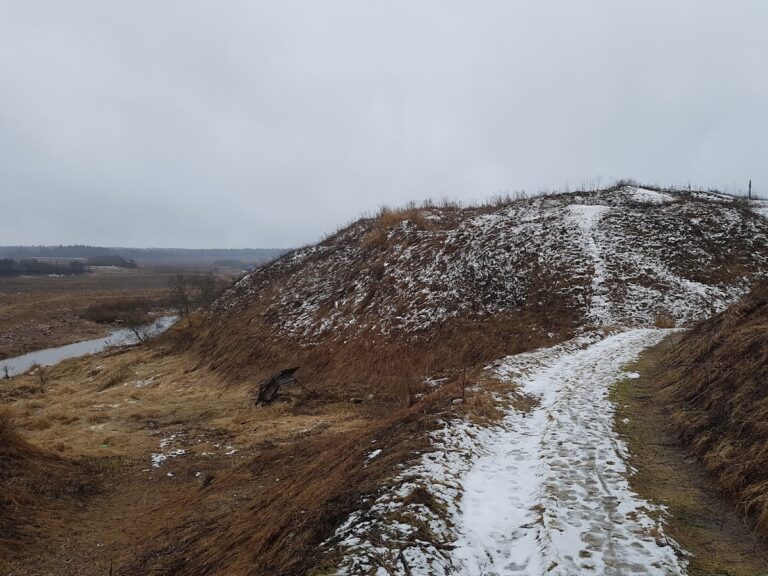
Luzhetsky Monastery occupies the high right bank of the Moskva River on the outskirts of Mozhaysk. Its surviving fortified ensemble combines churches, monastic residences, gates, towers, burial features, and remains from several centuries. The main stone enclosure dates from the late seventeenth century, while the principal churches and later additions reflect continued rebuilding through the eighteenth and nineteenth centuries.
Churches and religious buildings
Cathedral of the Nativity of the Theotokos
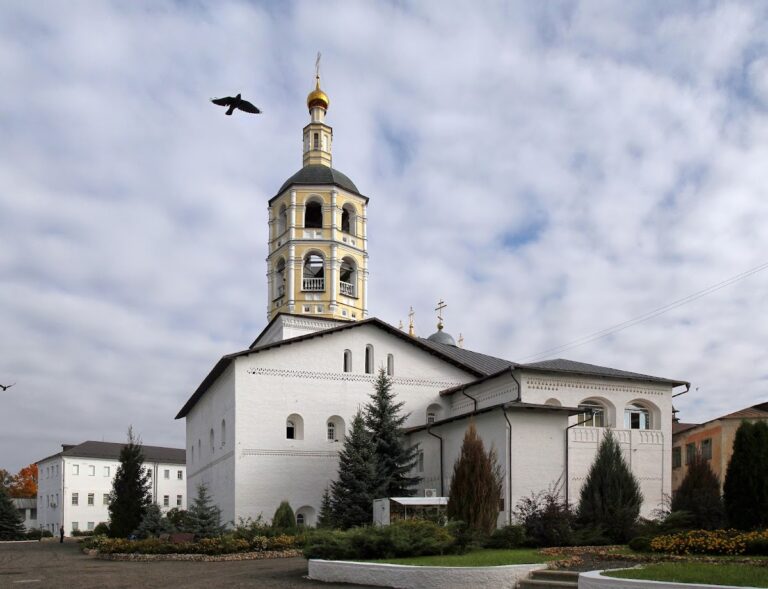
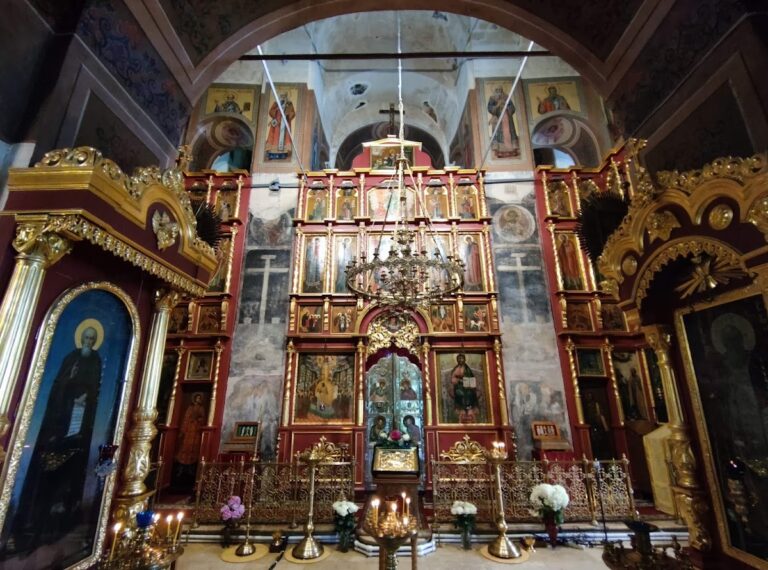
The stone Cathedral of the Nativity of the Theotokos replaced the monastery’s earlier stone cathedral during the first half of the sixteenth century. The surviving five-domed building was constructed in 1524–1547. Its interior and exterior form were affected by later changes, many of which were addressed during the restoration of 1961–1964.
That restoration removed later additions, restored the traditional gable roofs over the vaults, and covered the domes with wooden shingles. Later window openings were blocked, revealing older narrow slit windows in the facades and in the cylindrical structures supporting the domes. The relics of St. Therapont are kept inside the cathedral.
Church of the Presentation of the Theotokos
The Church of the Presentation of the Theotokos belongs to the first half of the sixteenth century and includes refectory chambers, rooms associated with the monks’ communal dining facilities. The building was reconstructed during the second half of the eighteenth century, giving the surviving structure a later phase of monastic use.
Gate Church of the Transfiguration
The Gate Church of the Transfiguration was built in 1603 above the Holy Gates, the monastery’s principal ceremonial entrance. Its position combines a religious dedication with the controlled entry point through the monastic enclosure.
Fortifications and monastic residences
Enclosure and towers
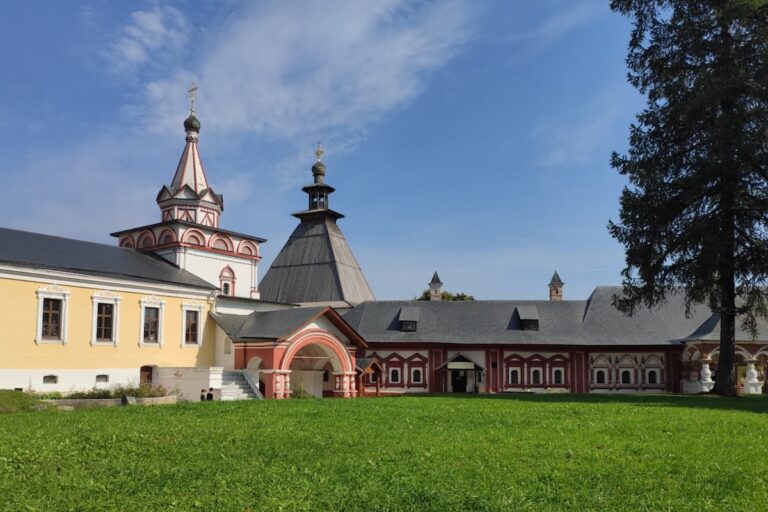
A stone enclosure with towers was erected in 1681–1684. The original arrangement included four round towers and two gates. A square tower was added at the northeastern corner in 1761–1768, and another round tower was constructed during the eighteenth century. Together, these elements preserve the defensive character that had shaped the monastery’s role on the Muscovite frontier.
Bell tower and Savelyov burial vault
The bell tower was built between 1673 and 1692 and incorporates the Savelyov family burial vault. It is a four-tiered structure approximately 35 metres high, crowned by a steep tent-shaped roof. Reconstruction work was carried out on the tower in 2015, alongside the installation of a new bell weighing more than 2.5 tonnes.
Cells and abbot’s building
The cells and abbot’s building date from 1681–1692 and underwent repeated rebuilding. The northern and southern cell buildings belong to the late nineteenth or early twentieth century. Other surviving access structures include the eastern entrance gates of 1780 and the service-yard gates built in 1890–1895. The foundation of the treasurer’s house also survives from the late nineteenth century.
Burial features and associated remains
Former Church of St. Therapont
The foundation of the former Church of St. Therapont remains within the monastery. The church was first built in the late sixteenth century as a dedication to St. John Climacus and was rededicated to St. Therapont in 1723. Demolition in the 1960s left the foundations, which were constructed with white-stone gravestones taken from a cemetery and marked with old forked crosses.
Other gravestones found while the grounds were being cleared form part of the surviving necropolis, a historic burial ground. A reconstruction project has been prepared for the former church and the cathedral gallery.
St. Therapont’s Well
St. Therapont’s Well lies in the nearby village of Isavitsy, about 100 metres from the monastery. The spring is associated with reputedly healing water and bathing pools. Tradition attributes its discovery to Therapont, although its original location is not marked on archival plans. Reliable references begin only in the late nineteenth or early twentieth century, and different springs may have been identified under the same association at different times.