Borovsk Monastery of St. Paphnutius: A Russian Orthodox Monastic and Fortress Complex


Site at a Glance
- Rating
- 4.8
- Popularity
- Medium
- Country
- Russia
- Primary era
- Early Modern
- External website
- Open
- Eras represented
- Medieval, Early Modern, Modern
- Civilizations
- Russian
- Site type
- Religious
- Remains
- Fortified Monastery
On this page13 sections
History
Borovsk Monastery of St. Paphnutius is a Russian Orthodox male monastery in Russia, on the outskirts of Borovsk at the meeting of the Istierma and Protva rivers. Founded by Paphnutius of Borovsk in 1444, it developed as a Russian Orthodox religious community and later as a fortified monastery whose surviving ensemble reflects building phases from the seventeenth to the nineteenth centuries.
Foundation and early development
A foundation tradition places Paphnutius’s arrival in the surrounding forests in 1405. A monastic community formed around him before the formal foundation of the monastery in 1444, when the Church of the Nativity of the Virgin was built for the growing brotherhood. Donations from boyars and grand princes brought the monastery considerable wealth. After Paphnutius was canonized in 1545, he became the monastery’s second patron.
After Paphnutius’s death, his disciple Joseph of Volokolamsk became abbot. Joseph later left the community when the brethren rejected a communal monastic rule, and he founded the Joseph-Volokolamsk Monastery. The Borovsk monastery also became a burial place for the Repnin-Obolensky princes, whose patronage contributed to its development. In 1670, Maria Mironovna, the wife of Boyar Boris Repnin, and their son, Prince Ivan, sponsored the Chapel of the Prophet Elijah.
Fortress, war, and religious conflict
During the sixteenth and seventeenth centuries, the monastery combined religious buildings with defensive walls and towers. Its position on a route toward Moscow gave it the character of a fortified border post. In 1610, during the Time of Troubles, a period of dynastic crisis, foreign intervention, and political conflict in Russia, the monastery was besieged by the Lithuanian-Polish forces supporting False Dmitry II, a claimant to the Russian throne.
Prince Mikhail Volkonsky led the defense, but treachery enabled the attackers to capture and burn the fortress. Several thousand defenders, monks, and civilians who had taken shelter there were killed. The dead included Ioasaph of Borovsk, a former archimandrite of the Trinity-Sergius Monastery. After the conflict, representatives of the monastery took part in the Zemsky Sobor of 1613, the representative assembly that helped choose a new tsar. Its abbot Jonah signed the charter electing Mikhail Romanov.
Religious disputes gave the monastery another place in Russian history during the seventeenth century. Abbot Pavel was considered for the patriarchal office in 1652, but Patriarch Nikon appointed him Bishop of Kolomna and Kashira instead. Pavel, several monastic leaders, and the Borovsk archpriest Polieukt opposed Nikon’s reforms, which changed Russian Orthodox liturgical practices, and supported communities that defended the old rites. Pavel and Polieukt were executed.
Avvakum, a prominent Old Believer archpriest and opponent of Nikon, was imprisoned at the monastery during part of the early 1660s. In 1673, Boyarina Feodosiya Morozova and her sister, Princess Evdokia Urusova, were imprisoned there. They were later held in the prison at Borovsk and starved to death in 1675.
Decline, damage, and changing use
By the late seventeenth century, changes in the Russian frontier had ended the monastery’s military importance. It was rebuilt and became one of the largest landowners in the region. After Nikon’s reforms, however, the monastery entered a period of decline. Under Catherine II, its estates were largely confiscated, and only 33 monks and novices remained.
French troops occupied the monastery briefly in 1812 and caused further damage. Rebuilding afterward included proposals to replace historic churches with new structures. The first church built by Paphnutius and the seventeenth-century Church of St. Michael the Archangel were dismantled, while the Nativity Cathedral was retained.
The monastery was dissolved in the early 1920s. Its property first passed to the state museum administration, after which the complex housed a correctional colony, agricultural schools, and a school of agricultural mechanization. German troops occupied the buildings from 1941 to 1945. Educational use resumed after the war, and the complex became a museum in 1968.
Restoration and renewed monastic life
Restoration and conservation of the historic buildings began in the second half of the 1950s and continued through the 1960s. The Russian Orthodox Church recovered the complex in 1990, and the first monks returned in 1991. The monastery formally reopened in March of that year. The Church of the Prophet Elijah initially hosted all monastic services, while regular services in the Nativity Cathedral began in 1995.
In 1991, part of Paphnutius’s relics was transferred from the Pskov-Pechersky Monastery by Archbishop Clement of Kaluga and Borovsk. A monastery cross also came from the parish church in Roshcha. The Transfiguration Church in Kaluga became a metochion, an affiliated monastic establishment away from the main monastery, in 1993, and the monastery also established the Nikitsky Skete, a small associated monastic settlement, in Kolodezi village.
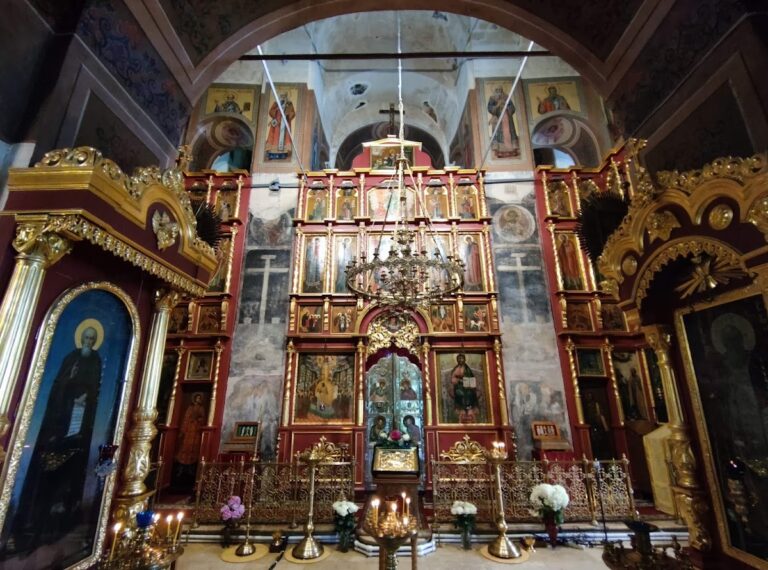
Patriarch Alexy II visited in 1994 for the monastery’s 550th anniversary and the 600th anniversary of Paphnutius’s birth, celebrating a service and procession. In 1995, an iconostasis and a chapel dedicated to Paphnutius were installed in the Nativity Cathedral. Bells were raised to the bell tower in 1996, and the Church of the Holy Great Martyr Irene opened in 1997. The monastery ensemble is recognized as a cultural-heritage object of federal significance in the Russian Federation.
Remains
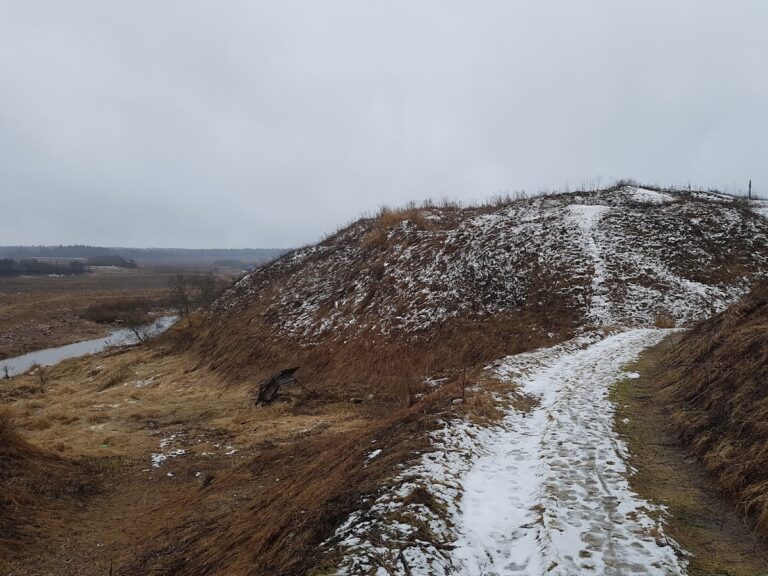
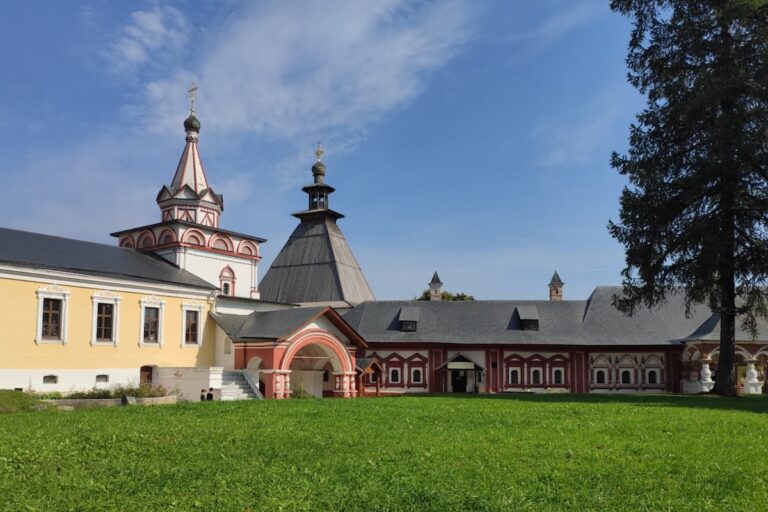
The monastery occupies an elevated site at the mouth of the Istierma River, where it flows into the Protva. Its buildings and enclosure form a complex of churches, refectories, a bell tower, an infirmary, walls, and towers. The architectural ensemble is generally characterized as Russian style architecture developed between the seventeenth and nineteenth centuries, while its defensive works preserve elements of an older fortress plan.
Churches and communal buildings
Nativity Cathedral
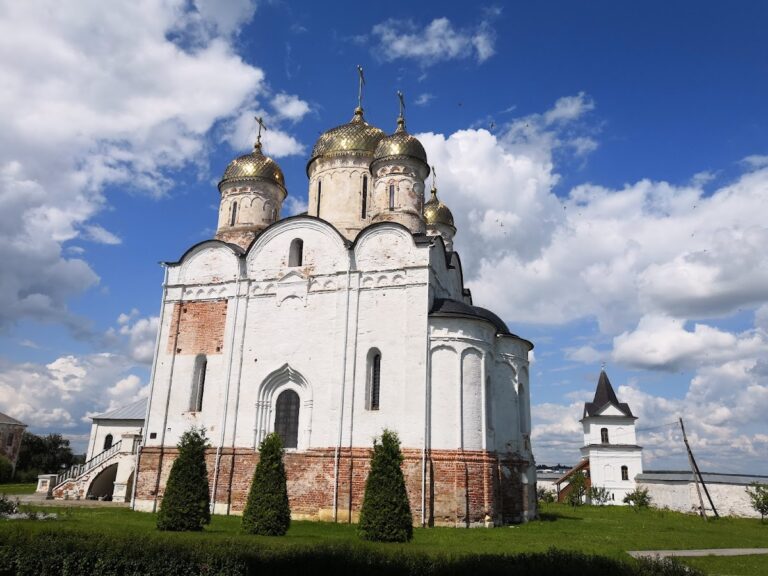
The original wooden Church of the Nativity of the Virgin was replaced by a white-stone cathedral in 1467. Its frescoes were painted by Dionysius, a major Russian iconographer of the late fifteenth and early sixteenth centuries, working with the monk Mitrofan, an icon painter associated with Simonov Monastery, and an unnamed assistant.
In 1586, the 1467 cathedral was almost entirely dismantled and replaced on the same site by a five-domed cathedral built by order of Tsar Fyodor Ivanovich. Blocks carrying fifteenth-century painted decoration were reused in its foundations. Restoration in the 1960s recovered 194 white-stone blocks, 29 of which retained fragments of figural and ornamental painting from the early sixteenth century. These fragments are held by the Andrei Rublev Museum of Ancient Russian Culture and Art in Moscow and the Borovsk branch of the Kaluga Regional Museum of Local Lore. Paphnutius’s relics are kept in the Nativity Cathedral, which also received a new iconostasis and a chapel dedicated to him in 1995.
Refectories and bell tower
A refectory, or monastery dining hall, with a Church of the Nativity of Christ was built during the sixteenth century. The complex also contains a separate refectory with a bell tower, a structure that houses or supports bells. A further refectory was added to the Nativity Cathedral in 1837.
A belfry built in 1523 was replaced by a bell tower in 1688. Commissioned by Prince Konstantin Shcherbatov, the later tower follows the forms of the bell tower at the Vysoko-Petrovsky Monastery in Moscow. Other surviving religious buildings include the Church of St. Mitrofan and the Church of the Prophet Elijah with its infirmary. The Chapel of the Prophet Elijah dates from 1670.
Historic bell
A small bell dated 1487 bears the inscription, “In the year 6996, on October 10. Made by Fedka the Cannonmaker.” It is preserved at the Kolomenskoye Museum rather than within the monastery complex.
Walls and defensive towers
The monastery walls and towers were built during the sixteenth and seventeenth centuries. The defensive arrangement concentrated strength on the exposed outer, or assault, side. Its tower plan reflects a fortress type characteristic of the fourteenth and fifteenth centuries, although this form was becoming outdated by the end of the sixteenth century.
Early enclosure and round tower
One interpretation attributes the Povarennaya, Armory, and St. George towers to Fyodor Kon, an architect also associated with the White City in Moscow, the Smolensk Kremlin, and Simonov Monastery. Modern researchers instead attribute the enclosure, including its oldest surviving round tower, to the architect who completed the cathedral and bell tower after 1523.
Rebuilt towers
After the destruction of 1610, master Trefil Sharutin rebuilt much of the surviving defensive enclosure. The Secret, St. George, and Armory towers were built in 1635. The Watchtower and Entrance Tower followed in or after 1636. A new entrance gate was constructed in the late nineteenth century, adding another phase to the fortified complex.