Santo Stefano degli Agostiniani: An Augustinian Church and Convent in Empoli


Site at a Glance
- Rating
- 4.7
- Popularity
- Very Low
- Country
- Italy
- Primary era
- Medieval
- Eras represented
- Medieval, Early Modern
- Civilizations
- Grand Duchy of Tuscany, Republic of Florence
- Site type
- Religious
- Remains
- Church
On this page17 sections
History
Santo Stefano degli Agostiniani is a Catholic church and former Augustinian convent in Empoli, Italy. The complex was established by Augustinian friars in the late fourteenth century and combines Gothic and Renaissance features. It became an important setting for religious patronage and painting in Empoli, with work by Masolino, Lorenzo di Bicci, Bicci di Lorenzo, Gherardo Starnina, and other Italian artists.
Foundation and medieval development
In 1367, the Augustinian friars moved inside Empoli’s city walls and took possession of the area where the church and convent were begun. The church was probably completed in 1432, the year Prior Michele da Florence died. He had strongly promoted its construction and was commemorated inside the church by a floor tomb.
The complex developed through the activity of religious companies, lay or mixed devotional associations organized around particular religious practices. In 1397, the Company of the Cross, also known as the Black Robe, purchased the Chapel of Sant’Elena, later called the Chapel of the Cross. The company commissioned a triptych, a three-panel altarpiece, from Lorenzo di Bicci. It was installed in 1399, followed by a stained-glass window completed in 1402. Masolino later painted the chapel’s cycle of the Stories of the True Cross, for which he was paid in 1424.
From 1423 to 1424, Masolino and Bicci di Lorenzo worked together on the decoration of the church. Matteo Federighi had arranged in 1401 for a chapel dedicated to Saint Matthew to be founded after his death. His cousin Carlo Federighi, a jurist and diplomat, probably commissioned Masolino’s fresco in 1423. The Federighi family’s association with the church is also recalled by a coat of arms on the architrave beneath a frescoed lunette in the right transept.
Other chapels received paintings and furnishings during the same period. The Chapel of the Santissima Annunziata was decorated by Gherardo Starnina with a cycle of the Stories of the Virgin in 1409. The Oratory of the Santissima Annunziata, accessible from the adjoining chapel, later received Bernardo Rossellino’s group of the Annunciation between 1446 and 1447. In 1445, Prior Nicola da Rome commissioned Bicci di Lorenzo’s Saint Nicholas of Tolentino Protecting Empoli from the Plague, a painting that includes one of the oldest known views of Empoli.
Early-modern chapels and alterations
The church’s chapels continued to change during the sixteenth and seventeenth centuries. In 1505, the Chapel of the Most Holy Sacrament became the Oratory of the Company of the Cross. The adjoining Oratory of the Company of the Santissima Annunziata could be reached from the chapel dedicated to the Annunciation.
The Chapel of the Purification of Mary was remodeled in 1599 and 1600, when it received a new Mannerist altar. The Chapel of the Assumption was remodeled by the Neri family in 1654. The Chapel of Santa Caterina, under the patronage of the Scarlini family, acquired a seventeenth-century pictorial ensemble. Ottavio Vannini painted God the Father in the vault and the Evangelists in the lunettes, probably around 1622 and 1623 and no later than 1627. The altar painting, Rutilio Manetti’s signed and dated Martyrdom of Saint Catherine, belongs to 1627.
In 1634, Bicci di Lorenzo’s painting of Saint Nicholas of Tolentino was vertically extended and framed within Francesco Furini’s Madonna of the Rosary. After spending decades in the Museum of the Collegiate Church of Sant’Andrea, the earlier painting was returned to the center of Furini’s canvas in 1990. The Chapel of the Assumption contains Mario Balassi’s Assumption of the Virgin with Saints Philip Neri, Nicholas of Tolentino, John Gualbert, and Lawrence, documented there in 1659. Domenico Cresti, known as Passignano, painted the Adoration of the Shepherds for the chapel to the left of the high altar in 1621.
In 1661, Masolino’s frescoed lunette in the right transept was incorporated into a Baroque stone altar. The alteration blocked the original doorway and created another entrance at the side. The later arrangement was eventually dismantled, and the original doorway was restored. The fifth chapel on the right, which gives access to the Chapel of the Most Holy Sacrament, originally held Ludovico Cardi’s, known as Cigoli, Descent from the Cross. During the time of Grand Duke Ferdinando II, it was replaced by a copy by Anton Domenico Gabbiani.
The bell tower and eighteenth-century remodeling
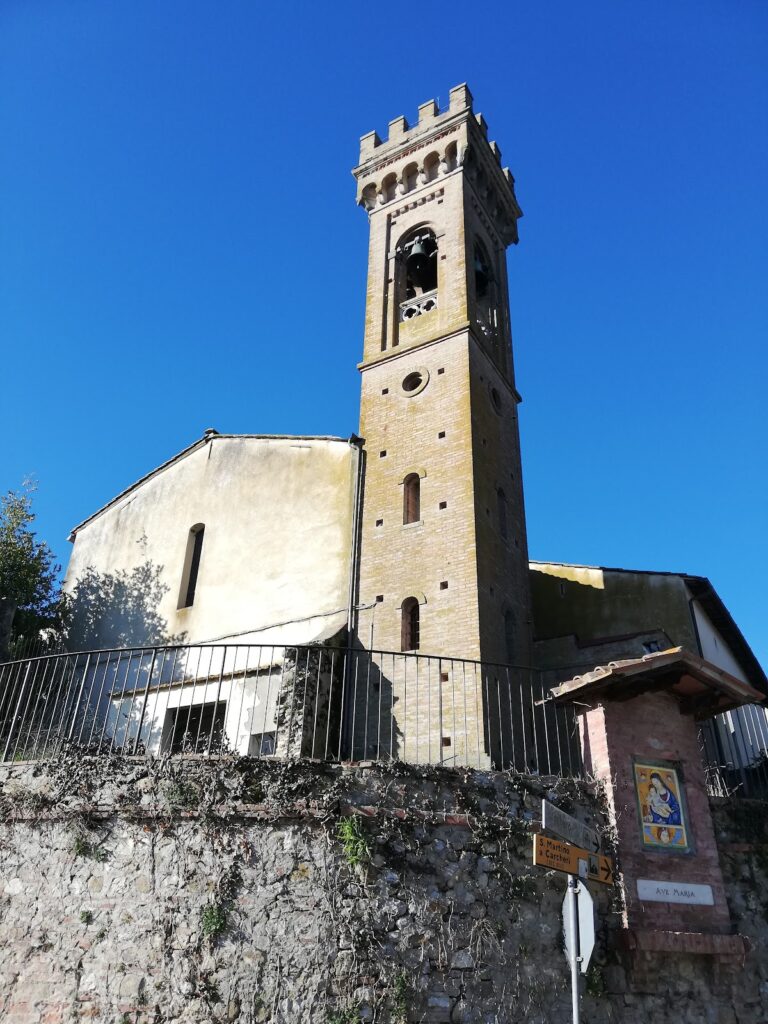
The Augustinians acquired the site of the bell tower in 1618. Construction of the new tower was completed between 1684 and 1686 to a design by Jacopo Landini, inspired by the bell tower of the Augustinian Basilica of Santo Spirito in Florence. The tower reached 46 meters and was a seventeenth-century structure with a later-modified upper order. In 1775, master bell maker Domenico Antonio Cari replaced its principal bell and two smaller bells because they had been worn by use.
Lightning struck the spire in 1845. In 1846, a civic commission approved a project that substantially altered the tower’s third order. The revised design echoed Giotto’s bell tower of Santa Maria del Fiore. The church itself underwent radical remodeling during the eighteenth century, including the creation of its lateral chapels. Earlier plans had called for a dome over the center of the transept, but the dome was never built.
The refectory was frescoed by Alessandro Masini in 1780. Its decoration was restored in 1994, and the room now serves for temporary exhibitions and as an auditorium. The former convent spaces are also used for temporary exhibitions and services connected with the adjacent library.
Secularization, wartime destruction, and restoration
The complex was secularized in 1808. The friars left, and the buildings became state property under municipal management. The former religious complex was converted for use as a school, while the church’s religious function was later restored under ecclesiastical authority.
In 1944, during the Second World War, German troops retreating north detonated the bell tower. Its collapse severely damaged the eastern part of the church and destroyed much of Masolino’s fresco decoration. The tower also fell onto the adjacent historic Salvini Theatre. The church was subsequently restored, but the bell tower was not rebuilt. The restored church was returned to religious authority for worship, while the convent remained municipally owned.
Remains
Layout and exterior
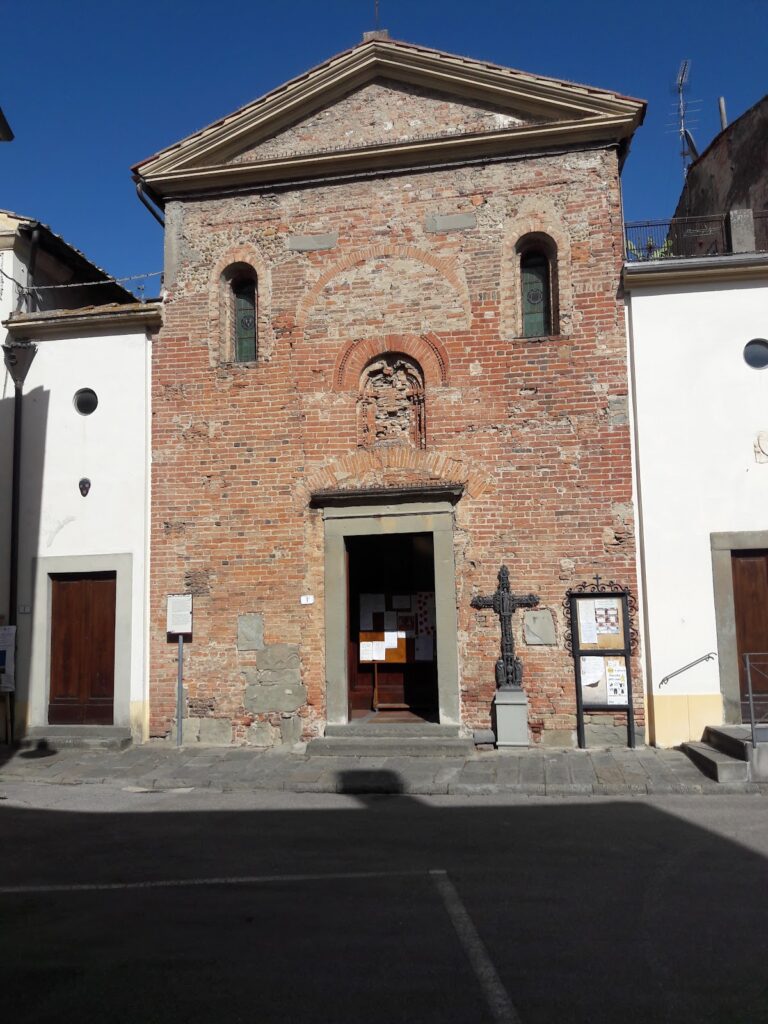
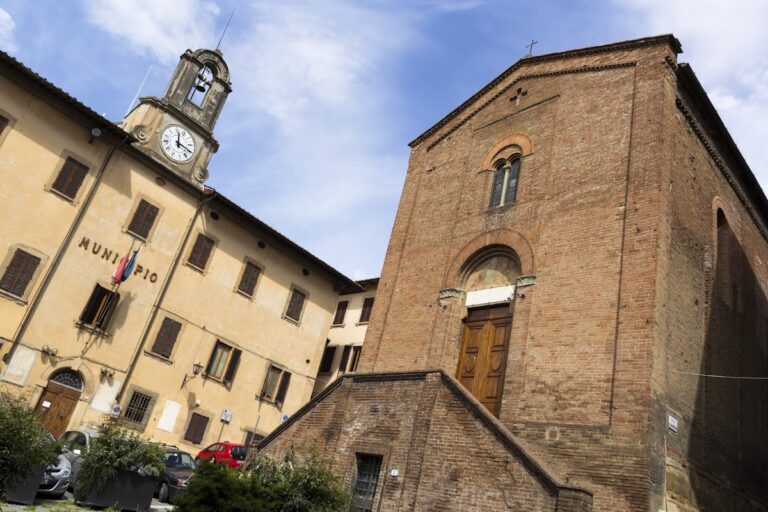
The church was built parallel to the present Via dei Neri, so its exterior presents a long and simple side rather than a monumental facade opening onto a piazza. This side retains traces of former Gothic windows, a smaller entrance portal, and a portal with a broken pediment that formerly led into the convent. The principal late-fourteenth-century portal stands at the end of Via Santo Stefano and gives direct access to the church at the left side of the transept.
Inside, a central nave covered by ribbed cross-vaults is separated from two aisles by massive piers and broad, tall Gothic arches. Five chapels line the right side and four line the left. The building terminates in three apsidal chapels. Two large oratories extend the complex. They belonged to the Companies of the Cross and the Santissima Annunziata and contained independent chapels reserved for, and communicating with, the church.
Right-hand chapels and transept
Chapel of Sant’Elena
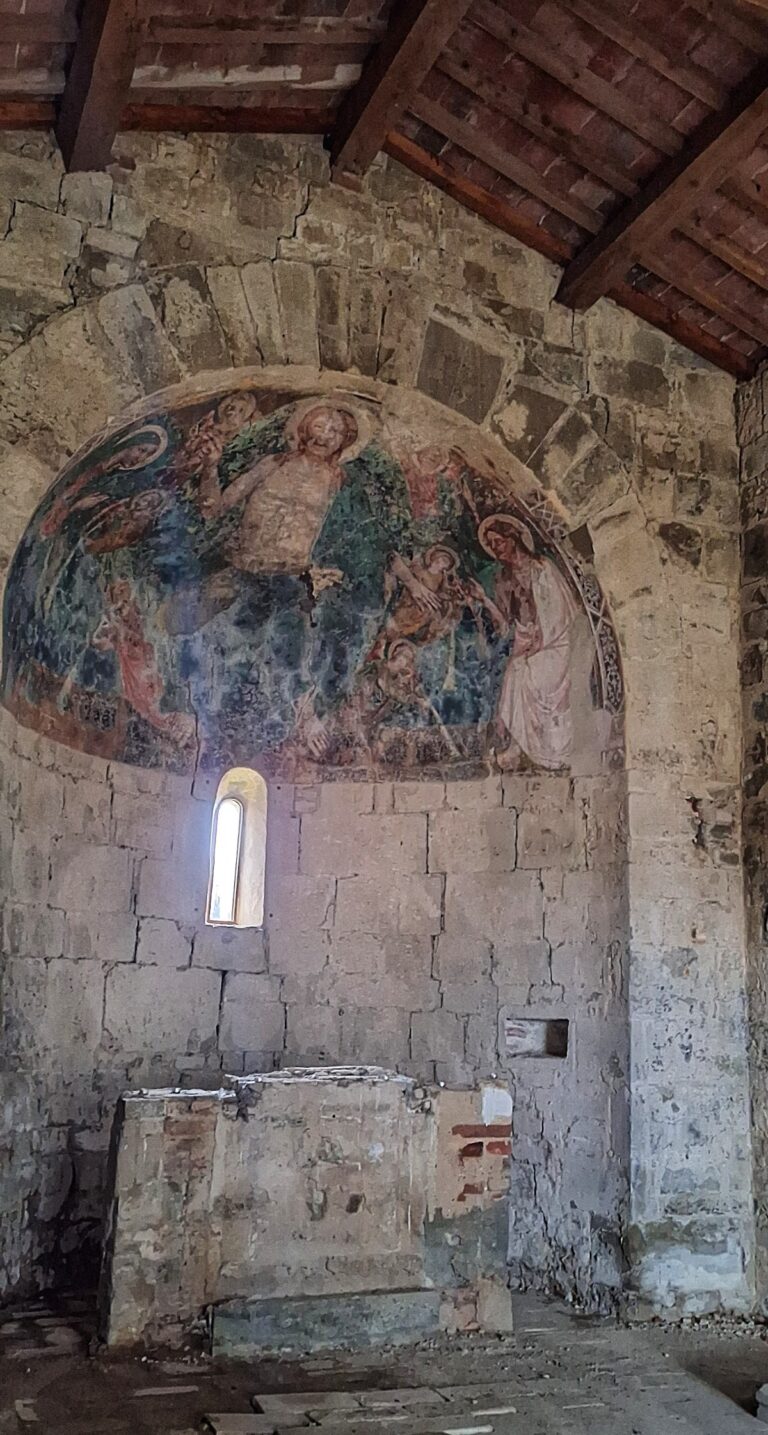
The first chapel on the right, the Chapel of Sant’Elena or the Cross, retains fragments of Masolino’s fresco cycle on the lower wall surfaces. The surviving decoration includes partial illusionistic loggias, a Neo-Giottesque repository with vessels and books, and saints in the archivolt, the ornamental band following the curve of an arch. The saints were probably produced collaboratively with Francesco d’Antonio or another follower.
The fragments and sinopias, reddish underdrawings made beneath a fresco, allow portions of the Stories of the True Cross to be identified. On the right wall are scenes of the Queen of Sheba venerating the wood, her meeting with Solomon, the extraction of the wood from the probatic pool associated in Christian tradition with the healing of the sick in Jerusalem, the making of the Cross, and the Testing of the True Cross. The left wall included Helena bringing the Cross to Jerusalem, Chosroes worshiping in the temple, the Dream of Heraclius, the Beheading of Chosroes, and Heraclius entering Jerusalem.
The vault contained four representations of Christ: the Volto Santo, a Eucharistic Ecce Homo, Christ Carrying the Cross, and the Risen Christ. The rear wall is no longer legible. Most of the chapel’s decoration was destroyed during the 1792 remodeling. The central panel of Lorenzo di Bicci’s 1399 triptych, a Crucifixion with mourners in the Orcagnesque tradition, is now in the Museum of the Collegiate Church of Sant’Andrea. Its two side panels have been documented but not located. An Invention of the True Cross attributed to Tommaso Gorini and probably dating from the 1660s also came from the chapel.
Second and fourth chapels
The second chapel on the right may have held another triptych by Lorenzo di Bicci, dated approximately 1395 to 1400 and known to have been there by 1416. Its surviving central panel, the Madonna of the Girdle, is in the Museum of the Collegiate Church of Sant’Andrea. A panel showing Saint Nicholas of Tolentino is in the collections of the Cassa di Risparmio of San Miniato, and a predella panel, the narrow lower section of an altarpiece, is in a private collection.
The fourth chapel, dedicated to Mary Magdalene, was under the patronage of the Guidarrighi family. It retains frescoes depicting scenes from the saint’s life by Stefano d’Antonio, a collaborator of Bicci di Lorenzo.
Most Holy Sacrament and Annunciation chapels
The fifth chapel on the right gives access to the Chapel of the Most Holy Sacrament. Its altar originally held Cigoli’s Descent from the Cross, now in the Pitti Palace, and later received Anton Domenico Gabbiani’s copy. The chapel dedicated to the Santissima Annunziata retains the Mannerist altar installation made during the remodeling of 1599 and 1600.
The Annunciation chapel formerly contained Jacopo Chimenti’s, known as Empoli, 1604 Presentation in the Temple. The painting was destroyed during the Second World War and replaced by an old copy of Caravaggio’s Saint John the Baptist. Caravaggio’s original is in the Nelson-Atkins Museum of Art in Kansas City. The adjoining Oratory of the Santissima Annunziata retains Bernardo Rossellino’s Annunciation group, made between 1446 and 1447.
Right transept and principal chapel
Only a small part of the right transept’s original fifteenth-century decoration survives. Above the sacristy doorway is Masolino’s frescoed lunette of the Virgin and Child with Angels. The right wall retains the fresco traditionally called Saint Ivo and the Orphans, while the architrave beneath the lunette bears the Federighi coat of arms. Saint Ivo was associated with justice and the protection of the poor, and images of him with orphans reflect that charitable role.
The transept also contained an altar dedicated to Saint Raphael. Its triptych showed the Archangel Raphael with Saints Ansanus and Apollonia on one side and Saints Michael the Archangel and Tobias on the other. Attributed to the Master of Signa and dated about 1445, the triptych is now in the Museum of the Collegiate Church of Sant’Andrea.
A fragment of a fresco showing Saint James remains on the right pier at the entrance to the principal chapel. It is attributed to Lorenzo di Bicci and dated between the late fourteenth and early fifteenth centuries. The fragment may be the only surviving remnant of the presbytery’s decoration, which perhaps included a contemporary polyptych, an altarpiece composed of several panels, documented at the high altar until the end of the sixteenth century.
Left-hand chapels and cloister
Chapel of San Nicola da Tolentino
The first chapel on the left, dedicated to San Nicola da Tolentino, contains Bicci di Lorenzo’s Saint Nicholas of Tolentino Protecting Empoli from the Plague. Prior Nicola da Rome commissioned the painting in 1445. It includes one of the oldest known views of Empoli and remains associated with the chapel after its return to the center of Furini’s Madonna of the Rosary in 1990.
Chapel of Santa Caterina
The Chapel of Santa Caterina contains the seventeenth-century decoration commissioned under the patronage of the Scarlini family. Ottavio Vannini’s God the Father occupies the vault, and the Evangelists appear in the lunettes. The altar painting is Rutilio Manetti’s Martyrdom of Saint Catherine, signed and dated 1627.
Chapel of the Assumption and presbytery chapel
The Chapel of the Assumption contains Mario Balassi’s Assumption of the Virgin with Saints Philip Neri, Nicholas of Tolentino, John Gualbert, and Lawrence, documented in 1659. In the chapel of the presbytery to the left of the high altar is Passignano’s Adoration of the Shepherds, dated 1621.
Cloister and refectory
The former convent is organized around a two-level Renaissance cloister adjacent to the church. Its lower level has round-headed arches resting on columns, while the upper level forms a loggia that remains partly open. The refectory is accessible from the cloister and retains Alessandro Masini’s fresco decoration of 1780, restored in 1994.
Nearby sites