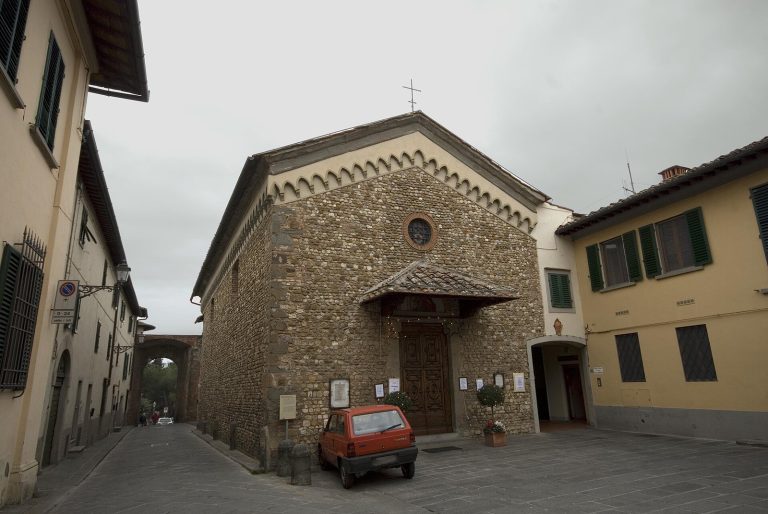
Chiesa di San Martino: A Medieval Parish Church at Carcheri
Site at a Glance
- Rating
- 4.4
- Popularity
- Very Low
- Country
- Italy
- Primary era
- Medieval
- Eras represented
- Medieval, Early Modern
- Civilizations
- Grand Duchy of Tuscany, Republic of Florence
- Site type
- Religious
- Remains
- Church
On this page6 sections
History
Chiesa di San Martino is a Roman Catholic church in Carcheri, within the municipality of Lastra a Signa, Italy, dedicated to Saint Martin of Tours, a fourth-century Christian bishop. Its earliest known reference dates to 17 July 1260, when its rector, Andrea Jacobi, agreed to provide six staia of grain, a historical measure whose quantity varied by locality, for the maintenance of the Florentine army.
The church stood beside an ancient medieval route connecting the Badia and Pieve di Settimo with the Valdelsa and, through that network, with the Via Francigena, the major pilgrimage road linking western Europe with Rome. At the time of the 1260 reference, Chiesa di San Martino was a suffragan church, meaning a subordinate church under a larger ecclesiastical centre, of the Pieve dei Santi Ippolito e Cassiano.
Medieval parish and dependencies
After the Battle of Montaperti in 1260, a major conflict between supporters of the Holy Roman Emperor and the opposing forces in the political struggles of the Italian cities, Ghibelline troops destroyed and plundered the parish territory. Despite this devastation, the church was able to pay an annual tithe of six lire by the end of the thirteenth century. A tithe was a church levy traditionally based on a tenth of specified income or produce.
Its economic position remained strong during the fourteenth century. The hospital of Santa Maria at Ginestra Fiorentina was a direct dependency of Chiesa di San Martino, linking the parish to an institution that provided care and religious support.
Restoration and changing administration
The church was completely restored during the sixteenth century under the rector Michele di Filippo Baldovini. At the end of that century, the chapel of the Compagnia della Santissima Annunziata was founded, and its construction was completed in 1611. A new organ was installed between 1757 and 1758 on a choir loft, an elevated gallery intended for singers or an organ, built specifically for it.
On 3 June 1789, the parish community of San Martino a Carcheri was transferred to the piviere of San Vincenzo a Torri. A piviere was a local territorial grouping of parish churches administered from a principal church. In 1834, patronage belonged to the Roti-Michelozzi family, which had the building of the Compagnia reconstructed. Further restoration campaigns took place in 1976 and 1996, contributing to the present form of the church.
Remains
Facade and interior
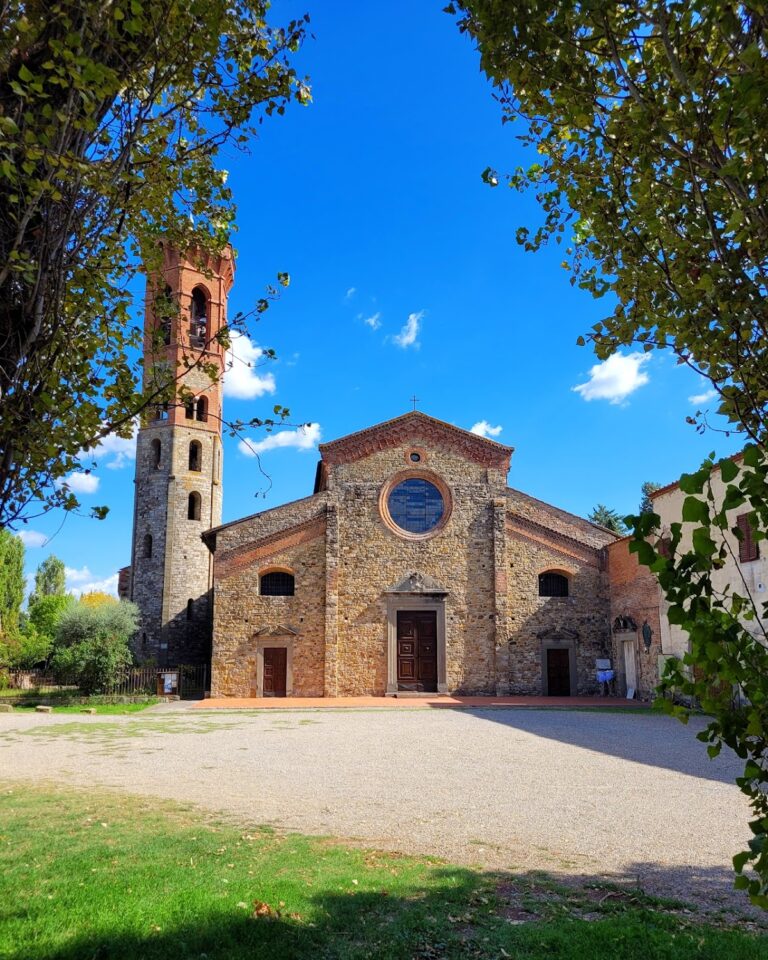
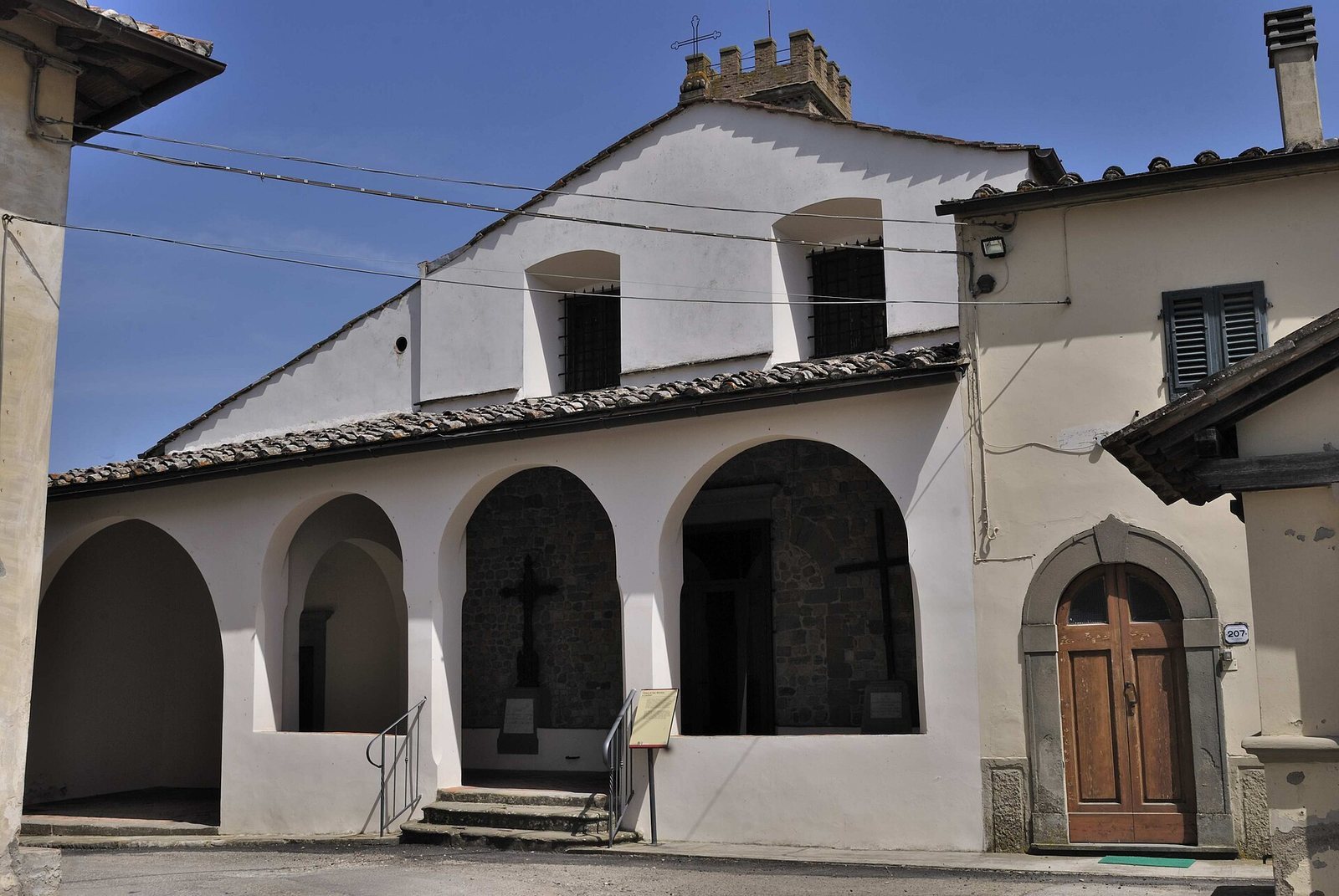
The present church incorporates fabric from several periods of restoration. The oldest surviving elements are in the facade, which is now preceded by a portico. They include part of a sandstone portal with a round arch, a form associated with Romanesque architecture. This entrance was later blocked and replaced by a Renaissance portal made of pietra serena, the gray sandstone widely used in Tuscan Renaissance buildings.
Inside, the roof is supported by large timber trusses, while the interior was reshaped in the Gothic style. The presbytery contains two small portals with horizontal lintels, each supported by concave corbels. A lintel is a horizontal structural member spanning an opening. Together, these elements reflect the church’s repeated alterations across the medieval, Renaissance, and later periods.
Fifteenth-century triptych
Chiesa di San Martino preserves a valuable triptych from the beginning of the fifteenth century. A triptych is an artwork formed from three hinged or adjoining panels. Attributed to the unidentified artist known as the Master of 1399, the painting depicts Saint Martin and the Beggar among saints. The conventional name refers to an anonymous artist associated with works from around that period.