San Michele a Luciano: A Romanesque Church in Italy
Site at a Glance
- Rating
- 4.6
- Popularity
- Very Low
- Country
- Italy
- Primary era
- Medieval
- External website
- Open
- Eras represented
- Medieval
- Civilizations
- Holy Roman Empire
- Site type
- Religious
- Remains
- Church
On this page10 sections
History
Medieval origins and dependencies
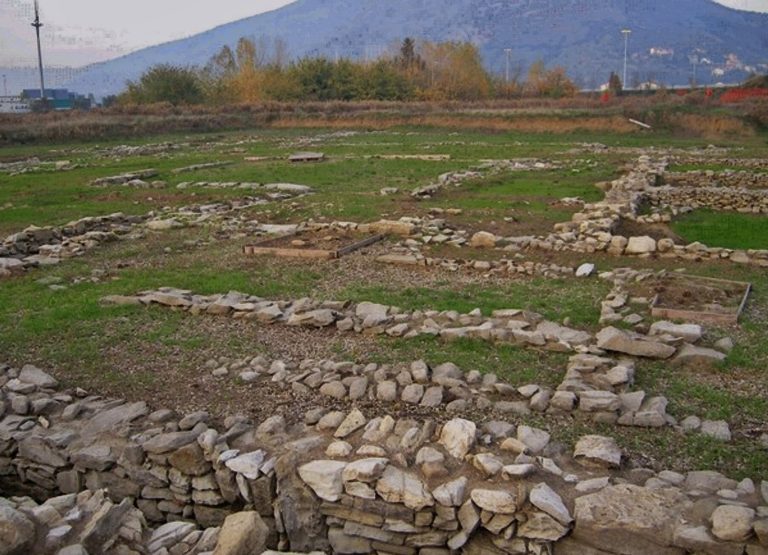
San Michele a Luciano is an abandoned Romanesque church in Italy, above Antinoro in the municipality of Montelupo Fiorentino. Built in the late twelfth century, it stands in an area where a Roman settlement once existed. A Roman inscription found in the cemetery and several fragments reused in the church point to that earlier occupation. The church is dedicated to Saint Michael the Archangel, the Christian protector traditionally associated with the defeat of evil.
The church is first recorded in 1243, when it formed part of the now-vanished Castle of Luciano, owned by the Alberti Counts. Its rector swore an oath to the Pieve of Signa, an important rural parish church that exercised authority over dependent churches and clergy. San Michele depended on Signa despite the considerable distance between the two institutions.
Changing patronage and decline
San Michele’s economic position remained difficult and unstable. A document dated 31 October 1306 places the church within the commune of Montelupo and identifies it as being under the patronage of the Frescobaldi family, in the castle of Baldo Frescobaldi. On 3 April 1319, its rector, a priest named Michele, exchanged the church of Luciano with the Pieve of Signa.
The surrounding parish territory soon lost much of its population. In 1422, San Michele was annexed to the nearby church of San Vito. The church of San Mamante near Signa was later united with this annexed institution, while San Michele a Luciano continued to decline. During an apostolic visitation on 15 June 1575, the building was found completely ruined. The Frescobaldi family probably financed a later restoration, but the church eventually became entirely abandoned.
Remains
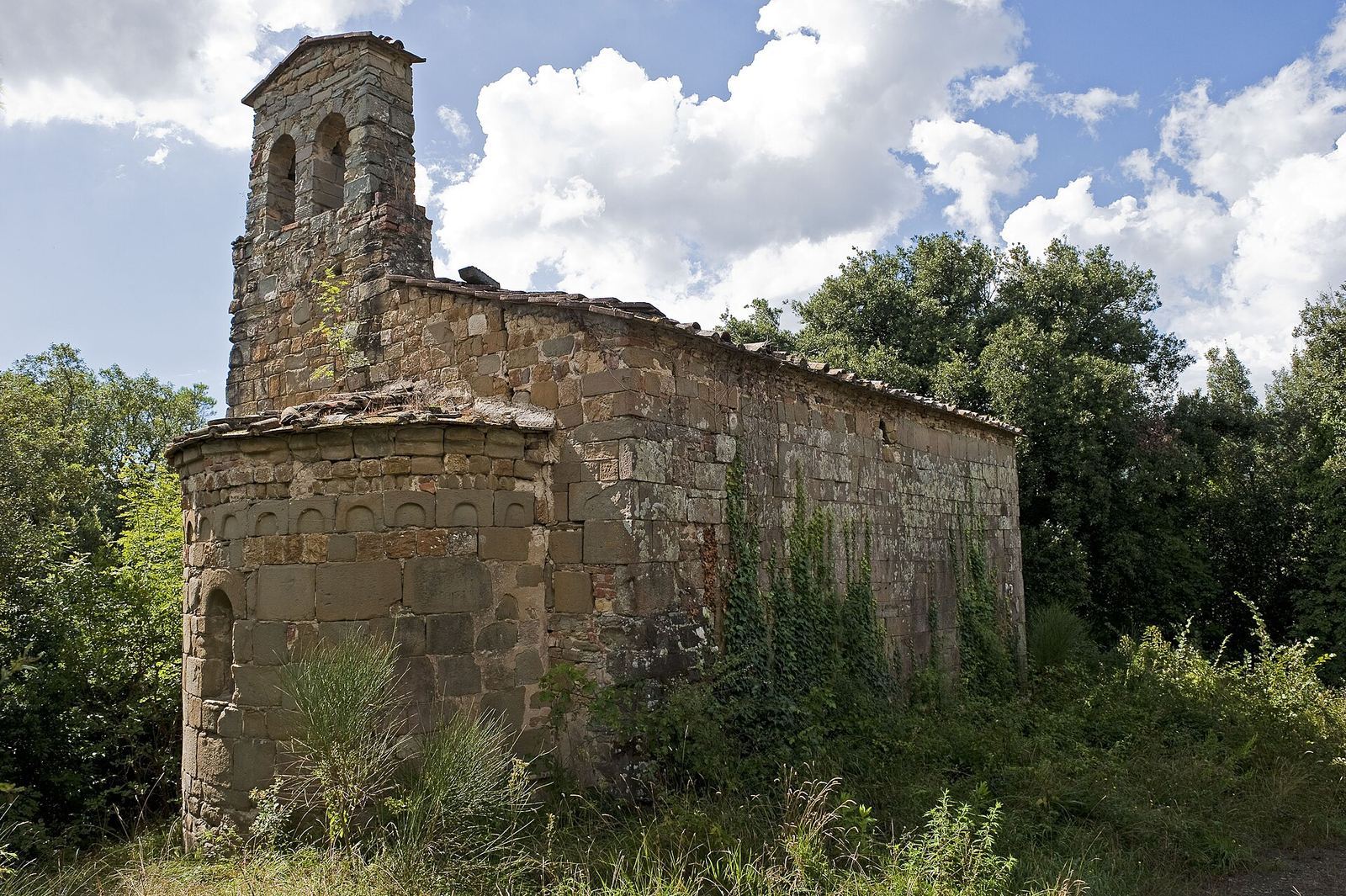
San Michele a Luciano is a small Romanesque building positioned in the Antinoro woods above the Via Livornese. Its compact form consists of a rectangular single nave, a double-pitched roof, and a semicircular apse. The original construction used pietra serena, a gray sandstone quarried near the Arno, while the foundations contain rubble made from locally quarried alberese limestone. The exterior walls are formed from carefully squared sandstone blocks laid in regular, parallel horizontal courses.
Exterior structure
Gabled facade
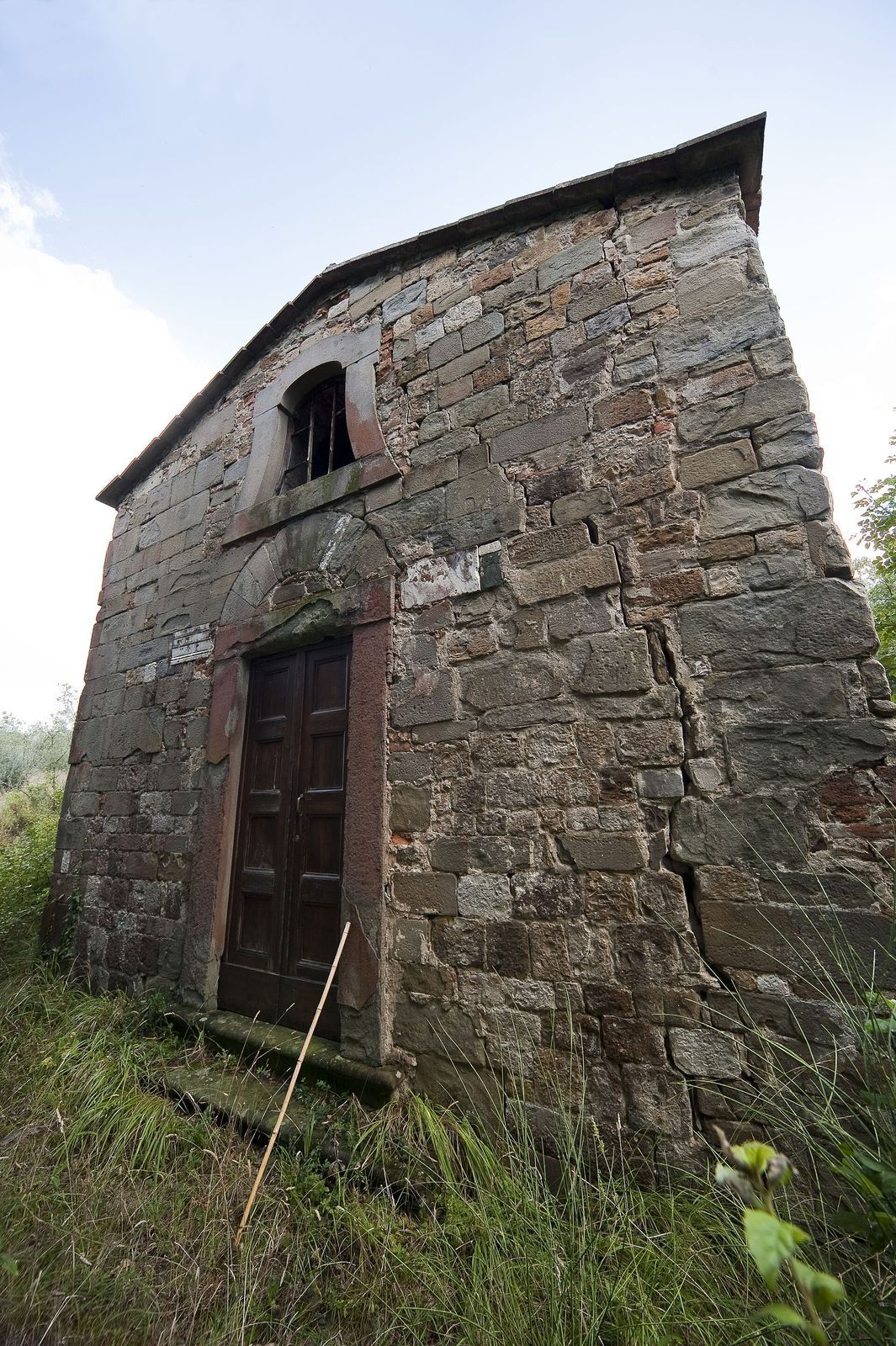
The gabled facade preserves signs of structural damage and later rebuilding. Its central portal has rebuilt jambs and a round arch. Fragments of Roman architraves were reused above and beside the entrance as decoration. Sections of the original sandstone masonry were replaced with limestone rubble and plastered, probably during the seventeenth century after a collapse. A bell-shaped window is set above the portal.
Side walls
The southern wall retains more stretches of the original masonry and formerly contained a small portal with a lintel. That entrance was later blocked with bricks, leaving a small recess where additional traces of fresco survive. The interior face of the entrance wall preserves the portal’s round arch, supported by corbels and lacking an architrave.
Apse
The apse is a semicylindrical structure built of sandstone. Its single-light window has double-splayed reveals, which widen toward both faces of the wall, and a monolithic archivolt. Above it, an ochre band of alberese-limestone rubble supports a sequence of lightly carved sandstone arches. Two further layers of brick fragments and sandstone rubble form a saw-tooth pattern across the upper treatment.
Bell gable
A sandstone bell gable with two openings stands along the church’s left side. It belongs to a much later phase than the foundation of the church.
Interior decoration
The interior masonry is better preserved than the exterior. The vault of the apse is covered by a fresco of the Last Judgment, depicting the Virgin Mary and Saint John the Baptist. Painted by an unknown artist in the early fifteenth century, the fresco provides a surviving record of the church’s medieval decoration.