Cathedral of the Archangel: Moscow’s Dynastic Burial Church


Site at a Glance
- Rating
- 4.6
- Popularity
- Low
- Country
- Russia
- Primary era
- Early Modern
- External website
- Open
- Eras represented
- Early Modern, Modern
- Civilizations
- Russian
- Site type
- Religious
- Remains
- Cathedral
On this page16 sections
History
The Cathedral of the Archangel is a Russian Orthodox cathedral in Moscow, Russia, dedicated to the Archangel Michael and built in its present form between 1505 and 1508. Its architecture combines the traditional Russian cross-domed plan with Italian Renaissance forms. Standing on Cathedral Square in the Moscow Kremlin, it became the principal burial church of Moscow’s grand princes and later Russian tsars. The building now forms part of the Moscow Kremlin Museums.
Early churches and the princely burial tradition
A wooden church probably stood on the site around 1247 to 1248, traditionally during the rule of Moscow Prince Mikhail Khorobrit, the brother of Alexander Nevsky. The exact circumstances of this first foundation remain uncertain. In 1333, Grand Prince Ivan I Kalita ordered a stone replacement after a famine ended. The famine had been caused by rye that produced abundant stalks but no grain. Metropolitan Theognost consecrated the new church, which became the burial place of the grand-princely dynasty.
The stone church received painted decoration during the fourteenth century. A princely workshop worked on its decoration from 1344 to 1346, and Theophanes the Greek with his pupils repainted it in 1399. Two wooden side chapels were added before the Kremlin fire of 1475, but both were destroyed in the blaze. Stone replacements followed in 1481 and 1482. By the beginning of the sixteenth century, the church had become overcrowded with tombs and was structurally weak.
The construction of the present cathedral
Ivan III ordered the old church to be dismantled in 1505 and commissioned Aloisio the New, also known as Alewis the New, an Italian Renaissance architect working in Moscow, to build a replacement. The remains of earlier princes were temporarily moved to the nearby Church of St. John Climacus. Ivan III died in 1505 and was buried in the unfinished building. Construction continued under his son, Grand Prince Vasily III, and the cathedral was completed and consecrated in November 1508.
The new building followed the five-domed and five-part altar arrangement of the Kremlin’s Assumption Cathedral, while adapting that traditional Russian church plan to Renaissance facade decoration. It originally contained seven side chapels. The chapels of the Intercession of the Virgin and John the Baptist were later added beside the apses, while other chapels were altered, transferred, or abolished. The chapel of Saint Uar also became associated with the cathedral.
Sixteenth- and seventeenth-century decoration
The cathedral was damaged by the Kremlin fire of 1547. Novgorodian and Pskovian painters restored the fire-damaged decoration, and the interior was first extensively frescoed in 1564 and 1565 during the reign of Ivan IV. A fresco of Lazar of Serbia was painted in 1564. Between 1652 and 1666, deteriorated wall paintings were replaced. Earlier compositions were recorded before removal, and the new work largely retained the iconography of the sixteenth-century frescoes. Ninety-two artists took part, with Simon Ushakov leading the final stage.
From 1599 to 1765, special bishops attached to the cathedral conducted memorial services for deceased princes and tsars. After an independent Moscow diocesan administration was established in 1742, the cathedral became the diocesan cathedral. Its burial function continued alongside these religious and administrative roles.
Ivan IV ordered the burial of his son, Tsarevich Ivan, in the southern apse in 1581. Ivan IV himself and Tsar Boris Godunov were later buried there. Boris Godunov’s remains were removed in 1606 on the orders of False Dmitry I and later transferred to the Trinity Lavra of St. Sergius. The remains of Tsarevich Dmitry were brought to the cathedral in 1606. A carved white-stone canopy was installed over his tomb in 1632, while a silver shrine made in 1630 was later transferred to the Kremlin Armoury.
A new carved iconostasis was made in 1679 and 1680. An iconostasis is the screen separating the sanctuary from the main body of an Eastern Orthodox church. In 1677, Simon Ushakov also painted posthumous portraits of Tsars Michael I and Alexis I. The cathedral’s paintings, portraits, tombs, and icons increasingly formed a unified dynastic and religious program.
Fire, alteration, and imperial repair
The Trinity Fire of 1737 caused major damage. During repairs under Empress Elizabeth, paintings, royal portraits, and tombs were restored under the direction of Prince Dmitry Ukhtomsky. The central dome was changed from a helmet-shaped form to an onion dome, and parts of the southern facade were strengthened with white-stone buttresses. Several covered galleries were later dismantled because of their poor condition, and the chapel of John the Baptist was substantially rebuilt. Further galleries were removed in 1749 and 1750.
A palace planned by Vasily Bazhenov caused the ground near the cathedral to subside and cracks to appear in the building. The palace project was stopped, and the southern wall was reinforced with three buttresses. The surviving support structure reflects this intervention. The chapel of Saint Michael of Chernigov was also transferred from a church above former administrative buildings that was demolished during construction associated with Bazhenov’s planned palace.
French forces looted the cathedral during the occupation of Moscow in 1812. Icons were damaged, precious coverings and ornaments were taken from reliquaries, and a kitchen was installed in the altar. Wine barrels were placed on the royal tombs. After the war, the decorations were replaced, the icons were washed, and soot was removed from the paintings. The cathedral was reconsecrated in 1813.
A two-storey clergy building was erected against the southern wall in 1826, replacing an earlier one-storey chamber that had been used for the trial of monastic peasants. A Pokrovsky chapel was moved into the western inter-wall space in 1848. Restoration of icons and wall paintings took place in 1853, and the icons were restored again in the 1870s. In 1895, the cathedral and its property, funds, and clergy were transferred from the diocesan administration to the Court Department.
Revolution, museum use, and renewed research
For the 1913 tercentenary of the Romanov dynasty, the burial interior, wall paintings, principal iconostasis, Royal Doors, chandeliers, and candleholders were restored or cleaned. A canopy based on drawings by Grand Duke Peter Nikolaevich was installed over the tomb of Tsar Michael I. During the armed uprising of 1917, artillery struck the southern wall and destroyed part of a buttress. The cathedral closed in 1918, although restoration began soon afterward.
During the 1920s, specialists strengthened and oiled the principal icons, removed a wooden vestibule that concealed paintings in the western loggia, and dismantled an eighteenth-century pseudo-Gothic portico. Further icon restoration was undertaken in 1934 and 1935. In 1929, before the Ascension Convent was demolished, the remains of princesses and tsarinas were transferred to a crypt beneath the southern extension.
The cathedral became a museum in 1955. Restoration and research continued from the 1950s onward. Seventeenth-century paintings were exposed beneath later overpainting, the paintings in the drums were restored in 1969, and frescoes were renewed while the iconostasis was strengthened during the 1970s. Architectural and archaeological investigations in 1962 to 1965, followed by further research in 2000 and 2001, examined the cathedral, the rooms above the choir, the clergy building, and remains associated with the Treasury Yard. Excavations revealed white-stone masonry and a brick floor covered with glazed ceramic tiles. From discovered remains, sculptural portraits of Ivan IV and Feodor I were reconstructed by anthropologist Mikhail Gerasimov.
The cathedral contains the principal dynastic necropolis of Moscow’s grand princes and Russian tsars from Ivan Kalita through the early eighteenth century. The transfer of the capital to Saint Petersburg shifted the main imperial burial place to the Peter and Paul Cathedral. Peter II was nevertheless buried in Moscow in 1730, making his burial the last in the Cathedral of the Archangel. Religious services resumed in 1991, including services on patronal feasts, commemorative days, saints’ feast days, and Radonitsa, the Russian Orthodox memorial observance. The building continues to function primarily as a museum. It is a federal-level cultural heritage monument of the Russian Federation and forms part of the Moscow Kremlin and Red Square World Heritage property, inscribed in 1990.
Remains
Layout and exterior
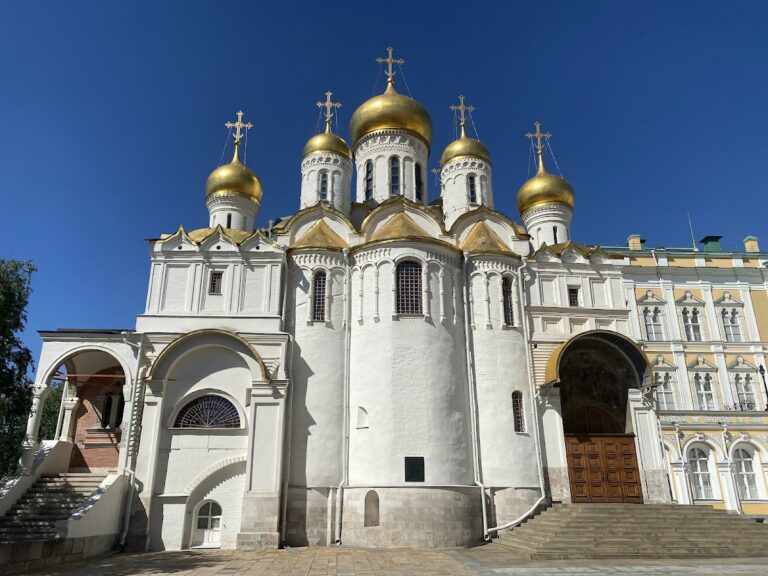
The cathedral is a five-apsed, six-pier, cross-domed building approximately 21 metres high. Its brick walls are faced with white stone, and five domes are shifted toward the east. The central dome rises above the ambo, a raised platform used for Scripture readings or sermons, while the smaller domes stand above the altar area. The altar is divided into five compartments, allowing side chapels beside the main altar, with additional chapels accommodated in the western part of the building.
Main facades
Pilasters, horizontal cornices, and wall bays divide the facades into an apparent two-storey composition. The lower zone is taller and heavier, with decorative arches between the divisions, while the upper zone is smaller and contains broad recessed panels. The northern and southern facades have unequal vertical divisions because the western drums are wider than the eastern drums. The western facade has three symmetrical divisions.
Traditional Russian church forms are combined with Italian, especially Venetian, Renaissance motifs. The decoration includes pilasters with carved volute and acanthus-leaf capitals, articulated cornices, shell-shaped ornaments in the zakomary, semicircular upper facade terminations that correspond to internal vaults, recessed panels, round windows, and plant ornament. Tall vessel-shaped finials originally crowned the gables. Their bases survive as rosette-like forms with palmettes, and fragments of the white-stone finials were found on the vaults in the 1940s.
Portals and western extension
The western, northern, and other portals are made of white stone and carry carved plant ornament. The principal western portal is the most elaborate and is set within a broad recessed entrance. Two additional western doors lead to the upper levels of the western extension, the basement sacristy, and the internal side chapels. An exterior covered gallery once ran behind an arcade. Later alterations removed it, but rows of arched niches preserve an indication of its former position.
The western part contains a walled chamber with an upper gallery intended for women of the tsar’s family. A loggia opens onto the western facade. Its walls were painted in the mid-sixteenth century with scenes concerning the baptism of Rus, and these paintings were repeatedly renewed. The eastern side chapels of Saint Uar and John the Baptist were built in the second half of the sixteenth century. A southern extension formerly contained the Court Chamber, whose basement was used in the sixteenth and seventeenth centuries to detain insolvent serf peasants from the cathedral’s estates. The existing clergy building replaced it in 1826 and served as a winter room because the cathedral was not heated until the mid-nineteenth century.
Interior and painted decoration
Inside, traditional semicircular vaults and cruciform piers support the structure rather than the round supports and cross-shaped vaults used in the Assumption Cathedral. Six brick piers carry the vaults. Four stand in the central part of the church and two in the altar. Each rests on a tall base that increases its section. Windows are arranged in two horizontal rows, while the eighteenth-century buttresses required some windows in the southern wall to be blocked. The side aisles contain rows of similar princely and royal tombs.
Wall paintings
Most of the surviving wall paintings belong to the seventeenth century and repeat much of the iconography and composition of the sixteenth-century frescoes. Portraits of more than sixty Russian princes appear on the piers and lower wall zone. Other scenes include episodes from the New Testament, prophets and forefathers in the domes, Adam and Eve in the central drum, and Archangels Michael and Gabriel with apostles, saints, warrior-martyrs, and scenes of Michael’s miracles.
Additional painted cycles depict the Dormition of the Virgin above the altar, the fall of the walls of Jericho on the southern wall, the story of the youth Vasily who found gold, and the Creed in the western part. A composition of the Last Judgment is painted above the exterior western entrance. These images accompany the tombs and the cathedral’s dedication to Michael, whom Russian Orthodoxy regards as a heavenly protector and military defender.
Iconostasis and principal icons
The four-tier wooden iconostasis is approximately 13 metres high. Royal woodcarvers made it in 1679 and 1680 under the direction of I. Nedumov. Its polychrome carved decoration is arranged in the prophetic, Deesis, festal, and local ranks. Most of the icons date from 1681, while other images belong to the fourteenth through sixteenth centuries. The iconostasis was damaged during the French occupation in 1812, when soldiers removed icons from its two lower tiers for use as benches and beds. It was restored in 1813, when carved columns and the Royal Doors were added or replaced, and underwent another restoration in 1979 and 1980.
The oldest icon associated with the iconostasis is the image of the Archangel Michael with Deeds, dating from the late fourteenth or early fifteenth century. Eudoxia, the widow of Dmitry Donskoy, commissioned it in memory of her husband and his victory at the Battle of Kulikovo. The iconostasis also includes a wooden Crucifix painted by Feodor Zubov and Mikhail Milyutin. Its Deesis rank centres on Christ in Majesty, flanked by the Virgin and Archangel Michael on one side and John the Baptist and Archangel Gabriel on the other. The cathedral also contains the icon of the Virgin known as “Blessed Heaven.”
Dynastic tombs and relics
Burial complex
The necropolis contains 46 tombs and 54 burials. The dead were placed in white-stone sarcophagi, stone burial containers, approximately 1.5 metres below the floor, with brick tomb monuments above them. These monuments were replaced by standardized brick structures with carved white-stone sides between 1630 and 1638 and enclosed in bronze protective cases in the early twentieth century.
Ivan Kalita’s tomb stands near the southern wall. Tombs of close relatives of the grand princes line the western side, while princes who fell from favour and died violently were buried along the northern side. Romanov tsars occupy positions near the southeastern and northeastern piers. Ivan IV and his sons Ivan and Feodor were buried behind the iconostasis on the southern side. Full-length painted images of nearly all the grand princes buried in the cathedral appear opposite their tombs.
Burials include Ivan Kalita, Simeon the Proud, Ivan II, Dmitry Donskoy, Vasily I, Vasily II, Ivan III, Vasily III, Ivan IV, Feodor I, Vasily IV, Michael I, Alexis I, Feodor III, Ivan V, and Peter II. Other burials include members of the Moscow princely house, the military commander Mikhail Skopin-Shuisky, and members of Tatar nobility who converted to Orthodoxy and served at the Russian court. The southern crypt also holds the remains of princesses and tsarinas transferred from the Ascension Convent in 1929.
Shrines and preserved relics
The tomb of Tsarevich Dmitry of Uglich stands beneath a carved white-stone canopy from the first half of the seventeenth century. A silver reliquary made in 1630 is kept in the Kremlin Armoury, while the carved canopy remains over the tomb. The relics of Prince Michael of Chernigov are held in a shrine on the northern side. The cathedral also preserves or commemorates relics associated with Dmitry Donskoy, Prince Michael of Chernigov and his boyar Theodore, Tsarevich Dmitry, and Euphrosyne of Moscow. In 2008, the relics of Euphrosyne of Moscow were placed in the chapel of Saint Uar.