Church of St. Francis of Assisi: A Franciscan Religious Complex in Kraków


Site at a Glance
- Rating
- 4.8
- Popularity
- Medium
- Country
- Poland
- Primary era
- Medieval
- External website
- Open
- Eras represented
- Medieval, Early Modern, Modern
- Civilizations
- Habsburg, Kingdom of Poland, Polish–Lithuanian Commonwealth
- Site type
- Religious
- Remains
- Church
On this page16 sections
History
The Church of St. Francis of Assisi is a Roman Catholic Franciscan complex in Kraków, Poland, founded in the thirteenth century and combining Gothic and Baroque elements. Together with the adjoining Friary of the Conventual Friars Minor, one branch of the Franciscan Order, it stands in Kraków’s Old Town at the corner of All Saints Square and Franciszkańska Street. The complex belongs to the Roman Catholic Archdiocese of Kraków and has served as a religious centre, a place of burial, and a sanctuary associated with several revered figures and sacred images.
Foundation and medieval development
Duke Henry II the Pious brought Franciscans from Prague to Kraków in 1236 or 1237. The precise foundation history of the church remains connected with several members of the ruling dynasty. Henry II and his wife Anna, together with Anna’s sister Agnes, are identified as early founders or contributors, while Duke Bolesław V the Chaste and his wife Kinga are also widely regarded as founders, especially in connection with later construction and rebuilding.
The first Mongol invasion of Poland in 1241 was followed by a major rebuilding campaign, for which Bolesław V was the principal initiator and investor in the late 1260s. The church was consecrated under the dedication of St. Francis of Assisi in 1269. The original construction, including the completion of the body added to an earlier cross-shaped section, is placed variously in the later thirteenth or early fourteenth century. A sacristy was added around 1260 to 1270.
Bolesław V was buried in the church in 1279 with his sister, Blessed Salomea. Stephen and Władysław, sons of Władysław the Elbow-high, were also buried there. The Kraków court appears to have envisaged the church as a dynastic mausoleum for Salomea, Bolesław, and Bolesław’s wife Kinga, who was later venerated as a Catholic saint.
Fifteenth-century enlargement
The church was substantially enlarged during the first half of the fifteenth century. Its presbytery was extended by two bays in 1401, and the main body was rebuilt between 1420 and 1436. The expanded building was reconsecrated by Cardinal Zbigniew Oleśnicki in 1436. The narrower northern nave was originally dedicated to Corpus Christi and later became the Chapel of the Passion. A chapel built beside the northern side of the presbytery for the carpenters’ and masons’ guild has been dedicated to Blessed Salomea since 1673.
Fires, rebuilding, and restoration
Fires affected the church in 1462, 1476, 1655, and 1850, while a tower collapsed in 1465. After the fire of 1655, the interior was divided into a main nave and a chapel, now known as the Chapel of the Passion, and the interiors were recreated in the Baroque style.
The fire of 1850 was the most destructive. A large part of the church and adjoining monastery burned, along with written records of the consecration and valuable objects. Restoration began immediately under Karol Kremer, with work by Teofil Żebrawski and Antoni Stacherski. Later in the nineteenth century, Władysław Ekielski restored the presbytery and Karol Knaus worked on the main nave. Bishop Anatol Nowak reconsecrated the church on 14 June 1908.
During the foreign partitions, the late-eighteenth-century divisions of Polish territory that ended Poland’s independence, the Franciscan presence in Poland was severely reduced. By 1864, only eight of more than ninety Franciscan monasteries remained, including the Kraków monastery. Austria granted Kraków a degree of autonomy in 1866, after which the situation improved somewhat.
Franciscan life and later status
Pope Benedict XV granted the church the title of Minor Basilica on 23 February 1920 through the efforts of Father Marian Sobolewski. The complex is a triple sanctuary, meaning a church associated with the veneration of particular sacred figures or objects, dedicated to Our Lady of Sorrows, Blessed Salomea, and Blessed Aniela Salawa. It is also a stop on the Lesser Poland section of the Way of St. James, a network of Christian pilgrimage routes associated with the shrine of St. James at Santiago de Compostela.
The friary has housed the Archconfraternity of the Passion of Christ, a Catholic devotional brotherhood, since 1595 and is associated with a Higher Franciscan Seminary of the Conventual Friars Minor. Maximilian Maria Kolbe served there as a priest from 1919 to 1922 and celebrated his first service in the church after Poland returned to sovereignty. Other notable friary residents included Benedict the Pole, Blessed Raphael Chyliński, and Saint Józef Sebastian Pelczar.
The church and friary form part of Kraków’s protected historic heritage. The complex lies within the Historic Centre of Kraków, inscribed on the UNESCO World Heritage List in 1978, and within the Kraków historic urban complex designated a Historic Monument of Poland in 1994. The church is also entered in the heritage register of the Małopolska Voivodeship under number A-22, dated 2 June 1934.
In June 2015, georadar surveys and endoscopic inspections beneath the Chapel of the Passion revealed previously unknown crypts. About twenty metal and wooden coffins were found, many in very good condition, and the investigations suggested the possible existence of a second, lower level beneath the crypts.
Remains
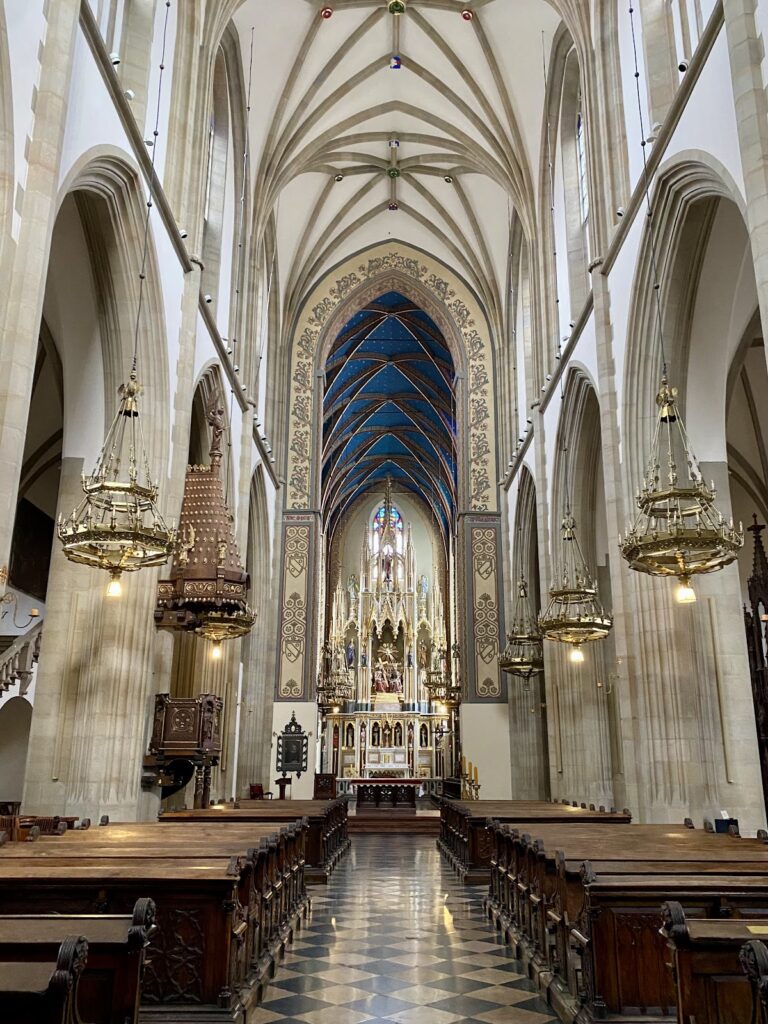
The present church is an oriented brick building composed of a presbytery, transept, main nave, and three chapels. Its principal material is brick, complemented by stone details. The building combines medieval Gothic architecture, characterized by pointed arches, ribbed vaults, and large window openings, with later Baroque work. The plan of the earliest church is uncertain. It may have formed a Greek cross with a tower at the crossing, or the tower may have stood near the junction of the north nave gable and the western arm of the cross.
Church layout and exterior fabric
Fifteenth-century rebuilding lengthened the presbytery by two bays and ended it with a three-sided apse, the terminating end of the sanctuary. The rebuilt body became an asymmetrical two-nave hall, with the naves connected by arcades. A single-storey Neo-Gothic vestibule was later added to the northern side of the Gothic transept.
A substantial square-plan bell tower was erected in front of the church near the outlet of Bracka Street in 1563. Constructed of stone and brick, it had four gateways at ground level, leading north to Bracka Street, south to the church, and east and west to the church cemetery. Its second storey had four large windows, including one with a small bell for the dying. The third storey also had four windows and an iron gallery for musicians on the Bracka Street side. A large church bell there required four people to swing it. Father Modest Wybranowski secured a copper-clad domed roof for the tower in 1645, and the tower was demolished in 1816. The wall around the former church cemetery was also demolished that year.
Presbytery and transept
Presbytery decoration
The presbytery contains a high altar made by Edward and Zygmunt Stehlik in 1861 with funding from Zofia Potocka. Its painting, Glory of St. Francis, was made by Gerhard Flatz in the third quarter of the nineteenth century. A floor slab designed by Jan Matejko and produced in 1871 depicts Bolesław V the Chaste. A brass floor slab marks the crypt in which Blessed Salomea’s coffin lay from 1269 to 1630.
Five stained-glass windows designed by Stanisław Wyspiański depict the elements and figures of St. Francis and Blessed Salomea. Wyspiański also created the presbytery’s polychrome decoration, painted architectural surfaces using several colours, with scenes including Virgin and Child, Caritas, St. Michael the Archangel, and Casting Down the Rebellious Angels. Paintings by Władysław Rossowski show episodes from Franciscan history, while Neo-Gothic choir stalls line the walls.
Transept
The transept, the crosswise arm of the church, contains a reconstructed ribbed cross-vault from the rebuilding after the 1850 fire and polychrome decoration by Wyspiański. Its northern arm has an epitaph to Piotr Kochanowski by Oskar Sosnowski. The southern arm contains an epitaph to Wincenty Pol, a bust of Jan Kochanowski, and a seventeenth-century Baroque crucifix.
Main nave
The main nave contains polychrome decoration by Tadeusz Popiel. Four figured scenes on the northern wall show Prayer at the Foot of the Cross, Stigmatization, Death of St. Francis, and Heavenly Glory of St. Francis. Władysław Rossowski painted scenes of the religious vows of Kinga and Jolanta and the baptism of Lithuania.
Between the pilasters stand statues of St. Basil, St. Augustine, St. Benedict, St. Dominic, and St. Francis, carved by Stanisław Wójcik. The nave also contains late-Baroque altars transferred from the demolished Church of St. Michael, two of which were probably designed by Franciszek Placidi. Above the choir, Wyspiański’s stained-glass window God the Father, Let There Be was installed in the western window in 1904.
Chapels
Chapel of Blessed Salomea
The Chapel of Blessed Salomea, formerly the Carpenters’ Chapel, contains her remains. Its marble and alabaster altar, erected in the second half of the seventeenth century, includes statues of Bolesław V the Chaste and his mother, Duchess Grzymisława, together with a painting of Salomea’s vision. A small coffin containing Bolesław’s bones stands in a niche beside the altar. Late-nineteenth-century polychrome decoration by Józef Mikulski and Franciszek Górski covers the walls.
Chapel of the Passion
The Chapel of the Passion contains a Baroque altar from the second half of the seventeenth century with a statue of the Sorrowful Christ. Fourteen paintings by Józef Mehoffer depict the Stations of the Passion and were produced between 1933 and 1946. Other works include a reliquary monument to Blessed Aniela Salawa by Czesław Dźwigaj, a large Baroque sculpture of Christ falling beneath the cross, and an early-sixteenth-century figure of the Thoughtful Christ.
A life-size certified replica of the Shroud of Turin is displayed at the chapel’s main altar. The shroud is a linen bearing a reversed human image and traditionally associated with the burial of Jesus Christ. Pope John Paul II consecrated the replica at the Vatican on 19 March 2003, and Cardinal Franciszek Macharski unveiled it ceremonially on 14 April 2003. The represented cloth measures approximately 4.3 by 1.10 metres and bears the reversed image of a man traditionally believed to be the dead Christ, including an apparent imprint of the face.
The chapel also contains a modern stained-glass window by Łukasz Karwowski above the choir and windows by Teresa Stankiewicz below it. A sculpture of Bishop Marcin Szyszkowski’s head is mounted on the choir parapet.
Chapel of Our Lady of Sorrows
The Chapel of Our Lady of Sorrows was separated from the northern arm of the monastery cloister in 1879. Its wall decoration, made in 1897 by Piotr Niziński and Stefan Witold Matejko under the direction of Władysław Łuszczkiewicz, surrounds a Baroque altar from the second half of the seventeenth century.
The altar contains a miraculous image also called the Sorrowful Benefactress of Kraków. Kraków’s population has venerated the image for centuries, and the church functions as its sanctuary. Cardinal Jan Puzyna crowned it in 1908. The upper part of the altar contains a small seventeenth-century Veraicon, an image of Christ’s face traditionally associated with St. Veronica’s cloth. Two Mannerist tombs commemorate the physicians Jan Baptysta Gemma and Jan Roszkowicz.
Friary and associated monuments
The adjoining friary has cloisters, covered walkways enclosing an open courtyard, with a gallery of portraits of Kraków’s bishops and a courtyard garden. In front of the church stands a monument to Cardinal Adam Stefan Sapieha, sculpted by August Zamoyski and installed in 1976. The complex also contains a reliquary monument to Blessed Aniela Salawa and relics of Blessed Salomea, Blessed Aniela Salawa, Blessed Jakub Strzemię, Blessed Zbigniew Strzałkowski, and Blessed Michał Tomaszek.
Nearby sites