Chiesa di San Pantalon: A Baroque Parish Church in Venice


Site at a Glance
- Rating
- 4.7
- Popularity
- Medium
- Country
- Italy
- Primary era
- Early Modern
- External website
- Open
- Eras represented
- Medieval, Early Modern, Modern
- Civilizations
- Venetian
- Site type
- Religious
- Remains
- Church
On this page23 sections
History
Chiesa di San Pantalon is a Roman Catholic parish church in Venice, Italy, in the Dorsoduro district, rebuilt in the Baroque period and dedicated to Saint Pantaleon. Saint Pantaleon was a Christian physician from Nicomedia who was martyred during the persecutions of Emperor Diocletian and is venerated as a healer and martyr. The church belongs to the Patriarchate of Venice, the Catholic jurisdiction headed by the Patriarch of Venice, and to the Vicariate of San Polo, Santa Croce, and Dorsoduro.
Origins and medieval parish
The church’s earliest history is uncertain. Tradition places its foundation in the ninth century, while other traditions associate a rebuilding in 1009 with the Giordani family and Doge Ottone Orseolo. Another tradition dates construction to 1025 and connects it with the Signolo and Dandolo families. The earlier sanctuary was erected on an existing religious building. It was first dedicated to Saints Pantaleon and Juliana, and later became known as San Pantalon, the Venetian form of San Pantaleone.
The first written record of the church dates to 1161, when Pope Alexander III granted it a privilege. The parish may have been established in 1222, when the church was rebuilt and Angelo Semitecolo was appointed to administer it. The medieval building was a basilica with several naves and a facade facing the Rio de San Pantalon. It was renovated and reconsecrated on 14 July 1305 under the parish priest Bartolomeo Dandolo.
Maps from 1500 and 1635 continue to show the facade turned toward the Rio de San Pantalon. An entrance opening toward Campo San Pantalon was added later. The earlier medieval bell tower was restored in 1225, but collapsed in the earthquake of 1511. Its represented form was that of a brick tower with three-part openings, stone balustrades, an octagonal drum, and a conical dome.
Seventeenth-century reconstruction
By the seventeenth century, the building had become unsafe. The major chapel was entirely rebuilt between 1668 and 1671, and the reconstruction of the whole church followed. The work was completed in 1686 under Francesco Comin of Treviso. Comin rotated the church’s longitudinal axis by 90 degrees, placing the main facade toward the campo rather than toward the canal.
The rebuilt church was reconsecrated in 1745 by Alvise Foscari, Patriarch of Venice. Its facade, however, remained unfinished. The church’s religious identity continued through its dedication to Saint Pantaleon, the Chapel of the Holy Nail, and the Chapel of the Holy House of Loreto. The latter was provided with a replica of the shrine in 1744 by the parish priest.
Parish reorganization
San Pantalon retained its parish status during the Napoleonic reorganization of Venetian churches and parishes. The process began with a decree of 5 June 1805 and was implemented through later measures. By 1810, the territory of the parish had been substantially reduced, with parts transferred to Santa Maria Gloriosa dei Frari, Santa Maria dei Carmini, and San Nicola da Tolentino.
From 1807, the parish was administered by a priest appointed by the patriarch. San Pantalon was originally affiliated with San Silvestro and is now a subsidiary parish of San Nicola da Tolentino. It remains an active parish church and is described as the smallest of Venice’s parishes.
Remains
Chiesa di San Pantalon is a Baroque brick building organized around a single broad, high nave, with three deep chapels on each side. The presbytery rises several steps above the nave. The building’s principal orientation reflects Comin’s seventeenth-century decision to turn the church toward Campo San Pantalon.
Facade and bell tower
Unfinished facade
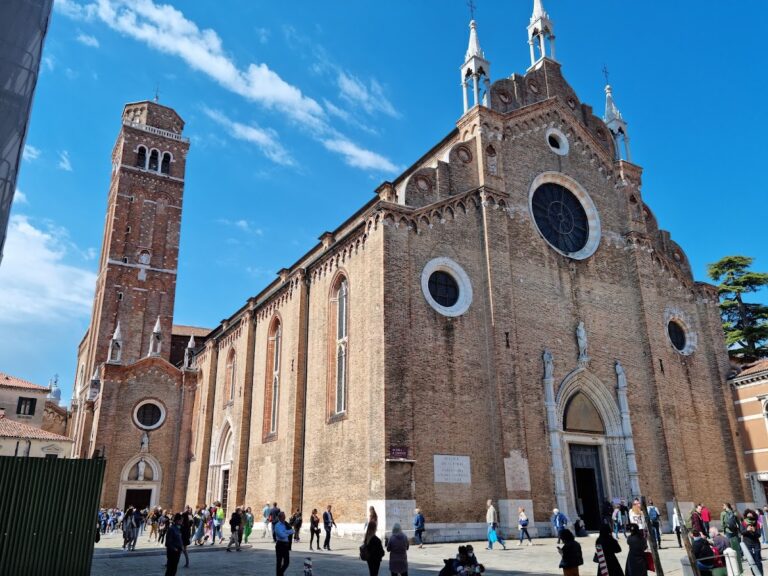
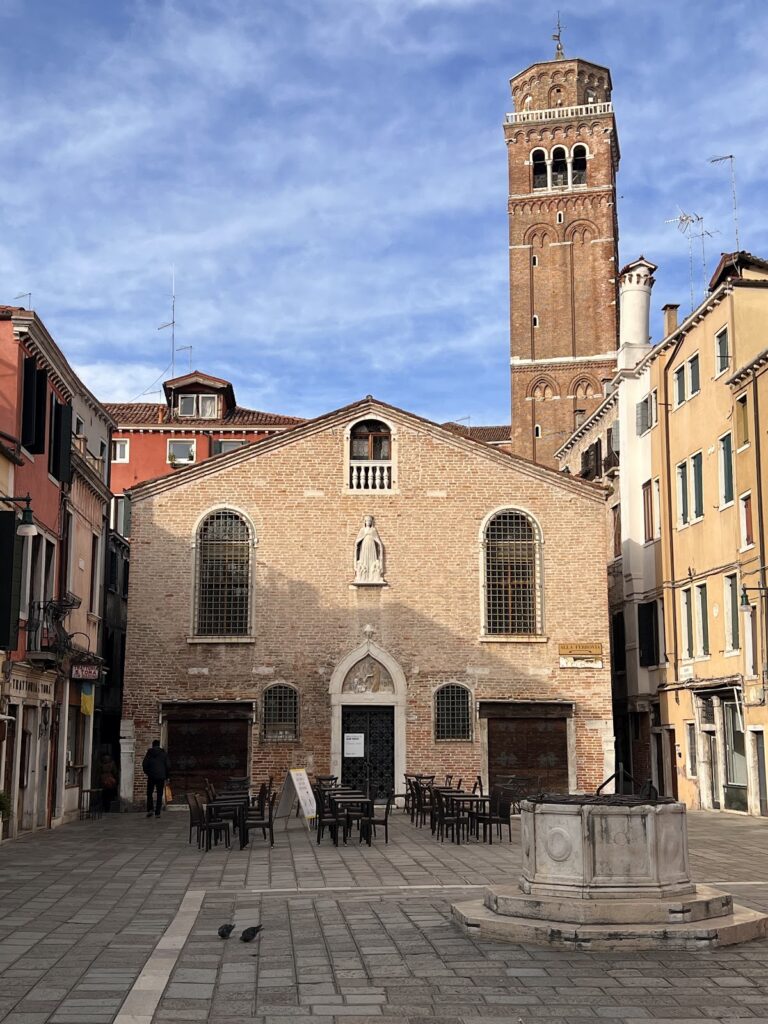
The seventeenth-century brick facade remains unfinished apart from the stone surrounds of the main portal and two side doors. It terminates in a gable, with low steps extending across its width and a semicircular window in the upper part. Its position facing Campo San Pantalon records the major change made during the reconstruction completed in 1686.
Present campanile
The present campanile, or bell tower, stands to the right of the church. Built in the early eighteenth century to a design attributed to Giovanni Antonio Scalfarotto, it is approximately 46 to 47 metres high and constructed of brick. The tower is divided into two levels articulated by pilasters, and each level ends in a projecting cornice of Istrian stone.
Its bell chamber has a single Serliana opening, a three-part opening with a central arch and narrower rectangular sides. Above it are a tall circular drum and an elongated domed roof. The bells are operated manually. This tower replaced the medieval campanile associated with the first church, which had fallen in the earthquake of 1511.
Nave, presbytery, and principal artworks
Main altar and presbytery
The freestanding main altar was built in 1671 by Giuseppe Sardi. Its rich decoration includes columns and capitals, swags, mirrors, entablature, and polychrome marble. Four marble statues of Saints Peter, Paul, Juliana, and John the Evangelist, made in 1600 by T. Ruer, stand on the altar.
Giovanni Antonio Fumiani’s Triumph of the Eucharist covers the rear wall and vault of the presbytery. On the right wall is The Pool of Bethesda, attributed to Guy Charon, while Antonio Molinari’s late-seventeenth-century Multiplication of the Loaves and Fishes occupies the left wall. A marble Crucifix hangs in front of the presbytery. It is attributed to the unknown Venetian artist called the Master of San Pantalon and probably dates from the third decade of the fourteenth century.
The Crucifix was illegally transferred to an antiques dealer by the parish priest around 1935. It passed through several owners before returning to the church in 2016. Its history explains the presence of the medieval sculpture in the present church, where it remains associated with the presbytery.
Ceiling painting
The nave ceiling is formed by 40 joined canvas panels mounted on a supporting structure. Together they make Fumiani’s Martyrdom and Glory of Saint Pantaleon, painted from 1680 to 1704 across 443 square metres. The composition uses trompe-l’oeil, an illusionistic technique that makes painted forms appear three-dimensional and continuous with the surrounding architecture. Without a conventional frame, the painting gives the impression that the ceiling opens into the building around it. It is probably the largest work of its type in the world.
Left-hand chapels
Chapel of Saint Bernardino
The first chapel on the left when proceeding from the presbytery is the Chapel of Saint Bernardino, formerly the Chapel of the Small Woolworkers’ School. Its altar painting, Saint Bernardino Receives the Christogram, dates from the late sixteenth century and is attributed to the school of Paolo Veronese, including Luigi Benfatto.
Giovanni Battista Lambranzi’s 1701 Saint Bernardino Founding a Hospital in Siena is displayed in the chapel, together with another late-sixteenth-century painting of the same subject attributed to Veronese’s school. Alessandro Longhi painted the 1780 frescoes of the Apostles Thaddeus and Matthew on the outer pendentives. Other works include Giovanni Segala’s The Samaritan Woman at the Well and P. Manfredi’s Faith.
Chapel of Saint Pantaleon
The Chapel of Saint Pantaleon contains a seventeenth-century dome fresco of Saint Pantaleon in Glory by Fumiani, with images of prophets by the same artist in the ovals above. Its altarpiece is Paolo Veronese’s 1587 Saint Pantaleon Healing a Boy, identified as Veronese’s last work.
The chapel also contains Palma the Younger’s 1599 Saint Pantaleon Healing a Paralytic and The Beheading of Saint Pantaleon, Antonio Lazzarini’s 1702 Saint Pantaleon Treating the Sick, and Fumiani’s Saint Pantaleon Visiting Saint Juliana in Prison. Giovanni Faccioli painted the eighteenth-century frescoes of Saints Matthew and Simon on the outer pendentives.
Chapel of Saint Anne
The Chapel of Saint Anne has a seventeenth-century vault fresco of Christ in Glory with the Virgin Mary, Saint Joseph, and the Saints, attributed to Fumiani. Its altar holds an eighteenth-century marble group of Saint Anne with Saints Joachim and Joseph, attributed to Giovanni Bonazza or one of his sons. Marble reliefs of the Birth of the Virgin Mary and the Presentation of Mary in the Temple are attributed to the same sculptural circle.
Jacopo Guarana painted the 1779 frescoes of Saints Philip and Bartholomew on the outer pendentives. Nearby paintings on the outer wall include F. Pittoni’s Christ Giving the Keys to Saint Peter, Alessandro Longhi’s Prudence and Charity, Giovanni Faccioli’s An Angel Appearing to Saint Peter, Angelo Trevisani’s Christ Healing the Possessed Man, and G. Segala’s Healing the Blind Man.
Right-hand chapels
Chapel of the Most Holy Trinity
The first chapel on the right from the presbytery is the Chapel of the Most Holy Trinity. Its altar painting is Gregorio Lazzarini’s 1723 The Holy Trinity with Saints John the Baptist, Peter, Anthony, and the Guardian Angel. Three seventeenth-century vault paintings attributed to Fumiani depict The Beheading of Saint John the Baptist, Saint John the Baptist before Herod, and Saint John the Baptist and the Angel.
Fumiani also painted the chapel’s Baptism of Christ and The Preaching of Saint John the Baptist. Pietro Longhi’s frescoes of Saints Peter and Andrew occupy the outer pendentives.
Chapel of Our Lady of Sorrows
The second right-hand chapel is the Chapel of Our Lady of Sorrows. Its vault contains Paolo Veronese’s late-sixteenth-century circular painting The Eternal Father in Glory, set within elaborate stucco decoration. The Baroque altar uses white and black marble and bears a seventeenth-century Descent from the Cross by an imitator of Fumiani.
Two seventeenth-century oval paintings by Fumiani, Preparation for the Crucifixion and Christ with Judas, are also preserved here. Vincenzo Guarana painted the 1780 frescoes of Saints James the Elder and James the Younger on the outer pendentives.
Chapel of the Immaculate Conception
The third chapel on the right is the Chapel of the Immaculate Conception. Its altar painting, Nicolò Bambini’s 1710 Immaculate Conception with the Archangel Michael and Saint Anthony of Padua, is accompanied by Fumiani’s seventeenth-century circular vault painting The Eternal Father and Other Holy Figures. The outer pendentives contain frescoes of the Apostles Thomas and James by A. Tonioli.
Between the first and second right-hand chapels is a late-fourteenth-century marble relief of The Baptism of Christ and the Beheading of Saint John the Baptist by an anonymous artist. Two Greek-marble columns frame the relief.
Relic chapels and sacristy
Chapel of the Holy Nail
Formerly the Chapel of All Saints, the Chapel of the Holy Nail preserves a relic identified as one of the nails used in the Crucifixion. The relic is dated to 1590. The chapel’s altar was made between 1427 and 1458 and is richly ornamented with small figures and decoration on its sides and upper section. Its antependium contains a sixteenth-century relief of Christ Laid in the Tomb, attributed to M. Cedrini.
Antonio Vivarini’s large Coronation of the Virgin, probably produced in collaboration with Giovanni d’Alemagna and dated to 1444, is one of the chapel’s principal works. The left wall has a triptych centred on a Madonna and Child, also called the Madonna of the Poppy. Its panels depict the Annunciation and Nativity on the left, and the Presentation of Jesus in the Temple and Dormition of the Virgin on the right. These works are attributed to Paolo Veneziano or his circle, with the Annunciation dated to the mid-fourteenth century.
Other paintings in the chapel include Luca Carlevarijs’s Landscape, Vincenzo Guarana’s Supper at Emmaus, and Alessandro Longhi’s Charity. Fragments of a fresco by Pietro Longhi, dating from around 1745, are also preserved there.
Chapel of the Holy House of Loreto
The Chapel of the Holy House of Loreto, also called the Oratory of Our Lady of Loreto, is a small brick-lined space containing a faithful replica of the Holy House of Loreto, built in 1744. The shrine is associated with the house traditionally connected with the Virgin Mary and believed to have been transported to Loreto. A fourteenth-century alabaster statue of the Madonna and Child stands in a niche in the side wall, and the church also contains a wooden statue of Our Lady of Loreto.
Sacristy and furnishings
The sacristy contains P. Manfredi’s Hope, Vincenzo Guarana’s Christ and Saint Mary Magdalene, and Luca Carlevarijs’s Landscape above the entrance. Its altar has Alessandro Varotari’s Christ Laid in the Tomb. The walls also display two early-sixteenth-century Venetian-school organ doors depicting saints and Elisabetta Lazzarini’s Rebecca at the Well, dated to the seventeenth or eighteenth century.
The pulpit was designed by P. Chezia, who also reconstructed the former San Luca Theatre, now the Teatro Carlo Goldoni. Above the entrance is an organ built by Gaetano Callido, gilded by Chezia, and dated to 1803. Paintings on the inner facade wall include Alessandro Longhi’s Prudence, G. Lazzarini’s Saint Mary Magdalene Washing Christ’s Feet, and Antonio Balestra’s The Raising of Lazarus.
Nearby sites