Sanctuary of Saint Michael the Archangel: A Pilgrimage Shrine at Monte Sant’Angelo


Site at a Glance
- Rating
- 4.8
- Popularity
- High
- Country
- Italy
- Primary era
- Medieval
- External website
- Open
- Eras represented
- Classical, Medieval, Early Modern
- Civilizations
- Kingdom of Naples, Kingdom of Sicily, Lombard, Norman
- Site type
- Religious
- Remains
- Sanctuary
On this page17 sections
History
The Sanctuary of Saint Michael the Archangel is a Roman Catholic shrine and minor basilica at Monte Sant’Angelo in Italy, built around a cave associated with the apparitions of Saint Michael from approximately 490 onward. Dedicated to the archangel, the sanctuary belongs to the Archdiocese of Manfredonia–Vieste–San Giovanni Rotondo and became the principal western centre of Michael’s cult.
Origins and the Apparition Traditions
The earliest account of the sanctuary’s foundation appears in the Latin work Liber de apparitione Sancti Michaelis in Monte Gargano. Its narrative is divided into three parts and describes three apparitions. The first tradition tells of Elvio Emanuele, a landowner who found his finest bull inside an inaccessible cave. When he shot an arrow toward the animal, the arrow allegedly turned back and wounded him.
After three days of prayer and penance, Lorenzo Maiorano, bishop of Sipontum, received Michael’s command to dedicate the cave to Christian worship. Maiorano initially hesitated because pagan worship continued on Mount Gargano. A first sanctuary was built over the cave in 493. Christian tradition holds that Michael himself consecrated the cave, rather than human clergy, giving it the title “Celestial Basilica.”
The second apparition tradition is connected with the rescue of Sipontum from a siege. Maiorano obtained a three-day truce for prayer and penance, after which Michael promised victory. The inhabitants then defeated their attackers during a storm of sand and hail. The episode is traditionally placed in the early 490s, although the narrative may preserve a memory of the Lombard Duke of Benevento Grimoald I’s victory over unidentified “Greeks,” possibly Byzantine forces, at Mount Gargano on 8 May 663.
The church of Sipontum established a feast for Michael on 8 May, and the observance spread through Western Christianity during the ninth century. Pope Pius V later formalized it as Apparitio Sancti Michaelis. Its earliest focus may have been the Lombard victory rather than an apparition.
In the third tradition, Pope Gelasius I approved Maiorano’s plan to consecrate the cave after a period of fasting. Michael declared that he had already consecrated it through his presence, and a church was built before the cave entrance. It was dedicated to Michael on 29 September 493, with some accounts giving 494.
Lombard and Medieval Development
From the seventh century, the Gargano region formed part of the Lombard Duchy of Benevento. The Lombards were a Germanic people who established a kingdom in Italy and a powerful duchy in the south. Their conversion from Arian Christianity to Catholic Christianity began under Queen Theodelinda in 589 and was completed during the reign of King Cunipert. Michael’s cult developed within this setting, spreading through the Lombard territories and establishing the archangel as the people’s patron.
Lombard dukes of Benevento and kings based at Pavia sponsored major work at the sanctuary. These interventions improved access to the apparition cave and allowed the shrine to receive more pilgrims. The sanctuary became a model for other shrines dedicated to Michael.
After the Lombard kingdom fell in 774, the sanctuary retained its importance within Langobardia Minor, the Lombard territories of central and southern Italy that remained politically distinct from the northern kingdom. It also remained connected with the Principality of Benevento, created from the duchy on the initiative of Arechis II. After Benevento’s decline in the eleventh century, Normans, Swabians, and Angevins successively cared for the shrine and altered its upper structure and decoration. The Angevins were a ruling dynasty whose members governed territories in southern Italy.
The sanctuary became a major medieval pilgrimage destination and a station on a branch of the Via Francigena known as the Via Sacra Langobardorum, a route leading toward the Holy Land. It was one of three principal European places of worship dedicated to Michael, together with Sacra di San Michele in Val di Susa and Mont-Saint-Michel in Normandy.
Pilgrimage, Memory, and Later History
Pilgrims travelled to the sanctuary from the early Middle Ages onward, including visitors from as far away as Ireland. Popes associated with the shrine included Gelasius I, Leo IX, Urban II, Alexander III, Gregory X, Celestine V, John XXIII as a cardinal, and John Paul II. Among its royal and noble visitors were Louis II, Otto III, Henry II, Matilda of Tuscany, Charles I of Anjou, and Ferdinand II of Aragon. Saints connected with the sanctuary included Bridget of Sweden, Bernard of Clairvaux, and Thomas Aquinas.
Francis of Assisi visited in 1216. Considering himself unworthy to enter the grotto, he prayed at its entrance, kissed a stone, and carved a Tau-shaped cross on it. A Tau is a cross shaped like the letter T and is associated in Christian devotion with penitence and Francis of Assisi. The carved mark is described as surviving.
The association between the three principal Michael shrines produced the legend of a “sacred line of Saint Michael.” According to the story, the line was created by Michael’s sword strike against Satan and extended through other sanctuaries to the northwest and southeast. The claim has no scientific support. The sites deviate from the relevant connecting line by approximately 14 to 42 kilometres, making coincidence the probable explanation.
A fourth apparition tradition belongs to the plague of 1656. Alfonso Puccinelli, archbishop of Lucca, prayed and fasted at Monte Sant’Angelo before Michael appeared to him on 22 September. The archangel instructed him to mark stones from the cave with a cross and the letters “M. A.” Devotees who kept the stones believed that they were protected from the plague, which soon abated.
Puccinelli commemorated the event by erecting a monument to Michael in the town square opposite the window of the prelatial palace associated with the apparition. He also commissioned a similar statue made from stone taken from the caves and presented it to the Republic of Lucca. It remains in the church of San Michele in Foro.
Until 1929 the sanctuary was a palatine church, and its archpriest held the rank of prelate over a church nullius, meaning a church placed directly under a prelate rather than within a diocese. Since 13 July 1996, pastoral care has been entrusted to the Congregation of Saint Michael the Archangel. The sanctuary received the “Angelic Pardon” and a plenary indulgence in 1997.
The historic site and its surroundings have been protected within Gargano National Park since 1991. In 2011 the sanctuary became part of the UNESCO World Heritage serial property Longobards in Italy: Places of Power (568–774 A.D.), which includes seven sites recognized for Lombard architectural, pictorial, and sculptural evidence.
Remains
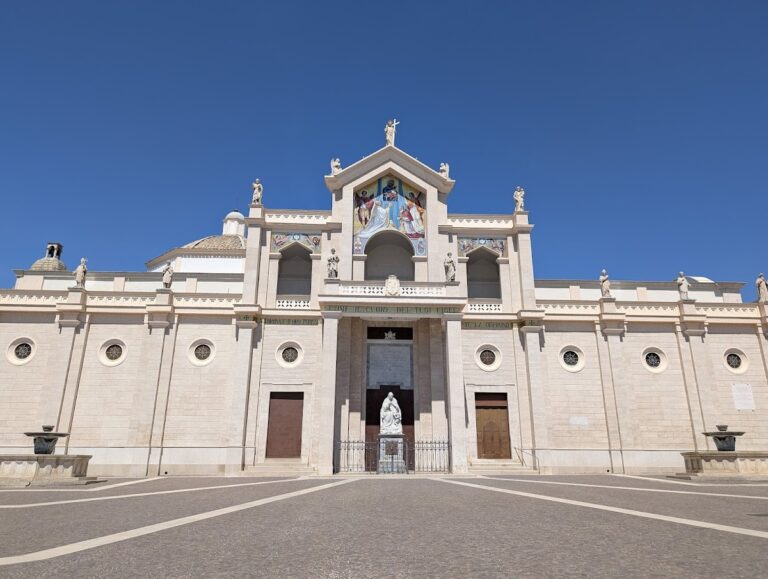
The sanctuary is a Romanesque complex arranged on upper and lower levels. The upper level contains the Romanesque entrance portal and bell tower, while the lower level leads to the cave, the Angevin staircase, the devotional museum, and the crypts. The wider complex also includes the Baptistery of San Giovanni in Tumba, the Church of Santa Maria Maggiore, the castle, and associated atria and chapels.
Upper Buildings and Approach
Baptistery of San Giovanni in Tumba
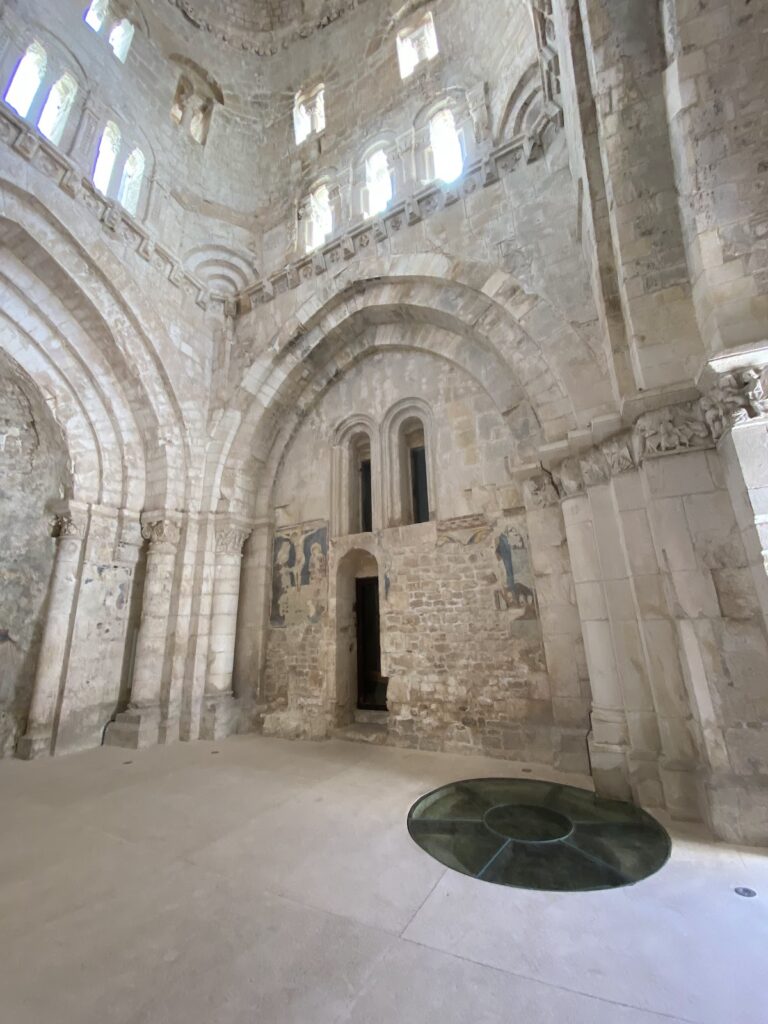
The Baptistery of San Giovanni in Tumba has a rectangular lower storey, an octagonal section, an elliptical transition, a high drum, and a cupola. The building was damaged in 1942, and its sequence of changing forms remains a distinctive part of the sanctuary complex.
Church of Santa Maria Maggiore
The Church of Santa Maria Maggiore was erected in the eleventh century by Archbishop Leone over the remains of an ancient necropolis. Fragments of its former decoration indicate that the church once contained extensive fresco work.
Castle and Bell Tower
The castle was enlarged by the Normans over an episcopal residence associated with Orso, bishop of Benevento. Frederick II later modified it, and the building served as a residence connected with the Honor Montis Sancti Angeli.
The massive octagonal bell tower was built by Frederick II in the late thirteenth century as a watchtower. Charles I of Anjou later converted it into a bell tower. Angevin rebuilding began under the local architect Giordano on 27 March 1274 and ended in 1282. The tower originally stood about 40 metres high, was later reduced for unknown reasons to 27 metres, and now has four storeys.
Portico and Angevin Staircase
A portico before the sanctuary has two Gothic arches. The right arch was made in 1395 by the local architect Simone, while the left was reconstructed in 1865. Work on the portico began under Charles I of Anjou and was completed under King Ladislaus in 1395. Its central portal dates from the twentieth century.
The Angevin staircase descends from the portico toward the cave. Built under Charles I of Anjou, it contains 86 steps divided into five flights. Gothic arches support the staircase, and small windows open in its side walls.
Cave and Medieval Access
Gate of the Bull
The cave is entered through the Romanesque Portale del Toro, or Gate of the Bull. Its bronze doors were made in Constantinople in 1076 and donated by an Amalfitan nobleman. Twenty-four panels show angels and scenes from the Old and New Testaments, including the apparitions of Michael to Lorenzo Maiorano.
Cave Interior
The cave retains an archaic natural interior. It contains a holy well, votive offerings, an altar, the Episcopal Chair, the statue of Saint Michael, the statue or altar of Our Lady of Perpetual Help, and a small Stone Cave formed from pieces of the cave wall distributed to pilgrims.
The marble Episcopal Chair dates to the twelfth century and rests on crouching lions. The Carrara marble statue of Saint Michael was carved by Andrea Ferrucci in 1507. It depicts the archangel holding a sword in his right hand, an attribute representing his divinely granted power over evil. Antonio del Monte, cardinal and bishop of Manfredonia and a fellow townsman of Ferrucci, probably commissioned the work. The cave also contains a statue of Saint Sebastian and a statue of Michael by Andrea Sansovino among its votive offerings.
Inner Courtyard and Crypts
The inner courtyard directly adjoins the cave. Sarcophagi there contain the remains of local notable figures, including Alfonso Puccinelli, who died in 1658.
The crypts occupy Lombard-period spaces that originally served as an entrance to the cave and were definitively abandoned in the thirteenth century. Inscriptions along their walls, including some in runic characters, record the arrival of pilgrims from across Europe from the Lombard period onward.
The crypts developed in two architectural phases from the late seventh to the early eighth century. The first section is a porticoed gallery divided into eight rectangular bays. It once displayed sculptures recovered chiefly through excavations at the sanctuary. The second section is Lombard in date and originally had two staircases. The stairs ended at a small platform with an apse and an altar bearing numerous inscriptions.
Interior Sanctuary
Angevin Nave and Main Altar
The interior sanctuary combines the brick-built Angevin Nave with a portion of the cave that later rebuilding did not alter. Local craftsmen Giordano and Maraldo constructed the nave between 1273 and 1295. Its cross vaults give it the form of a Gothic building.
The Baroque Altar of the Blessed Sacrament in the apse dates to 1690. Its tabernacle goes back to the ninth century and is now accompanied by statues of Saint Joseph, Saint Nicholas of Myra, and Saint Anthony of Padua.
Chapel of the Cross and Choir
The Chapel of the Cross, also called the Chapel of the Relics, began as a sacristy. It was rebuilt between 1705 and 1791 to house relics, including a silver filigree cross presented by Frederick II and said to contain particles of the True Cross. The chapel also contains relics associated with the martyr-popes Alexander I, Cornelius, and Felix I.
The Choir is raised six steps above the floor and separated from the main church. It was finally arranged in 1630 after clergy suffered illness during long services in the damp cave. The sanctuary’s named spaces also include the upper atrium, internal atrium, Altar of Our Lady of Perpetual Help, museum, and Stone Quarry.