Manfredonia Cathedral: Seat of the Archdiocese of Manfredonia–Vieste–San Giovanni Rotondo


Site at a Glance
- Rating
- 4.6
- Popularity
- Low
- Country
- Italy
- Primary era
- Early Modern
- External website
- Open
- Eras represented
- Medieval, Early Modern, Modern
- Civilizations
- Italian, Kingdom of Naples, Spanish
- Site type
- Religious
- Remains
- Cathedral
On this page7 sections
History
Manfredonia Cathedral is a Roman Catholic cathedral in Italy dedicated to Saint Lawrence of Siponto, one of Manfredonia’s patron saints. Built after the episcopal see moved from Siponto to Manfredonia, the church was begun on 7 February 1270 and completed in 1274. It remains the seat of the Archdiocese of Manfredonia–Vieste–San Giovanni Rotondo, the ecclesiastical jurisdiction formerly associated with Siponto.
The Angevin Cathedral
The first cathedral was an Angevin church. Its history was violently interrupted in 1620, when an attack and fire carried out by the Turks destroyed the building. The cathedral was not rebuilt until 1700, when the surviving ruins of the earlier church were used in the reconstruction.
Reconstruction and Later Changes
The rebuilding involved Bishop Bartolomeo della Cueva, Cardinal Vincenzo Maria Orsini, who later became Pope Benedict XIII, and Monsignor Andrea Cesarano. Della Cueva moved the principal entrance to the opposite end of the church and was associated with the construction of the canons’ stalls and the high altar. In 1677, Cardinal Orsini planned a new campanile, or bell tower, on the site of the former main entrance. Bells cast in 1646 by the Neapolitan founder Onofrio Giordano and donated by Archbishop Marullo were transferred from the earlier tower.
Saint Lawrence’s body had been brought from Siponto to the cathedral by Bishop Matteo Orsini, a Dominican who later became a cardinal, on 30 October 1327. The relic was destroyed in the fire and attack of 1620, with the exception of the right arm, which is preserved in the cathedral. Madonna of Siponto is regarded as Manfredonia’s patroness, while Saint Lawrence is its patron. On 28 August 1955, Cardinal Angelo Giuseppe Roncalli, the future Pope John XXIII, blessed a statue of the Virgin with a gold crown set with diamonds during the celebration of the Virgin’s coronation.
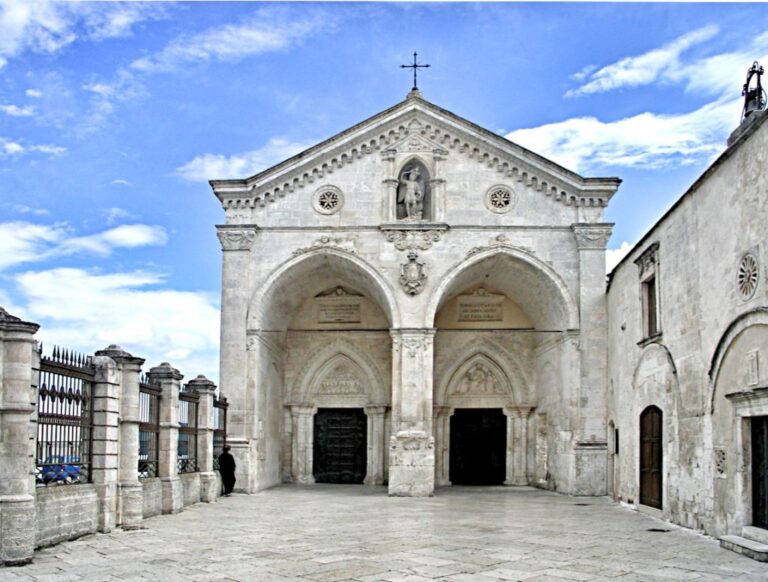
At the request of Bishop Andrea Cesarano, a new travertine-marble facade was built in the 1960s. It incorporated a marble statue of John XXIII by the sculptor Aronne del Vecchio. The cathedral remains an active Roman Catholic church and retains its cathedral status.
Remains
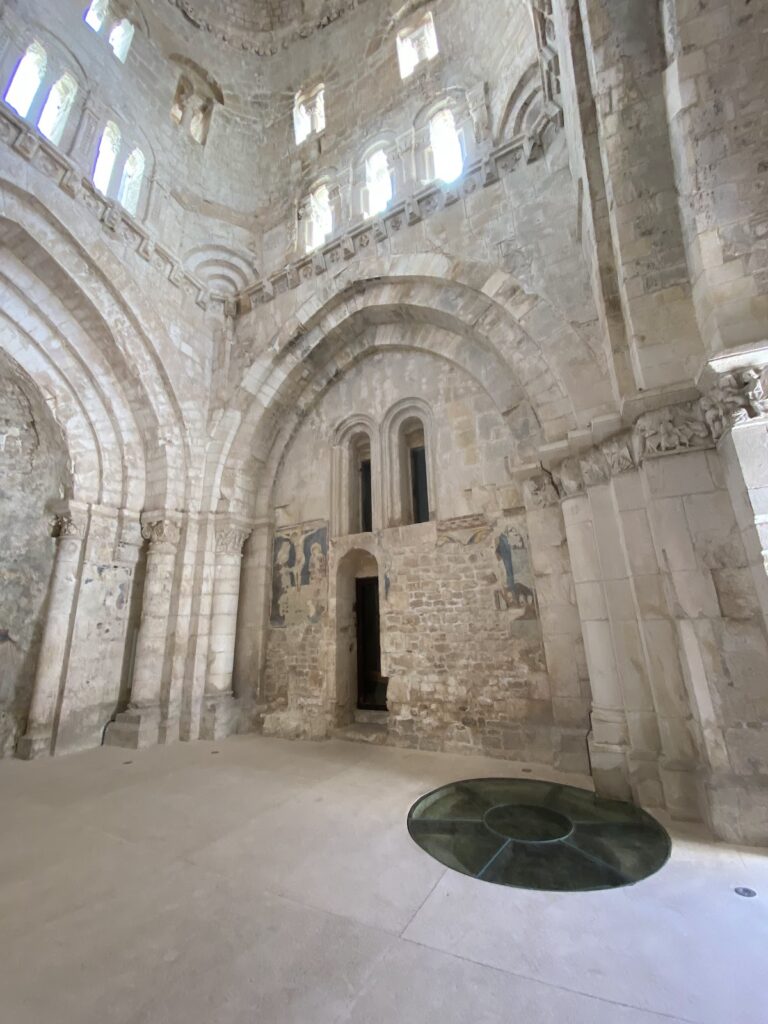
The cathedral’s interior is organized around a large single nave preceded by a narthex, or entrance hall. The nave is covered by a substantial semi-cylindrical vault with lunettes, the curved sections where the vault meets the walls. A dome interrupts the vault before it continues over the apse. The rectangular apse is enclosed by a frontal wall and adjoins a finely carved choir.
Nave and Liturgical Interior
Two groups of Corinthian columns support the organ gallery. Along the walls, six pairs of fluted pilasters face one another. Their composite capitals carry an entablature, the horizontal architectural band supported by columns or pilasters, which runs around the church. Six arcades open on each side of the nave. Some lead to chapels, while others are walled and form spaces for altars and decorated niches.
The predominantly white walls are marked by wrought-iron crosses shaped like the Greek cross. Corresponding marble crosses stand on the high altar, recalling the building’s use for the Greek rite until 1586. The choir contains walnut-wood stalls associated with Archbishop Antonio Marullo’s tenure from 1643 to 1648.
Paintings and Facade
Frescoes painted in 1940–1941 by Natale Penati of Milan depict Popes Julius III and Benedict XIII, the apparition of Saint Lawrence to Totila, the Ostrogothic king of Italy, Justinus of Siponto and his companions, the saints of Siponto, and the martyrs of Furci. The exterior presents the travertine-marble facade constructed in the 1960s, including Aronne del Vecchio’s marble statue of John XXIII.
Relics and Ecclesiastical Records
The cathedral preserves the right arm of Saint Lawrence of Siponto and the statue of the Virgin with its diamond-set gold crown. Its ecclesiastical holdings include portraits of archbishops such as Orsini, Muscettola, Rivera, and Tagliatela, together with parchments, baptismal registers dating from 1600 onward, and other books connected with the cathedral’s history.