Nativity Convent: An Orthodox Monastery in Moscow


Site at a Glance
- Rating
- 4.8
- Popularity
- Low
- Country
- Russia
- Primary era
- Early Modern
- External website
- Open
- Eras represented
- Early Modern, Modern
- Civilizations
- Russian
- Site type
- Religious
- Remains
- Fortified Monastery
On this page16 sections
History
Nativity Convent is an Orthodox women’s monastery in Moscow, Russia, founded in 1386. Its Cathedral of the Nativity of the Mother of God, built in 1501–1505 in the early Moscow architectural tradition, is regarded as one of the oldest surviving buildings in central Moscow outside the Kremlin walls. The convent takes its name from the Orthodox feast commemorating the birth of Mary, the mother of Jesus.
Foundation and princely connections
The convent was traditionally founded by Maria Konstantinovna, the wife of Prince Andrei of Serpukhov and mother of Prince Vladimir the Bold. Maria entered the community as a nun in 1389, taking the name Martha, and died there. The monastery initially stood within the Moscow Kremlin and was known as the Monastery of the Nativity of the Mother of God on the Moat. Another tradition places it beside the Neglinnaya River, on land belonging to Prince Vladimir, from the time of its foundation. Its transfer to the present site is dated to 1484.
The convent remained connected with the ruling princely families. In the 1430s, Princess Elena Olgerdovna, wife of Prince Vladimir the Bold, took the veil there as Eupraxia. She donated villages and dependent settlements to the convent and, according to her will, was buried in its cemetery in 1452. On 25 November 1525, Solomonia Saburova, the wife of Vasily III, the grand prince of Moscow, was forcibly tonsured at the convent under the name Sophia. She later transferred to the Intercession Convent in Suzdal.
Fire, rebuilding, and early modern expansion
The great Moscow fire of 1547 damaged the convent. Its buildings burned, and the stone cathedral was damaged. Restoration followed through the vow of Tsarina Anastasia Romanovna, the wife of Ivan IV, the first Russian ruler to use the title tsar. Ivan IV ordered a southern altar dedicated to Saint Nicholas to be added to the cathedral.
In the 1670s, the convent became the burial place of the Lobanov-Rostovsky princes. Their family burial vault was built east of the cathedral, and its upper floor was added in the nineteenth century for use as the convent sacristy, the place where liturgical vestments and sacred vessels are kept. Princess Fotinia Ivanovna Lobanova-Rostovskaya financed the stone Church of Saint John Chrysostom, together with its refectory and chapels, between 1676 and 1687. She also funded the stone enclosure built around the complex in 1671.
Institutional growth before 1917
During the nineteenth and early twentieth centuries, Nativity Convent expanded its educational and charitable work. It operated a parish school and an orphanage for girls, while new monastic buildings provided classrooms. The Church of Saint John Chrysostom was reconstructed in 1903–1904, and a convent refectory was built under the direction of architect Pyotr Vinogradov. In 1904–1906, Vinogradov also designed the Church of the Kazan Icon of the Mother of God with a new refectory.
Closure and secular reuse
A detention camp opened in the convent on 1 June 1920, alongside a separate barracks-style forced-labor hostel established no later than June of that year. The camp held approximately 200–300 prisoners and closed on 19 December 1921, when its prisoners and residents were transferred to the Pokrovsky camp. From 1920, a central hospital and outpatient clinic for the camps operated at the convent. It provided eye, ear, dental, surgical, and venereal services and was initially headed by surgeon Boris Markovich Zhirmunsky, who later emigrated to France and helped establish the Mirabeau hospital in Paris.
The convent was closed and liquidated in 1922–1923. In 1923, ninety people, including the abbess, were forcibly expelled. Some nuns remained as workers or guardians, and two elderly nuns reportedly continued living on the grounds until the late 1970s. Seventeen poods of silver were removed from the icon coverings after the closure. Some icons were transferred first to the Church of Saint Nicholas in Zvonari and later to churches in Pereyaslavskaya Sloboda.
The former convent was adapted for administrative, scholarly, educational, and military-related purposes. Its cells became communal apartments, the Church of Saint John Chrysostom became a workers’ club, and the Kazan refectory church was stripped and converted into a canteen. Religious services continued for a period only in the summer cathedral. The monastery cemetery, including the founder’s grave, the Lobanov-Rostovsky burial chapel, and part of the enclosure walls, was destroyed.
Restoration and revival
In 1974, Moscow city authorities transferred the complex to the Moscow Architectural Institute for a museum and storage institution devoted to ancient Russian art and architecture. Restoration followed, and the cathedral was subsequently used to store an academic institute’s archive.
The Cathedral of the Nativity of the Mother of God was returned to the Orthodox Church in 1992, and services resumed there on 14 May that year. The convent as a whole was revived on 16 July 1993, after which restoration continued. It received stauropegial status, meaning that it was placed directly under the central authority of the Russian Orthodox Church rather than under a diocesan bishop. Since 19 July 1993, the community has been headed by Abbess Victorina, also known as Perminova. Approximately thirty nuns belonged to the community in 2019.
The revived convent operates a Sunday school for children aged four to seventeen. A free three-year women’s church-choral school opened in 2010, and a convent library was established in 2011. Since 1999, the Church of the Joy of All Who Sorrow in the village of Fyodorovskoye has served as a dependency of the convent. The restored Kazan church was reconsecrated by Patriarch Kirill in November 2010. Nativity Convent is a federally significant cultural-heritage monument of the Russian Federation.
Remains
Nativity Convent occupies the angle of Rozhdestvenka Street and Rozhdestvensky Boulevard on the left bank of the Neglinnaya River, within Moscow’s historic central area. The surviving complex combines the early sixteenth-century cathedral, seventeenth-century churches and enclosure elements, nineteenth-century additions, and buildings associated with the convent’s educational and communal life.
Cathedral and burial buildings
Cathedral of the Nativity of the Mother of God
The Cathedral of the Nativity of the Mother of God is a small, single-domed stone church constructed in 1501–1505 in the early Moscow architectural tradition. Its original appearance changed over approximately 150 years after the fire of 1547, when additions accumulated around the building. The southern Saint Nicholas chapel belongs to the post-fire restoration. Chapels dedicated to the Descent of the Holy Spirit and Saint Dmitry of Rostov were added in 1814 and 1820.
Lobanov-Rostovsky burial vault
The Lobanov-Rostovsky burial vault stands east of the cathedral. Built as the family burial place in the 1670s, it received an upper story in the nineteenth century, when that level housed the convent sacristy. The burial chapel was later destroyed, while the vault remains part of the complex’s architectural history.
Church of Saint John Chrysostom
The stone Church of Saint John Chrysostom was built between 1676 and 1687 with a refectory, a communal dining hall incorporated into the church building, and chapels dedicated to Saint Nicholas and Saint Philaret the Merciful. A dedication to Saint Dmitry of Rostov could not have been given before the second half of the eighteenth century. The church was reconstructed in 1903–1904. After the convent closed, it served as a workers’ club.
Enclosure and monastic buildings
Walls and bell towers
A stone enclosure with four towers surrounded the complex from 1671. In 1882, it was dismantled and replaced by a new wall that incorporated elements of the earlier enclosure. The cathedral formerly had its own bell tower. The seventeenth-century tower replaced an earlier structure, carried a tent-shaped roof, and was destroyed by lightning in 1855.
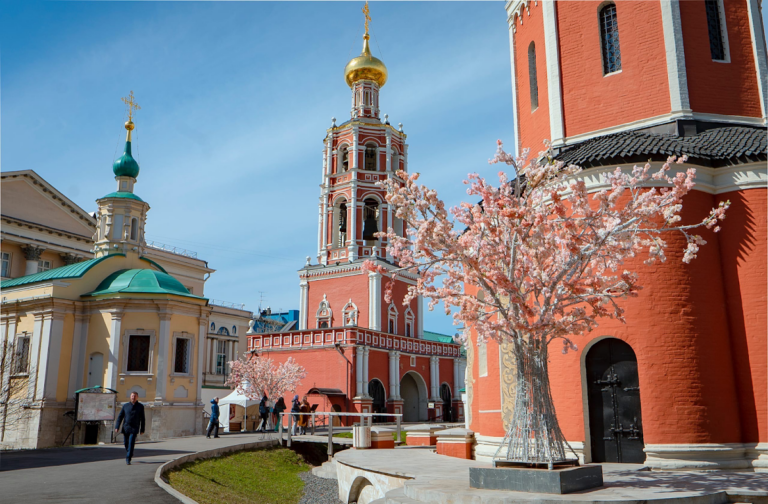
A new bell tower was built above the Holy Gates in 1835–1836 to designs by architect Nikolai Kozlovsky. Described as a Classical-style structure, it contains a chapel dedicated to Saint Eugene, Bishop of Chersonesus, constructed at the expense of S. I. Shterich.
Cell buildings
Monastic cell buildings stood along the northern and southern enclosure walls. The early twentieth-century cells housed classrooms for the parish school. After the convent’s closure, they were converted into communal apartments.
Church of the Kazan Icon of the Mother of God
The Church of the Kazan Icon of the Mother of God was built in 1904–1906 to designs by Pyotr Vinogradov. It is a five-domed, pillarless church in the Russian-Byzantine style with a refectory. The building is approximately 36 metres long, 15 metres wide, and 17 metres high.
The church originally contained a carved-oak iconostasis, the screen of icons separating the sanctuary from the main worship space. That furnishing was later lost. After the convent closed, the refectory was stripped of its interior and converted into a canteen. The church was subsequently restored and returned to religious use.
Sacred objects
The convent’s associated sacred objects include the Kazan Icon of the Mother of God, an icon of Saint Nicholas of Myra, and an icon of Saint Panteleimon with a particle of his relics. They also include an icon of Saint Sophia of Suzdal with a particle of her relics and a communal icon of the Optina Elders containing particles of the relics of twelve elders. The Optina Elders were influential spiritual figures associated with Optina Monastery, a major Russian Orthodox centre of monasticism and spiritual guidance.
Nearby sites