Basilica of Saint-Martin d’Ainay: A Romanesque Former Abbey Church in Lyon


Site at a Glance
- Rating
- 4.8
- Popularity
- Low
- Country
- France
- Primary era
- Medieval
- External website
- Open
- Eras represented
- Medieval, Modern
- Civilizations
- French, Holy Roman Empire
- Site type
- Religious
- Remains
- Basilica
On this page13 sections
History
The Basilica of Saint-Martin d’Ainay is a former abbey church in Lyon, France, dedicated to Saint Martin of Tours and attached to the Archdiocese of Lyon. Its principal structure was built in the late eleventh century in the Romanesque period and consecrated on 29 January 1107. The church developed within an abbey whose medieval influence extended across a wide area of southeastern France.
Traditions of an early foundation
The monks of Ainay traditionally maintained that the church stood where the remains of Lyon’s early Christian martyrs were discovered. The tradition referred to a sack of ashes and a stone on which Saint Pothin, one of the martyrs associated with Lyon’s second-century Christian community, was said to have rested his head. Historical research treats this origin cautiously. Gregory of Tours, a sixth-century bishop and historian, gave an imprecise account, the place he called Ad Athanacum is difficult to identify, and another tradition locates the discovery of the martyrs’ remains at Saint-Nizier.
A separate legend credited the foundation to the hermit Badulphe, who dedicated the institution to Saint Martin of Tours. Saint Martin was a fourth-century Christian bishop and a major Western saint, particularly associated with the spread of Christianity in Gaul. The early foundation remains uncertain, since no evidence confirms the abbey’s existence before the ninth century.
The ninth-century monastery
The first dated reference to Ainay comes from 859. In that year, Charles of Provence approved the foundation of a monastery at Cessieu by Aurélien, abbot of the royal monastery of Ainay, while describing the institution as abandoned. Evidence from the same year also records a Benedictine priory on the Lyon peninsula. Ainay later became associated with the celebration of the fête des Merveilles, whose origin was attributed to Saint Badulphe, and held an important annual solemnity for Saint Pothin and the Lyon martyrs on 2 June.
Medieval expansion and authority
After the priory was raised to abbey status, major construction began under Josserand de Foudras. The abbey church was completed in the late eleventh century and consecrated by Pope Paschal II, who dedicated it to Saint Martin of Tours. An altar dedicated to the Conception of Our Lady was established on the same day.
Ainay’s authority was publicly recognized at the First Council of Lyon in 1245. Pope Innocent IV convened this major church council in connection with proceedings against Emperor Frederick II. At the council, Ainay was acknowledged as having precedence over 71 churches, abbeys, and priories extending from Burgundy to Provence. Its affiliated priory of Saint-Jean in Geneva collected tithes, held land, and exercised authority over parishes in the Pays de Gex, Genevois, and Faucigny. Ainay was consequently among the most powerful religious houses in the French kingdom.
Jean II de la Palud, abbot from 1313 to 1324, commissioned a palace within the monastic complex. During the Renaissance, the monastery also possessed a port, substantial monastic buildings, a cloister, gardens, a vineyard, and an abbatial palace. From 1504, kings appointed commendatory abbots. These officeholders received the revenues and held the formal position of abbot without necessarily directing the resident monastic community. Although Ainay retained considerable temporal power, its monastic and spiritual life declined, while its lands were progressively sold and occupied by expanding urban districts between the sixteenth and eighteenth centuries.
War, royal visits, and secularization
In 1562, during the French Wars of Religion, troops led by the Baron des Adrets destroyed part of the complex. The cloister was demolished, the church was severely damaged, and the archives were burned. The abbey nevertheless continued to possess royal associations. Henry IV stayed there in 1600 during celebrations surrounding his marriage to Marie de’ Medici in Lyon Cathedral. Louis XIII later stayed at Ainay with Richelieu, and Louis XIV lodged there four times.
Camille de Neufville de Villeroy became commendatory abbot at the age of five. After becoming archbishop of Lyon in 1653, he secured the secularization of the abbey in 1685. A secular chapter, a body of clergy organized for worship and administration rather than monastic life, received the church and remaining buildings. By the end of the seventeenth century, the monastic community had disappeared. Between 1723 and 1769, the chapter subdivided the surrounding estate for development, and the church became a parish church. It lost its abbey title on 27 January 1780.
Revolution and modern recognition
During the French Revolution, the monastic property was confiscated and nationalized, and the abbots’ palace was demolished. The church was converted into a grain store, a use that saved it from demolition. It returned to parish use in 1802. The church was classified as a French historic monument during the 1840s.
In the nineteenth century, architects Pollet and Benoît restored and enlarged the building in a Romanesque Revival interpretation described as “pure Romanesque.” Their work added side chapels and destroyed the last traces of the cloister. Medieval mosaics uncovered in the Sainte-Blandine Chapel during works in 1844 and 1845 were destroyed because they attracted little contemporary interest. Another mosaic was found near the principal altar in 1851 and was partially restored in 1852 to 1855 and again in 1934.
Pope Pius X raised the church to the rank of minor basilica on 13 June 1905. This papal designation recognizes a church’s particular religious and historical importance. The basilica now forms part of the UNESCO World Heritage designation covering notable buildings in Lyon’s historic centre, a recognition of the city’s long history as an important European city and of its mixture of architectural styles.
Remains
The surviving building combines pre-Romanesque elements in the Sainte-Blandine Chapel, a mainly Romanesque structure, the Flamboyant Gothic Saint-Michael Chapel, and nineteenth-century Romanesque Revival additions. The church is 37 metres long, while its nave is 17 metres wide. Massive walls, narrow window openings, spaces for heavy doors, and a watchtower have been interpreted as responses to defensive concerns during a period of warfare and violent incursions.
Church exterior and medieval structure
The façade rises to a 31-metre-high bell-tower porch. Its base dates from the eleventh century and incorporates worked stones taken from ancient monuments. The portal and its ribbed vault, a vault supported by intersecting structural ribs, belong to the late twelfth century. The tympanum was made by Joseph-Hugues Fabisch in 1860. To the left of the entrance, an eleventh-century bas-relief stands on the forecourt. The exterior piece is a reproduction, while the original is preserved inside the basilica.
Two different apsidal endings can be seen at the rear of the church. The Sainte-Blandine Chapel ends in a square form and dates from the early Middle Ages, while the circular Saint-Martin apse was built in the twelfth century. The central apse and a smaller apse were produced by Hippolyte Flandrin in 1855.
Sainte-Blandine Chapel and crypt
The Sainte-Blandine Chapel is regarded as the oldest surviving part of the complex. Archaeological evidence indicates an earlier chapel, although the present structure probably dates from the eleventh century. Nineteenth-century alterations and new vaulting changed its appearance, leaving few elements that reflect its form around the year 1000.
The chapel has a rectangular nave and a square choir covered by a half-dome, or conch, a semicircular vault commonly placed over an apse or choir. A crypt lies beneath it. Its floor carries a mosaic naming Lyon’s martyrs, including Saint Blandina and Saint Pothin. The crypt also contains two niches for relics and a small altar.
Saint-Michael Chapel and other chapels
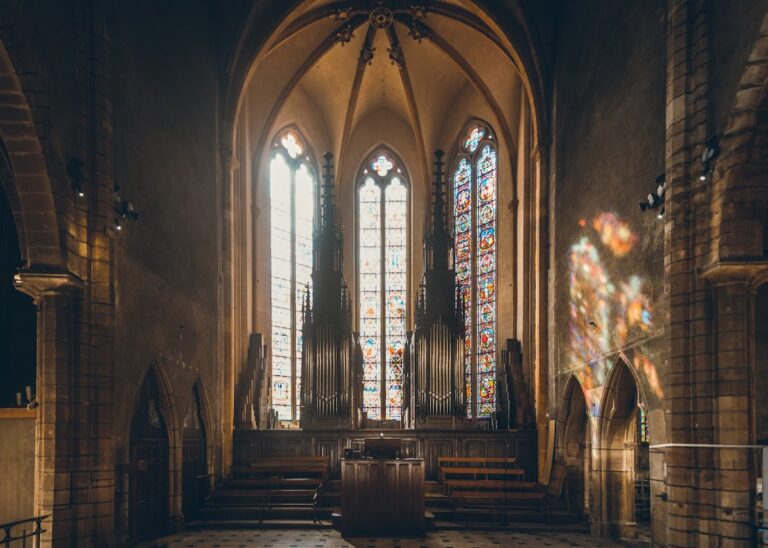
The Saint-Michael Chapel was rebuilt shortly before 1485 on the site of the Romanesque Chapel of the Conception of Our Lady. It received its dedication to Saint Michael in 1690. Jacobé Razuret painted its decoration in 1899, while Lucien Bégule made its three stained-glass windows at the end of the nineteenth century. Fabisch carved panels on a mosaic ground for the chapel, reusing work originally made for the pulpit of the church of Saint-Martin.
Other chapels within the basilica are dedicated to Saint Joseph, the Virgin Mary, and Saint Benedict. The building also contains a Sainte-Blandine window and a Saint-Michael window depicting the archangels Gabriel, Michael, and Raphael. The Saint-Michael Chapel windows date from 1893, and those in the sacristy crypt date from 1894. Both groups were made by Lucien Bégule.
Crossing, columns, and chandelier
Four monolithic columns support the crossing. They are made of grey granite or syenite, a coarse-grained igneous stone containing little or no quartz, and probably came from Egypt or possibly Corsica. Lyon archaeological research has connected them, with some uncertainty, to the Imperial Altar in the federal sanctuary of the Three Gauls. Their shafts were cut in half and reused in the basilica: the northeast column corresponds with the southwest, and the southeast can be matched with the northwest. Their capitals imitate ancient forms but are not themselves ancient.
A gilded and enameled copper chandelier hangs in the dome. Made around 1860 and donated by Irénée Chalandon in 1861, it represents a city’s walls and towers. Its design was conceived as a homage to the chandelier commissioned by Emperor Frederick Barbarossa for Aachen Cathedral as an offering to the Virgin Mary.
Organs and musical furnishings
An organ made by Beaucourt and Voegeli between 1847 and 1850 was sold second-hand to Lyon’s Great Synagogue in 1864. In 1866, a choir organ by Cavaillé-Coll was commissioned with two manuals and 12 stops, including a 16-foot bourdon. Its case, made of Nordmann fir with limewood carving, was installed at the entrance to the Saint-Michael Chapel in 1867.
The present grand organ, made by Joseph Merklin, was installed in the nave north of the dome in 1890. It has three manuals, 36 stops, 56-note manuals, and a 30-note pedalboard with electronic transmission. Michel, Merklin and Kuhn worked on the instrument in 1921 and 1938, and Émile Poillot inaugurated the 1921 work. The gallery case belongs to the 1867 Cavaillé-Coll organ, while the nave case is the case made for the 1890 Merklin organ.
Former abbey estate and burial
The former abbey estate extended across the Lyon peninsula from the confluence of the rivers to the Rhône bridge. It included the cloister, gardens, and abbatial residence. During the Revolution, the former cloister and residence were replaced by rue de l’Abbaye d’Ainay. Fragments of the abbatial palace remain in the wall of the hotel on the church square, while the present place d’Ainay occupies the area once enclosed by the cloister.
An eighteenth-century vault crosses the roadway in Voûte d’Ainay, in line with place d’Ainay. A house designed by Paul Perrache stands above it, on the site that formerly contained an entrance gate to the abbey complex. The basilica also contains the burial place of John O’Brien, Bishop of Cloyne and Ross, an Irish lexicographer and antiquarian who died in Lyon on 13 March 1769.
Nearby sites