Mariawald Abbey: A Former Trappist Monastery in Germany


Site at a Glance
- Rating
- 4.4
- Popularity
- Medium
- Country
- Germany
- Primary era
- Medieval
- External website
- Open
- Eras represented
- Medieval, Modern
- Civilizations
- German, Holy Roman Empire, Kingdom of Prussia
- Site type
- Religious
- Remains
- Monastery
On this page15 sections
History
Mariawald Abbey is a former Cistercian monastery of the Strict Observance, commonly known as a Trappist monastery, in Germany near Heimbach. It originated in the fifteenth century as a pilgrimage shrine and was traditionally founded as a monastery in 1486. Its history includes Cistercian and Trappist phases, wartime destruction, postwar reconstruction, and closure as an independent abbey in 2018.
From shrine to Cistercian monastery
The site began with a Pietà, a devotional image of the Virgin Mary mourning the dead Christ. In 1470, Heinrich Fluitter, a thatcher from Heimbach, acquired the image and placed it in a hollow tree trunk. Because the location was too remote for pilgrims, he built a wooden chapel at a road junction, added a small cell for himself, and cared for the shrine and its visitors until his death.
In 1479, Johann Daum, the parish priest of Heimbach, replaced the chapel with a wooden church and invited the Cistercians of Bottenbroich to care for the pilgrimage site. A charter dated 10 November 1480 transferred the church and Pietà to the Cistercian Order. Arnold von Unkel, an auxiliary bishop of Cologne and a Franciscan, consecrated the church on 12 September 1481. The first monastic community entered the newly built monastery on 4 April 1486, the date traditionally regarded as Mariawald’s foundation.
The wooden church began to give way to a stone building in 1494, and the stone church was consecrated in 1539. Around 1520, the Pietà was placed within an Antwerp retable, an ornamental altar structure behind or above an altar, whose scenes trace the life of Jesus from the Annunciation through his death and Resurrection. The monastery endured repeated wars, especially the Thirty Years’ War, and later entered a period of relative peace and development.
Dissolution and nineteenth-century restoration
French occupation of the territories west of the Rhine in 1794 brought Mariawald under French rule. The monastery was dissolved on 2 April 1795. Its land and inventory were auctioned, while the abandoned buildings deteriorated. On 22 June 1804, the Pietà and Antwerp retable were moved to the parish church of St Clement in Heimbach. They are now preserved in Heimbach’s Salvator Church, consecrated in 1981. Parts of the former church windows were sold to England and are held by the Victoria and Albert Museum in London.
Ephrem van der Meulen, abbot of the Trappist Abbey of Oelenberg in Alsace, purchased the former monastery estate in 1860. Two Oelenberg brothers arrived in February 1861, rebuilding began, and regular monastic life resumed in April 1862. Trappists are members of the Order of Cistercians of the Strict Observance, a contemplative Catholic order traditionally associated with prayer, silence, manual work, and disciplined communal life.
The reconstruction followed plans by August Carl Lange and was completed in 1891. Work was interrupted by the Franco-Prussian War of 1870 to 1871 and by the Kulturkampf, the conflict between the German Empire and the Catholic Church that was particularly intense during the 1870s. The monks were expelled from September 1875 until 18 October 1887. A Prussian attempt to expropriate the property failed because van der Meulen, rather than the monastery, was registered as its owner.
Mariawald was elevated from a priory to an abbey on 29 September 1909. For much of the twentieth century and the beginning of the twenty-first, it was the only male Trappist monastery in Germany. It also established daughter foundations. Mariastern near Banja Luka was founded in 1869 by the Mariawald monk Franz Pfanner, while the Trappistines’ Abbey of Maria Frieden at Dahlem was founded jointly with the Dutch Trappistine monastery of Koningsoord in 1952 and 1953. Pfanner also founded Mariannhill in South Africa; Pope Pius X separated it from the Trappist Order in 1909 and made it the motherhouse of the Mariannhill Missionaries.
War, suppression, and rebuilding
During the First World War, 33 monks were drafted and three died. Under the Nazi regime, workers involved in constructing the Westwall were quartered at the monastery. Other monks were conscripted, and some lay brothers were arrested by the Gestapo. The monastery was dissolved on 21 June 1941 for alleged anti-state activities. The priest-monks were expelled, while the lay brothers were assigned to agricultural work on the former monastic estate, which had become publicly owned.
As the front approached in autumn 1944, a field hospital operated at Mariawald for several months. Four hundred and fourteen people died there and were buried on a slope west of the monastery. The Ardennes Offensive then caused extensive destruction and drove out the remaining brothers. On 28 April 1945, Pater Christophorus Elsen retook possession of Mariawald after the British military government approved the abbey’s continuation. Most of the displaced monks later returned. Three monks had been killed, four were still missing, and several priests had died in exile.
Christophorus Elsen was elected abbot in December 1946. Reconstruction and the removal of war damage continued until 1959. The church was renovated between 1962 and 1964 and adapted to changes associated with the Second Vatican Council, the Catholic council held from 1962 to 1965 that introduced major reforms in liturgy and church practice.
Late twentieth-century observance and closure
Mariawald’s former agricultural work had largely ended by the modern period, apart from beekeeping. From 1 January 2006, the abbey leased 100 hectares of agricultural and forest land to Eifel National Park for a proposed European bison reintroduction project, which was later abandoned. The community supported itself through activities including a restaurant, bookshop, liqueur production, shop, guesthouse, and the sale of food and other products. Its own beer production ended in the 1950s, while breweries later produced beers based on preserved Mariawald recipes.
On 21 November 2008, Pope Benedict XVI approved Abbot Josef Vollberg’s request to restore the liturgy and observance associated with the use of Monte Cistello in its 1963 to 1964 form. This was a historical Cistercian liturgical and disciplinary usage. Mariawald became the first German-speaking Trappist community to return to pre-conciliar observance and the traditional Latin liturgy. The change divided the community, whose numbers continued to decline.
The abbey had operated a priest-monk training program since 2010, providing philosophical, theological, historical, and linguistic formation for its own members and for monks and clergy from other communities. The Association of Friends and Supporters of Mariawald Abbey, founded in 1995, supported the monastery. In 1997, Mariawald joined seven other Trappist abbeys in founding the International Trappist Association, a federation intended to protect the authenticity and commercial use of the Trappist name.
By 2016, the community had fallen below the twelve monks considered necessary for an independent abbey. After a visitation in May of that year, Josef Vollberg resigned as abbot in October. From 27 November 2016, Bernardus Peeters of Tilburg served as immediate abbot, the superior responsible for direct oversight within the Cistercian order. Vollberg became prior and remained superior of the house.
In January 2018, the Congregation for Institutes of Consecrated Life and Societies of Apostolic Life decided that the abbey should be closed and sold. The stated reasons included the community’s advanced average age, lack of new vocations, internal difficulties, and inability to support itself. After a thanksgiving service on 15 September 2018, the abbey formally closed and the monks left. Several elderly or care-dependent members moved to a residential care facility.
Following the closure, the association formerly known as Trappistenkonvent Mariawald was renamed Kloster Mariawald and admitted non-monastic members, including representatives appointed by the Bishop of Aachen. From 1 January 2021, Kloster Mariawald GmbH & Co. KG operated the restaurant, bookshop, liqueur production, and online shop. The church and former monastic buildings continued to be maintained as a spiritual and cultural site. A pastoral project led by Andreas Rose, with volunteer assistance and support from Steinfeld Abbey, ran for three years and ended in late 2025 after support from the Diocese of Aachen ceased. Pastoral services continued.
Remains
Setting and overall layout
The abbey stands in the northern Eifel Nature Park Hohes Venn–Eifel, surrounded by Eifel National Park, south of central Heimbach in the wooded Kermeter. The complex occupies a slope between approximately 400 and 420 metres above sea level, near the Altenberg rise, which reaches about 424 metres, and the Griesberg, whose height is 421.3 metres. The monastery courtyard contains the cemetery beside the restaurant wing. Meadows and woodland around the complex are largely managed by the State of North Rhine-Westphalia in cooperation with Eifel National Park.
Historic core and church
Gate and monastic core
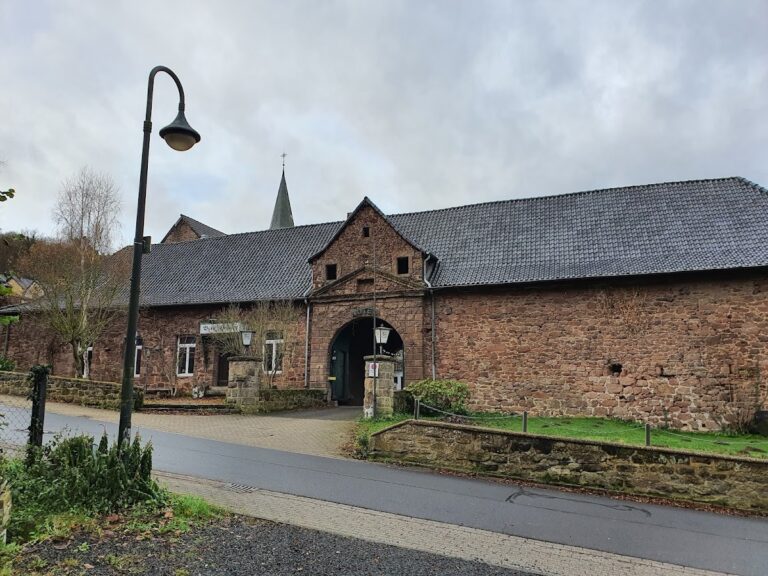
The late Gothic main gate, built in 1538, is among the oldest surviving parts of Mariawald. The sixteenth-century main building includes the cloister, chapter hall, refectory, library, and original principal entrance. A cloister is the covered passage surrounding a monastic courtyard. The chapter hall served as the community’s meeting room for governance and the reading of its rule, while the refectory was the communal dining hall. Their present arrangements, together with that of the house chapel, reflect eighteenth-century uses and designs. The cloister wall was renovated in 2009.
Abbey church
The present abbey church was built between 1874 and 1891 for the returning Trappist community, using the foundations of the earlier church. The Joseph Chapel is integrated into the main building and formed part of the monastic enclosure. The church contains an organ built in 1978 by Rudolf Strohmer, an organ builder from Munich.
Trappist additions and service buildings
A western cloister was added around 1900. It was framed by the kitchen, brewery, later administration wing, and novitiate wing. A novitiate is the period and institutional setting in which prospective members receive training before taking their vows. A guesthouse and new main entrance were added in the late nineteenth century. After the Second World War, a restaurant wing was constructed and later enlarged, while the guesthouse was expanded to include an apartment for the spiritual leader. A supplier entrance with gatehouse and garages dates from the late twentieth century, and the monastery shop west of the complex was built in the 1980s.
Service buildings already existed during the Cistercian period. Under the Trappists, an economy building was constructed with stables, workshops, staff accommodation, and administrative rooms. A liqueur-production wing was added later in the twentieth century. The former brewery operated after the Second World War until beer production ended in the 1950s. Later beers based on preserved Mariawald recipes included Fluitter and Nemus Mariae.
Pilgrimage and wartime remains
Stations of the Cross
A Stations of the Cross follows the pilgrimage path from Heimbach through the Ruppendal toward the abbey. Its fourteen stations include seven free-standing chapels, while the others are incorporated into the cloister wall. Reliefs depicting Christ’s Passion were influenced by the Nazarene movement, a nineteenth-century Christian artistic style known for religious subjects and deliberate revivalism. Weathered stations were renovated in 2012. A storm destroyed the seventh station in 2018, and it was later rebuilt. The lower part of the route passes through Eifel National Park.
Heimbach War Cemetery
The former field-hospital burial ground developed into the Heimbach War Cemetery on the monastery grounds. Dedicated on 20 September 1953, it contains the graves of the 414 people who died during the Second World War field-hospital period. A memorial ceremony is held there annually on Volkstrauertag, Germany’s national day of mourning for victims of war and tyranny.
Associated works preserved elsewhere
The Pietà that began Mariawald’s pilgrimage history and the Antwerp retable associated with it are preserved in Heimbach’s Salvator Church rather than at the abbey. The retable presents scenes from the Annunciation to the death and Resurrection of Jesus. Parts of the former church windows are preserved at the Victoria and Albert Museum in London.