Cathedral of the Holy Trinity: Lutsk’s Former Roman Catholic Cathedral


Site at a Glance
- Rating
- 4.7
- Popularity
- Low
- Country
- Ukraine
- Primary era
- Medieval
- External website
- Open
- Eras represented
- Medieval, Early Modern
- Civilizations
- Grand Duchy of Lithuania, Polish–Lithuanian Commonwealth
- Site type
- Religious
- Remains
- Cathedral
On this page11 sections
History
The Cathedral of the Holy Trinity in Lutsk, Ukraine, was the city’s first Roman Catholic cathedral, established in 1427 after Grand Duke Vytautas of Lithuania transferred the Catholic see from Volodymyr. Traditionally known as the “Mother of Churches in Rus,” it developed from a wooden church in the Okolny Castle into a major religious, political, and civic complex.
Foundation of the cathedral
Vytautas settled in Lutsk with his family, princes, and boyars in 1387. After the city became his permanent possession in 1392, he promoted it as an important political center and sought to establish the Catholic see there. Construction of a wooden Church of the Holy Trinity began inside the Okolny Castle in 1425 and was completed in 1427.
Pope Martin V authorized the transfer of the see, and the new church became Lutsk’s cathedral in 1427. A cathedral is the principal church of a diocese and the seat of its bishop. The first bishop was Andriy Splavsky, who also participated in the delegation that welcomed guests to the 1429 congress of European monarchs held in Lutsk.
During the Lutsk War of 1431, Polish forces attacked and robbed Bishop Splavsky. Several members of the local Dominican priory were later executed in the city. In 1439, the Council of Florence, a fifteenth-century church council, changed the Latin designation of the diocese from Lucensis Episcopatus to Luceoriensis Episcopatus. The related change from Lucensis to Luceoria distinguished Lutsk from the Italian diocese of Lucca.
Growth and rebuilding
Grand Duke Sigismund Kestutaitis confirmed the estates that Vytautas had granted to the cathedral. Further donations came from Yuri Stavsky and Bishop Pavel Holshansky. The cathedral eventually owned 13 houses in Lutsk and received tithes from estates belonging to the nobility. Its diocese later extended across the Volhynian, Podolian, Bratslav, and Brest palatinates and the Pinsk district. A palatinate was a major territorial-administrative unit in the Polish-Lithuanian political system. The diocese contained 13 deaneries and 185 churches.
In 1535, Queen Bona recommended Yuri Falchevsky for the bishopric of Lutsk. He initiated the rebuilding of the Latin cathedral, and a new masonry church had been completed by 1545 on the site of the earlier wooden building. The designer may have been Lukas of Presov, although that attribution remains uncertain. The church was a Renaissance structure built from dressed stone and decorated inside with frescoes.
The cathedral complex had expanded by 1552. Its 24-meter-long cathedral house contained the chapter, chancery, archive, and Hospital of the Holy Spirit. A chapter was the body of clergy responsible for assisting with a cathedral’s administration and liturgical life. A cemetery stood beside the church and the cathedral house. The Trinity Latin School also operated nearby, educating lay pupils and preparing chancery workers and lower-ranking clergy. Ivan Vyshensky was among its pupils.
Religious and civic center
Following the Council of Trent, a sixteenth-century Catholic council whose reforms strengthened administration, education, discipline, and institutional activity, Catholic foundations in Volhynia received increased support. The cathedral gained estates in Torchyn, Sadiv, and Luchytsi. King Sigismund II Augustus later granted it the villages of Porsk and Pidloztsi, customs revenue from Torchyn, 30 kopy of Lithuanian grosz from the customs house at Berestechko, land at Hnidava, and a plot in Lutsk. In 1648, the Lutsk suffragan bishop Stanislav Loza donated 5,000 zlotys. A suffragan bishop was a bishop whose diocese was subordinate to a metropolitan archbishopric.
The cathedral served as more than a place of worship. District and palatinate assemblies met there, political questions were debated, deputies to the general Sejm were elected, courts were held, and ecclesiastical hierarchs were enthroned. It therefore formed part of Lutsk’s institutional and political life as well as its Catholic administration.
Jesuits initially rented a house with a chapel near the cathedral bell tower. Bishops Martin Szyszkowski and Pavel Volutsky later helped fund a Jesuit church and college. Canon Balthazar Tyszka supported charitable projects and founded a Rosary Brotherhood connected with the Lutsk Jesuits.
Confessional tensions also reached the cathedral. In 1628, a dispute between the cathedral bell-ringer Sobko and Pavel Telitsa, a monk of the Lutsk Brotherhood Monastery, concerned an insult to Telitsa’s Orthodox identity and the removal of his monastic hood. In 1647, a political assembly held in the cathedral turned into a sword fight. The Lutsk town notary Stanislav-Kazimierz Benevsky was seriously wounded, and blood stained the altar. In 1648, Cossacks led by the landvogt Fedor Lipka attacked the church and destroyed or plundered its liturgical objects.
The cathedral remained a center of Volhynian Catholic noble society during the second half of the seventeenth century. An attack on Lutsk in 1667 affected it, while a lightning strike in 1680 caused no major damage.
Fire, transformation, and destruction
A major city fire on 17 June 1724 severely damaged the cathedral and other religious complexes. Bishop Stefan Rupniewski spent 200,000 zlotys on reconstruction. The work substantially remodeled the church, replacing its Renaissance character with a Baroque one. The former four corner towers were replaced by three tall spires. Rupniewski was buried in the cathedral after his death in 1731.
The wooden cathedral bell tower, which held four large bells, also burned in 1724 and was rebuilt in masonry. An image of Saint Ignatius, probably made by Josef Prechtl for the Lutsk Trinitarian monastery around this period, shows the rebuilt cathedral among the buildings of the Okolny Castle.
Another major city fire on 5 September 1781 damaged the cathedral so severely that restoration was considered impossible. The remains of the church were later dismantled to ground level, and the cathedral ceased to exist as a functioning building. The eastern wing of the complex became unusable, while the western wing and bell tower survived.
The cathedral chapter and chancery moved into the former Jesuit church after paying the Commission of National Education 100,000 zlotys and surrendering their former chapter premises. The former Jesuit college became an academy-like higher school. Four rooms occupied restored cathedral buildings, and the Trinity Latin School probably became part of the new institution. Other former chapter rooms housed an asylum for elderly and disabled people. In 1782, Jozefa Polyanovska founded the nearby “Angelika” orphanage for girls.
Nineteenth- and twentieth-century reuse
After the Third Partition of Poland in 1795, Volhynia was annexed to the Russian Empire. In 1829, Bishop Kasper Tsetsishovsky sent representatives of the Sisters of Charity to Lutsk and assigned them the Angelika orphanage and the hospital for elderly people in the former chapter premises. The Sisters of Charity were a Catholic order devoted especially to caring for the sick, poor, elderly, and orphaned. They cared for and educated the residents while a school continued in the remaining rooms.
Russian imperial policy during the nineteenth century led to the closure of most Catholic churches and monasteries in Volhynia. The Sisters of Charity left Lutsk in 1866. The school became a district school, and a gymnasium operated there for a period. The writer Panteleimon Kulish taught at the gymnasium. A primary school began operating in 1860, and Tadeusz Czacki was associated with it.
A general school named for Queen Jadwiga was established in 1917 and partly occupied the former cathedral premises. A commercial school was temporarily housed there in 1921. After 1991, the Catholic see was restored in the former Jesuit church. The partially reconstructed former Trinity cathedral premises became the seat of the Roman Catholic diocesan administration in Lutsk and the Maltese Relief Service, with Bishop Markiyan Trofimyak as diocesan bishop.
Remains
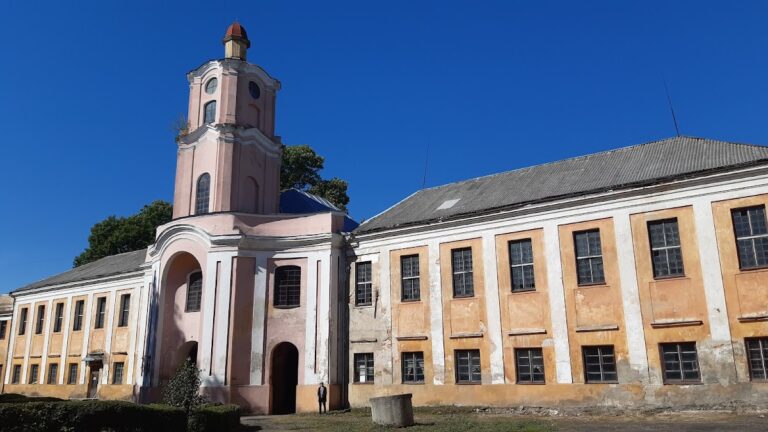
The surviving cathedral complex consists of the former cathedral house and the masonry bell tower. The former cathedral house is a two-story, U-shaped building with a gabled roof. An arch connects it to the bell tower, while a central five-sided projection extends from its north side. Oak tie elements are set within the walls of this projection.
Former cathedral house
Western wing
The western wing, at 17 Cathedral Street, was built during the fifteenth and sixteenth centuries. Its northwestern corner has a sloping four-sided projection containing an interior room and a small upper window. The sixteenth-century cathedral house incorporated the basements of an earlier masonry building and stood between the Peremyl and Pinsk towers of the Okolny Castle.
Archaeological work in 1991 identified remains of that earlier masonry building in the basement of the western wing. It dates from the late fourteenth or early fifteenth century, and its associated bricks measure approximately 29 to 30 by 8 to 9 by 14 to 15 centimeters.
Eastern wing
The eastern wing, at 19 Cathedral Street, largely reflects rebuilding after the eighteenth-century fire. Its northern wall is reinforced by buttresses, which are projecting supports used to strengthen a wall. Pilasters, shallow column-like projections attached to a wall, decorate the exterior. The windows have surrounds, sills, and cornices above them.
The former cathedral house now contains the Lutsk Roman Catholic diocesan administration and the Maltese Relief Service. The complex lies within the Old Lutsk historical and cultural reserve, and the former cathedral house forms the western wing of the nationally significant architectural monument known as the “Monastery of the Sisters of Charity.”
Bell tower
The cathedral bell tower originally formed part of the complex near the church. Its earlier wooden form held four large bells before the fire of 1724 destroyed it. The tower was then rebuilt in masonry. It now stands opposite Lutsk’s present Cathedral of Saints Peter and Paul, preserving one of the principal surviving elements associated with the former Cathedral of the Holy Trinity.