Zymne Monastery: An Orthodox Monastic Complex in Ukraine


Site at a Glance
- Rating
- 4.7
- Popularity
- Low
- Country
- Ukraine
- Primary era
- Medieval
- Eras represented
- Medieval, Early Modern, Modern
- Civilizations
- Grand Duchy of Lithuania, Kievan Rus, Polish–Lithuanian Commonwealth
- Site type
- Religious
- Remains
- Fortified Monastery
On this page18 sections
History
Zymne Monastery is a women’s stauropegial monastery in Ukraine, situated on Holy Mountain above the Luha River near Zymne. A stauropegial monastery is placed directly under senior church authority rather than the ordinary jurisdiction of a local bishop. The community is traditionally linked to Vladimir the Great, the ruler of Kievan Rus who adopted Christianity and promoted it in his territories, with a foundation date of 1001. Another tradition places its beginnings around 992 or 993, while archaeological evidence and early testimony indicate monastic activity by the early eleventh century and possibly before 1018.
Early Orthodox community
The first community probably consisted of hermit monks, possibly gathered around Anthony of the Caves. Their way of life centered on individual ascetic cells, with communal worship, and resembled the early organization of the Kiev Pechersk Monastery, also known as the Kiev Caves Monastery. Investigations in the late nineteenth century revealed stone crosses, underground cells, connecting passages, and a cave church. Together, these remains point to an established early ascetic settlement rather than an isolated place of worship.
Tradition states that Vladimir gave the monastery an icon of the Mother of God brought from Constantinople through his wife, Anna Porphyrogenita, a Byzantine imperial princess. The Zymne icon became the principal sacred image of Holy Mountain. By 1223 the monastery was known as Holy Mountain and had become an important Orthodox center in Volyn.
During the second half of the thirteenth century, the loose association of hermits gradually developed into a cenobitic monastery. In a cenobitic community, monks live under a common rule and share worship and resources. At Zymne, however, monks continued to occupy cells cut into the caves. The monastery was connected with prominent religious figures. Barlaam of the Caves died there in the eleventh century while travelling back from Constantinople to Kiev. Nestor the Chronicler also stayed at Zymne and described a school attached to the community, regarded as one of the earliest schools in Volyn.
Episcopal and medieval transformations
Zymne served as a residence of the bishops of Volodymyr. Stephen held the bishopric there around 1090 to 1094, and Amphilochius reportedly died at the monastery in 1122. The episcopal residence may have remained at Zymne until 1495. Other members of the community, including Joasaph, Basil, Kuzma, and Nikifor, later became bishops. Niphont, the first abbot known by name, subsequently became bishop of Novgorod.
The Mongol invasion destroyed the monastery in 1241. Its history over roughly the next two centuries is poorly documented, while its political affiliation changed repeatedly during conflicts between Poland and Lithuania in Volyn. After 1440, Zymne entered territories granted by Casimir IV Jagiellon to Švitrigaila. The village and monastery later passed to the Czartoryski family.
In 1495, Fyodor Mikhailovich Czartoryski founded a new masonry Church of the Assumption on the site of an earlier wooden church. He also fortified the monastic hill with walls and corner towers. The Czartoryskis supported a school and printing house at Zymne, and the Assumption Cathedral was intended to serve as a burial place for the family. Fyodor’s son, Alexander Fyodorovich Czartoryski, provided a bell traditionally dated to 1566.
Union, dissolution, and restoration
The monastery opposed the Union of Brest, the agreement that brought part of the Orthodox hierarchy in the Polish–Lithuanian Commonwealth into union with the Roman Catholic Church while retaining Byzantine worship. In 1682, however, Zymne was transferred to the Uniate Church and the Basilian order, an Eastern Christian monastic order associated with that tradition, under the influence of Hipacy Pociej, bishop of Volodymyr and a leading supporter of the union. Orthodox monks who rejected the change left the monastery and took its archival documents with them.
In 1724, Michał Czacki, the Catholic starosta of the Volodymyr district, ordered the Assumption Cathedral to be converted into a Catholic church. Its onion domes were removed, the facade was reshaped with two towers, Czartoryski tombs were dismantled, and the ornamental covering was taken from the Zymne icon. Local tradition later connected Czacki’s blindness and death three years afterward with his alleged mockery of the icon.
The monastery’s finances deteriorated during the eighteenth century, and it was dissolved in 1790. Following the Third Partition of Poland in 1795, Volyn became part of the Russian Empire. The former cathedral was taken from the Catholic Church and restored for use by an Orthodox parish. Donations from the imperial family financed restoration of the former monastic buildings in 1857. In 1892, ten nuns from the monastery at Korets arrived, re-establishing Zymne as a women’s monastery. Its formal consecration took place on 10 July 1894.
The restored community was non-contemplative and focused especially on social work and education. During the First World War, the nuns evacuated to Zhytomyr with the Zymne icon. The buildings suffered serious damage. One tradition holds that three artillery shells struck the complex but failed to explode and remained lodged in its walls.
Interwar and Soviet periods
After Volyn became part of interwar Poland, the nuns returned in 1922 under Abbess Maria. The monastery then belonged to the Polish Autocephalous Orthodox Church, the self-governing Orthodox church that administered Orthodox communities in interwar Poland. Its estate was reduced to 36 hectares, while 409 desiatinas, a historic land measure, were expropriated. Two monastery houses in Lutsk were also confiscated, and disputes over land and buildings continued for much of the interwar period.
The nuns operated an orphanage and, from the 1930s, a correctional institution for juvenile girls in a former residential building. Fifty-two nuns lived at Zymne in 1936, making it the third-largest convent of the Polish Autocephalous Orthodox Church at that time.
The monastery closed in 1939 after the Soviet invasion and annexation of eastern Poland. It reopened temporarily during the German occupation of Volyn, but Stalinist authorities dissolved the sisterhood in the late 1940s. The buildings were subsequently used for a library, clinic, village club, tractor-brigade headquarters, and storage. Poor maintenance led to serious deterioration, and the Assumption Cathedral lost all its furnishings. The Trinity Church alone continued to function as a parish church.
Revival after 1975
The first major restoration of the complex began after 1975. Work in the 1980s added new cathedral frescoes modeled on decorations at the Pochaiv Lavra, a major Orthodox monastery in western Ukraine, and Saint Volodymyr Cathedral in Kyiv.
The buildings were transferred to the Ukrainian Orthodox Church in 1990. On 6 September that year, Bishop Bartholomew of Lutsk and Volyn celebrated a prayer service in the ruined monastery. The women’s community officially reopened in 1991. Its first new residents were the nun Stefania and the ryasophore sister Halyna, a monastic who had received an initial habit but not yet made full vows, both from Korets. Thirteen novices joined them during the following year, and Stefania became abbess on 14 March 1992.
The revived monastery carried out extensive repairs and established a bakery, pasta workshop, mill, ten-hectare orchard, and gardens with two greenhouses. An attempted transfer to the Ukrainian Autocephalous Orthodox Church in 1992 did not succeed. Relics of Arsenius of the Caves and Stephen, bishop of Volodymyr, came to the monastery in 1993. The Zymne icon returned in 1995, with its ceremonial return held on 24 September, and the community received stauropegial status in 1996.
In 2001, Zymne commemorated a millennium of monastic life. A pilgrims’ house was built for the occasion and a monument to Vladimir the Great was erected in the courtyard. Approximately 40 nuns and novices lived at the monastery in 2009 and 2010.
Remains
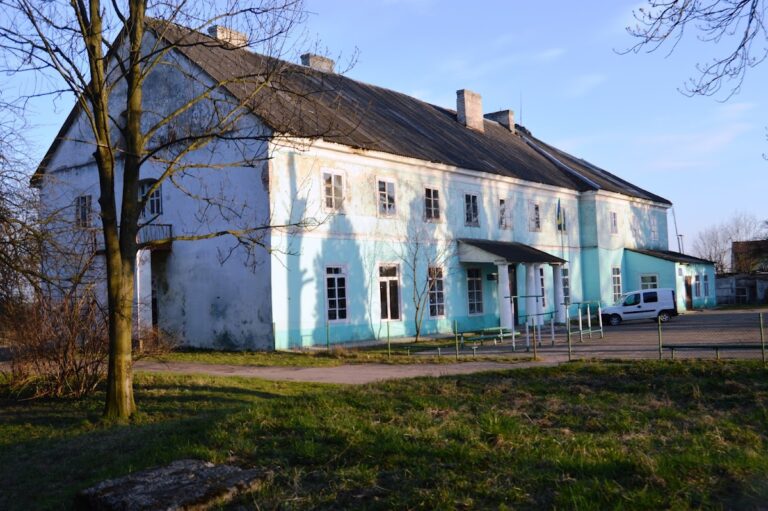
The monastery occupies a promontory on Holy Mountain above the Luha River. Steep slopes on the north and west helped shape its defensive character. The fortified complex has a generally rectangular plan, with masonry walls, corner towers, and five gates. Its historic enclosure contains the Assumption Cathedral, Trinity Church, the Church of Saint Juliana, the cave Church of Saint Barlaam, a gate-bell tower, a refectory, residential buildings, and service structures. A second wall separates this historic area from a later garden and greenhouse complex.
Churches and sacred buildings
Assumption Cathedral
The Assumption Cathedral is the principal church of the monastery. Its present form is a twentieth-century reconstruction that evokes its original late-fourteenth- or early-fifteenth-century architecture while incorporating Byzantine-Rus elements. The building is a three-aisled basilica with a wider central aisle, four rectangular pillars, and vaults carried by the walls and pillars.
Five gilded domes rise on drums above the cathedral. Each drum has four semicircular windows framed with ornament. Buttresses reinforce the walls, and pairs of similarly shaped windows occupy the spaces between them. The facade has a pointed-arch gable, a projecting entrance vestibule, and a cornice extending around the building. A nineteenth-century three-tier iconostasis survives inside, together with especially venerated icons of the Mother of God and Saint Nicholas.
The cathedral’s appearance changed repeatedly. Before the First World War, three onion domes on round drums stood above the main facade. The original flanking towers were dismantled during the 1724 remodeling, after which the facade was reshaped in a Polish style. Later Russian-period work introduced Russian Revival decoration. The building suffered wartime damage, was repaired during the 1930s, lost its roofing during the Second World War, and received its five gilded domes during later twentieth-century restoration.
Trinity Church
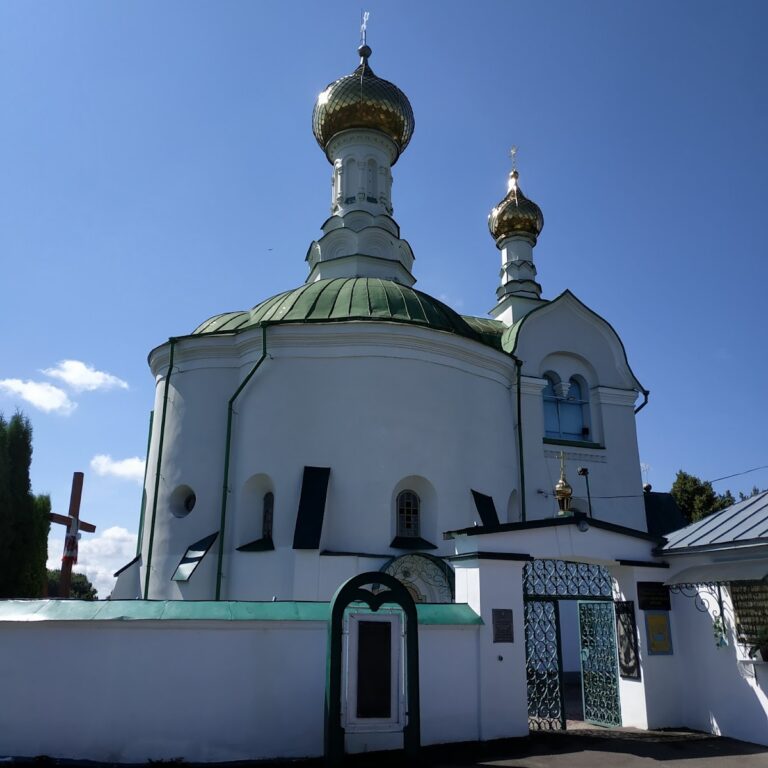
Trinity Church is the oldest surviving church in the complex. It was originally built as a rotunda, probably in connection with the early cave community, and was enlarged during nineteenth-century restoration. Its shingle roof was replaced with sheet metal, and its windows were reshaped.
The present church has a rectangular nave and a semicircular sanctuary. Conical roofs over both parts are topped by gilded crosses. Narrow semicircular and rectangular windows illuminate the building. Inside are a modern marble one-tier iconostasis and neo-Byzantine frescoes. Trinity Church stands outside the principal defensive enclosure, on the slope of Holy Mountain.
Church of Saint Juliana
The building now used as the Church of Saint Juliana originally belonged to the residential complex. Tradition identifies it as a residence of Vladimir the Great during visits to Volyn, although that attribution is traditional rather than archaeologically established. It became a church after the monastery reopened in 1991, while the other churches were still being restored.
Saint Juliana’s Church has a rectangular plan and a polygonally closed altar space. It adjoins the residential buildings on the west and has a single bell turret with a gilded cross above the sanctuary. Its windows are narrow and semicircular. The interior contains a two-tier iconostasis and venerated icons of the Protection of the Mother of God, the Volyn Icon of the Mother of God, and Saint Juliana. The last includes a fragment of a relic.
Caves and early ascetic remains
Cave Church of Saint Barlaam
The cave Church of Saint Barlaam lies within the underground complex, with its entrance through the Assumption Cathedral. It occupies a small rectangular chamber with two apses, one at the east and one at the west. A closed vault covers the room, with a square opening for ventilation, and the present church has a one-tier iconostasis.
Underground passages and cells
The caves contain two parallel corridors joined at the center. Cells and passages were cut into the rock, with passages generally near adult height and about one metre wide. Niches for candles remain in the walls. The underground spaces served first for habitation and later for monastic burials, while much of the cave system continues to be investigated.
Fortifications and monastery grounds
Walls, towers, and gates
The fortifications were built mainly from the fifteenth century onward, with masonry buildings and defensive walls rising from the 1460s. The walls incorporated drains and water outlets to manage groundwater. The foundations of a probable three-level bell tower were identified in the courtyard between the churches and other buildings.
Refectory and courtyard
The refectory foundations were built in curved sections so that underground water could flow toward the Luha floodplain. The central courtyard contains a garden with a fountain and chapel, as well as the monument to Vladimir the Great. The monastery also preserves the bell attributed to Alexander Czartoryski, which is displayed in the main courtyard.
Sacred objects and relics
The Zymne Icon of the Mother of God is a Greek-style painting on a cypress panel. Losses of paint and gesso indicate repeated restoration. The image is set in a metal frame bearing a plate with its identifying inscription. Its ornamental covering was removed in the eighteenth century, and the icon was taken to Zhytomyr during the First World War before returning to Zymne in 1995.
The monastery also preserves relics associated with Arsenius of the Caves and Stephen of Volodymyr. Along with the icon and the Czartoryski bell, these objects remain connected with the revived monastic community and the religious history of Holy Mountain.
Nearby sites