San Giorgio in Lemine: A Romanesque Church in Almenno San Salvatore


Site at a Glance
- Rating
- 4.6
- Popularity
- Low
- Country
- Italy
- Primary era
- Medieval
- Eras represented
- Medieval, Early Modern
- Civilizations
- Holy Roman Empire, Venetian
- Site type
- Religious
- Remains
- Church
On this page15 sections
History
San Giorgio in Lemine is a Roman Catholic Romanesque basilica in Almenno San Salvatore, Italy, dedicated to Saint George and belonging to the Diocese of Bergamo. Built broadly during the eleventh or twelfth century, it stands within the historic district of Lemine, a territory whose medieval name survives in Almenno and Almè.
Lemine from Roman rule to the Middle Ages
Lemine extended between the western bank of the Brembo and the eastern bank of the Adda, including the Imagna Valley to the north and reaching south toward present-day Brembate. It was inhabited during the protohistoric period and gained particular importance during Roman expansion. Its fertile plain, waterways, and proximity to a bridge over the Brembo supported a substantial settlement.
The Roman bridge had eight arches and connected the eastern Po Plain with Rhaetia through Bergamo. This route was strategically important for movement toward central and southern Europe. Roman military camps and later colonization gradually absorbed the indigenous Cenomani Gauls into a Roman political and cultural framework. Under Lombard rule, the area known as the ager became the seat of a royal court, while under the Franks it developed into a fortified center.
In the tenth century, Count Radald built a castle in the territory. Lemine belonged to the Frankish counts of Lecco until 975, when, after the death of Count Atto, it passed to the Bishop of Bergamo through a testamentary disposition regarded as doubtful and probably apocryphal. The district remained an episcopal fief until the commune of Almenno was established in 1220.
Foundation and early development
The foundation of San Giorgio and its exact construction date remain uncertain. The earliest certain written reference dates from 1171, when the church was already in existence. An episcopal initiative is considered plausible because Lemine was controlled by the politically, militarily, and economically powerful Bishop of Bergamo. The church may have been established in response to the devotional and liturgical needs of a growing population, rather than through a popular initiative.
Construction proceeded in two phases, using different materials and building techniques. The later phase was executed less carefully and may have been affected by political and economic difficulties. These included the excommunication of Bishop Gerardo in 1167 for supporting the Empire and the conflict between the Lombard League, an alliance of northern Italian communes opposed to imperial power, and Frederick Barbarossa, the Holy Roman Emperor whose Italian policy brought him into conflict with the league.
Prosperity and communal life
From the second half of the fourteenth century to the first half of the fifteenth, San Giorgio entered its most prosperous period. It was not a parish or a collegiate church, but it served as a subsidiary church of the Pieve of Lemine, the district’s principal parish church. Over time, San Giorgio took on many of the pieve’s practical functions and eventually replaced it in practice.
Population growth encouraged this development, as did the violent conflict between the Guelphs and Ghibellines. These rival medieval Italian political groupings generally supported the papacy and the Empire respectively. The parish church was difficult to reach within the castle, so San Giorgio became increasingly favored. Local inhabitants contributed to its construction and decoration, while donations and bequests gave it a measure of liturgical and economic autonomy. These resources helped finance the extensive fresco decoration of the interior.
By the first half of the fifteenth century, the church served both religious and civic purposes. It was a meeting place where the community conducted civil business, and it was associated with the Disciplinati, or Disciplini, a lay penitential confraternity. Its members prayed, preached, assisted the needy, practiced self-flagellation, and intervened directly to calm conflicts within the community.
The confraternity was influenced by the preaching of the Dominican Venturino da Bergamo, who promoted peace and penitential practice in northern and central Italy from 1335. Other interpretations connect its development with Bernardino da Siena, a fifteenth-century Franciscan preacher whose campaigns of preaching and penance influenced religious life in many Italian communities. Canon law prevented the confraternity from using the church interior, so its principal meeting place was the portico, which no longer survives.
Destruction, burial use, and decline
San Giorgio declined as the Guelph-Ghibelline conflicts became more violent. These struggles were connected with the wider rivalry between Venice and Milan under the Visconti, the ruling dynasty of Milan during this period. After the Guelph victory, the settlement of Lower Lemine was destroyed on 13 August 1443 by order of Andrea Gritti, then podestà of Bergamo, a Venetian official who later became doge. Its community was dispersed.
The destruction removed much of the population and local support on which San Giorgio had depended. The center of settlement shifted toward Upper Lemine, where new churches were built, leaving San Giorgio isolated and increasingly neglected. Its deterioration continued through the seventeenth century.
The plague of 1630 gave the church a new role. Its position in the fields, separate from the settlement but still accessible, led to its use for burials during the epidemic, which killed nearly one-third of Lemine’s population. The building consequently became known as the Church of the Dead and continued to serve funerary purposes after the plague. In 1761, burial customs and renewed devotion led to the establishment of a chaplaincy for funeral suffrages. This attention also helped preserve the remaining frescoes because the interior walls were not whitewashed.
Restoration and renewed recognition
During the nineteenth century, periods of care alternated with neglect. By the beginning of the twentieth century, the church had deteriorated almost into a ruin. Interest in its historical and artistic importance revived from the 1950s, particularly because of its medieval frescoes.
Don Angelo Rota promoted restoration during the 1960s and 1970s, working with the Diocesan Commission for Sacred Art, the Fine Arts Superintendency, and private supporters. Some frescoes were removed by the strappo technique, a conservation method that detaches the painted surface from its plaster support and transfers it to another support. Other paintings were removed illegally and never recovered. A theft trial on 24 September 1976 established the perpetrator’s guilt.
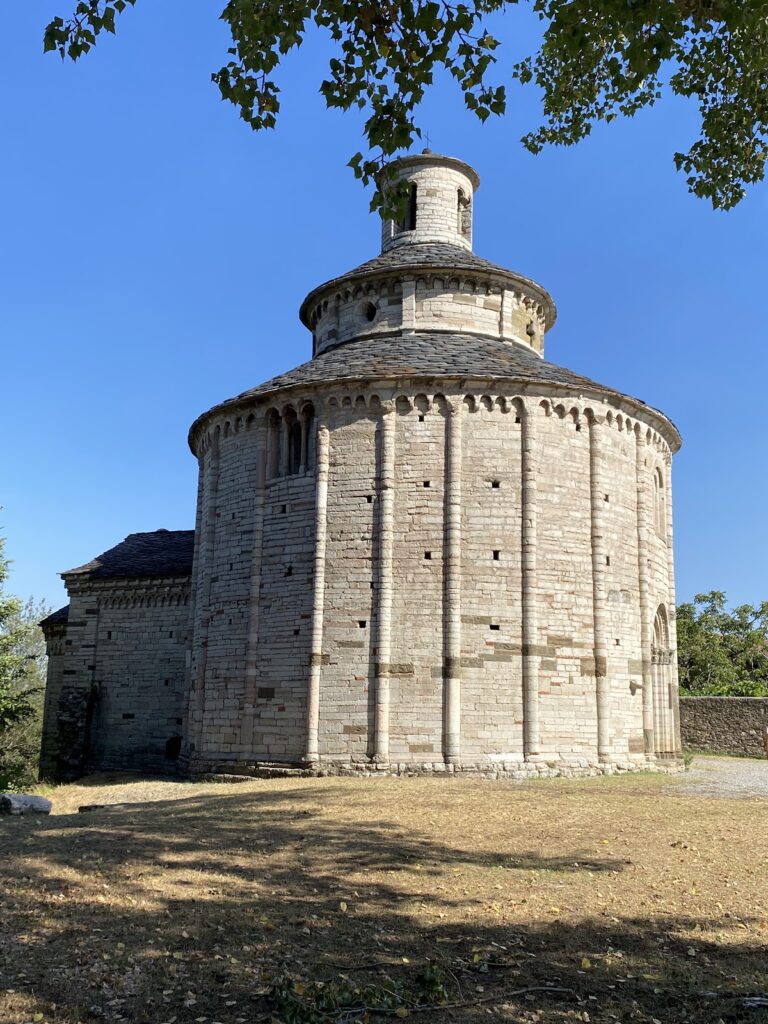
After Don Rota’s death in 1982, a further restoration campaign, primarily architectural, took place in 1989. It returned the church substantially to its present form and supported renewed appreciation of San Giorgio as an important example of Romanesque art in the Bergamo area, alongside the Rotonda di San Tomè.
Remains
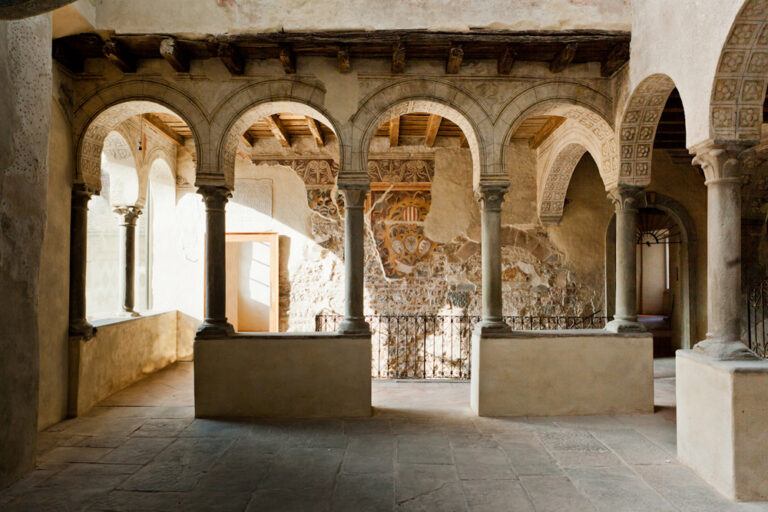
San Giorgio survives as a three-aisled Romanesque basilica with a central apse. Its eleventh- or twelfth-century construction is expressed in the building’s simple structural forms, massive masonry, and restrained openings. Two building phases remain visible in the facade and side walls, while the interior preserves a layered cycle of medieval frescoes painted in different periods and styles.
Exterior and burial ground
Facade and side walls
The facade’s lower section is built from darker, higher-quality stone that was carefully squared and finished. The upper section uses lighter limestone with a nearly white appearance and less precise workmanship. This contrast was not planned as decoration but resulted from the different construction phases and materials. The same division continues along the exterior side walls. Their lower courses use material comparable to the lower facade, while the upper courses consist mainly of river cobbles set in mortar, combined with irregularly placed limestone blocks.
A later window was opened on the central axis above the entrance. Its upper frame contains a course of red bricks, creating a three-color effect on the facade. A small portico was added over the entrance in the eighteenth century and removed at the beginning of the twentieth. At the rear, slender columns divide the apse into niches and frame its windows, giving the exterior a light and elegant articulation.
Apse and cemetery
The central apse contains three elegant windows with deeply splayed reveals. Their subdued light reaches the remains of the Maiestas Domini, the Christian image of Christ enthroned in majesty. Windows in the lateral walls provide a pale, diffuse illumination for the surviving wall paintings.
A small cemetery beside the church was laid out in the eighteenth century. It contains gravestones and small chapels arranged within the open burial area. These features belong to the church’s later funerary history, which followed its use for burials during and after the plague of 1630.
Medieval frescoes
The interior was originally almost entirely covered with frescoes. The paintings that survive form a layered pictorial cycle, with the earliest works dating from the twelfth and thirteenth centuries and later compositions extending from the fourteenth century into the first decades of the fifteenth. Individual attributions remain difficult, although the cycle is associated with conventionally designated masters such as the Master of 1388, the Master of the Life of Christ, the Master of the Mystical Marriage, and the Master of the Deposition. The presence of workshops rooted in the Bergamo area provides a more secure general framework than attribution to particular individuals.
Early apse and pillar paintings
The oldest frescoes use a Romanesque visual language with Byzantine influences and are attributed to artists from the Bergamo area. They include saints painted on the pillars, as well as the Maiestas Domini in the apse and the symbols of the four Evangelists. These early works are badly deteriorated and only partly legible. Some pillar paintings were removed by the strappo method to protect them, while the remaining paintings continue to show the early phase of the church’s pictorial decoration.
Saint George and the Princess
The paintings on the right wall belong to the following century and have a more complete composition, with features that anticipate later Renaissance conventions. The asymmetrical triptych of Saint George and the Princess, the Madonna and Child, and Saint Alexander occupies the angle between the south wall and the right wall. The group is attributed to the Master of 1388.
Saint George appears in white armor on a white horse as he kills the dragon before the Princess, whose drapery is arranged with particular elegance. In the central panel, the Madonna holds the Child by the hand within a frame of slender twisted columns, and the two exchange an intimate gaze. Saint Alexander, dressed as a mounted knight, rides a white horse in the adjoining panel. Two further works, the Baptism of Christ and the Nativity, are also attributed to the Master of 1388.
Deposition in the Tomb
A fifteenth-century Deposition in the Tomb has no certain attribution. Its crowded arrangement intensifies the emotional force of the scene. Joseph of Arimathea, Mary Magdalene kissing Christ’s knees, the Virgin kissing his face, and Saint John the Evangelist supporting Christ’s head can be recognized among the figures. A pious woman raises her arms and cries out, adding to the drama of the composition.
Saint Lucia and Saint Jerome
Other surviving paintings include a severely damaged Saint Lucia, identified by her traditional attributes, a small plate and eyes. Saint Jerome can be recognized by his distinctive headgear, the two books in his right hand, and the pastoral staff in his left.
The surviving frescoes, together with those removed for conservation, constitute a rare and particularly important body of medieval painting from the Bergamo area. Their differing techniques, dates, and styles preserve the changing artistic character of San Giorgio across several centuries.