St Winefride’s Well: A Roman Catholic Holy Well and National Shrine in Wales


Site at a Glance
- Rating
- 4.7
- Popularity
- Low
- Country
- United Kingdom
- Primary era
- Early Modern
- External website
- Open
- Eras represented
- Early Modern, Modern
- Civilizations
- English
- Site type
- Religious
- Remains
- Sanctuary
On this page14 sections
History
St Winefride’s Well is a Roman Catholic holy well and national shrine in Holywell, United Kingdom, dedicated to the 7th-century Welsh Christian martyr St Winefride. The present chapel is an early 16th-century Perpendicular Gothic building, while the well’s association with Winefride became firmly established during the Middle Ages. Pilgrims have continued to visit the shrine from the medieval period to the present, seeking her intercession and the reputed healing properties of its water.
Winefride and the medieval shrine
The foundation story appears in two 12th-century Lives of St Winefride, a form of medieval writing about saints. According to the legend, a local prince named Caradoc attacked Winefride after she rejected his advances and severed her head. St Beuno, the Christian saint associated with her religious instruction, cursed Caradoc and restored Winefride to life. The spring supposedly appeared where her head had fallen. The two Lives differ in details of her later life, but both state that she eventually led an abbey at Gwytherin, where she died and was buried.
The well’s connection with Winefride cannot be securely dated before the 12th century, although a fragment of a wooden reliquary from Gwytherin shows that she was venerated as a saint by the mid-8th century. Her remains were transferred to Shrewsbury Abbey in 1137, making that monastery another important centre of her cult. During the later Middle Ages, devotion to Winefride expanded and Holywell drew pilgrims who sought healing and her intercession.
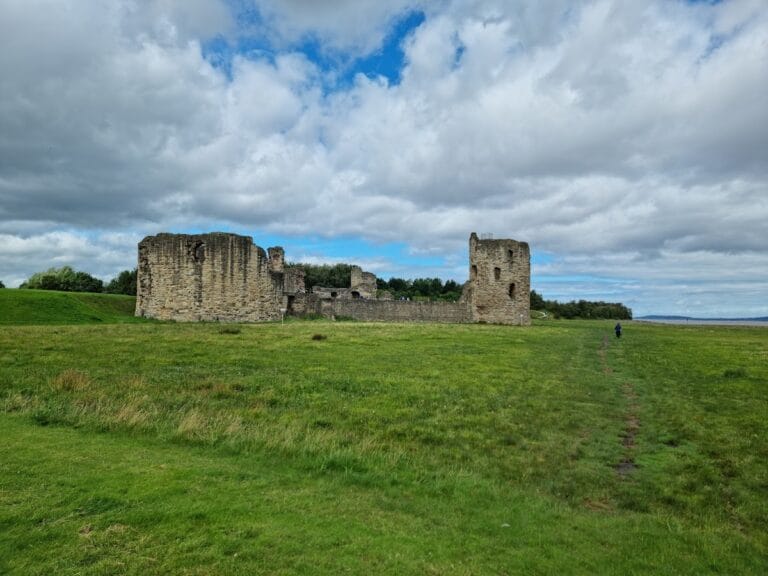
The earliest known reference to a church at Holywell is a document of 1093 recording its grant to the monks of St Werburgh’s Abbey. The grant was confirmed in 1119. In 1135, the town and church passed to the newly established Basingwerk Abbey, a medieval monastic institution that controlled the Holywell estate for much of the Middle Ages. The property briefly returned to St Werburgh’s between 1157 and 1196 before coming back to Basingwerk.
Royal attention and the early chapel
Holywell attracted royal visitors as well as ordinary pilgrims. Richard II visited in 1398 and appointed a chaplain to celebrate Mass regularly at the well. The associated pension continued under later monarchs into the 16th century. Henry IV came in 1403 after his victory at the Battle of Shrewsbury, perhaps to give thanks for the survival of his wounded son, although the visit may also have had a political purpose. Henry V may have made a pilgrimage from Shrewsbury around 1416, and Edward IV was also associated with a pilgrimage to the shrine.
Henry IV apparently established an early chapel over the spring, but that building probably did not survive. Tradition attributes the present chapel to Margaret Beaufort, the mother of Henry VII, after the Battle of Bosworth in 1485. No contemporary evidence supports that attribution. A 16th-century poem instead credits Thomas Pennant, abbot of Basingwerk, with funding the chapel in 1512, while tree-ring dating indicates that its roof timbers were probably installed around 1525.
Reformation and Catholic resistance
The well continued to receive Catholic pilgrims after Henry VIII rejected papal authority in 1534 and established the Church of England. Local Catholics resisted attempts to suppress the pilgrimage, and their activity helped protect the chapel from the organized destruction of religious images and objects during the English Reformation. The continued pilgrimage tradition is regarded as distinctive among Britain’s sacred sites.
During the reign of Elizabeth I, Catholic pilgrimage was treated as a possible threat to national security. In 1579 she ordered an investigation into whether the water possessed natural curative properties. Access was to be restricted to sick people if it did, while the chapel was to be demolished if it did not. The outcome is unknown, but the chapel remained and pilgrimage continued. Jesuit ministry began in Holywell in 1590 and continued there until the 20th century. The Jesuits, formally the Society of Jesus, were a Roman Catholic order active in missionary, educational, and pastoral work.
In 1605, the Jesuit Henry Garnet led a pilgrimage from Enfield to Holywell. He was accused of using it as cover for a meeting connected with the Gunpowder Plot, the failed attempt to destroy the English Parliament and government, but that interpretation is considered unlikely. Anti-Catholic measures continued during the 17th century. Bishop Richard Parry, Bishop Lewis Bayly, and Chief Justice John Bridgeman each took steps to restrict pilgrimage or enforce oaths of allegiance.
Pilgrimage repeatedly resumed despite official suppression. On 3 November 1629, about 1,400 lay pilgrims and an estimated 150 Catholic priests gathered at the well for St Winefride’s feast. In 1637 Bridgeman closed most of Holywell’s inns, damaged the shrine statue, removed the iron supports used by bathers, and ordered the names and addresses of pilgrims to be recorded. The chapel was also damaged during the English Civil War, possibly by Parliamentary soldiers passing through Holywell in 1643.
Monarchy, tourism, and renewed pilgrimage
The well attracted Protestants as well as Catholics. Some Protestant visitors accepted that the water might have medicinal effects because of its mineral content, while Catholic accounts attributed cures and conversions to Winefride’s intercession. During the reign of James II, Mary of Modena gave the chapel into the sole possession of the Jesuits. James visited in August 1687 to pray for a son and donated £30 toward repairs to the upper chapel, which had been used as a sessions house, a building for judicial sessions. After James was deposed in 1688, England again became Protestant.
From the 18th century, Holywell drew tourists and curiosity seekers alongside religious pilgrims. Celia Fiennes, Daniel Defoe, and Samuel Johnson were among those who visited. The upper chapel became a day school in 1722. By 1795, Thomas Pennant recorded that the number of Catholic pilgrims had considerably declined.
A widely publicized event in 1805 helped revive the pilgrimage. Winefrid White, who had been paralyzed on her left side and unable to walk without a crutch, reportedly recovered immediately after bathing in the well. Bishop John Milner collected witness testimonies and described the event as an evident miracle. The upper chapel returned to religious use in 1841.
Restoration and modern administration
Mining and drainage works in the Greenfield valley later affected the spring. The well dried completely on 5 January 1917 after a drainage tunnel near Bagillt intercepted its water supply. An abandoned mine shaft northwest of Holywell was converted into a pumping plant, and underground water was diverted through the Holway Level into the well basin. The spring began flowing again on 22 September 1917.
In 1930, the stream beside the well was partly covered, the adjacent former brewery was demolished, and the area was landscaped as St Winefride’s Park. During the 1990s, the Well House became a museum and library, while the Westminster Bath became a visitors’ centre. The crypt was restored with strengthened masonry, replacement floor slabs, and repairs to damage caused by humidity, candle smoke, and fires. Cadw, the Welsh national heritage body, assumed guardianship of the crypt in 2010, having maintained the upper chapel since the mid-20th century. The flow was temporarily interrupted during repair work in early 2019.
The shrine and well are administered by the parish of Holywell on behalf of the Roman Catholic Diocese of Wrexham. The chapel sections are under state guardianship and managed by Cadw. The chapel is a Grade I listed building, a category for buildings of exceptional interest, and a scheduled ancient monument. Its listing dates from 1951. In November 2023, the site was designated a national shrine.
Organised pilgrimages continue several times each year. The June pilgrimage includes a procession from St Winefride’s Church, Mass in the well garden, and veneration of Winefride’s relic. An annual Orthodox pilgrimage has taken place each October since 1987, and services are held daily in the crypt during the pilgrimage season. The well is associated with miracle stories from the medieval period onward, including accounts gathered by the Jesuit Philip Metcalf, Charles De Smedt, and Herbert Thurston. It became known as “the Lourdes of Wales,” appears by name in the medieval poem Sir Gawain and the Green Knight, and is included in a traditional list of the Seven Wonders of Wales.
Remains
The chapel and well crypt
Upper chapel
The chapel over the well is a Perpendicular Gothic structure dating from the early 16th century. This later medieval style is characterized by strong vertical lines, elaborate window tracery, and ribbed vaulting. The principal roof timbers were probably installed around 1525. The exterior walls are built from coursed sandstone imported from Storeton and Bebington on the Wirral.
The upper chapel has a low-pitched roof with a crenellated parapet. Its plan contains a four-bay nave, a three-bay north aisle, and a semi-octagonal chancel. The window tracery combines basket arches with ogee arches. A narrow stone bench runs around the inside of the chancel, and sockets in the masonry indicate that a rood screen, a partition between the chancel and nave, may once have stood across the chancel arch.
The arch-braced roof is decorated with foliage bosses. The supporting corbels and the arches of the north arcade carry carvings of animals, grotesques, and family emblems. The building has two principal levels. The hillside was cut away to allow entry to the crypt from the north, while the upper chapel is entered from the south.
Well crypt
The crypt lies beneath the chapel and contains the spring basin. A blocked external staircase at the west end once descended to a gallery overlooking the crypt and then continued through a spandrelled doorway, which had formerly been the main entrance. Two other doorways in the north wall are topped by large unglazed windows. A third unglazed window extends almost the full height of the crypt and overlooks the plunge pool.
A band of carved animals runs along the outer crypt wall. Inside, the star-shaped well basin is enclosed by a ring of stone columns. Traceried screens with basket-arched openings formerly joined the columns, allowing the spring to be viewed. Above the spring is a tierceron vault, a ribbed vault with secondary ribs branching from the main ribs. Its pendant boss, an ornament projecting downward from the vault, depicts six scenes from Winefride’s life. Other bosses show a range of subjects, while an 18th-century statue of Winefride stands in a crocketed-canopy niche in the northeast corner.
The chapel foundations were repaired in 1859 with finely cut ashlar stone beneath the well pool, and the plunge bath was relaid with stone flags. Later work in the crypt included replacement flooring slabs, strengthened masonry, repaired surfaces, and new gates and railings. Hundreds of pieces of graffiti cover the chapel stonework, including pilgrims’ initials and inscriptions associated with reported cures.
Spring, pools, and associated buildings
Spring and bathing pools
The well basin encloses the spring and opens toward a bathing pool. The traditional bathing area consists of the smaller pool beside the spring, the outer pool, and the submerged St Beuno’s stone. Medieval and later practice involved passing three times through the small pool while reciting one decade of the Rosary, then kneeling on the stone in the outer pool while completing the prayer. An 18th-century form of the ritual involved placing the head beneath the water to kiss the stone and make a wish. Bathing now takes place in the outdoor pool at specified times.
The spring was once described as exceptionally powerful. Medieval tradition held that objects dropped into it were carried downstream before sinking. Observers in the 17th and 18th centuries estimated a flow of more than 100 tons of water per minute, while a measurement made during the 1859 repairs gave 22.5 tons per minute. A pile of stones now covers the point where the spring emerges to prevent it from becoming a fountain.
Red stones in the stream bed have long been associated with the water. Legend connected their color with Winefride’s blood, while natural iron deposits or the red alga Trentepohlia jolithus have been proposed as physical explanations. The alga still grows on the north wall. The site was also known for moss called “St Winefride’s hair,” which was reputed to have a sweet smell. Pilgrims took stones and moss as charms or relics, and some moss was reportedly replenished by custodians from a nearby hill.
Well House and Westminster Bath
The three-storey Well House was built as a bathhouse and caretaker’s residence. It now contains a museum and library. The museum displays a piece of the True Cross, the Christian relic traditionally identified as part of the cross on which Jesus was crucified, along with relics of various saints, a surviving fragment of the Arch Gwenfrewi reliquary from Gwytherin, and a piece of bone believed to be part of Winefride.
The Westminster Bath is a swimming pool completed by 1871 and now functions as a visitors’ centre. Crutches and surgical boots left by pilgrims in connection with alleged cures, formerly displayed around the well, are now kept there. The stream beside the complex was partly covered in 1930, and the former brewery next to it was demolished. The former stream area became St Winefride’s Park.
Little Spring
A smaller spring, formerly called the Little Spring, was associated with cures for sore eyes. Visitors reportedly offered it a bent pin and recited a charm. By 1796, Thomas Pennant stated that the charm had been forgotten and that the spring was considered to have lost its efficacy. The Little Spring is now buried beneath the Well House.
Nearby sites