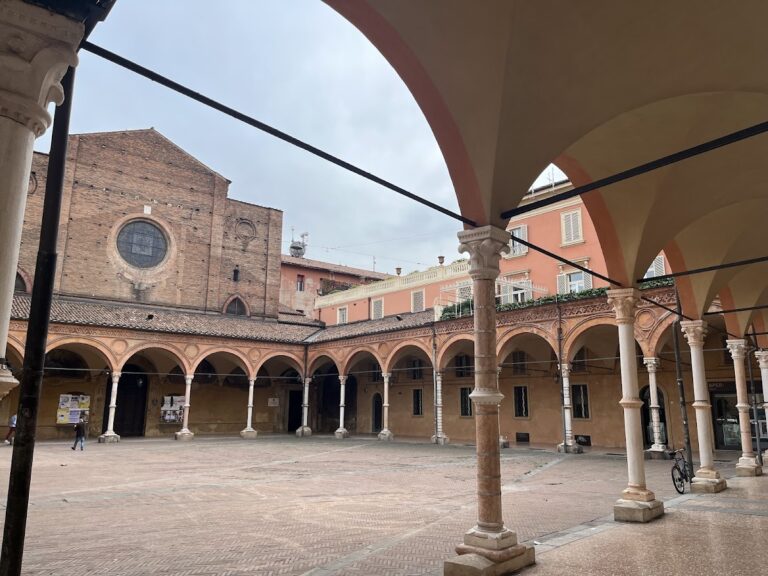
Santo Stefano Church: Bologna’s Seven Churches Complex


Site at a Glance
- Rating
- 4.8
- Popularity
- Medium
- Country
- Italy
- Primary era
- Medieval
- External website
- Open
- Eras represented
- Classical, Medieval, Early Modern, Modern
- Civilizations
- Lombard, Roman
- Site type
- Religious
- Remains
- Monastery
On this page18 sections
History
Santo Stefano Church is a Catholic complex in Bologna, Italy, whose construction and development extended from the fourth to the thirteenth century. Built and reshaped by Christian communities, Lombards, Benedictines, and later ecclesiastical patrons, it is known as the Seven Churches and Holy Jerusalem and holds the status of a minor basilica. The complex stood outside the walls of Roman Bononia, near the junction of the Via Aemilia and the minor Via Flaminia, and is regarded as Bologna’s oldest and most venerated monument.
From pagan sanctuary to Christian cemetery
A pagan sacred area occupied the site before the Christian complex developed. It included a circular temple and a sanctuary of Isis, an ancient Egyptian goddess whose worship often involved sacred water sources. The sanctuary was probably associated with a natural spring. Toward the end of the fourth century, a Christian necropolis formed east of this area.
Excavations in 1911 and 1912 confirmed two structures known from plans made in the sixteenth and early seventeenth centuries. One was a trilobed cell. The other was a cemetery enclosure containing a cross-shaped sanctuary, probably built where the present Church of the Trinity stands. A woman named Iulia Afrodite was buried beneath the sanctuary’s eastern arm, according to her funerary inscription.
The cemetery also became associated with Bologna’s first martyrs, Vitalis and Agricola. Traditionally described as servant and master, they were killed in Bologna’s arena during the persecutions of Diocletian in the early fourth century. Their remains were discovered and transferred in 382, in the presence of Ambrose, bishop of Milan. They were moved from a Jewish cemetery to the Santo Stefano necropolis, and Ambrose described the discovery in his sermon Exhortatio virginitatis, delivered in Florence in 393.
Petronius and the early Christian complex
Tradition attributes the foundation of Santo Stefano to Petronius, bishop of Bologna from 431 to 450 and the city’s patron saint. According to a life of Petronius written in 1180, he intended to reproduce the holy places of Jerusalem after making a pilgrimage there. No document confirms that he undertook such a pilgrimage, but his burial at Santo Stefano has supported the tradition that he promoted the complex’s foundation.
By the fifth century, the site probably included a basilica dedicated to Vitalis and Agricola and a Christianized circular building. This circular structure may have been converted from the former temple of Isis into an adult baptistery. The complex may have taken the name Santo Stefano from relics of Saint Stephen, although the details of its earliest development remain uncertain.
Lombard and early medieval transformations
The Lombards, a Germanic kingdom that ruled much of northern Italy from the sixth to the eighth century, occupied Bologna in 727. Their kings Liutprand and Hildeprand built a church dedicated to John the Baptist between 736 and 744. It was probably smaller than the present building but stood in the same position. An inscription on the associated stone basin records the foundation and refers to its offering-related function.
The complex’s baptismal functions changed as Christian practice developed. The former baptistery probably ceased to be used for adult baptism by the eighth century, when infant baptism had become customary. The Church of the Trinity may later have served as a baptistery under Lombard rule and was modified under the Franks.
A monastery was active at Santo Stefano by the first half of the tenth century, according to the Life of Saint Bononius. Because the complex still stood outside Bologna’s walls, it was exposed to Magyar raids in the late tenth century. The raids devastated Santo Stefano, and its relics were concealed. They resurfaced in 1141.
Benedictine rebuilding and the Jerusalem model
Benedictine monks, who followed the Rule of Saint Benedict, undertook extensive rebuilding from the early eleventh through the twelfth century. Abbot Martino commissioned the crypt beneath the present Church of the Crucifix. On 3 March 1019, the relics of Vitalis and Agricola were transferred there, probably because their earlier church had suffered serious damage.
The middle of the twelfth century brought a major reorganization intended to create a symbolic image of Jerusalem’s holy places. The Church of the Holy Sepulchre acquired its octagonal form, gallery, strengthened Roman columns, and dome, while the cloister received an additional level. This arrangement was intended to recall the Constantinian complex in Jerusalem, rather than the later church built there by the Crusaders.
The relics of Petronius were discovered in 1141 in the central shrine of the Holy Sepulchre. They remained there until 2000, when Cardinal Giacomo Biffi arranged their transfer to Bologna’s Basilica of San Petronio, which already held the saint’s head. During the thirteenth century, frescoes were added to the dome and walls of the Holy Sepulchre, the campanile was raised, and further medieval work affected the Courtyard of Pilate and the Church of the Trinity. The original purposes and chronology of some elements remain uncertain.
Later interventions and changing interpretations
In the late fourteenth century, a tomb inscribed “Symon” was mistakenly identified as the tomb of Saint Peter. The resulting pilgrimage threatened to divert pilgrims and income from Rome and from Bologna’s new Basilica of San Petronio. A pope ordered Santo Stefano closed and filled with earth, leaving the church unusable for roughly seventy years. Giuliano della Rovere, then archbishop of Bologna and later Pope Julius II, intervened to restore and reopen it.
Construction of the external arengario, a balcony used to bless the faithful and display relics, began in 1488. The monks’ refectory and dormitory were altered between 1700 and 1710. Extensive restorations around 1880 and during the early twentieth century removed later additions but also changed much of the complex’s historic appearance. The Courtyard of Pilate was enlarged, and the Church of the Trinity was reconstructed in a neo-Romanesque form based largely on the Crusader Church of the Holy Sepulchre rather than the Constantinian model that had originally inspired Santo Stefano.
The relics of the True Cross were kept in the central chapel of the Church of the Trinity from the Crusades until 1950. Since 2013, the basilica has hosted a Benedictine family from the Brazilian congregation, succeeded by the Franciscans Minor in 2020. The complex’s Jerusalem identity also survives in traditional surrounding names such as Jerusalem Street, the Valley of Jehoshaphat, the Mount of Olives, and the Pool of Siloam. Historical rituals included Easter veneration of the Holy Sepulchre, prayers associated with Mary Magdalene, and a tradition in which pregnant women circled the shrine thirty-three times before praying before the pregnant Madonna in the Martyrium.
Santo Stefano’s interpretation remains debated. The life of Petronius written in 1180 presents the complex as a fifth-century New Jerusalem, while most of Bologna’s surviving archaeological evidence belongs to the eleventh and twelfth centuries. The relationship between an early Constantinian model, medieval reinterpretation, and the Crusader Holy Sepulchre therefore remains unresolved. After the restoration of Piazza Santo Stefano in 1994, two medieval sarcophagi associated with Bologna’s first bishops were moved to the garden beside the right side of the Church of the Crucifix.
Remains
The complex consists of adjoining churches, chapels, the Courtyard of Pilate, a two-level medieval cloister, monastic buildings, a campanile, and a museum. From Piazza Santo Stefano, the principal visible group is formed by the Churches of the Crucifix, the Holy Sepulchre, and Vitalis and Agricola. The surviving buildings combine early Christian foundations, Lombard construction, Romanesque additions, reused Roman materials, and later restorations.
The Church of the Crucifix and its crypt
Church of the Crucifix
Formerly the Church of Saint John the Baptist, the Church of the Crucifix is an eighth-century Lombard building with a single nave, an exposed trussed roof, and a raised presbytery above a crypt. Its exterior has been heavily altered. Later additions include the external balcony, central oculus, crown of hanging arches, and enlarged portal. Inside, eight blind round arches carried on brick pilasters divide the nave.
The presbytery, the area surrounding the main altar, was remodeled in Baroque style in 1637. A central staircase leads up to it, while two side staircases descend to the crypt. Until the seventeenth century, the presbytery and crypt functioned as separate churches with independent entrances. The presbytery contains a painted wooden Crucifix by Simone dei Crocifissi, dated to about 1380, fifteenth-century frescoes of the Calvary and Crucifixion probably by Giovanni da Modena, and a seventeenth-century Noli me tangere.
The nave contains Angelo Gabriello Piò’s eighteenth-century polychrome papier-mâché Lamentation over the Dead Christ. Other works include Pier Francesco Cittadini’s mid-seventeenth-century Martyrdom of Saint Stephen, Angela Teresa Muratori’s Miracle of Saint Maur from 1701, a sixteenth-century Decollation of Saint John the Baptist, and a fourteenth- or fifteenth-century Madonna of Paradise by Michele di Matteo.
The crypt
The crypt has five aisles separated by columns of different forms and materials. One column is traditionally said to have been brought from Jerusalem by Petronius. Legend holds that it equals the height of Jesus from base to capital, approximately 1.70 metres. The remains of Vitalis and Agricola lie in two urns on an altar. Two sixteenth-century frescoes showing their martyrdom were discovered beneath plaster beside the altar. The crypt also contains the early fifteenth-century Madonna of the Snow, possibly by Lippo di Dalmasio, and a white statue of the Child Madonna.
The arengario
The arengario projects from the northern corner of the Church of the Crucifix’s façade. A marble copy of an inscription is fixed to the exterior wall. The original was found in two pieces during excavation in front of Palazzo Bolognini rather than within Santo Stefano, and its surviving lettering differs from the copy in form and completeness.
The Church of the Holy Sepulchre
The Church of the Holy Sepulchre is centrally planned. Its exterior is an irregular octagon, while an internal twelve-sided colonnade supports the dome. The space between the outer walls and inner colonnade forms an ambulatory, or passage around the central area, with vaults of irregular width and shape.
Twelve principal columns form the interior. Seven Roman marble columns, reportedly from Karystos, are paired with medieval brick columns, while five heavier columns are entirely made of eleventh-century brick. Some of the Roman columns may have belonged to the former temple of Isis. Another interpretation regards them as reused material brought from several ancient buildings, and their original positions remain disputed.
A separate black cipollino column made from African Roman marble stands apart from the colonnade. It represents the column of Christ’s scourging. An attached inscription promises 200 years of indulgence for each visit. The central shrine originally held the relics of Petronius. Its present form incorporates a thirteenth-century structure substantially reconstructed in the early twentieth century, while retaining its original position, slightly displaced toward the west. Later additions include façade reliefs, a trilobed arch, ambos, a balustrade, and two staircases.
A spring is reached through an opening in the floor and a stairway. It is symbolically identified with the Jordan and archaeologically associated with the sacred spring of the earlier Isis complex. Together with the surviving Roman marble columns, it supports the proposed identification of this area with the Isis sanctuary.
The church originally contained mid-thirteenth-century biblical frescoes by Marco Berlinghieri. Most were removed in 1804 and replaced with Baroque frescoes by Filippo Pedrini. Those paintings were themselves removed during the late nineteenth-century restoration. A thirteenth-century scene of the Massacre of the Innocents survives in the basilica museum.
A “stone of truth” is set into the exterior wall facing the square. Tradition held that it changed color when confronted with the statements of unfaithful women. Access was eventually prohibited after alleged ordeals resulted in deaths.
The Basilica of Vitalis and Agricola
The Basilica of Vitalis and Agricola is the oldest part of the complex. It has a three-aisled basilical plan with five bays, no transept, and a three-lobed apse. Its present form derives from the fifth-century basilica attributed to Petronius, but Benedictines extensively rebuilt it after the Magyar destruction.
The façade has a projecting profile, a single portal, a central bifora, two lateral single-light windows, and rows of hanging arches. Most of it was reconstructed in the nineteenth century and does not accurately represent the medieval building. A relief above the entrance shows Christ between Vitalis and Agricola. The present relief is a nineteenth-century copy of a presumed eighth-century original that disappeared during restoration; a plaster copy of the copy is preserved in the museum.
The secondary northern doorway combines stone elements from the first century, the eighth or ninth century, the fifteenth century, and especially the nineteenth century. Its reused Roman architrave bears an imperial-period inscription and another commemorating Giuliano della Rovere’s restoration. The concentric arches and figurative selenite capitals are nineteenth-century additions, while two small marble capitals were reused from eighth- or ninth-century elements.
Inside, fragments of Roman mosaic pavement can be seen beneath protective glass. The church also contains Ionic, Byzantine, and Frankish capitals and two early medieval sarcophagi attributed to the martyrs. Their flattened reliefs show Christian-symbolic animals such as peacocks, deer, lions, and an angel. A cross on the right wall is traditionally identified as the cross of Agricola’s martyrdom, although it belongs to a later period. The main altar is a pagan sacrificial altar turned upside down and placed against the rear wall.
The Courtyard of Pilate and the Church of the Trinity
Courtyard of Pilate
The Courtyard of Pilate, also called the Holy Garden, is reached from the Church of the Holy Sepulchre. Romanesque porticoes on the north and south sides enclose it, and their distinctive cruciform columns are made of brick. At the centre stands the limestone Basin of Pilate on a sixteenth-century pedestal. The basin is a Lombard work dated to 737 to 744 and carries an inscription connected with Liutprand, Hildeprand, and Bishop Barbatus.
A fourteenth-century stone rooster stands on a column beneath one of the porticoes. Known as the Rooster of Saint Peter, it commemorates Peter’s denial of Jesus. The porticoes also contain mortuary slabs, including a tailor’s tomb marked by a pair of real scissors. The courtyard’s chapels include the Chapel of Consolation with a pregnant Madonna, the Chapel of Saint Jerome with a Crucifixion by Giacomo Raibolini, and the Chapel of the Blessed Virgin of Loreto and the Lombard Society, which was also used as a sanctuary of the aviators.
Church of the Trinity
The Church of the Trinity, also called the Martyrium, the Church of the Holy Cross, or the Church of Calvary, currently has five naves and two vaulted bays. Its central chapel has a single deep aisle, a small projecting transept, and an apse, while the lateral chapels are square and niches separate the central and lateral spaces.
The present façade faces the Courtyard of Pilate and the apses face east. Both were rebuilt in a late nineteenth-century neo-Romanesque style. The building’s earlier orientation and intended five-nave basilical plan remain uncertain. Fragments of fourteenth-century frescoes survive inside, including Saint Ursula with her martyred companions and a pregnant Madonna. The last chapel on the right is dedicated to the Bersaglieri.
The church houses the large wooden Adoration of the Magi, a group of life-sized, three-dimensional statues regarded as the oldest known freestanding sculptural nativity group. The figures were carved from lime and elm trunks, probably during the final decade of the thirteenth century, by an anonymous Bolognese sculptor identified in a 1981 study with the Master of the 1291 Crucifix.
The sculpture remained unpainted until 1370, when Simone dei Crocifissi added polychromy and gilding. A major restoration in 1981 recovered its darkened colors. Further deterioration caused by church humidity led to another restoration from 2000 to 2004. After exhibition in Bologna’s Pinacoteca until 2006, the group returned to Santo Stefano and was permanently installed in an electronically climate-controlled, shatter-resistant case inaugurated on 21 January 2007.
Cloister and campanile
The medieval cloister is larger than the Courtyard of Pilate and has two levels. Its lower level, probably earlier than the year 1000, has broad pre-Romanesque arches. The upper level is a Romanesque gallery with paired columns, probably made by Pietro d’Alberico in the middle of the twelfth century.
Two unusual capitals show a naked man crushed by a stone and a man turning his head 180 degrees toward his back. They have traditionally been associated with punishments described in Dante Alighieri’s Purgatory. Memorial plaques on the cloister walls list Bolognese soldiers killed in the First World War, while large plaques in the western entrance atrium commemorate those killed in the Second World War.
The campanile visible from the cloister originated in the thirteenth century and was heightened in the nineteenth century. Its bell chamber contains four manually operated bells: the large bell cast by Andrea and Leone Vernizzi in 1521, the middle bell by Serafino Golfieri in 1847, the smaller middle bell by Domenico Fantuzzi in 1782, and the smallest by Angelo Rasori in 1828.
Museum and reliquaries
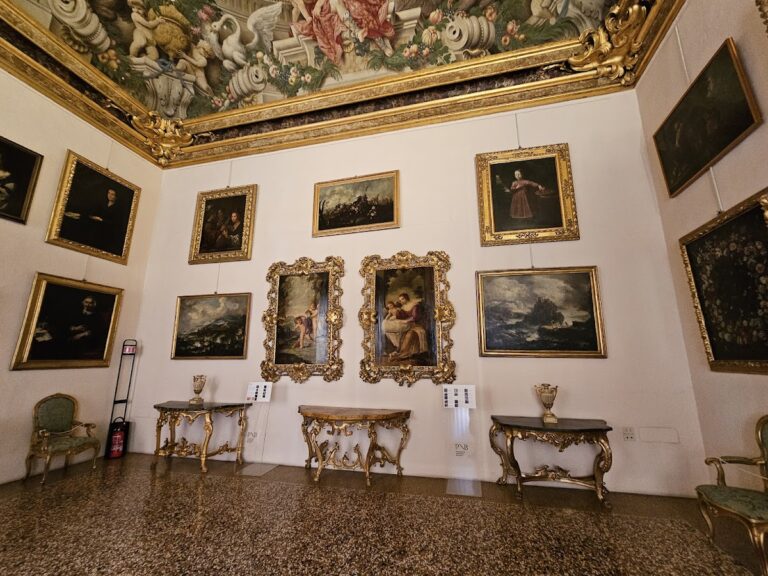
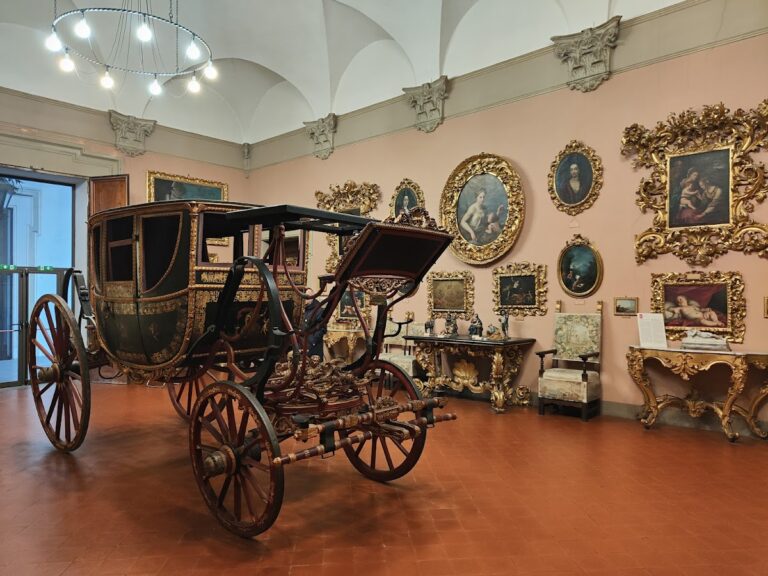
The Santo Stefano Museum occupies seven rooms, including the Chapel of the Bandage. It contains reliquaries, liturgical vestments, monstrances, pastoral staffs, detached frescoes, paintings, and works removed from the churches. Among its holdings are a detached fifteenth-century fresco of Petronius and scenes from his life attributed to Michele di Matteo, fragments of fourteenth-century polyptychs by Simone dei Crocifissi, a sixteenth-century Madonna and Child with Saint John by Innocenzo da Imola, Orazio Samacchini’s Trinity, and the silver-and-enamel reliquary of Petronius’s head made by Jacopo Roseto in 1380.
The museum also preserves a 1451 reliquary of Saint Florian’s head, a nineteenth-century plaster cast of the relief of Christ between Vitalis and Agricola, the thirteenth-century Massacre of the Innocents fresco from the Holy Sepulchre, and a fourteenth-century marble statue of Petronius giving the city to Bologna by Giovanni di Balduccio. The carved and gilded wooden urn of the Forty Martyrs was made by Antonio and Gaspare Billi in 1568.
The Chapel of the Bandage is a sixteenth-century Renaissance chapel with a single nave and an apsidal presbytery. Its relics include a traditionally Marian bandage in a silver reliquary made by Joannes Jacobs in 1625, a relic identified as the stone that killed Saint Stephen, a relic of Saint Catherine of Alexandria, a bandage associated with Saint Catherine of Bologna, and a fragment of the True Cross in a Joannes Jacobs reliquary dated 1634. Other relics are located elsewhere in the complex, including the remains of Saint Juliana de’ Banzi in a marble urn near the Courtyard of Pilate, an ivory pastoral staff attributed to Saint Isidore in the museum, a stole associated with Pope Pius V, remains attributed to Saint Maur or Saint Isidore, and small eighteenth-century Bolognese reliquaries containing fragments of saints’ bones and a bone attributed to Paschal Baylon.
Nearby sites