Market Church: Hanover’s Lutheran Parish Church


Site at a Glance
- Rating
- 4.5
- Popularity
- Medium
- Country
- Germany
- Primary era
- Medieval
- External website
- Open
- Eras represented
- Medieval, Modern
- Civilizations
- German, Holy Roman Empire
- Site type
- Religious
- Remains
- Church
On this page18 sections
History
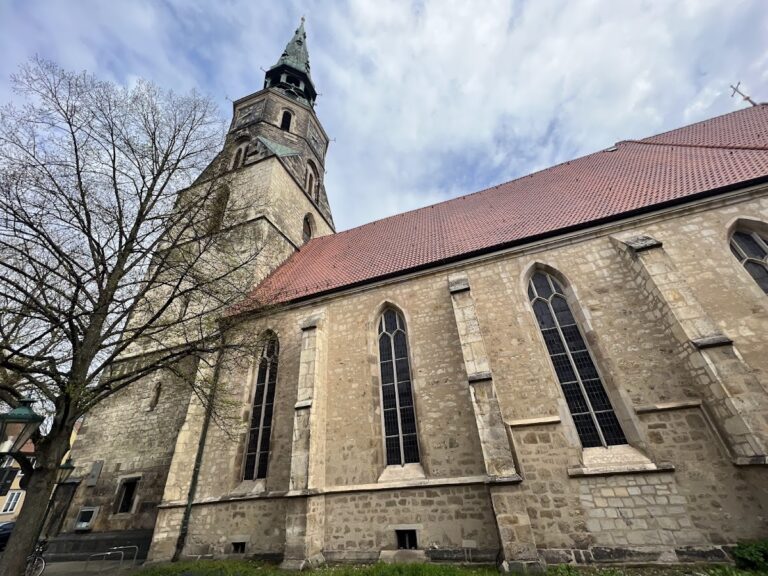
Market Church is a medieval Lutheran parish church in Hanover, Germany, built in the fourteenth century in the northern German Brick Gothic tradition. Officially known as the Market Church of Saints George and James, it is the oldest of Hanover’s three parish churches in the old town and remains closely connected with the city’s religious and civic institutions.
Medieval foundation and construction
A Romanesque church stood on the site by about 1125. It was first recorded as St. George’s Church in 1238, and its foundations were uncovered during excavations in 1952. The church’s first colored-glass windows were completed in 1340. From 1342, the name ecclesia Sanctorum Jacobi et Georgii, meaning the Church of Saints James and George, appears in the historical record.
In 1344, Hanover’s citizens appealed for donations to build a new church. Work on the tower foundations began in 1347, while the new structure was built around the older church. Permission to demolish the predecessor followed in 1349. The completed church was consecrated around 1360, but tower construction stopped in 1368 because plague, hardship, and the resulting lack of funds interrupted the work. A surviving record dates the roof structure to 1388, and dendrochronology, the dating of timber through its annual growth rings, places the felling of the roof timbers between 1385 and 1388.
The church was dedicated to Saint James and Saint George. Saint James the Elder was a major Christian apostle and a medieval patron of pilgrims and merchants. Saint George was a Christian martyr traditionally represented as a dragon slayer and was counted among the Fourteen Holy Helpers, a group of saints invoked for protection against particular dangers and illnesses.
Reformation and civic patronage
Market Church was originally Roman Catholic. On 26 June 1533, Hanover’s citizens swore an oath on the market square between the church and the Old Town Hall. Made under the civic spokesman Dietrich Arnsborg, the oath is regarded as the beginning of the Reformation in Hanover. The Reformation was the sixteenth-century movement that challenged established Western Catholic practice and led to the formation of Protestant churches. Under the church order issued in 1536, Market Church became Lutheran, the Protestant tradition associated with Martin Luther.
The city of Hanover has exercised patronage over the church since 1574. Its patronage representative participates in the church governing body and helps appoint pastors. The market square around the church has also hosted Hanover’s Christmas market since about 1850, continuing the area’s long civic and commercial association with the old town.
Market Church has served as the preaching church of the bishops of the Evangelical-Lutheran Church of Hanover since 1925. It is also the church of Hanover’s city council and the Lower Saxony state parliament. Its first pastoral position is held by the city superintendent of the Hanover church district.
Alterations, war damage, and reconstruction
After the fourteenth century, a small annex was added on the northern side and used as a sacristy. Immediately to its west stood Saint Anne’s Chapel, also called the Soden Chapel, from 1510. In 1852–1855, Ludwig Droste directed a major restoration that repainted and refurnished the interior. The Duve Altar disappeared during this work.
Air raids on Hanover in July and October 1943 severely damaged Market Church. Most of the interior was destroyed, leaving the building largely reduced to its exterior walls and columns. Much of the roof structure survived, although the roof and nave vaults needed restoration. The church was rebuilt between 1946 and 1952 by Huta Hoch- und Tiefbau according to plans by Dieter Oesterlen. The work exposed the interior brickwork, restored the roof and vaults, and revealed foundations extending more than three metres below ground.
The rebuilding also created the Bödekersaal community hall in the lower level. It was named after Hermann Wilhelm Bödeker, who served as pastor of Market Church from 1825 to 1875. The hall contains a memorial plaque to 21 citizens killed near Hainholz during the Thirty Years’ War, the seventeenth-century conflict that brought prolonged military and political upheaval to much of Central Europe. Pastor David Meyer commissioned the plaque.
Altars and the Reformation window
The medieval high altar was moved to the Aegidienkirche in 1663 to make room for a Baroque altar donated by Johann Duve. The medieval altar was transferred to the Welfenmuseum in 1856, a move that largely protected it from wartime destruction, and it returned to Market Church in 1952.
In 2017, the church council accepted a proposed gift of a 13-metre Reformation window designed by Markus Lüpertz and offered by former Federal Chancellor Gerhard Schröder. A copyright dispute involving the estate of the postwar reconstruction architect was settled in 2021. After the council postponed installation in 2022, the window was dedicated during a service on Reformation Day in 2023.
Remains
Plan, materials, and tower
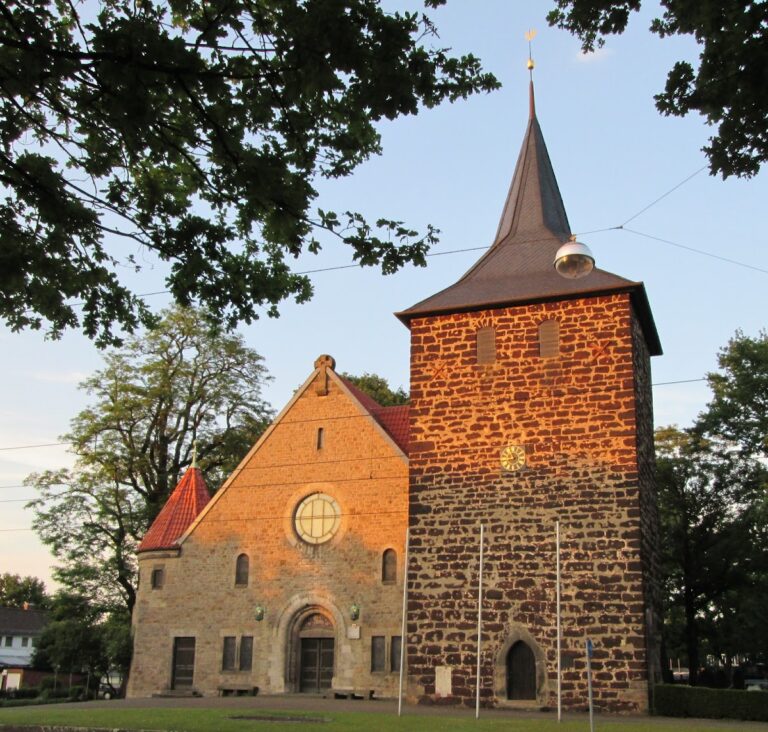
Market Church is a three-aisled hall church built predominantly from red brick. Including the tower, it measures 61.50 metres in length and 26.60 metres in width, with eaves 19 metres high. The nave is 8 metres wide, while each side aisle measures 5.40 metres. The five-bay hall ends in a large main choir with a 7/10 polygon and side apses with 5/10 polygons. The choir arrangement has been compared with the Wiesenkirche in Soest, the monumental west tower with Westphalian models, and the nave’s round piers with clustered shafts with St. John’s Church in Lüneburg.
Sandstone forms the base, cornices, west portal, and corner masonry of the tower. The western tower rises 97.26 metres, or about 98 metres including the weather vane, and is a major Hanover landmark. Its planned steep spire was replaced by a roof turret shaped as a reduced version of the tower itself. Three triangular gables carry geometric symbols, an inverted pentagram on the east side and a hexagram on both the north and south sides. The weather vane and finial were renewed after storm damage in 1624. The tower top was covered with copper in 1702, but its new vane fell in 1703 and was replaced in 1705.
West portal and exterior sculpture
The present main entrance is a bronze portal made by Gerhard Marcks in 1959. Beneath the motto discordia et concordia, meaning discord and harmony, it presents fundamental human situations beneath a two-trunked Tree of Life. The scenes include gallows, tanks, a Nazi speaker, heaps of corpses, and burning houses, while the upper field shows the resurrected Christ. Hanover donated the portal for the church’s six-hundredth anniversary.
Above the portal stand sculptures of the patron saints made by Jürgen Weber in 1992. Saint George with the dragon is on the left, and Saint James with a pilgrim’s staff is on the right. An earlier statue of James was destroyed during the Second World War, while the earlier George was moved to the northern choir. On the tower’s north side is Carl Dopmeyer’s sculpture of Hermann Wilhelm Bödeker, and on the south side stands his Martin Luther. A choirboy sculpture beside the Luther monument recalls a local legend that a choirboy survived a fall from the tower.
Sundials and historic viewpoint
Two sundials remain on the exterior of the former south portal. One dates from 1555. The other is a canonical sundial, an instrument showing prayer times, and probably dates from the church’s construction period. It may be Hanover’s oldest clock.
A cross set into the pavement near the west portal marks a viewpoint from which the towers of Market Church, Aegidienkirche, Kreuzkirche, and Neustädter Church can be seen. More than 300 years ago, this viewpoint was regarded as one of Hanover’s seven landmarks.
Choir, altar, and memorials
High-altar retable
The high-altar retable, the decorated structure behind an altar, was made around 1480. Originally a double-winged altar, it has hinged panels that could be opened or closed. When open, it displays 21 scenes of the Passion of Christ carved in lindenwood, based on graphic models by Martin Schongauer, a fifteenth-century German painter and printmaker. Medallions of prophets run along the lower edge, including the patriarch Jacob wearing spectacles. The outer sides of the painted inner wings show scenes from the lives and martyrdoms of Saints James and George, while most of the external wings are destroyed.
Baptismal fonts and stained glass
Two brass baptismal fonts, probably made in Hildesheim around 1500, stand in the side choirs. The font in the southern choir rests on five lions and came from the Aegidienkirche, which was destroyed in 1943.
The three eastern windows of the main choir contain notable colored glass. Twenty of the 30 panes in the central choir window show martyrdom scenes and date from around 1370. Other panes were transferred from different windows or produced during nineteenth- and twentieth-century restorations. Two windows were made by the Frankfurt studio of Alexander and Otto Linnemann.
Epitaphs and gravestones
Epitaphs and gravestones inside and outside the church date predominantly from the sixteenth and seventeenth centuries. They include memorials associated with Antonius Corvinus, a Protestant reformer active in Lower Saxony, and Hans Michael Elias von Obentraut, a cavalry general who fought on the Danish side and died near Seelze in 1625. Memorials of Hanover mayors and civic figures, including Hans Blome the Younger and Franz von Wintheim, were later moved to other interior and exterior walls. Von Wintheim’s epitaph had previously stood in the Nikolaikapelle and was transferred to Market Church after the Second World War.
Organs and bells
Organ history
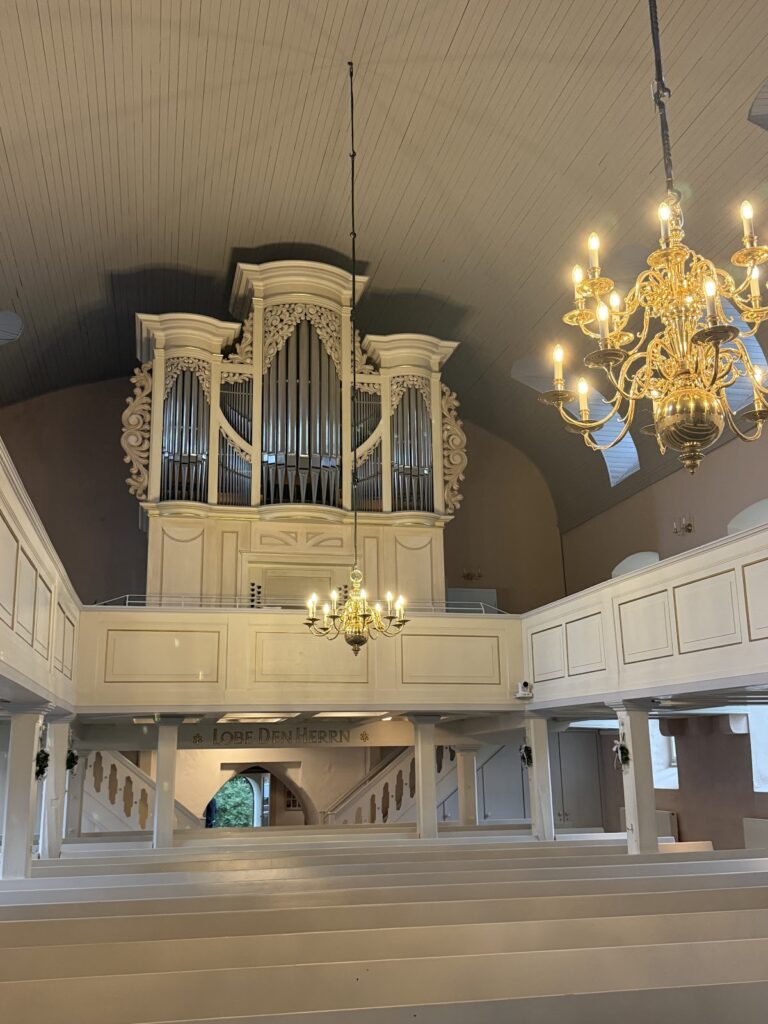
The first evidence of an organ dates from 1403, when the instrument probably stood beside Saint Anne’s Chapel in the northern aisle. A large west-gallery organ was built between 1589 and 1594 by Henning Henke, Severin Krosche, and Andreas de Mare. It was later altered by several builders, including Conrad Abt, Adolph Compenius, Friedrich Besser, and Christian Vater, who extensively repaired and enlarged it in 1733.
During the 1852–1855 rebuilding, a new gallery was inserted in the tower hall. Eduard Meyer built a 46-stop organ there in a Neo-Gothic case, reusing pipes from the earlier instrument. Furtwängler & Hammer rebuilt and enlarged it in 1893, and it was modified again in 1940–1941. The instrument was largely destroyed during the Second World War and removed during the postwar rebuilding.
Main organ
The main organ stands against the rear wall of the southern aisle. Its predecessor was built in 1953–1954 by Emil Hammer Orgelbau of Hanover and Rudolf von Beckerath Orgelbau of Hamburg, with 61 stops on four manuals and pedal. Dieter Oesterlen designed its curving, kidney-table-style case, which is protected as a monument.
Orgelbau Goll of Lucerne rebuilt the organ between 2007 and 2009, retaining the case and about half of the pipework. It now has 64 stops, including 39 that partly or wholly reuse pipes from the earlier organ. Its key action is mechanical, while its stop action is both mechanical and electrical.
Choir and Italian organs
Eule Orgelbau of Bautzen installed a choir organ on the tower gallery in 2008. It has 15 stops, including two transmissions, on two manuals and pedal. Its key action is mechanical and its stop action electrical. Its design follows that of nineteenth-century French choral organs.
An Italian organ made by Fabrizio Cimino in 1780 was installed in Market Church in 2003 and restored in 2007 by Jörg Bente and Paul-Uwe Dietzsch. It has seven stops on one manual with an attached pedal, meantone tuning at 440 Hz, and two wedge bellows that can be operated electrically or manually.
Bell collection
The tower contains eleven bells. The Christus and Peace Bell is the largest bell in Lower Saxony and is rung only on feast days and special occasions. The Great David was originally donated by Pastor David Meyer for the Church of the Cross and was transferred to Market Church after the Second World War. The George Bell and the larger quarter-hour bell also originally belonged to the Church of the Cross. Three clock-striking bells are housed in the tower lantern.
Nearby sites