San Pietro in Ciel d’Oro: A Lombard Romanesque Basilica in Pavia


Site at a Glance
- Rating
- 4.9
- Popularity
- Very Low
- Country
- Italy
- Primary era
- Medieval
- External website
- Open
- Eras represented
- Medieval, Early Modern, Modern
- Civilizations
- Duchy of Milan, Holy Roman Empire, Italian, Lombard, Spanish
- Site type
- Religious
- Remains
- Basilica
On this page18 sections
History
San Pietro in Ciel d’Oro is a Catholic church and minor basilica in Pavia, Italy, whose present form was rebuilt in the Lombard Romanesque style between the eleventh and twelfth centuries and completed around 1132. Its history reaches back to a church dedicated to Saint Peter recorded at Pavia in 604, and the earlier building probably stood over a sixth-century church. The basilica became important as the home of Saint Augustine’s relics, the burial place traditionally associated with the philosopher Severinus Boethius, and later the dynastic church of the Visconti rulers.
Lombard foundation and the relics of Augustine
King Liutprand, a Lombard ruler of northern and central Italy, founded or substantially renewed the basilica in the early eighth century. Between about 720 and 725, he arranged for the relics of Saint Augustine, the late Roman bishop and theologian of Hippo, to be brought from Cagliari to Pavia. They had reached Sardinia from Hippo in 504. Liutprand feared that raids by Muslim forces on Mediterranean coasts could lead to their theft, so he established the church as a secure place for their preservation.
The church is first mentioned by Paul the Deacon, an eighth-century Lombard historian, poet, and monk. The early medieval basilica was also linked to the tomb of Severinus Boethius, a late Roman philosopher and statesman executed by the Ostrogothic king Theoderic the Great in 525. Its name, meaning “Saint Peter in the Golden Sky,” refers to gilded vaults associated with the building.
Monastery, school, and imperial privilege
The monastery was initially entrusted for a period to Columbanian monks. Paul the Deacon entered monastic formation there, and in the ninth century the community developed an important school and manuscript center under the Irish monk Dungal. An imperial decree issued by Lothair in 825 required students from a wide area of northern Italy, including Milan, Brescia, Bergamo, Lodi, Novara, Vercelli, Tortona, Asti, Acqui, Genoa, and Como, to study at the monastery.
From the tenth century, the monastery enjoyed exemption from the authority of the bishop of Pavia and was subject directly to the pope. In 987 Maiolo of Cluny stayed there and reformed monastic discipline. In 1004, Emperor Henry II took refuge inside the monastery’s fortified enclosure when hostile citizens of Pavia opposed his coronation.
Pope Benedict VIII presided over a council at the basilica in 1022, with Henry II in attendance. The council addressed clerical celibacy and included a public display of Augustine’s relics. An arm of Augustine was given to Egelnoth, archbishop of Canterbury, while smaller bone fragments went to other bishops who attended.
Imperial support continued from the ninth through the twelfth centuries. Donations and privileges came from rulers including Hugh, Otto I, Otto II, Otto III, Henry II, Conrad II, Henry III, Henry V, and Frederick Barbarossa. In a diploma dated 11 February 1159, Barbarossa confirmed the monastery’s extensive properties and rights around Pavia, along the Ticino, in the districts of Pavia and Lodi, and in territories reaching the Trebbia valley, Monferrato, Florence, Val Camonica, Val d’Ossola, Bellinzona, and several dioceses of northern Italy.
Estates and medieval religious communities
The monastery also built a substantial economic base. By at least 974, its monks owned vineyards and wine presses near San Damiano al Colle. From the eleventh century they expanded viticulture in the Oltrepò Pavese. Wine traveled to Pavia along the Po and Ticino, and the surplus beyond monastic use was sold. The monastery’s wealth and privileges produced repeated disputes with the bishops of Pavia, especially during the episcopates of Guglielmo d’Este and Guido II.
During the twelfth and thirteenth centuries, the monks exchanged distant properties that were difficult to control for nearer lands. This created a more compact estate containing fields, mills, farms, and other holdings at Santa Sofia, Carbonara Ticino, Zeccone, Giussago, Miradolo Terme, Bereguardo, Sartirana, Casei Gerola, and Alpepiana in the Trebbia valley. The monastery also held seigneurial and bannum rights, meaning jurisdictional powers, at Villanterio and Lardirago, where it owned a castle.
Between 1169 and 1180, Abbot Ulrico directed the transfer of Liutprand’s remains and those of his father Ansprand from the dynastic mausoleum of Sant’Adriano near Santa Maria alle Pertiche to the basilica. After the abbot was murdered by several monks in 1221, Pope Honorius III converted the monastery into a collegiate foundation and entrusted it to the Canons Regular of Santa Croce di Mortara. In 1327, Pope John XXII appointed Augustinian hermits to guard Augustine’s tomb. The two communities initially shared the complex, but the Augustinians built a convent opposite the basilica in 1332, while the canons established a separate cloistered complex.
Visconti court and dynastic church
The Augustinian friar Iacopo Bussolari led the revolt of 1356 that expelled the Beccaria from Pavia and established a popular government. The city resisted military operations by the Visconti, the ruling dynasty of Milan and Pavia, for almost three years.
After Galeazzo II Visconti moved his residence and court from Milan to Pavia in 1365, he used San Pietro in Ciel d’Oro to connect his dynasty with the city’s earlier royal history. He had supported the church from 1361 and financed the preparation of Augustine’s marble ark from 1362. By his own wish, he was buried in the basilica, which became the principal burial church of the Visconti court at Pavia.
Other burials included Galeazzo II’s advisers Giovanni Pepoli and Roberto de Fronzola, Lionel of Antwerp, Francesco d’Este, Violante Visconti, and the military commander Facino Cane. The church also hosted the funeral of the Visconti commander Luchino Dal Verme, who died at Constantinople in 1367. Gian Galeazzo Visconti was buried there after his death in 1402, although his remains were transferred to the Certosa of Pavia in 1474 according to his will.
The religious communities maintained close relations with the court. Bonifacio Bottigella, prior of the Augustinian hermits, served as confessor to Bianca of Savoy, while Dionigi da Cermenate, abbot of the Canons Regular, was chaplain and confessor to Gian Galeazzo Visconti. Diplomats and ambassadors visiting the Visconti court also came to the basilica, including Geoffrey Chaucer in 1378.
A major manuscript center near the convent was directed by the friar Pietro da Pavia. Its work combined close observation of everyday life with the influence of French courtly Late Gothic art. The center produced a copy of Pliny the Elder’s Naturalis Historia commissioned in 1389 and a prayer book ordered by Gian Galeazzo in 1390. Many of its illuminated manuscripts later entered the Visconti-Sforza Library at Pavia Castle, and the center influenced Lombard art and may have trained Michelino da Besozzo.
Later changes and restoration
Fifteenth-century renovations included the construction or reconstruction of the central nave vaulting by the Candia brothers. The central rib vault is also associated with Giacomo da Candia and the year 1487. In 1465, the canonry’s abbacy was granted in commendam, placing its revenues and administration in the hands of an appointed holder, and in 1509 the Canons Regular joined the Lateran order. Francesco II Sforza established a ducal chaplaincy at Augustine’s altar in 1522.
After the Battle of Pavia in 1525, the basilica received the burials of aristocratic and military figures killed in the conflict, including Eitel Friedrich III, count of Hohenzollern and captain of the Landsknechte, and Richard de la Pole, the last member of the York dynasty and a claimant to the English crown. Pietro da Cortevilla, a councillor and treasurer of Emperor Charles V, was buried there in 1543.
Following the Council of Trent, many sarcophagi and funerary monuments were removed in the 1570s because they obstructed the church. Apart from Liutprand’s remains, most human bones found during nineteenth-century restoration were reburied beneath the main nave near the penultimate pillar before the crypt. A floor inscription records the burial.
Disputes between the Lateran canons and the Augustinians over liturgical administration continued until an agreement in 1635. The Augustinians used the right nave and the Laterans the left, while the high altar and choir remained shared, with the two communities alternating monthly.
The Lateran canons were suppressed in 1781. Their complex was temporarily entrusted to Franciscans and then confiscated for other uses in 1799. The Augustinians were expelled from their convent in 1785 and replaced by Dominicans; that convent was likewise confiscated in 1799. In 1796, Napoleon Bonaparte’s troops stripped and desecrated the church and used it as a stable or depot. The friars were expelled, and the convents came under military control.
During the nineteenth century, the right nave and the first bay of the central nave collapsed. The interior was exposed, and surviving frescoes were severely damaged. The Society for the Conservation of Pavia’s Christian Monuments, chaired by Carlo dell’Acqua, negotiated the return of the basilica and former Augustinian convent from the army, achieved in 1884. Restoration directed by the Pavia architect Angelo Savoldi took place from 1875 to 1896. It reconstructed the collapsed nave, rebuilt the crypt, and removed later alterations from the medieval plan. The basilica reopened for worship on 15 June 1896, and Augustine’s relics and fourteenth-century ark returned from Pavia Cathedral. Augustinian friars again occupied the former convent and continue to officiate at the church.
Excavations behind the apse in 2018 and 2019 exposed masonry attributable to the apse of the earlier building. In 2018, bioarchaeological and genetic analysis of bones traditionally attributed to Liutprand identified three high-status individuals. Two were men dating to the sixth century; a third person died at approximately 40 to 50 years of age and was contemporary with Liutprand, making the royal attribution possible but not certain.
The basilica’s religious and literary associations continued to shape its reputation. Dante refers to Boethius’s burial in Paradiso, Canto X. Petrarch mentions the church in writings concerning Giovanni Boccaccio, and Boccaccio’s Decameron includes an episode set at the basilica. Saint Bridget of Sweden stopped at Pavia in 1349 during her pilgrimage to Rome to venerate Augustine’s relics.
Remains
Romanesque structure and exterior
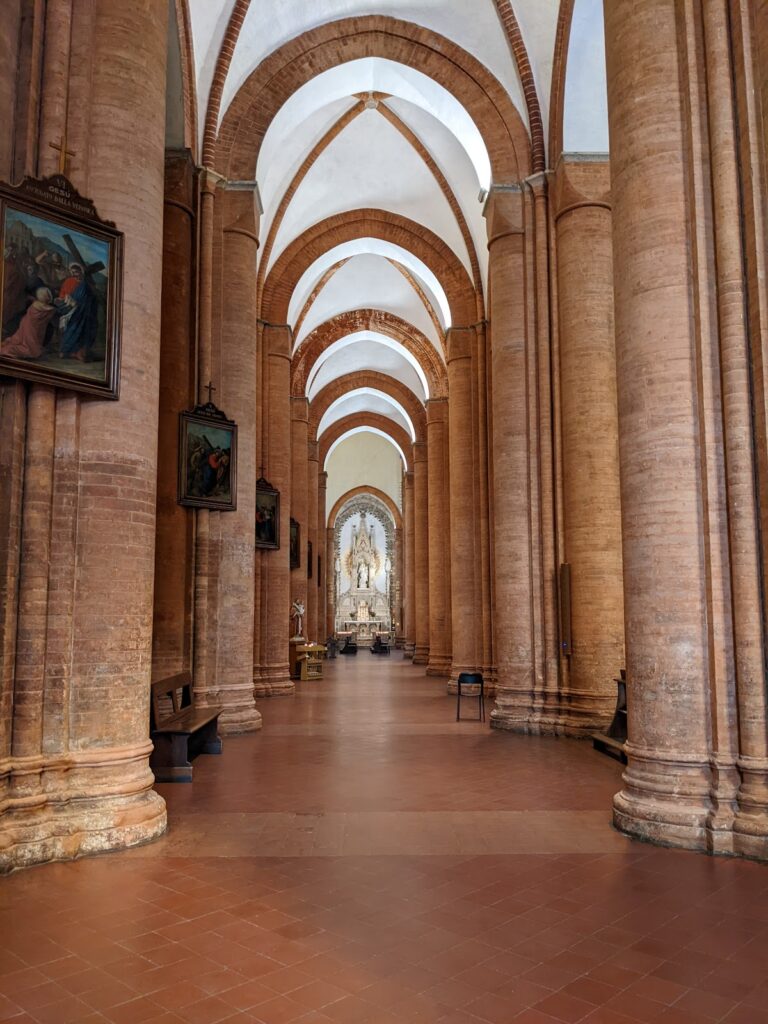
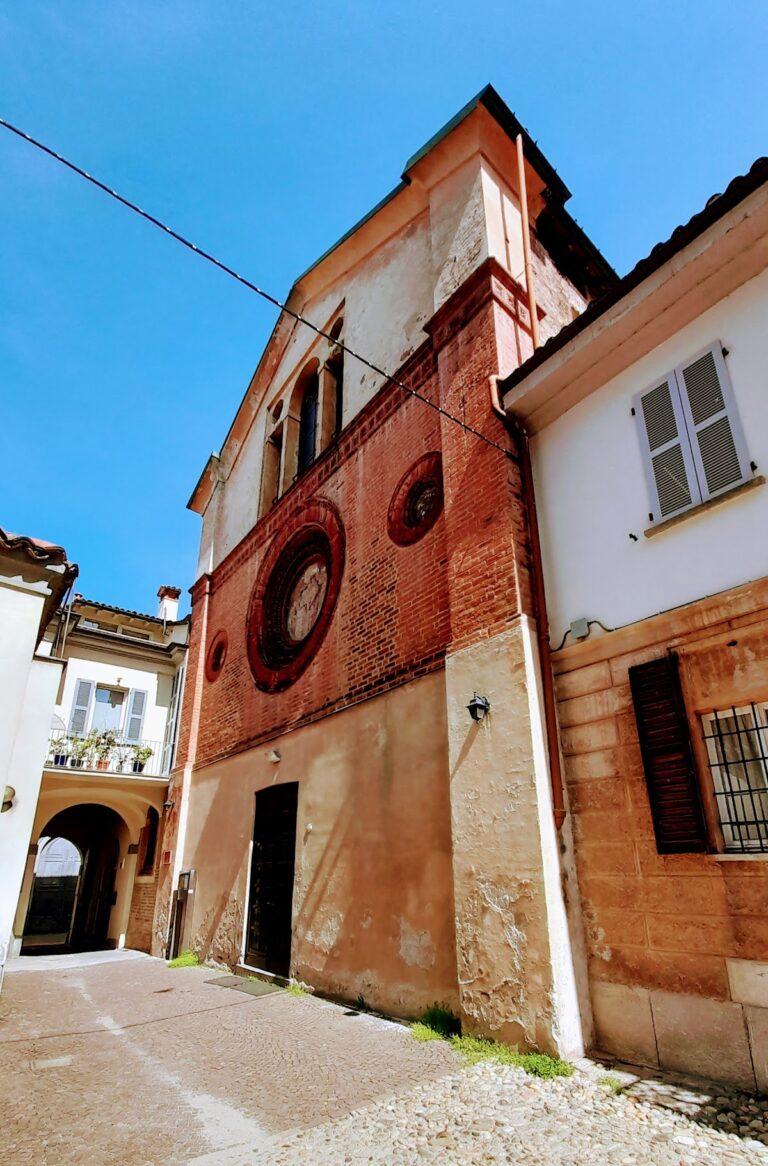
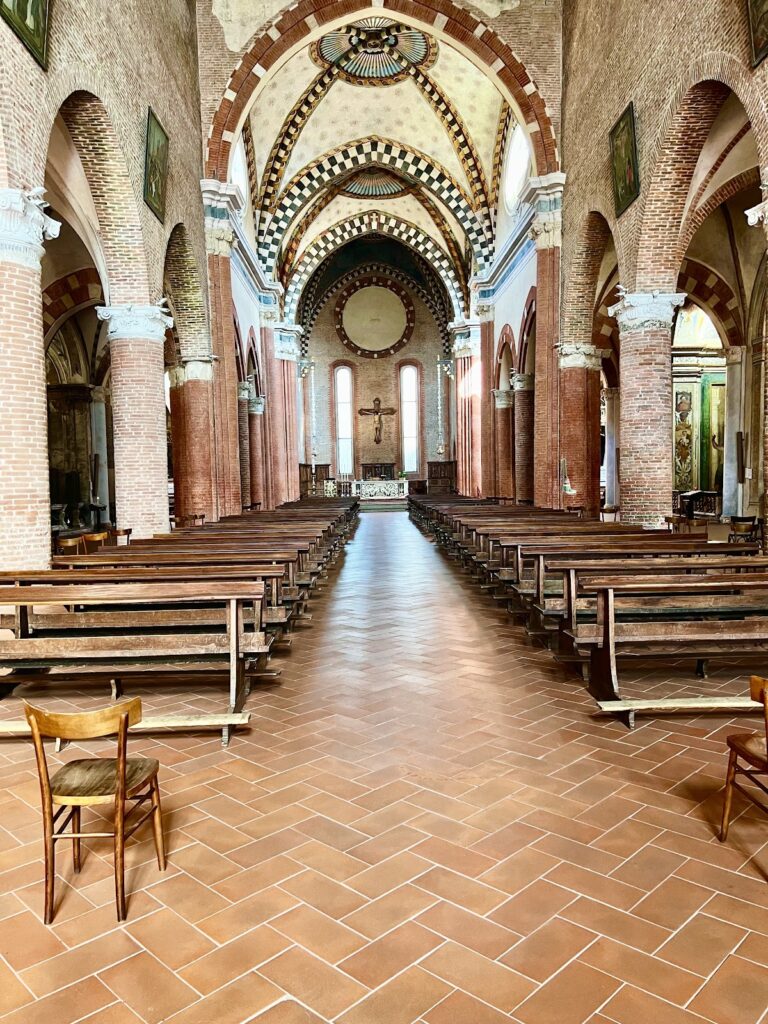
The present basilica is built mainly of brick and follows a three-nave plan with a transept, an eastern apse, and a crypt. The floor lies below the modern level of Piazza San Pietro in Ciel d’Oro. Its gabled facade is divided into three sections by two buttresses that correspond to the internal naves. The thicker right buttress contains a staircase leading to the roof. Above, a blind loggia and interlaced arches enrich the facade.
Facade and entrance
Sandstone marks the principal architectural elements, including the portal, windows, and circular openings, while the portal also incorporates marble. Its tympanum shows Saint Michael at the center with two praying figures at either side. These sculptures date to approximately 1050–1090 and may have come from the earlier basilica. Lines along the facade buttresses indicate an earlier entrance structure, possibly a four-sided portico known as a quadriporticus.
Nave and crossing
Inside, five bays organize the building. The central nave bays are rectangular, while those of the side aisles are square. The central nave is wider, longer, and less vertically slender than the nave of San Michele Maggiore, and its piers follow a regular sequence with approximately uniform sections. The second through fifth bays carry rib vaults, whose weight is partly borne by projecting masonry ribs.
The first bay is higher and functions as an internal atrium, or possibly a false transept. Its barrel vault also supports the facade. The different roof forms can be seen externally in the changing slopes of the roof planes. Beyond the triumphal arch, the transept occupies the full depth of the three naves without projecting beyond the main body. The three naves end in eastern apses decorated outside with blind loggias. An octagonal dome rises over the crossing on Lombard-type supports and is enclosed externally by a terracotta structure called a tiburium.
Chapels, apses, and furnishings
Frescoes and apse
The first two bays of the left nave contain scenes from the life of Christ, including a surviving Resurrection attributed to Bartolomeo Bonone. Some paintings are partly concealed by frescoes made in the second half of the sixteenth century. In the central apse, a fresco by Ponziano Loverini dated 1900 covers the semi-dome. It was based on an ancient mosaic destroyed in 1796.
Northern transept room
A small portal in the northern transept, framed by Romanesque sculptures more archaic than those elsewhere in the basilica, leads to a small room. Formerly an oratory, the room is now used as a bookshop. In the sixteenth century an iron door separated it from the basilica. Its original purpose was probably to house Augustine’s relics and other saints’ remains brought to Pavia from Sardinia in the Lombard period, and its form probably reflects an earlier medieval oratory.
New Sacristy and organ
The New Sacristy, reached from the left nave, is a large rectangular room built in 1561. Its vaulted ceiling was decorated with Mannerist grotesques during the same period. The church also contains a Lingiardi pipe organ built in 1913, modified by Mascioni in 1978, and restored by Inzoli in 1990. It has two keyboards and a pedalboard and stands in an elaborate Neo-Gothic case.
Crypt and funerary monuments
Crypt and Boethius’s tomb
The crypt occupies the area beneath the presbytery and choir and connects with the central and side naves through four staircases. It ends in an eastern apse and is divided into five naves by twenty-four columns supporting rib vaults. These vaults carry the floors of the two spaces above. The crypt was partly reconstructed during the nineteenth-century restoration from surviving traces.
Severinus Boethius’s tomb stands in the crypt. His bones are held in a small urn in the style of those made at Ravenna, produced by Antonio Cassi after a design by the architect Brusconi. Behind the altar, a marble slab bears an epitaph praising Boethius’s wisdom, attributed to Gerbert of Aurillac, later Pope Sylvester II. Boethius’s original sixth-century tombstone is preserved in the Civic Museums. An ancient well stands against the rear wall. It was already known in the twelfth century, was traditionally believed to have healing properties, and was restored during the late nineteenth-century work.
Ark of Saint Augustine
The Ark of Saint Augustine stands in the presbytery before the choir. This fourteenth-century Gothic marble monument was carved by Giovanni di Balduccio and commissioned in 1362 by Bonifacio Bottigella, a Pavia Augustinian, prior of the convent, and professor at the city’s university.
The monument has three horizontal zones. Its lower plinth contains the urn with Augustine’s remains; the open middle section holds a sleeping statue of the saint; and the upper zone rests on small pillars and ends in triangular cusps. More than 150 statues of angels, saints, and bishops, together with panels showing scenes from Augustine’s life, decorate the ark.
Inside the ark is Augustine’s reliquary box, a Lombard silverwork object donated by King Liutprand around 725. Its gilded-silver crosses and related details show Lombard art moving toward Byzantine and Early Christian models.
Royal and court tombs
The basilica contains the tombs of Facino Cane, Giovanni Pepoli, Roberto de Fronzola, Lionel of Antwerp, Francesco d’Este, Richard de la Pole, Eitel Friedrich III, and Pietro da Cortevilla. Their funerary inscriptions are preserved in the Civic Museums. A tomb traditionally attributed to Liutprand lies at the base of the last pillar of the right nave.
Liutprand’s original burial was at Sant’Adriano near Santa Maria alle Pertiche. After his remains and those of Ansprand were transferred to the basilica between 1169 and 1180, a marble sarcophagus raised on columns and bearing the king’s effigy was erected. The monument was dismantled in the sixteenth century, and the supposed royal remains were buried in the church floor. Bones identified as Liutprand’s in 1895 by Rodolfo Majocchi and Carlo dell’Acqua remain a probable rather than certain attribution.
Nearby sites