Franciscan Monastery in Złotoryja: A Medieval and Early Modern Religious Center


Site at a Glance
- Rating
- 4.7
- Popularity
- Low
- Country
- Poland
- Primary era
- Early Modern
- External website
- Open
- Eras represented
- Early Modern
- Civilizations
- Habsburg, Holy Roman Empire
- Site type
- Religious
- Remains
- Monastery
On this page14 sections
History
The Franciscan Monastery in Złotoryja is a historic Franciscan complex in Złotoryja, Poland, established by the Catholic order founded by Saint Francis of Assisi in 1209. Its medieval foundation belonged first to the Duchy of Silesia and later to the Duchy of Liegnitz. The monastery became an important Franciscan administrative and educational center before the Reformation, was dissolved in the sixteenth century, and was reoccupied and rebuilt in the eighteenth century.
Foundation and Franciscan administration
The date of foundation is uncertain. Tradition placed a consecration in 1232 and associated the foundation with Duchess Hedwig, later canonized as a saint. Other proposed dates place the establishment around 1240, before 1244, or between about 1240 and 1245. A tradition that a provincial chapter, the formal assembly of a Franciscan province, met at Goldberg in 1242 is less secure. The first documentary evidence dates from 2 December 1258.
That document was issued at the Goldberg monastery by Duke Boleslaw II of Silesia. As penance for offenses against Bishop Thomas I of Wrocław, the duke declared that he would make a penitential journey to Wrocław with 100 knights to obtain release from ecclesiastical penalties. The document indicates that the monastery was already substantially complete by that time.
The community initially belonged to the Bohemian Franciscan Province and probably formed part of the Bautzen Custody. A custody was a regional administrative subdivision of a Franciscan province. In 1274, the order transferred the Bautzen Custody to the Saxon Franciscan Province, renamed it the Goldberg Custody, and probably moved its administrative seat from Bautzen to Goldberg.
The custody included convents at Goldberg, Bautzen, Crossen, Görlitz, Lauban, Liegnitz, Löbau, Löwenberg, Sagan, Sorau, and Zittau. Its houses in the later Upper Lusatia and Lower Lusatia belonged ecclesiastically to the Diocese of Meissen, while the five Silesian convents belonged to the Diocese of Wrocław. Goldberg’s selection as the custody’s seat in 1274 reflects its established place within the order.
Medieval conflicts and intellectual life
The Goldberg friars became involved in the dispute of the 1280s between Duke Henry IV and Bishop Thomas II of Wrocław over tithes from newly established settler villages in Silesia. In 1285, the cathedral chapter and bishop complained that the convents of Goldberg and several other Silesian towns were opposing the bishop and supporting Henry IV.
The custody also faced criticism over its internal standards. In a letter dated 24 December 1337, Saxon provincial minister Werner of Apenburg reprimanded the custodian for the poor quality of study within the custody. A provincial chapter may have met at Goldberg in 1341, although Angermünde has also been proposed as its location.
By 1498 or about 1500, the monastery had a house of study. Lectors including Ambrosius and Valentinus Gerült taught the liberal arts, philosophy, and theology required for pastoral work and preaching. The friars also pursued changes in religious discipline. Attempts to introduce the Martinian Constitutions, regulations associated with a milder Franciscan reform, may have begun around 1481. By 1510 the convent had at least been reformed under these rules, although the custody’s proposed transfer to the Bohemian Observant Vicariate was rejected by the Saxon provincial minister. In 1518, the convent was assigned to the Saxon Province of St. John the Baptist, which followed the milder Martinian discipline.
Destruction, dissolution, and educational reuse
Hussite forces, followers of the religious reformer Jan Hus, captured Goldberg in 1428 and burned the monastery buildings. They returned in 1431 but failed to take the town. A friar named Thomas, who had fled the monastery and city, was captured, confined in a wooden cage, and burned outside the city walls. Reconstruction continued until about 1500.
The convent maintained relatively few properties, but it received fixed income from interest payments, bequests, and obligations to celebrate masses. Its income included property in Hermannsdorf, Brockdorf, and other estates. Between 1497 and 1505, benefactors endowed masses, requiems, candles, liturgical equipment, intercessory prayers, and the maintenance of a forest known as the Monks’ Forest.
The friars also accepted pensioners who transferred property in return for lifetime maintenance. In 1507, Margareta Tischer gave all her possessions to the convent in exchange for accommodation, food, and drink for the remainder of her life. The community possessed liturgical furnishings and books, including chalices, silver shoulder cloths, peace crosses, host containers, chasubles, choir garments, missals, and other valuable volumes.
In 1523, the Goldberg Custody was dissolved. The Goldberg and Liegnitz convents were transferred to the Bohemian Franciscan Province, while the other houses joined the newly formed Görlitz Custody of the Saxon Province. The Reformation, the sixteenth-century religious movement that produced Protestant churches in western and central Europe, was introduced by Duke Frederick II in the Duchy of Liegnitz from 1526 and quickly spread through Goldberg. As donations declined, the convent lost its financial foundation and was dissolved between 1526 and 1530.
After the dissolution, the municipal Latin school moved into the former monastery buildings. Its rector, Valentin Friedland, known as Trotzendorf, developed the school into the first humanist gymnasium in Silesia. A humanist gymnasium was an advanced secondary school shaped by Renaissance humanist education, and the institution attracted pupils from distant places.
A town fire in 1554 destroyed the former monastery buildings, which were then being used by the school, together with the church. The monastery buildings were rebuilt for educational purposes, but the church was not reconstructed and its ruins were later dismantled.
Reoccupation and eighteenth-century transformation
In the late seventeenth century, both Franciscan branches sought to return to the site. On 2 January 1704, Emperor Leopold I, acting as king of Bohemia, decided in favor of the Bohemian Franciscans, also known as Franciscan Observants. Imperial delegates transferred the buildings and grounds to the Bohemian Province on 9 April, and three friars moved in the following day.
The restored settlement first functioned as a residence under a praeses, the superior of a small or newly established Franciscan residence. It became a convent under a guardian, the elected superior of a Franciscan convent, in 1725. The friars agreed not to undertake crafts or other civic activities, not to permit such activities on the premises, not to misuse the right of asylum, and not to build directly against the city wall. The city retained free access to the wall.
At first, the returning Franciscans lacked permission to preach or hold public services. They received limited preaching rights in 1707, followed in 1709 by authorization to hold public worship, preach, and administer the sacraments. The church then served as a quasi-parish for Goldberg’s Catholics, meaning that it exercised parish functions without being a fully established canonical parish. The convent’s guardian also served as the town’s Catholic parish priest until 1810.
After Silesia passed to Prussia in 1742, King Frederick II sought to separate Silesian monasteries from their Austrian, Bohemian, and Moravian mother provinces. In 1755, the Goldberg convent became part of the new Silesian Franciscan Province of St. Hedwig. It had 17 members in 1747. During the Second Silesian War, Austrian troops occupied Goldberg in late 1744 and threatened to plunder the town unless it paid 1,000 ducats. At the town’s request, the guardian negotiated with the officers and reduced the demand to 250 ducats.
Secularization and continued parish use
The Prussian secularization edict of 30 October 1810 transferred the monastery to the state. Its real property was valued at 6,000 gulden and its net total assets at 6,425 gulden. The Silesian Franciscan Province of St. Hedwig was dissolved, and the convent then consisted of seven members: the guardian, three other priests, and three lay brothers.
Following the suppression, the church and monastery buildings continued to function as a Catholic parish center. The present church and the rebuilt monastery buildings belong to the eighteenth-century reoccupation and reconstruction of the site.
Remains
The monastery stood on the eastern edge of Goldberg’s old town, close to the town wall. Its grounds included a garden running along the fortification. The surviving complex is formed by the church and associated monastery buildings constructed or rebuilt during the Franciscan return after 1704.
Eighteenth-century complex
Monastery church
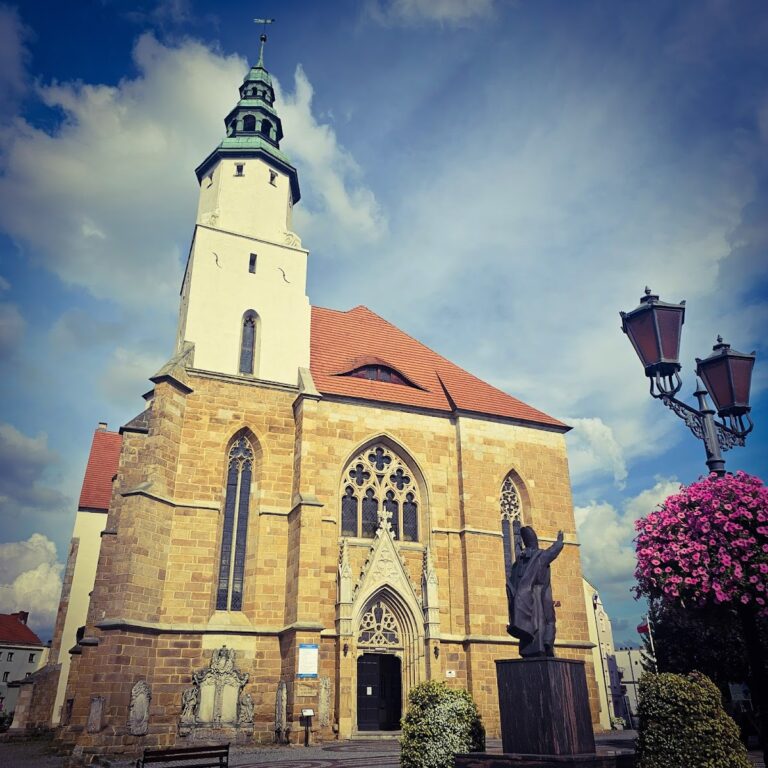
The first church of the eighteenth-century reoccupation was completed in 1725. Within a few years, an exterior wall cracked and began to subside dangerously. An assessment attributed the defect either to foundations that were not deep enough because of poor planning or to faulty workmanship. The building was demolished, its walls received new or deeper foundations, and a replacement church was completed in 1734. It was consecrated to Saint Hedwig on 2 January 1735, giving the church its present patronage.
Monastery grounds and buildings
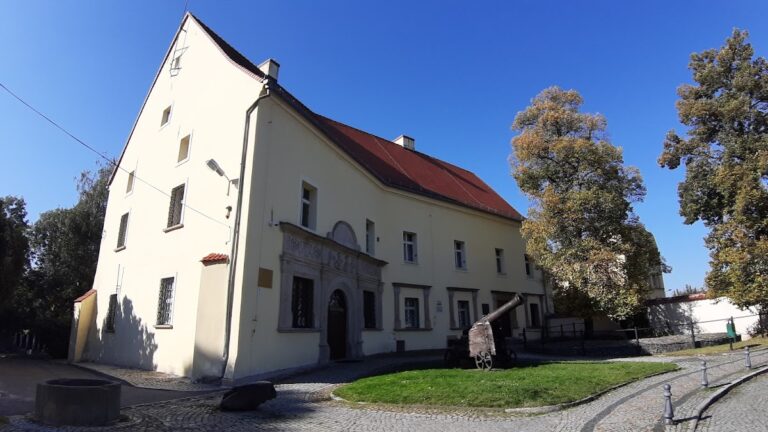
The monastery buildings associated with the present church date from the eighteenth century. Their position beside the town wall reflects the conditions agreed at the friars’ return in 1704: the community was not to erect buildings directly against the fortification, while the garden could extend along it and the town retained access to the wall.
Earlier church and surviving material evidence
Medieval monastery church
The original monastery church probably stood under the patronage of Saint Anthony of Padua, the thirteenth-century Franciscan preacher and theologian. The church was destroyed in the town fire of 1554. Its ruins were subsequently dismantled, so the present church belongs to the later eighteenth-century rebuilding rather than to the medieval foundation.
Liturgical furnishings and books
The late-medieval convent possessed four chalices, four silver shoulder cloths, two peace crosses or pacificals, two host containers, twelve good chasubles, four choir surplices, a choir cope, nine lower-value chasubles, five missals, and other valuable books. A pacifical was a small devotional object, often a cross, presented for veneration. In 1484, a new monstrance, a vessel used in Catholic worship to display the consecrated Eucharistic host, was being financed through a penitential payment of two marks.
Two bequests from 1499 also related to the church and monastery. Stanislaus Schönwalder, an altarist at the Goldberg parish church, left 30 gulden toward vaulting the choir of the monastery church, while another testamentary gift of five marks was assigned to construction work at the monastery.
Monastery seal
The monastery seal depicted Saint Hedwig holding an image of the Virgin Mary with the Christ Child beneath a ducal crown and carrying a scepter. Its inscription identified it as the seal of the Goldberg convent of the Franciscan Reformates under Saint Hedwig.
Nearby sites