Saint Nicholas Monastery in Kyiv: History and Surviving Remains


Site at a Glance
- Rating
- 4.7
- Popularity
- Low
- Country
- Ukraine
- Primary era
- Modern
- External website
- Open
- Eras represented
- Modern
- Civilizations
- Russian
- Site type
- Religious
- Remains
- Monastery
On this page13 sections
History
Saint Nicholas Monastery was an Orthodox male monastery in Kyiv, Ukraine, known from the fifteenth century and developed by the seventeenth and eighteenth centuries into one of the city’s principal and wealthiest religious institutions. Its first community occupied the wooded area of Askold’s Grave before moving in the 1690s to a substantial Ukrainian Baroque complex on the Pechersk plateau.
Origins at Askold’s Grave
The monastery’s foundation date is unknown. Several traditions connect its beginnings with an early church at Askold’s Grave, a historic Kyiv area associated with Askold, an early ruler traditionally linked with the city’s pre-Christian and early Christian past. One tradition attributes the church to Olma, an obscure figure whose identity is uncertain, and places its foundation in the eleventh or early twelfth century. Another associates it with Princess Olga, the tenth-century ruler of Kyivan Rus later venerated as a Christian saint, and says that she was buried there before her remains were moved to the Church of the Tithes.
A separate tradition says that in 1113 Prince Mstislav Volodymyrovych, known as Mstislav the Great, became lost while hunting in the surrounding woodland. After seeing a radiant image of Saint Nicholas, the Christian bishop of Myra venerated as a protector of travelers, he supposedly found his way and founded the monastery in gratitude. Nineteenth-century criticism pointed out that Mstislav was ruling in Novgorod at the time and may never have visited Kyiv.
A women’s Saint Nicholas monastery also existed in the area of Askold’s Grave or higher on the Pechersk plateau. The mother of Theodosius of the Caves, an eleventh-century monk associated with the Kyiv Pechersk Monastery, was said to have taken monastic vows there. The relationship between the women’s and male communities remains uncertain. They may have coexisted, or the male monastery may have developed where the women’s community had stood. A cave found on the Dnieper descent in 1853 indicates that monks occupied the Askold’s Grave area approximately between the eleventh and thirteenth centuries.
Medieval Endowments and Expansion
The first certain record of Saint Nicholas Monastery is a handwritten Gospel dated 1411. Its colophon states that the book was written at the monastery. In 1427, an unidentified prince bequeathed it land associated with Konon of Tolstoles, together with income from honey, beavers, martens, and tribute.
During the fifteenth and early sixteenth centuries, the monastery’s estates grew through royal grants, donations, and exchanges. King Casimir IV granted it the village of Knyazhichi in 1489, while Grand Duke Alexander of Lithuania gave it land along the Borshchahivka stream in 1497. Bohdan Hlynsky donated Hatne in 1500, Kyiv voivode Yuri Montovtovich gave Dolob Lake in 1508, and Ostafiy Dashkevych bequeathed Hvozdove in 1514 or 1529. Yukhno Oberneyovych donated Horodyshche near Malyn in 1518; the monastery later exchanged it with his son-in-law Ivashko Nemyrich for Vorokhobovychi. In the early sixteenth century, King Sigismund confirmed its rights to Dovha Nyva on the Pechersk plateau.
The Kyiv Pechersk Monastery transferred the Dovha Nyva tract to Saint Nicholas Monastery in 1518. In 1629, Ivan Sulima took part in an armed attack that plundered the monastery’s village of Trostianets. The seized lands were later granted to him, and he established the villages of Sulymivka, Lebedyn, and Kuchakiv there.
Religious and Political Change
Following the Union of Brest in 1596, an ecclesiastical union in which part of the Eastern Christian hierarchy in the Polish-Lithuanian Commonwealth accepted papal authority while retaining the Byzantine rite, the monastery temporarily came under the Ukrainian Greek Catholic Church. In 1639, Metropolitan Peter Mohyla and the heads of Kyiv’s leading monasteries petitioned Tsar Alexei Mikhailovich for assistance for communities plundered and devastated by Polish forces.
After Ukraine came under Muscovite rule, Hetman Bohdan Khmelnytsky confirmed the monastery’s estate rights in 1651, and Hetman Ivan Vyhovsky confirmed them again in 1658. In 1656, Hetman Petro Doroshenko purchased land near Chyhyryn-Dibrova on the Sula River and later transferred it to the monastery. Abbot Varlaam Yasynsky secured a further confirmation of the monastery’s lands from Tsar Feodor Alexeyevich on 20 March 1681. On 31 March that year, King John III Sobieski exempted several of its estates from military taxes and billeting.
The Pechersk Plateau Complex
The monastery moved from Askold’s Grave to a newly built complex on the Pechersk plateau in the 1690s. It then became known as the Great Saint Nicholas Monastery. Hetman Ivan Mazepa began construction of its large masonry cathedral in 1690. The building was designed by the Moscow architect Osip Startsev, probably completed in 1694, and finished no later than 1696.
Mazepa had appointed Joasaph Krokovsky abbot in 1689. At Krokovsky’s request, Mazepa authorized the settlement of a sloboda, a settlement whose inhabitants historically enjoyed exemptions from certain obligations or taxes, at the abandoned town of Maksymivka in 1694. He also confirmed the monastery’s possession of Horodyshche, later called Hradyzk, together with the estates of the incorporated Pivsky Monastery.
Prosperity and Secularization
The eighteenth century brought the monastery its greatest prosperity. It became one of the most orderly and populous monasteries in the Kyiv diocese. From 1732 it was governed by archimandrites, a senior monastic rank generally used for the head of an important monastery, and in 1766 it received first-rank status.
Its fortunes changed at the end of the century when the state secularized its lands in 1786. Secularization transferred monastic land and revenue to state control, reducing the community’s independent economic resources. The monastery received an annual treasury allowance of 2,317.50 rubles, while its monastic staff was limited to 24 monks.
Fire, Military Appropriation, and Dissolution
The great Podil fire of 1811 altered the monastery’s use. Nuns from the damaged Florivsky Monastery were temporarily housed there while its monks moved to the Kyiv Pechersk Lavra. The nuns returned to their rebuilt monastery the following year, after which prisoners of war and soldiers wounded during the War of 1812 were accommodated in the buildings.
The monks returned around 1827 and began repairs, but a major Pechersk fire that year severely damaged the buildings and property. In 1830, construction of the New Pechersk Fortress brought the Great Saint Nicholas Cathedral and adjoining structures under military authority. The cathedral became a garrison church, a church assigned to military personnel or a military establishment, while the cells were converted into barracks. The monks were moved to the smaller Saint Nicholas church.
The smaller complex could not house the entire community. Archimandrite Varlaam proposed rebuilding its church and creating a masonry monastery designed by A. Melensky. Instead, an order for complete dissolution was issued on 12 July 1831. Varlaam, supported by Metropolitan Eugene and Governor-General Levashov, petitioned to preserve the community within the Small Slup, or Pillar, complex. The Holy Synod accepted the arrangement in 1833, and Emperor Nicholas I approved it on 1 August that year.
The monastery received second-rank status in 1841. From 1844, its superiors also served as rectors of the Kyiv Theological Seminary. In the mid-nineteenth century, the community received 3,020 rubles annually from the treasury, income from shops and a two-storey commercial building, invested capital of about 13,000 rubles, two farms at Hatne, lakes at Bortnychi and Obolon, and 59 desyatinas of hay meadow at Obolon. It also administered the cemetery church at Askold’s Grave and several Kyiv chapels.
Twentieth-Century Transformation
By the early twentieth century, the monastery’s possessions had been reduced to Askold’s Grave and its immediate surroundings. It built a pilgrim hotel in 1912 and began a large income-producing building in 1914. The monastery continued operating under Soviet rule. In 1928 it had 19 monks and belonged to the traditional Old Slavonic community.
The Military Saint Nicholas Cathedral was damaged during the shelling of Kyiv in January 1918. From 1919 to 1930 it was used by the Ukrainian Autocephalous Orthodox Church, an independent Ukrainian Orthodox movement established during the revolutionary and post-imperial period. In 1919, Metropolitan Vasyl Lypkivsky celebrated the first liturgy there in Ukrainian.
In 1931, the military department took over the cathedral and converted it into a production warehouse. The cathedral and its bell tower were demolished in 1934 despite efforts by the Ukrainian Academy of Sciences to preserve and restore the building. A planned cultural center for the Arsenal factory was not built because of the Second World War. Between 1962 and 1965, the Palace of Pioneers was erected on the cathedral site, while the monastery’s last building, the refectory, was demolished. A memorial stone to the Military Saint Nicholas Cathedral was installed beside the palace in March 2009.
Remains
The monastery developed across two principal locations. Its early community stood in the wooded area of Askold’s Grave, where a wooden Saint Nicholas church later continued as a cemetery church. In the 1690s, the main community moved to the Pechersk plateau near present-day Slava Square and established the Great Saint Nicholas complex. After the 1831 reorganization, the surviving community centered on the smaller Saint Nicholas church near present-day Arsenal Square.
Askold’s Grave
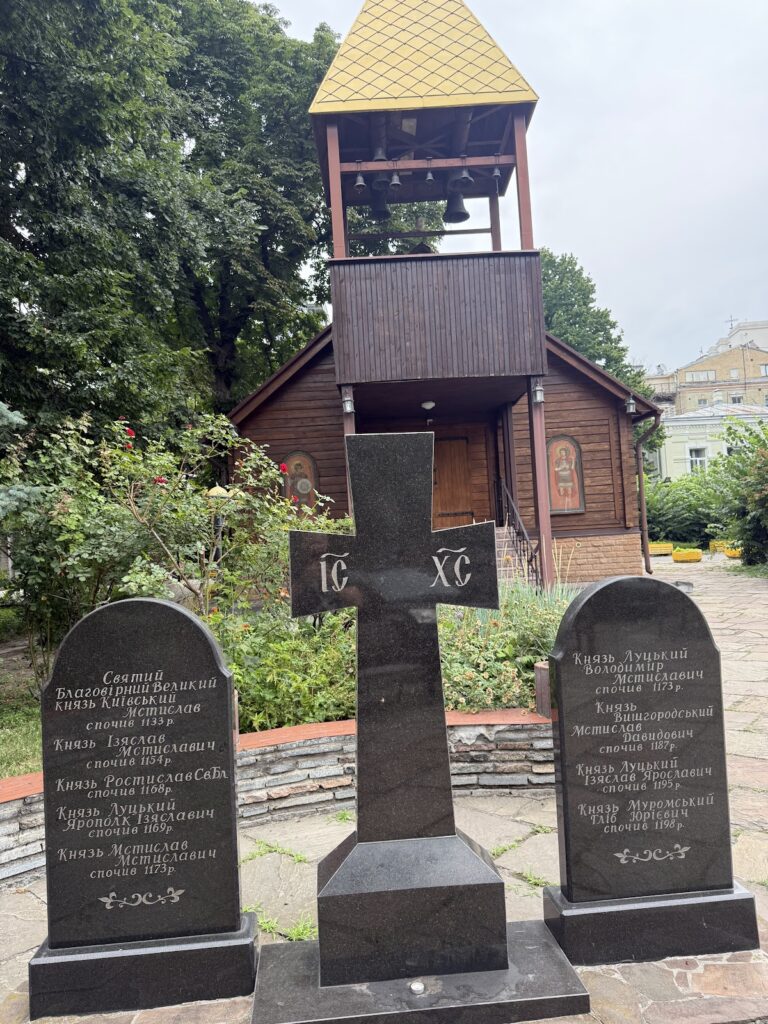
The earlier monastery at Askold’s Grave included a wooden Saint Nicholas church. After the main community moved to the Pechersk plateau, the church served as a cemetery church. A chapel or stone post carrying an icon of Saint Nicholas stood nearby in the 1650s and probably acted as a landmark for travelers seeking the monastery. The cemetery church was replaced in 1810 by an Empire-style rotunda designed by Andrei Melensky. It was reconstructed in 1816 and again in 1856. The cemetery closed in 1845 and subsequently became a burial place for Kyiv’s urban elite.
Great Saint Nicholas Complex
The Great Saint Nicholas complex contained a large masonry cathedral, a bell tower, a refectory with the Church of the Intercession, monastic cells, and other masonry and wooden buildings. The group displayed Ukrainian Baroque, an architectural style that combined Baroque forms with regional Ukrainian church traditions. Relics of Saints Philip the Apostle, John Chrysostom, Eustratius of the Caves, Nikon of the Caves, Hilarion of the Caves, Moses of the Caves, and Mardarius of the Caves were placed in the cathedral’s foundation in 1690.
The refectory, a communal monastic dining building that also contained a church, was built approximately in 1695-1696. It had a decorated pediment and a church crowned by a Baroque dome. The original bell tower was wooden. In 1750 it was replaced by a three-tiered masonry tower about 45 meters high, topped by a pear-shaped Baroque dome and incorporating the gateway Church of the Annunciation. The cathedral became a military church in 1831, and its adjoining cells were converted into barracks. The cathedral was later used as a production warehouse before demolition in 1934.
Small Saint Nicholas, or Pillar, Complex
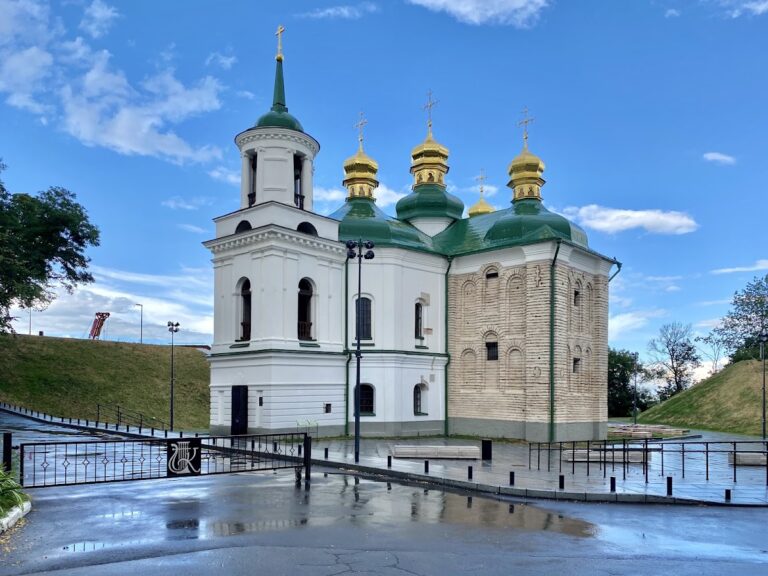
The Small Saint Nicholas church was built between 1713 and 1715 near the landmark post associated with the old monastery, or possibly on the site of an earlier wooden church. Prince Dmitry Golitsyn financed the construction. The church formed a smaller branch of the monastery and gave rise to the popular names Slup and Pillar monastery. It was enlarged in 1836 with side altars and a heated church, and this nineteenth-century rebuilding substantially obscured its earlier Baroque character.
In 1836, the complex received a small masonry kitchen and masonry sheds. During the late 1830s it also acquired a two-storey masonry income building on Nicholas Street, with shops on the ground floor. A tall masonry gateway bell tower was built in the nineteenth century, with its date given as either 1843 or 1875. In the 1870s, two-storey masonry buildings for the superior and brethren, a single-storey masonry refectory, and a wooden parish-school building were added.
Surviving Associated Buildings
The pilgrim hotel built in 1912 was a two-storey structure designed by Yevhen Yermakov, with six rooms and one bathroom on each floor. The large income-producing building begun in 1914 at 11 Nicholas Street was also designed by Yermakov, with construction supervised by Kyiv contractor Pavlo Alyoshyn. It was adapted for the Second Infantry Military School, which used it from 1914 to 1917 and installed sports halls, a library, a dining room, and an arms classroom.
The Ukrainian State’s Ministry of War used the building in 1918, when a fire severely damaged it. From 1922 or 1923, it housed a communal residence for Arsenal factory workers. The former income building and the heavily altered former pilgrim hotels at 7 and 9 Ivan Mazepa Street remain associated with the monastery’s later history. The Palace of Pioneers occupies the former cathedral site, while the Hotel Salut stands approximately where the cathedral bell tower had stood.
Nearby sites