Piast Castle in Chojnów: A Silesian Piast Residence and Renaissance Castle


Site at a Glance
- Rating
- 4.7
- Popularity
- Very Low
- Country
- Poland
- Primary era
- Early Modern
- External website
- Open
- Eras represented
- Medieval, Early Modern
- Civilizations
- Holy Roman Empire, Kingdom of Prussia
- Site type
- Domestic
- Remains
- Palace
On this page11 sections
History
Piast Castle in Chojnów is a castle in Poland that originated in the thirteenth century and was transformed from a Gothic residence into a Renaissance castle. It controlled the Chojnów section of the Via Regia Lusatiae Superioris, a major medieval route through Upper Lusatia and neighboring Silesian territories, and later served as a residence for members of the Silesian Piast dynasty and temporarily for the Duchy of Haynau.
Medieval Origins
A castellan, a ducal official responsible for administering and often defending a castle district, is recorded at the site in the early 1290s. This evidence shows that an established ducal administration was present, although it does not reveal the form of the earlier settlement, which may have been a wooden stronghold. A Gothic castle was built there in 1329.
The site suffered repeated destruction during the fifteenth and early sixteenth centuries. Hussite forces destroyed Chojnów and the castle in 1418. A further fire damaged the complex in 1428, while later fires, including one in 1503, caused additional losses. After a fire in 1510, a tower partly collapsed.
Piast Residence and Renaissance Rebuilding
Heinrich IX, the son of Duke Heinrich VIII, was the first ruler to use the title “Duke of Haynau.” From 1545, Duke Friedrich III resided at Haynau, and in 1547 he also became Duke of Liegnitz. Friedrich III belonged to the Legnica-Brzeg branch of the Piast dynasty, which governed the Silesian duchies associated with the castle.
Friedrich III ordered a major rebuilding and modernization in 1546–1547, with the work also dated more broadly to 1546–1548. The Gothic residence was reshaped as a Renaissance castle, probably under the direction of the court architect Franz Parr, also known as Franz Pahr. The rebuilding inscription on the entrance records work on this part of the castle in 1546 and again in 1547.
In 1596, Duke Joachim Friedrich assigned the castle as a widow’s residence for Anna of Württemberg, the widow of Duke Johann Georg. Such a residence was property set aside to support a widowed duchess after her husband’s death. After Anna died in 1616, the castle continued to serve widowed duchesses.
Prussian Administration and Later Use
The Silesian Piast line ended with the death of George William in 1675. The Duchy of Liegnitz and its associated territories then passed to Emperor Leopold, as King of Bohemia, as reverted fiefs of the Bohemian Crown. A Marian chapel for Catholic worship was established in the unoccupied eastern wing in 1707. Haynau became part of Prussia with Silesia in 1742, after the First Silesian War.
A major fire in 1762 led to only partial rebuilding. After another fire, the southeastern wing was demolished and the northern wing was reduced by one storey. The remaining buildings were adapted for Prussian administration, and the city acquired them in 1831. The surviving wing later served as a school and, at times, as a hospital. After 1875, it housed the Haynau district court.
A local-history museum occupied the building from 1933, and its portal was restored in 1934. The museum had been established in 1908 and was re-established in 1959. Restoration carried out in 1957–1959 led to its development as a regional museum. Archaeological work between 1990 and 1994 exposed medieval castle remains, which were restored and opened to visitors. Piast Castle in Chojnów has been a legally protected immovable monument in Poland since its registration under number 527 on 23 February 1959.
Remains
Castle Buildings
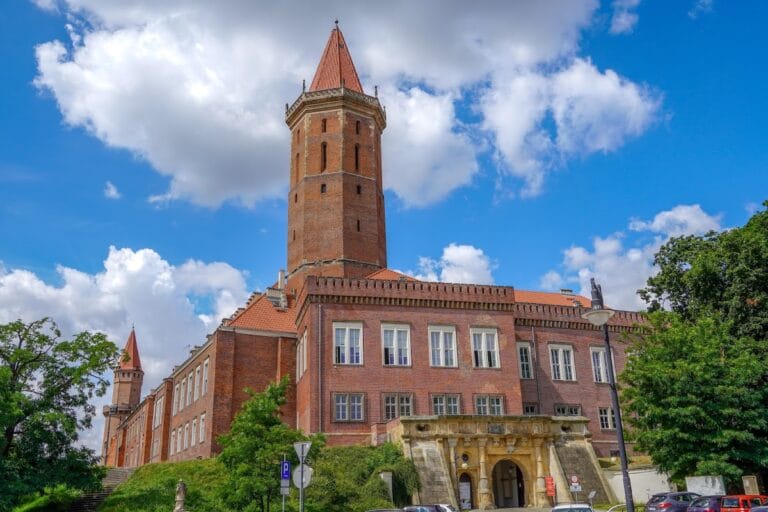
The Renaissance castle was arranged in three sections forming a crescent-like plan. The surviving remains consist of the central and northwestern sections, while the southeastern wing was demolished in 1768 after the town fire of 1762. The castle follows the line of the town wall, whose course bends around the building. The surviving structure is seven bays wide.
Entrance Portal
The main entrance is formed by a Renaissance round-arched portal with profiled surrounds. Decorated pilasters frame the side windows, making the portal zone the most elaborate part of the building. Busts of Duke Friedrich III and his wife, Katharina von Mecklenburg-Schwerin, stand above the entrance, together with their coats of arms. An inscription in the semicircular pediment names Emperor Ferdinand I and records the rebuilding of this section in 1546 and 1547.
Medieval Towers
The earlier Gothic castle had a circular tower about 12 metres in diameter at its southeastern corner. Storms and fires particularly affected this tower, which partly collapsed after the fire of 1510. A document from 1588 still mentions it. Archaeological investigations also exposed thirteenth-century remains, including the foundations of a square tower and parts of a castle tower, as well as the foundations of a free-standing medieval round tower prepared for public display.
Museum and Grounds
Regional Museum
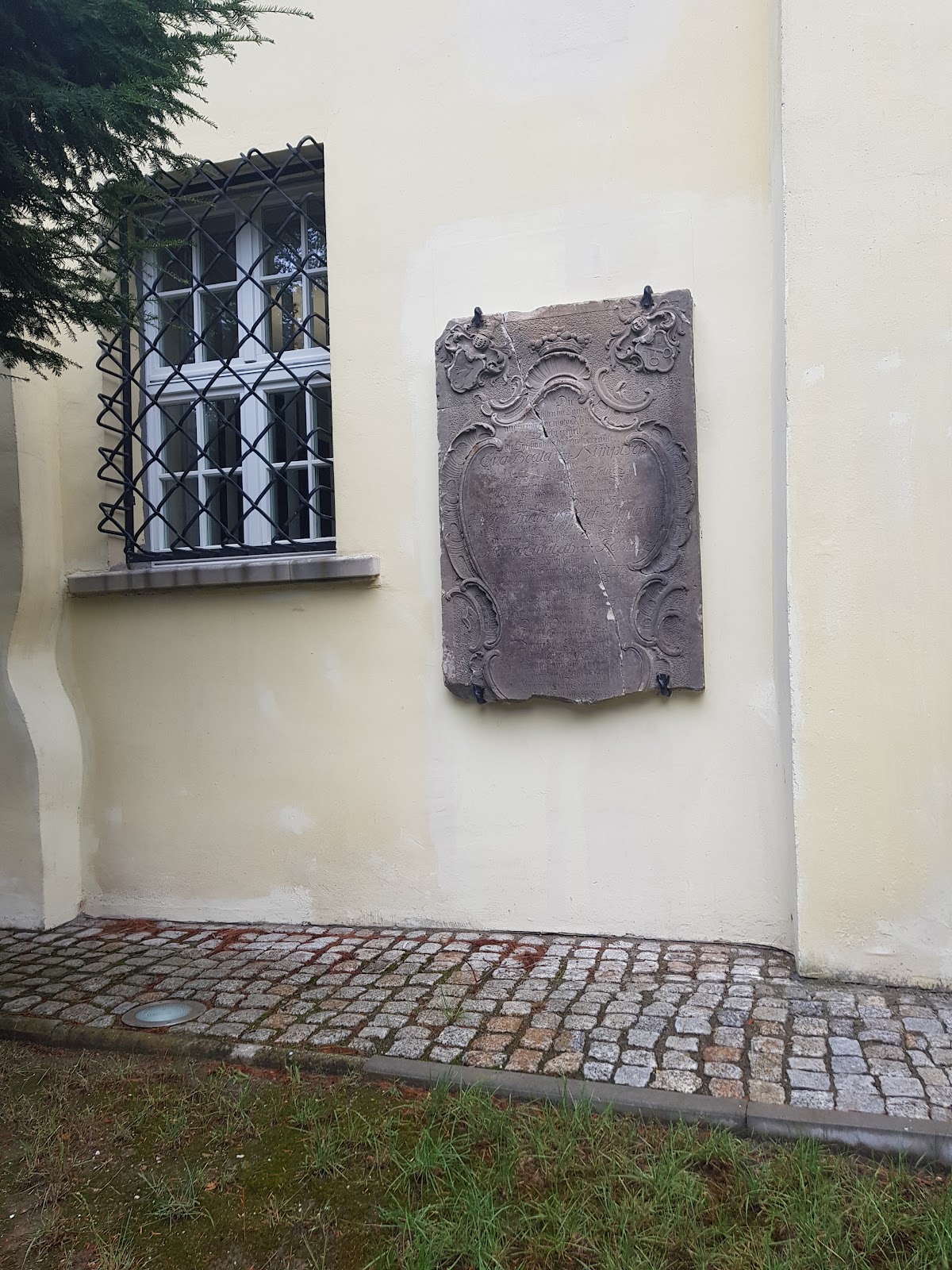
The surviving castle building houses a regional museum whose collections are arranged in archaeology, ethnography, history, and art. They contain more than 1,400 exhibits. The ethnographic holdings include Silesian and Lusatian furniture and wooden objects, a shoemaker’s workshop, and the complete equipment of a smithy. A painting room presents changing displays, while a basement lapidarium, a collection of architectural fragments, stone sculpture, inscriptions, and related stone objects, preserves another group of material evidence.
Castle Garden
The grounds include a castle garden with numerous figures and statues. They also contain a dismantled fountain from Station Square and the pedestal of a monument to Gebhard von Blücher. The pedestal is decorated with the coats of arms of Chojnów, Legnica, and Opole.