Emmaus Monastery: A Benedictine Abbey of Slavic Tradition in Prague


Site at a Glance
- Rating
- 4.6
- Popularity
- Medium
- Country
- Czechia
- Primary era
- Medieval
- External website
- Open
- Eras represented
- Medieval, Early Modern, Modern
- Civilizations
- Holy Roman Empire, Kingdom of Bohemia
- Site type
- Religious
- Remains
- Monastery
On this page17 sections
History
Emmaus Monastery, also called Na Slovanech, is a Benedictine abbey in Prague, Czechia, founded by Charles IV in the fourteenth century in the Gothic period. Charles IV, King of Bohemia and Holy Roman Emperor, established it on 21 November 1347 with papal approval granted by Clement VI on 9 May 1346. The monastery was intended for Benedictine monks using the Slavic liturgy and was designed to revive the tradition associated with Saints Cyril and Methodius, support Slavic-language theological learning, and bring Western Latin and Eastern Christian traditions into closer contact.
Foundation and Medieval Development
The foundation stood at Podskali beside the older parish church of Saints Cosmas and Damian. Its first monks came chiefly from the Benedictine monastery at Tkon on the island of Pašman, in present-day Croatia. Others came from Dalmatia or were sent by the Serbian ruler Stefan Dušan. Jan, the first abbot, was Croatian and used the full insignia of his office from 1350. Papal approval required Emmaus to remain the only monastery of its particular Slavic character within the Holy Roman Empire.
At first the institution was known by forms of the name Monastery of Saint Jerome, the Virgin Mary, and the Slavic Patrons at Podskali. The shorter name Na Slovanech later prevailed because of its Slavic patrons and monastic community. The name Emmaus comes from the Gospel account of Christ appearing to his disciples on the road to Emmaus, a passage read at the consecration of the church in 1372.
Charles IV founded a new monastery church in 1371 after the original church had become too small. The new church was dedicated to the Virgin Mary, Saint Jerome, Saints Cyril and Methodius, and the Czech saints Adalbert and Procopius. Archbishop Jan Očko of Vlašim consecrated the monastery and church on Easter Monday, 29 March 1372, in the presence of Charles IV, his son Wenceslaus IV, two imperial electors, and several bishops. Charles insisted that the Prague archbishop perform the ceremony rather than a papal representative, emphasizing the institution’s distinctive ecclesiastical position. The monastery also formed part of Charles IV’s plan for Prague’s New Town, whose major churches were arranged in the form of a cross.
Emmaus became a center of Slavic religious education and manuscript production. Translations and illuminated books were made there, including the Glagolitic section of the Reims Gospel. Glagolitic belonged to the early Slavic Christian literary and liturgical tradition associated with Cyril and Methodius and used the first alphabet created for Slavic liturgical writing. The manuscript probably left Prague during the Hussite Wars and later entered the treasury of Reims Cathedral. Two affiliated Slavic monasteries were established after Charles IV’s death, at Oleśnica near Wrocław in 1380 and at Klepary in Kraków in 1390. Both continued for more than a century.
Hussite and Catholic Periods
The Hussites, followers of the reform movement associated with Jan Hus, took control of Emmaus in 1419. The monastery survived the Hussite Wars without being plundered, but its religious character changed. From 1419 until 1589 it was the only Czech monastery where Utraquism, the practice of receiving communion in both bread and wine, was maintained. The community of monks gradually disappeared, and the complex functioned largely as a residence or college for Utraquist intellectuals.
The English Hussite theologian Peter Payne and Brother Gregory, who later founded the Unity of the Brethren, were active there. The last Utraquist abbot, Matouš Benešovský, known as Philonomus and also rector of Prague University, married and opened an inn in the monastery. He also established a shooting range in the garden. In 1592, Pavel Paminodas Horský succeeded him. After reconciling with the Catholic Church and completing his novitiate and further religious formation at Broumov, Horský began rebuilding a Catholic Benedictine community, ending the Utraquist period.
Troops from Passau plundered the monastery in 1611. By the reign of Rudolf II, however, it had again become Catholic. In 1635 Emperor Ferdinand III transferred the Czech monks to the Church of Saint Nicholas in Prague’s Old Town. The following year he installed Benedictines from the Catalan monastery of Montserrat at Emmaus. Known in Prague as the Black Spaniards, they promoted devotion to Our Lady of Montserrat and rebuilt the complex in the Baroque style.
Reform, Decline, and the Beuronese Revival
The community declined toward the end of the eighteenth century. Emmaus survived the Josephine reforms, but it had to assume responsibility for the grammar school at Klatovy, where monks were assigned to teach. The community consequently dwindled to the abbot and several elderly monks. Abbot Prokop Škoda took advantage of the suppression of other monasteries by buying their books, paintings, and other artworks at low prices. His activity created a large artistic collection at Emmaus.
In 1880, Prague Archbishop Friedrich Joseph Cardinal Schwarzenberg offered the monastery as a refuge to German Benedictines of the Beuron Congregation, who had been expelled from Germany during Bismarck’s Kulturkampf. The community arrived from Beuron on 19 March. In 1885 Emmaus became an independent abbey within the congregation, and Benedikt Sauter, previously its prior and administrator, became abbot. The Beuron Congregation was part of a nineteenth-century Benedictine revival centered on Beuron, and its art used highly stylized figures and decorative forms inspired by early Christian and medieval models.
Under Sauter, monastic life was renewed and Emmaus became a center of liturgical reform. An Oblate school opened in 1887 to prepare young men for monastic life. The Beuronese monks also opposed the German nationalist movement known as Away from Rome. During the First World War, the monastery housed a soup kitchen, a poor kitchen, and a hospital. Younger monks served as medical assistants with an Austro-Hungarian medical train.
After Czechoslovakia was founded, most of the German monks were expelled in 1919, partly because of Abbot Alban Schachleiter’s German nationalist position. The community dispersed to other Beuronese monasteries, while the state conservatory temporarily occupied part of the complex. Czech monks returned in 1920. Arnošt Vykoukal became prior-administrator that year and abbot in 1925. He stabilized the weakened community and made Emmaus a center of the Czech liturgical movement.
From 1926 the monastery published PAX, a periodical devoted to liturgy and monastic life. Services in the Byzantine rite were introduced in an effort to renew the monastery’s original Cyrillo-Methodian orientation. Old Church Slavonic worship was revived, and the community became associated with devotion to the Slavic apostles. By 1929 it numbered 68 members, including 22 priests, 13 novices, four clerics, and 29 lay brothers. Liturgical Weeks were held from 1933 until the beginning of the Second World War.
Occupation, Destruction, and Restoration
During the German occupation, an underground resistance transmitter known as Magda operated several times from the monastery complex in spring 1941. Its radio technicians, Bohumil Bachura, František Chyba, Jindřich Fröde, and Otakar Batlička, were connected with the Soviet consulate in Prague and the resistance organization Defence of the Nation.
German authorities closed the church to the public in July 1941. Schutzpolizei dispersed worshippers gathered for a protest mass on 13 July, and the Gestapo searched Abbot Vykoukal’s office on 16 July. On 18 July the monastery and church were closed definitively, the monks were expelled, and the complex became a German military hospital. Vykoukal was later arrested and died in Dachau on 9 or 10 September 1942. Monks Marcel Higi and Vavřinec Miloslav Filip also died in Nazi imprisonment, while the novice Vojtěch Ivan Novák was shot in the Oranienburg concentration camp between 1942 and 1945.
An American air raid on Prague on 14 February 1945 severely damaged the monastery and church. Three incendiary bombs, each weighing 227 kilograms, struck the complex. The church’s two western towers were destroyed, two-thirds of the vaulting collapsed, and fire consumed the buildings down to the surviving ground-floor vaults. Repairs followed during the first half of the 1950s, including reconstruction of the vaults in 1953 and 1954. In 1945 the monastery also became part of the Slavic Benedictine Congregation of Saint Adalbert.
The communist authorities forcibly dissolved Emmaus during Action K on 27 April 1950. Most monks were interned, while some escaped to Italy. The confiscated complex was transferred to the Czechoslovak Academy of Sciences, which established medical institutions there, including a clinic for occupational diseases and a dermatological clinic.
Exile and Return
An émigré Benedictine community was re-established in 1965 at a former Capuchin monastery in Norcia, Italy. It was led by Abbot Maurus Verzich until 1969 and then by Cyril Stavěl, who served as prior-administrator until 1990. The Norcia community continued until 1992, after which most of its members returned to the Czech lands.
Following the political changes of 1989 and 1990, the monastery and church were returned to the Benedictines. Cyril Stavěl became prior, followed by Vojtěch Engelhart. One stage of reconstruction was completed in 1995, when a clausura, the part of a monastery reserved for enclosed residential life, was established on the first floor of the old convent building and a community of seven members returned. Reconstruction of the church ended in 2003 with the consecration of a new altar. The cloister was restored in 2016 and 2017, and its restoration was blessed on 21 November 2017 during the monastery’s 670th anniversary celebrations. Garden revitalization began in 2018. After the death of Augustin L. Gazda in 2019, Prokop Siostrzonek, archabbot of Břevnov, became administrator. The monastery and church have been a national cultural monument since 1978. The present community consists of three monks, Dominik, Jeroným, and the long-term guest Radim Jan Valík from Břevnov.
Remains
Emmaus Monastery stands on a rocky hill above the upper Vltava terrace, beside the former parish church of Saints Cosmas and Damian and the historic route toward Vyšehrad. The complex occupies land bounded by Vyšehradská, Trojická, Pod Slovany, and Na Slovanech streets. Its principal elements are the convent church, a quadrangle adjoining it to the south, a cloister enclosing a central paradise courtyard, later buildings to the west from the first half of the nineteenth century and the 1930s, and the Chapel of Saints Cosmas and Damian with an Early Baroque vaulted interior.
Church and Monastic Buildings
Gothic Church
The church is a Gothic structure with three aisles built with the participation of Charles IV’s court workshop. The aisles are approximately equal in height, and each has its own chancel termination. There is no strong architectural division between choir and nave. In its relative plainness, the building has been compared with mendicant churches rather than with the more elaborate structures of the Parler Gothic.
Baroque and Beuronese Alterations
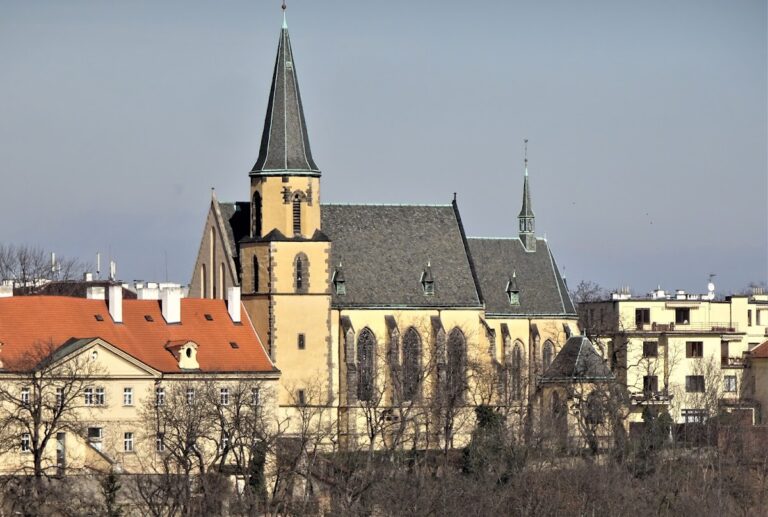
Seventeenth- and eighteenth-century alterations replaced the original broad half-hipped roof and large gable with a three-part roof. They also rebuilt the western end of the nave and added two towers. The monastery building gained an additional storey, and a Late Baroque facade was built between 1766 and 1769. The towered facade was completed between 1712 and 1723, when a new high altar was installed.
Between 1880 and 1890, the Beuronese Benedictines remodeled the complex in a Neo-Gothic version of the Beuron style. They removed Baroque furnishings and paintings, replaced the tower domes with pointed pyramidal roofs, and redecorated the church and monastery with historicizing forms. The work involved the Beuronese artists Desiderius Lenz, Gabriel Wüger, and Lukas Steiner. Part of the complex was altered in 1929 and 1930 according to designs by Bohumil Hypšman. After the 1945 bombing, Bedřich Hacar directed the reconstruction of the vaults in 1953 and 1954.
Postwar Church Design
Between 1964 and 1968, František Maria Černý replaced the destroyed western towers with modern concrete, shell-like wings ending in gilded points. The design was conceived as a compromise between the former high Gothic gable and the two lost towers. Four stained-glass windows installed in 1961 were designed by Jiří Binko for the Czechoslovak Academy of Sciences’ Astronomical Institute. They depict astronomical planetary symbols, the Holy Spirit, and personifications of astrology and astronomy.
A new altar by the sculptor Karel Stádník was installed and consecrated in 2003 by Archabbot Asztrik Várszegi. Most of the surviving church furnishings date from 2003 to 2008. The paradise courtyard was restored in 2016 and 2017 and contains a wooden inverted cross at its center.
Gothic Cloister Paintings
The cloister originally held a cycle of 85 Gothic wall paintings made around 1360. The paintings occupy two horizontal bands across all 22 cloister bays. The upper band generally contains one scene from the New Testament, while the lower band presents two corresponding scenes from the Old Testament. An ornamental strip with a Cosmatesque pattern ran beneath the paintings. This arrangement forms a typological cycle, in which Old Testament events are treated as symbolic prefigurations of Christ’s life and Christian history. Its program relates to medieval theological interpretation, moralizing Bibles, and the Biblia pauperum, a picture-book tradition built around paired biblical scenes.
The painters used lime pigments on hardened, lightly moistened plaster rather than true fresco technique. Later interventions contributed to the paintings’ poor condition, although original areas survive best where high-quality pigments, including azure blue, bonded firmly with the plaster. The cycle was substantially altered at the beginning of the fifteenth century and extensively overpainted after the arrival of the Montserrat Benedictines. By 1654 the Baroque repainting had replaced the original light tones with darker colors and covered paintings in the vault hoods with colorful Renaissance-style decoration.
Some scenes were barely legible by the beginning of the twentieth century. Restoration campaigns before the First World War and again in the 1930s removed parts of the Baroque overpainting and photographed the best-preserved scenes. The photographs made in 1933 remain an important record of the cycle. The 1945 air raid caused masonry to collapse and large areas of plaster to fall. In many places the Baroque layer detached, revealing the original underdrawing and basic-color underpainting. Of approximately 80 surviving scene areas, the New Testament paintings in the upper band of the north and west wings are in the best condition. Earlier restoration in the 1960s damaged some Gothic paintings through unsuitable technical procedures.
Iconographic Program
Manuscript Evidence
The Uppsala Manuscript C 209, preserved in Uppsala University Library, contains a medieval Latin description and diagram of the Emmaus cycle. Formerly belonging to the monastery of Saint Bridget at Vadstena, it shows that the roughly 80 scenes once associated with the cloister represented only part of the larger program. Major Passion scenes were placed in the Imperial Chapel. These included the Nailing to the Cross, the Crucifixion, the piercing of Christ’s side by the spear of Longinus, and the Harrowing of Hell, each accompanied by Old Testament counterparts. The manuscript therefore places part of the cycle beyond the cloister itself.
Surviving Scenes
The cycle begins in the southeastern corner bay of the south wing. The first bay probably showed the Enthroned Christ before it was overpainted with Christ traveling to Emmaus with his disciples. Both scenes were destroyed in the 1945 raid, although a fragment with three angel heads survives.
The west wing includes the Circumcision of Christ, the Adoration of the Magi, the Presentation of Christ in the Temple, the Massacre of the Innocents, the Flight into Egypt, the Baptism of Christ in the Jordan, and the Temptation of Christ. Their lower registers contain Old Testament parallels involving Abraham, Sephora’s son, Joseph’s brothers, the Israelite princes, the offering of the firstborn, Samuel, Pharaoh’s slaughter of boys, Athaliah’s killing of Jehoram’s descendants, Naaman, the Brazen Sea, Moses, and Elijah. The scenes of Moses’ temptation and Elijah’s strengthening in the wilderness are heavily damaged.
The north wing contains the Wedding at Cana, the Raising of the Young Man of Nain, the Gathering of Manna, the Stoning of Christ, Christ in the House of Martha, Christ’s meeting with the Samaritan woman at Jacob’s Well, and Christ in Simon’s house with Mary Magdalene. Their Old Testament parallels include Elisha filling a widow’s jars with oil, Elisha healing polluted water, Elijah and Elisha raising the sons of widows, two versions of the Feeding of the Multitude, Jezebel’s stoning of Naboth, the mystical winepress of Christ, Rebecca, the widow of Zarephath, and scenes of leprosy and healing. The Samaritan Woman is among the best-preserved scenes.
The east wing contains the Passion and concluding scenes. These include Christ’s Entry into Jerusalem, Judas’s betrayal with a kiss, the Mocking of Christ or Christ before Pilate, the Flagellation, and probably the Carrying of the Cross. The lower scenes include Cain killing Abel and probably the lost scene of Joab killing Abner. The Resurrection, Ascension, and Descent of the Holy Spirit are paired with Jonah being expelled by the whale, Samson carrying the Gates of Gaza, Elijah in the fiery chariot, Jacob’s dream of the heavenly ladder, the Tower of Babel, and Elijah’s sacrifice consumed by heavenly fire.
Artists and Sources
The paintings were produced by a large workshop rather than a single artist. Four principal masters, assistants, and probably a theologically educated cleric who supervised the iconographic program have been identified. Master A, sometimes associated with Nicholas Wurmser of Strasbourg, is linked with the work around 1360 and with refined, slender figures influenced by French court painting. Master B worked especially in the north, west, and south wings and is associated with a style that influenced Master Theodoric and Master C. Master C, called Oswald, is associated with the three angel heads in the first southern bay and the damaged Passion scenes in the east wing. Only half-figures of singing angels survive from Master D, whose work may have been that of an assistant.
The cycle draws on French moralizing and picture Bibles, the Biblia pauperum, illuminated royal manuscripts, and French and Italian artistic traditions. Some compositions resemble Giotto’s Last Supper at the Arena Chapel in Padua, but the relationship is understood as a general Western European parallel rather than direct dependence. The painters adapted book models to the pointed arches, irregular bays, and architectural interruptions of the cloister.
The imagery also includes local and contemporary associations. Healing and revival scenes relate to the cult of Saints Cosmas and Damian at the neighboring chapel. Scenes of manna and the multiplication of food have been connected with plague epidemics in the 1350s, later hunger and abundance, and the construction of Prague’s Hunger Wall. Charles IV may be symbolically represented in the forms of Samson, Jonah, and the prophet Elijah. The Tiburtine Sibyl appears as a beautiful blond girl and was often identified in the Czech context with the legendary Princess Libuša.
Historic Organ
The monastery’s historic pipe organ was regarded as one of the largest and most distinguished church organs of its period. Koulen enlarged it to three manuals, while pipes were produced in the monastery under the direct supervision of the organ builder Paštika. Benedictine craftsmen prepared the wooden components. The organ survived the 1945 air raid because the vault above the choir remained standing, and Professor Krajs and conservatory students dismantled it. After later relocations, it was installed in the Chapel of Saints Cosmas and Damian, where it was eventually dismantled and stolen through a breach made from outside.
Nearby sites