Solesmes Abbey: A Benedictine Monastery and Centre of Gregorian Chant in France


Site at a Glance
- Rating
- 4.6
- Popularity
- Low
- Country
- France
- Primary era
- Medieval
- External website
- Open
- Eras represented
- Medieval, Early Modern, Modern
- Civilizations
- French
- Site type
- Religious
- Remains
- Monastery
On this page16 sections
History
Solesmes Abbey, also known as Saint Peter’s Abbey, is a Benedictine monastery in Solesmes, France, founded in the early eleventh century on a site with earlier Christian and Merovingian-period activity. Over the centuries it developed from a rural priory into an abbey and an international centre for Roman Catholic liturgy and Gregorian chant.
Early foundation and medieval growth
The origins of Christian activity at Solesmes may reach back to the fifth century, and building work may have begun in the sixth or seventh century. Sarcophagi associated with the Merovingian period, the early medieval age of the Frankish kingdoms, were found in the area. The medieval site also included a large cemetery.
In the early eleventh century, Geoffrey, Lord of Sablé, gave land and a farm east of Sablé Castle to the monks of Saint-Pierre de la Couture Abbey in Le Mans. The foundation charter is dated 1010. The church was dedicated on 12 October, probably between 1006 and 1015, as part of a spiritual foundation for Geoffrey and his family.
The monks and agricultural workers cleared the surrounding land, cultivated rye, vines, and beans, and raised horses and cattle. A settlement grew around the monastery by the end of the eleventh century. A parish church dedicated to Saint Mary and, later, Saint Aquilin Chapel served the expanding community. William the Conqueror confirmed the foundation charter on 30 March 1073. Pope Urban II visited Solesmes on 14 February 1096, after calling for the First Crusade at Clermont, and the church and monastery were subsequently enlarged.
In 1170, Robert of Sablé, Lord of Sablé and later Grand Master of the Order of the Temple, gave the monks one-tenth of Sablé’s tax revenue. He also brought a fragment associated with the Crown of Thorns from the Holy Land. Solesmes received the relic for veneration, and it continues to be honoured there on Easter Monday.
War, recovery, and Renaissance rebuilding
Solesmes became a conventual priory and received further endowments during the thirteenth and fourteenth centuries. After 1380, during the Hundred Years’ War, an unsuccessful attempt to capture Sablé was followed by the sack and burning of the town and monastery. Louis II of Anjou confirmed Solesmes’s privileges in 1408 to support its financial recovery and reconstruction. The number of monks nevertheless fell from twelve to five by 1434.
The priory gradually recovered during the late fifteenth century and continued to attract new vocations. A dependent priory at Bouessay was founded in 1487. During the Renaissance, Priors Philibert de la Croix, Guillaume Cheminart, and Jean Bougler reorganized the estate, restored agricultural land, carried out irrigation works, enlarged the priory, and commissioned major sculptural projects. The 1496 Entombment of Christ and the decoration of the Belle Chapel belong to this period.
Huguenot forces attacked the priory in 1567, but local inhabitants defended it. The sculptural group representing the Finding of Jesus in the Temple was commissioned in the Belle Chapel as an ex voto, a devotional offering made in thanksgiving for perceived divine protection.
Decline and Maurist reform
From the sixteenth century, Solesmes declined under commendatory superiors. A commendatory prior received part of a monastery’s income but often did not reside there or direct its religious life. At Solesmes, this system weakened ordinary monastic discipline, and only four monks remained by 1659.
In 1664, Saint-Pierre de la Couture installed monks of the Congregation of Saint Maur, a Benedictine reform movement associated with stricter observance and scholarly work. Their arrival began a second foundation at Solesmes and restored regular communal life. The Maurists built a new portal around 1670, repaired the church, re-established the enclosure, and excavated a fishpond for the community’s dietary needs.
The recovery was hindered by Dom Étienne de Noyelle, a later commendatory prior who diverted the priory’s revenues and lived there as a country gentleman from 1671 until his death in 1706. Solesmes was left in severe material poverty. Dom Edmond Duret, appointed titular prior in 1712, rebuilt the priory buildings, while the church was rearranged and redecorated around 1740. About a decade later, Solesmes was removed from the commendatory system but became a simple dependent cell of La Couture. Monastic observance weakened again during the Enlightenment.
Revolution and nineteenth-century restoration
The National Constituent Assembly prohibited religious vows on 13 February 1790. One of the seven monks, the sub-prior, swore the revolutionary oath and became a constitutional priest, later serving as a soldier of the Republic. The other monks refused the oath and were imprisoned. Solesmes was emptied in March 1791, and the monastery became the country residence of Henri Lenoir de Chantelou. The abbey archives were burned in a civic bonfire on 14 July 1794. The church reopened after the Concordat of 1801, the agreement that restored relations between the French state and the Catholic Church.
In 1825, government administrators sold the monastic buildings, farms, and a 145-hectare estate. Demolition threatened the complex, and work began around 1832 with the destruction of the east wing. Prosper Guéranger, a priest born in the region, led a group of diocesan priests who resumed monastic life at Solesmes on 11 July 1833. They first obtained a lease and later purchased the property through a subscription supported by several benefactors, including Sophie Swetchine. Guéranger became prior, and Auguste Fonteinne served as cellarer, the officer responsible for the community’s provisions and material resources.
After Guéranger travelled to Rome, new constitutions restoring the Order of Saint Benedict in France were approved in 1837. Solesmes was elevated to an abbey and became the mother house of the Solesmes, or French, Benedictine Congregation, later a founding member of the Benedictine Confederation. Guéranger made his solemn profession at Saint Paul Outside the Walls on 26 July 1837 and received the first four professions of his companions in November.
Liturgy, chant, and monastic expansion
Guéranger restored Benedictine life at Solesmes and made the abbey an international centre of Roman Catholic liturgy and Gregorian chant. Between 1841 and 1866 he published the nine volumes of The Liturgical Year, promoting older liturgical practice after the disruptions of the Revolution and the influence of Gallicanism, a tendency within the French Church to assert considerable independence from papal authority.
With Augustin-Mathurin Gontier, Dom Paul Jausions, and later Dom Joseph Pothier, the monks studied medieval musical manuscripts to recover Gregorian chant. Dom André Mocquereau founded the Paléographie musicale series in 1889. The Solesmes workshop supplied transcriptions for the Vatican Edition of chant until its completion in 1926. Its research later continued under Dom Joseph Gajard, Dom Eugène Cardine, Dom Jean Claire, Dom Jacques Froger, Dom Jacques Hourlier, Dom Michel Huglo, Dom René-Jean Hesbert, and Dom Daniel Saulnier. Cardine developed Gregorian semiology, the study of medieval chant notation and its musical interpretation, while Claire proposed a theory of archaic Gregorian modality based on “mother cells.”
The workshop produced important chant books and studies, including the Liber usualis, the Antiphonale monasticum, and further volumes of Paléographie musicale. New editions of the Antiphonale monasticum began appearing from 2005. Solesmes maintained its own Saint Peter’s Press until the community’s exile in 1901. Publishing moved to Desclée in Tournai, and the abbey re-established its own publishing house, Éditions de Solesmes, in 1983.
Guéranger enlarged the monastic choir in 1865 and added chapels, including the Sacred Heart Chapel. The abbey church was placed on the French register of historic monuments in 1875. The government expelled the monks in 1880. Some returned in 1882 and 1883 but were again removed by force. Under Dom Paul Delatte, the community recovered the abbey after prolonged legal proceedings on 23 August 1895 and undertook further construction, including a large building above the Sarthe and a refectory.
Exile, return, and the modern community
The Associations Law of 1 July 1901 forced the Benedictines into exile. The monks left Solesmes on 20 September 1901, settled on the Isle of Wight, and eventually established Quarr Abbey there. In 1910, the Marquis Jacques de Juigné bought the confiscated buildings from the state with the intention of returning them to the monks. They were permitted to return in 1922.
Dom Bellot, assisted by Joseph Philippe, reconstructed the galleries of the great cloister, the library, and the lavatorium, a monastic washing facility traditionally associated with the cloister. Solesmes founded or served as the mother house of numerous other communities, including Saint Cecilia’s Abbey at Solesmes in 1866 and Fontgombault in 1948, as well as communities in Senegal and Morocco. By 2015, the Solesmes Congregation comprised 24 male and 8 female monasteries.
During the Second World War, fifty-four monks were mobilized in September 1939, sixteen became prisoners of war, and three were killed. The monks returned in June 1940 during the Occupation. The community later expanded to about 120 monks and continued its foundation work. The reforms associated with the Second Vatican Council reduced the use of Gregorian chant, but Solesmes continued its musical research. In the 1970s, its workshop prepared a new monastic antiphoner, a liturgical book containing antiphons and other chants for the Divine Office, published as the Antiphonale monasticum from 2005 onward.
In the 1980s, Solesmes sheltered Paul Touvier, a former militia member later accused of crimes against humanity. It also hosted Roger Vangheluwe, the former Bishop of Bruges, after his resignation for sexual abuse. In 2024, the Belgian bishops stated that he was permitted to remain at the abbey in isolation. The community numbered about sixty monks in the 2010s, and Geoffroy Kemlin was elected abbot in 2022.
Remains
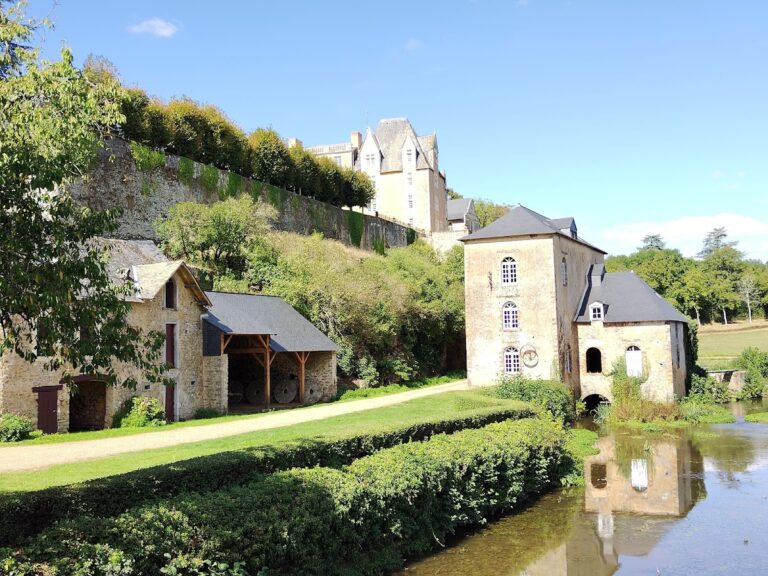
The monastic complex stands above the Sarthe valley in Solesmes. Its surviving fabric brings together an eleventh-century church, Renaissance sculpture, seventeenth- and eighteenth-century monastic buildings, and twentieth-century reconstruction. The buildings rebuilt under Dom Edmond Duret form a quadrangle around the cloister, with the southern side running alongside the abbey church and the complex extending beside the river.
Abbey church
Nave and medieval plan
The long, narrow abbey church has a nave, the main central part of the church, and a separate monks’ choir. The nave was built and altered between the eleventh and fifteenth centuries. It originally had two aisles, which were destroyed during the Hundred Years’ War. During the late fifteenth-century rebuilding, Prior Philibert de la Croix changed the plan from a basilica form to a Latin cross, a layout with a long nave crossed by a shorter transept. Jean Bougler completed the restoration, added the tower, and rebuilt the cloisters, sacristy, and library.
A fifteenth-century statue of Saint Peter stands in the nave. The saint wears pontifical vestments and a papal tiara and holds two large keys. A funerary slab for Robert of Sablé is visible in the church. At the rear of the nave, the installation of the great organ blocked a large stained-glass window.
Monks’ choir
The present monks’ choir was constructed in 1865 and contains 64 choir stalls, fixed seats for members of a religious choir. Twenty-four stalls date from the second half of the sixteenth century and were originally placed in the nave. Their imagery presents the genealogy of Christ, beginning with Jesse, the father of David, and ending with the Virgin Mary holding the child Jesus.
Renaissance sculpture
The Entombment of Christ, dated 1496, occupies a niche in the south transept. This Gothic-Flamboyant group places eight figures around the tomb, with two soldiers guarding its entrance. Mary Magdalene sits separately with a vessel for ointment, while other figures carry Christ’s shroud. Mary is shown supported by Saint John, and one of her hands is now missing. The work is associated with the Renaissance sculptor Michel Colombe.
The Belle Chapel contains numerous sculptures, including the group of the Finding of Jesus in the Temple. The Saints of Solesmes occupy the north and south sections of the transept. They were probably created around 1530 to 1553, with the latter date inscribed on the south colonnade. The sculptors and original financiers are unknown, partly because the monastery archives were destroyed during the Revolution; wealthy benefactors may have donated the works.
Monastic buildings and grounds
Cloister and principal buildings
The west façade of the monastic quadrangle is classical and has a pediment overlooking a small formal garden. The east wing destroyed during the nineteenth-century demolition no longer survives. Later construction added or reconstructed a large building above the Sarthe and a refectory. Following the monks’ return in 1922, the great-cloister galleries, library, and lavatorium were rebuilt.
Chapels and sculpture
The Sacred Heart Chapel contains stained glass by Maurice Denis. Henri Charlier created several sculptures for the complex, including a recumbent effigy of Dom Guéranger in the crypt and a Virgin and Child in the cloister.
Gardens and cemetery
Solesmes has two gardens. A smaller terrace garden surrounds a small house covered in coarse pink plaster, while a larger garden lies within the monastic enclosure. The adjoining slope, informally called “the valley,” is used for meditation and reflection. François-Xavier de Bourbon-Parma is buried in the monastery cemetery.
The medieval cemetery and its Merovingian-period sarcophagi form part of the archaeological evidence for the site’s early religious activity. The abbey’s coat of arms includes a natural thorn recalling the Crown of Thorns relic, together with heraldic elements connected with La Couture and Sablé.
Nearby sites